

Signal, not noise — AI, energy & macro. Free weekly newsletter for the Aware Family ↓
The Aware Family
Joined March 2026
- Tweets662
- Following46
- Followers49
- Likes42




Pinned Tweet
Here’s what this data is actually showing: the Great Rotation. For 20 years the premium lived in software, infinite margins, no physical assets. Now FCF is migrating from the software layer to the physical layer. Nvidia prints $430bn. Microsoft goes negative. The scarcity premium is moving from code to compute hardware and here’s the thing: passive funds are still weighted to the old world. That reweighting is what makes this volatile. The market is repricing which layer deserves the multiple. Which software multiple cracks first?

Shocking stat of the day:
Nvidia, $NVDA, Micron, $MU, Broadcom, $AVGO, and Applied Materials, $AMAT, are now expected to generate a record $430 billion in combined free cash flow (FCF) over the next 12 months.
That would be more than TRIPLE the FCF they generated just 2 years ago.
At the same time, the combined FCF of Amazon, $AMZN, Alphabet, $GOOGL, Meta, $META, Microsoft, $MSFT, and Oracle, $ORCL, is projected to turn negative for the first time on record.
That would mark a massive reversal from the +$260 billion peak reported by these companies in 2024.
This comes as AI-related CapEx by these 5 companies is estimated to surge to ~$1.8 trillion in 2026 and 2027 combined.
Chipmakers are becoming cash machines, while AI giants are burning record amounts of capital.

74
Meta's AI chips last 5.5 years on its own books. The bonds behind its Louisiana data campus run to 2049.
The campus, Hyperion, is owned by a separate company called Beignet. Meta has a 20% stake and Blue Owl has the rest. Beignet borrowed $27B against a site worth about $30B, so it's roughly 90% debt, and none of it sits on Meta's balance sheet.
If Meta's chip estimate holds, the campus needs about four rounds of new chips before that debt is paid off. Each round has to come out of a cash flow that just went negative: Meta's free cash flow was -$2.1B in Q3, its first negative quarter since 2012.
We've had eight build-out booms before this one, from canals and railroads to fibre and dot-com. Each time, the infrastructure survived and most of the people who financed it didn't.
The question was never whether there'd be a shake-out. It's who holds the debt when it comes.

67
Most market news tells you what happened. I trace what moved first — the domino six months before the headline.
A thousand headlines hit your feed this week. Maybe three were signal.
Free field guide on spotting it early — newsletter included.
→ slonesterling.com

25
Most market "news" is noise dressed as urgency. Some of it is engineered to be unfalsifiable.
I built a free tool that reads any headline against the four things that actually move markets — AI, capital, energy, people — and tells you: signal, or noise.
Watch it catch a classic 👇
1
68
"The AI bubble has further to run despite the looming crash."
Two contradictory hooks, no mechanism, no timeframe. Verdict: MANIPULATION.
Run your own → sterling-signal.netlify.app

32
Everyone's still arguing over which AI model is smartest. Wrong question.
Code is already the cheap part — frankly, it's a commodity now.
The scarce thing is what runs it: power, copper, transformers on a three-year wait.
The bottleneck quietly moved. Is the market pricing that yet?
1
40
Wrote a short field guide on where the real bottlenecks sit — energy, copper, compute — and what it means for the next decade. Free, plain English: slonesterling.com
17
Reading more news won't help you. Understanding it will.
Headlines tell you what happened — almost never why. And the why is the part that hits your savings, your career, the price of everything.
The cause sits one step behind the story. Learn to look there, and the noise turns into a map.
Free 10-page guide: the 4 questions I run on any market event. Your grocery bill and a strait you can't find on a map. $600B in AI spending and who really pays the power bill.
The kind of analysis that used to cost $40,000 a year. Yours for nothing.
slonesterling.com
1
54
Ten years ago, I didn't have a framework for what was happening to the economy.
I had anxiety. I had news. I had noise.
What I needed was someone to show me the pattern underneath.
Here's what I know now:
The world isn't chaotic. It's causal.
Every financial shock, every energy crisis, every AI headline — there's a First Domino. One thing that moved first and set everything else in motion.
When you can see the domino, the chaos becomes a sequence. The fear becomes a framework.
That's what I write. Every week. For families who are intelligent, time-constrained, and sense that something big is shifting — but can't quite name it yet.
AI. Energy. Macro. Geopolitics. Crypto. The human cost of all of it.
Not financial advice. Not hype. The pattern behind the noise, translated into something you can actually use.
I put the methodology into a free field guide.
It's called The First Domino — and it walks through three real examples of how the causal chain works.
It's free. It's in the link in my profile.
If it changes how you read the news, that's enough.
100
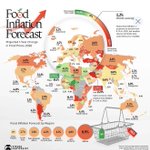
Iran: +55.9% food inflation.
Nigeria: +17.1%.
Argentina: +33.2%.
These aren’t data points.
They’re a father in Lagos watching his grocery bill consume most of his monthly income.
Scarcity always finds the most vulnerable first.
The global system optimised for efficiency and forgot to build resilience.
AI is accelerating that reckoning — not solving it.

2
135
1/8
Germany had 27,862 megawatts of clean nuclear power.
They switched it all off.
Not because it failed. Because the politics demanded it.
Two years later, the AI data center buildout arrived — and needs exactly that kind of 24/7 baseload power.
The physical world doesn't send invoices.
It sends consequences.
1
68
7/8
The macro signal is now precise.
CPI is crossing above 3-month bill yields. Real short-term rates are turning negative.
Historically — across 2,576 days of data — that is the exact quadrant where Bitcoin returns +247% annualized.
The Fed cannot raise into a softening labor market. Cannot cut without validating inflation.
That paralysis is fiscal dominance in practice.
Cash is quietly losing. Most haven't noticed yet.
1
58
8/8
Bitcoin doesn't need a new story.
It needs the world to enter the conditions it was built for.
Negative real rates. Fiat purchasing power eroding. AI exposing fragility in centralized systems.
Physical scarcity driving inflation that policy can't print away.
The interesting question isn't whether this is Bitcoin's moment.
It's whether markets are still pricing it as a software asset — when everything beneath the surface says it's something else entirely.
37
Three generations built their financial security on one idea:
Knowledge work is safe because expertise takes time, and time builds a moat.
AI just drained the moat.
The question now isn't whether to adapt. It's whether you see it clearly enough to know which direction to move.
28
This is what real civilizational progress looks like — AI unlocking novel proteins and breakthroughs that could genuinely improve human life for everyone on Earth.
Yet the escalating Middle East conflict is derailing these critical timelines exactly when our species can least afford the delay.
How much scientific momentum are we willing to sacrifice to another cycle of physical chaos?

Very interesting paper shows some suggestive evidence that release of AlphaFold caused researchers to work with more novel proteins than they would've otherwise


79