

Distressed PE Investor, previously BB IB DM for partnerships! Page sponsored by: https://xitter.cf/t.co/m0dUn8aOUy
Joined January 2021
- Tweets663
- Following72
- Followers5.1K
- Likes1.1K







Pinned Tweet
It’s funny because we said 3 months ago the future hedge fund analyst job will be to collect esoteric information
This is another step forward to automate that part of the job
My theory is that relationships and access to semi-private information will be all the alpha up for grabs in a few years
🤝 Paid partnership

Hertz lenders about to get their faces ripped off
What a shit show


Hertz, the next non-sub (JV) dropdown?
- Hertz has Oro Mobility in its own subsidiary
- Oro Mobility is Hertz’s side business that runs vehicle fleets for ride-hailing and robotaxi companies like Uber, a great asset
- Certares and Knighthead purchase 50% of voting units and 16% of common equity of that entity, the entity is therefore a JV (see next tweet)
- Hertz also agrees to retire $51mm of 2L due 2029 from Certares and Knighthead at 60% discount (which likely bought this debt before at even greater discount)
- Debt is retired at a discount, a JV is ready with unencumbered assets, Certares and Knighthead make a gain on the flip, everyone wins, right? Sorry to whoever sold their 2L to Certares and Knighthead ha!
The next step?
- Class, you now have a nice entity with unencumbered assets, a ParentCo which needs to extend its maturities. What do you suggest doing?
- Raise debt against those assets, a beautiful non-subsidiary dropdown. Maybe, yes!
Read our primer on Non-Subsidiary Dropdowns to learn more, awesome work from our legal analyst!

Do people actually think we will end up running models offline?
It seems a simplistic view to me.
Everyone thought we would never move to the cloud in mission-critical industries with regulations (e.g., healthcare), which has proven wrong.
Is this time different?
This quoted post is unavailable.


I find this challenging to believe.
If you segregated the data between under 40 and over 40 however, I bet you X would still be in the lead.


$SSTK is next. Down 82% this year and 96% over 5 years.

Yesterday, I did an online guest speaker event for my alma mater's investment club. Thought it went pretty well and honestly I love giving back!
Did notice some things though:
Very wide disparity in the quality of questions asked. Some were well phrased regarding things I brought up during the presentation portion, others sounded genuinely AI generated.
There was definitely a correlation between the students who had cameras on and those who asked good questions vs the opposite.
Some of the students were able to ask some pretty niche questions about topics that I really didn't know too much about when I was that age. The bar is much higher now.
Honestly, if I were them I don't know if I would even go into finance, but I didn't say that.
I've noticed that people often believe their company has a moat when in reality its more of a shallow line in the sand.
Sure, right now in the current competitive landscape, it would be hard for a new entrant to take market share.
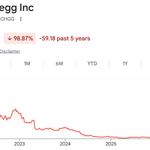
Once the competitive landscape begins to shift, that moat evaporates. Look at Chegg for example.
Chegg had a great moat as the leader for students to get quick answers in their College courses. It would be very challenging for someone new to enter the space as Chegg's network effect was too strong.
Then AI entered and shifted the whole landscape. $CHGG

I hear a lot of pushback from SMBs saying they don’t need AI because their industry has high moats.
To me, that’s like saying we won’t make a website or use the internet because we have a high moat.
Sure, that moat might give you some runway, but it won’t adapt; you’ll eventually fall behind.
And once you’re behind, you’ll never recover as the gap is only getting larger.

Breaking news: Your local government-regulated utility provider isn't dumping billions on AI research.
Of course it's going to be concentrated at the top.

1% of companies represent 90% of AI spending.
Of that 90%, 80% of this spend are from unprofitable VC backed companies.
So, roughly, $0.70-75 of every dollar of AI spending right now comes from AI companies spending VC investment dollars.
As a result, the revenue quality in AI is currently poor. This happened in previous cycles as well, like cloud when early users of AWS were mostly venture backed startups.
The thing, though, is that before AWS could scale and pull thru GCP and others as legitimate cash machines, there were a few clearing events to sort out these brittle revenues.
This is the extrapolation of Ken’s point. We will need to transition from speculative AI spending to consistent, reliable spend that shows up in public market earnings reports.
This hasn’t happened yet because most of the breathtaking revenue growth comes from LPs investing in VC funds who then send it to startups.
Feel a little bad for the college kids who didn't get return offers right now:
> Even if you did a solid job, your group could be cutting down headcount, leaving you with nothing
> You likely knew this and grinded even harder during your Summer to try and stand out
> Sacrificing your health for 10 weeks
> Spending your Senior year depressed trying to find a job instead of enjoying your last year of freedom
The worst part is, since the banks hired 18 months before the kids started, they didn't even know they would be cutting headcount come that Summer. Brutal.

Showing US GDP/American food spending is inaccurate here right? AI spending would need to bring in that figure globally.
The world population will be around 8.7B in 2032. That comes about to about 402 a person on average.
Aggressive? Maybe, but I wouldn't count it out.
To justify today’s data center buildout, AI would need to bring in about $3.5 trillion a year by 2032, per a new Brookings paper.
That’s 8.8% of U.S. GDP, nearly as much as Americans spend on food (9.1%), and far more than on energy (5.1%).
Why invest in PE directly when you can get access to the same companies at a discount to par?

Pantheon closed its eighth flagship private equity secondaries program at $6bn, 71% above its $3.5bn target and the firm's largest secondaries raise in nearly four decades in the market.
Pantheon Global Secondaries Fund VIII is about 85% larger than its predecessor, which closed at $3.25bn in November 2023 after beating a $2bn target. New investors from Asia and the Middle East made significant commitments this time.
The close follows record deployment of about $3.35bn across 17 secondary transactions in 2025. The fund blends LP-led and GP-led deals, with a focus on mid-market buyout managers.
The global private equity secondaries business is led by Amyn Hassanally. Pantheon manages about $84bn, including a $41bn private equity platform, and made its first secondaries investment in 1988.


I hear a lot of pushback from SMBs saying they don’t need AI because their industry has high moats.
To me, that’s like saying we won’t make a website or use the internet because we have a high moat.
Sure, that moat might give you some runway, but it won’t adapt; you’ll eventually fall behind.
And once you’re behind, you’ll never recover as the gap is only getting larger.
BlackRock CEO Larry Fink says “the competition for capital is the largest I’ve ever seen,” especially when hyperscalers state they need 7-9 trillion dollars to build out AI, or roughly 25% of U.S. GDP.
“We are starting to see the effect of our cumulative federal deficits in the U.S.” and “ at a time now where we’re finally unlocking private capital,” financing for both the deficit and hyperscaler spending makes that “term premium higher.”
“It is more inflationary to not build out data centers: the faster we can build up more compute, the faster we can bring down the cost.”
“About ⅔ of the US economy capex is spent on technology, whether it's cloud, AI, or capex for making sure that you’re competitive. If you slow the buildout, I think it jeopardizes the economy.”
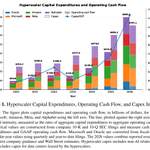
In 2020, big tech spent about 38 cents per dollar of operating cash flow on capex. In 2026, it’s projected to spend about $1.13, according to a Brookings paper.
That’s roughly $800bn of capex against about $707bn of operating cash flow.
The AI buildout is on track to outgrow the cash that pays for it.

Corporate AI spending grew 42% in July. In August it grew 1%, and in September 0.2%.
That’s from Ramp data cited by Apollo. Spending didn’t fall, it just stopped growing after months of big jumps. Apollo’s view is that demand for compute may only look unlimited while it’s nearly free, and that buyers may switch to cheaper open-source models once prices move.
Two quiet months aren’t a trend, since this series has stalled before and picked back up. But if growth doesn’t return, the risk sits with whoever financed data centres on the assumption that demand would keep rising.
With token prices falling, is flat spend a sign of weaker demand, or just companies getting more compute for the same budget?

If you think you're modeling skills are what's going to give you a long term career edge, you are wrong:
> Thousands of hours spent developing the skill
> Clueless nepo interns building crazy models
> Tasks that would take 1hr+ are done in 2 mins
You need to find a new edge

Simple representation of myself trying to get differentiated information
> You send an email asking for some experts
> You go back and forth to find someone that works and a time
> You speak for 60 min
> Most of them are useful, and you really get value out of 15min
> 1 call = $1,000+ = just a few core insights
> Scale over 50 names, multiple calls for names, and you see why pods create dedicated teams
Qualitate is trying makes easier and change the equation. One centralized repository with thousands of expert calls on the core insights that matter.
How painful is it to switch? Will you switch? And why?
