

Professional focus: LowCarbonMobility @Int'l Advanced EV-Hybrid; hill challenges via pedals ... RT not ipso facto endorsement. [email protected]
Greater Sydney area, Australia
Joined November 2010
- Tweets2.7K
- Following127
- Followers47
- Likes665





RJ retweeted

BREAKING: A major civil war has erupted inside the Albanese Government, with a leadership spill officially brewing within the Labor Party.
In a stunning and unprecedented move, Treasurer Jim Chalmers has gone into survival mode, publicly pointing the finger directly at his boss, Prime Minister Anthony Albanese, as the primary reason Labor’s popularity has completely plummeted.
Make no mistake, the lines have been drawn, the factions are fracturing, and a leadership spill is coming.
Here is exactly how the civil war is playing out:
Jim Chalmers openly name checked Anthony Albanese and other senior ministers, declaring that everyone is responsible for their own “parts of the shop”
Translation?
He is refusing to take the sole fall for Labor’s catastrophic economic failures and tanking poll numbers.
In what is being viewed as direct code for internal warfare, Chalmers’ comments firmly dump the blame for Labor's cascading crises onto his colleagues:
He ripped into Finance Minister Katy Gallagher for the ballooning public service.
Had a dig at Home Affairs Minister Tony Burke for national security and immigration failures.
Blamed Foreign Minister Penny Wong for diplomatic blunders.
And then stunningly, Anthony Albanese for the absolute disaster of the lot.
With yet another interest rate hike tipped for Melbourne Cup Day, Chalmers is desperately trying to shield himself from the impending fallout of a faltering economy and soaring inflation.
And typically, as the domestic front burns, Albanese is preparing to jet off to Antigua and Barbuda, leaving behind an increasingly toxic, agitated cabinet and a deputy chair relationship that is completely fractured.
The defensive posture from Chalmers proves he knows the ship is sinking.
The blame game has begun, trust is entirely gone, and a challenge for the lodge is now inevitable.

RJ retweeted

Ralph Fiennes has been a very, very naughty boy! He had the absolute audacity to publicly defend J.K. Rowling, the author of a series that gave him one of his most iconic roles to date… that of Harry Potter’s nemesis, Voldemort. Everyone is expected to perfectly goose-step in line and denounce her for her original sin of ‘transphobia’ due to a series of Tweets.
Fiennes is not the sort of man to get dragged along in pointless slacktivism on the internet. He doesn’t Tweet about how woke he is, he doesn’t run around with little rainbows on his lapels… no, Ralph Fiennes is an actual professional. No nonsense, old-school — you’re here to act, so act! I like that. He’s an admirable chap
Meanwhile Radliffe, Watson and whatever-his-name-is who plays Ron, the ginger sidekick, have all spat out Rowling and publicly denounced her, because the Gods of Social Justice have put a fatwa on her name.
Voldie: “I find the level of hatred that people express about views that differ from theirs, and the violence of language towards others, disturbing.”
Beautiful! To the point. And oh-so true. It is disturbing how incredibly, extremely, over-the-top pissed people get at you when you go against the narrative and dare to criticise whatever’s the current hype. The very fact that Fiennes is now “under fire” for a comment so benign, in defense of a woman so marvelous, is… terrifying.
Half the millennial cast of the Harry Potter universe wishes to all-but cancel the very Creator of their own universe, the woman to whom each of them owe their lucrative careers. Not Fiennes. Fiennes was somebody before Voldemort, and continued to be somebody after. He doesn’t need to defend or attack anyone. But he does, anyway, because he’s a decent human being.


RJ retweeted

Uniqlo's global success offers a valuable lesson.
Keep your brand promise consistent, but adapt your products to local needs.
AIRism for warmer markets. HEATTECH for colder ones.
How much should a brand adapt when expanding internationally?
RJ retweeted

A psychologist spent about 20 years collecting predictions from famous experts and found most did barely better than guessing, then ran a contest where ordinary volunteers beat intelligence analysts who had access to classified information.
His name is Philip Tetlock, and what he found explains why you should stop trusting the loudest person on TV.
In 1984 he started asking 284 experts to predict real events. Elections, wars, economies. Over the next 20 years he collected about 28,000 predictions and checked every one.
The experts did slightly better than a dart-throwing chimp. And the more famous the expert, the worse the forecasts got.
Tetlock found the split by borrowing an old idea from the philosopher Isaiah Berlin. The fox knows many small things. The hedgehog knows one big thing.
Hedgehogs have one big theory, and they bend every event to fit it. They sound great on TV. Confidence sells.
Foxes pull from many sources. They say "it depends" and "I could be wrong." They sound boring.
Foxes won.
Then the US government ran a forecasting tournament, and Tetlock entered a team of volunteers. By most reports, they beat the intelligence analysts by around 30 percent. He called them superforecasters.
Here is what they actually did:
- They broke big questions into small ones. Not "Will there be a war?" but "What would have to happen first, and how often does it happen?"
- They started with the base rate. Before looking at the news, they asked how often this kind of thing happens at all.
- They used real numbers. Not "probably," but "63 percent." A number can be checked later. A vague word cannot.
- They changed their minds in small steps. New evidence moved them from 63 to 67, not from yes to no.
- They hunted for people who disagreed with them. On purpose.
- They wrote down their reasoning and scored themselves afterward. Every miss was a lesson, not an insult.
None of this needs a genius. It needs a willingness to be wrong in writing.
That is the part most people hate. A pundit who says "this will definitely happen" never has to face the score. A superforecaster who says "70 percent" does, and learns from it.
So the next time someone tells you the future with total certainty, ask one question: "How often have you been right before?"
If they have no answer, they are a hedgehog with a microphone.
The people who see ahead best are rarely the ones with the biggest idea. They hold many small ideas loosely, and they keep score.

RJ retweeted

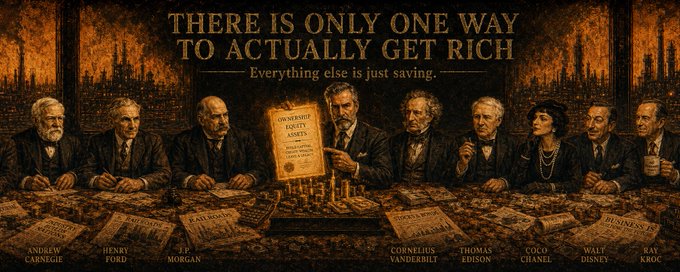
Charlie Munger thought McDonald's did a better job educating people than Harvard. He wasn't joking.
Charlie Munger literally explained why McDonald's beats elite universities at education. It is not the food. It is not the wages. It is one skill college never bothers to teach.
Munger said it straight to a room that expected him to mock the company. Elite academics love calling McDonald's the wrong kind of job, low pay, bad food, nothing to admire.
He disagreed completely.
McDonald's takes troubled young people with no resume and hands them a first job that leads to a second. It teaches showing up on time, counting money, pricing items, smiling at a stranger. Munger called it more successful at building good citizens than charter schools.
He described his own local McDonald's like a regular, not a critic. Same cashier every morning, knows his name.
Buffett backed him up with his own story. A paper route boss named John Daley taught him habits at thirteen that shaped his whole career. Nobody preached at him. The man just said try this, and it worked.
Their real point cut against business schools directly. Munger blamed a chunk of the last thirty years of financial mayhem on the conventional wisdom taught in those same elite programs.
The habits that compound a fortune get taught at a cash register, not a lecture hall.
Their full remarks are archived free online. Almost nobody outside finance has watched them.

RJ retweeted

STEVE JOBS GOT FIRED FROM APPLE.
Then he walked straight into MIT and dropped the most raw, unfiltered 60-minute business masterclass ever recorded.
Zero PR bullshit.
Zero image to protect.
Just pure, brutal honesty from the man who built Apple once and was about to rebuild it even bigger.
Stop scrolling.
Watch this tonight instead of Netflix.
Bookmark it. Come back to it.
RJ retweeted

Steve Jobs literally predicted the iPhone, the Internet, AI and the next 50 years of technology in a single speech from 1983:

RJ retweeted

Children who take music lessons develop a larger corpus callosum, the bridge between the two halves of the brain, and the change is permanent. A 2005 review in the Annals of the New York Academy of Sciences found that early music training produces structural brain changes that persist into adulthood, even if the person stops playing.
The review was led by Gottfried Schlaug at Harvard Medical School, one of the leading researchers on music and the brain. He found that children who started instrumental training before age seven had a significantly larger anterior corpus callosum than non-musicians, and the size difference was still visible in adults who had not touched an instrument in years.
The corpus callosum carries signals between the left and right hemispheres. A larger one means faster, richer communication between the two sides, and the effect shows up in tasks that have nothing to do with music: spatial reasoning, verbal memory, and the ability to process multiple streams of information at once. The music built the highway, and the brain uses it for everything.
Schlaug also found that musicians had larger cerebellums, the region involved in timing and motor coordination, and more grey matter in the areas that process sound. The brain had physically reorganised itself around the demands of the instrument, and the reorganisation was visible on a scan.
The age window matters. Children who started before seven showed the largest changes. Children who started after ten showed smaller ones. Adults who took up an instrument for the first time showed the least structural change, though they still showed some. The brain is most willing to be rebuilt by music during the years when most parents are debating whether to sign their child up for lessons. pubmed.ncbi.nlm.nih.gov/1659…

RJ retweeted

Warren Buffett: "America's bottom 2% by income live better than John D. Rockefeller did when he was the richest man in the world.
Today, you can get better medicine, better education, better entertainment, better transportation."
A higher standard of living does not guarantee a sense of enough. That feeling disappears when you measure your life against someone who has more.
Munger put it more bluntly: "The world is not driven by greed. It's driven by envy."
In his 1995 speech The Psychology of Human Misjudgment, Munger described 24 psychological tendencies that distort judgment. The expanded 2005 version contained 25, with envy among them.
Watch Buffett’s full answer in the video, then read Munger’s 25-point checklist in the article below.


RJ retweeted
Grace Hopper built the first program that let a computer translate human instructions into machine code, and then spent two years failing to get anybody to use it.
Her account of the reaction is worth quoting exactly. She had a running compiler, nobody would touch it, and they carefully told her that computers could only do arithmetic and could not do programs.
That was 1952, and it took two years of demonstrations before her own company's management accepted the thing worked. The idea underneath it sounds obvious now and was heresy then. Programming at the time meant writing instructions the machine could execute directly, in numeric codes, by hand. Hopper thought the machine should do that translation itself, so a person could write something closer to English and let the computer convert it.
When she proposed going further and using actual English words, she was told very quickly that she could not, because computers did not understand English.
Her reasoning was about who gets to use a computer. Very few people think naturally in symbols, she said, and the ones who do become mathematicians. Everyone else finds it easier to write a sentence.
She built it anyway. Her English-language compiler became the foundation of COBOL, which ran business, banking and government systems for decades and is still running some of them.
Every programming language since sits on the principle she was told was impossible. A machine can be handed instructions written in a language made for people, and do the translating itself.
She retired from the US Navy as a rear admiral. They named a destroyer after her.
spectrum.ieee.org/from-punch…

RJ retweeted

In 1948, a 32-year-old at Bell Labs published a paper nobody fully understood.
Engineers found it too mathematical. Mathematicians found it too engineering-focused. One prominent mathematician reviewed it negatively.
That paper - "A Mathematical Theory of Communication", became the founding document of the digital age.
The man was Claude Shannon. Father of Information Theory.
At 21, he wrote the most important master's thesis of the 20th century.
Working at MIT on an early mechanical computer, Shannon noticed its relay switches had exactly two states - open or closed. He had just taken a philosophy course introducing Boolean algebra, which also operated on two values: true and false.
Nobody had ever connected these two things.
His 1937 thesis proved that Boolean algebra and electrical circuits are mathematically identical, and that any logical operation could be built from simple switches.
Howard Gardner called it "possibly the most important, and also the most famous, master's thesis of the century."
Every digital computer ever built traces back to this insight.
At 29, he proved that perfect encryption exists.
During WWII, Shannon worked on classified cryptography at Bell Labs. His work contributed to SIGSALY, the secure voice system used for confidential communications between Roosevelt and Churchill.
In a classified 1945 memorandum, he mathematically proved the one-time pad provides perfect secrecy, unbreakable not just computationally, but provably, permanently, against an adversary with infinite power.
When declassified in 1949, it transformed cryptography from an art into a science. It laid the foundations for DES, AES, and every modern encryption standard.
At 32, he defined what information is.
His 1948 paper introduced one equation:
H = −Σ p(x) log p(x)
Shannon entropy. The average uncertainty in a probability distribution. The minimum bits required to encode a message.
Three things followed:
> He defined the bit - the fundamental unit of all information. His colleague John Tukey coined the name.
> He proved the channel capacity theorem, every communication channel has a maximum rate of reliable transmission. You can approach it. You can never exceed it.
> He unified telegraph, telephone, and radio into a single mathematical framework for the first time.
Robert Lucky of Bell Labs called it the greatest work "in the annals of technological thought."
Where his equation lives in AI today:
Cross-entropy loss - the function training every classifier and language model, is derived directly from H. Decision tree splits use information gain, which is H applied to data. Perplexity, the standard LLM evaluation metric, is an exponentiation of cross-entropy.
Every time a neural network trains, Shannon's formula runs inside it.
He also built the first AI learning device.
In 1950, Shannon built Theseus, a mechanical mouse that navigated a maze through trial and error, learned the correct path, and repeated it perfectly. Mazin Gilbert of Bell Labs said: "Theseus inspired the whole field of AI."
That same year he published the first paper on programming a computer to play chess. He co-organized the 1956 Dartmouth Workshop, the founding event of AI as a field.
The man:
He rode a unicycle through Bell Labs hallways while juggling. He built a flame-throwing trumpet, a rocket-powered Frisbee, and Styrofoam shoes to walk on the lake behind his house.
He called his home Entropy House.
When asked what motivated him: "I was motivated by curiosity. Never by the desire for financial gain. I just wondered how things were put together."
In 1985, he appeared unexpectedly at a conference in Brighton. The crowd mobbed him for autographs. Persuaded to speak at the banquet, he talked briefly, then pulled three balls from his pockets and juggled instead.
One engineer said: "It was as if Newton had showed up at a physics conference."
He died in 2001 after a decade with Alzheimer's, the cruel irony of information slowly leaving the mind of the man who defined what information was.
Claude, the AI model, is named after Claude Shannon, the mathematician who laid the foundation for the digital world we rely on today.

RJ retweeted
A 21-year-old computer science student in Helsinki bought his first PC in early 1991 and immediately hated the operating system it came with. So he sat down to write his own.
On September 25, 1991 he posted a quiet message to a Usenet newsgroup announcing what he called "just a hobby, won't be big and professional like GNU."
35 years later that hobby runs every Android phone on Earth, every supercomputer on the TOP500 list, the entire backend of the internet, the International Space Station, and SpaceX's Falcon rockets.
His name is Linus Torvalds. The hobby is called Linux.
Here is the story, because the man who runs the most consequential codebase in human history almost no longer needs an introduction inside engineering and still walks the streets unrecognized everywhere else.
Linus was born in Helsinki, Finland on December 28, 1969. He was named after Linus Pauling, the only person in history to win two unshared Nobel Prizes, in Chemistry and in Peace. He joked he might also be partly named after Linus van Pelt from the Peanuts cartoon. His family was unusual. Both parents were journalists. His grandfather was a statistician. Another grandfather was a poet. The family belonged to Finland's Swedish-speaking minority. There are fewer than 30 people in the world with the surname Torvalds, and according to Linus, they are all related.
At 10 he started programming on his grandfather's Commodore VIC-20. By his teenage years he was writing his own assemblers, editors, and games. He served in the Finnish Army for his mandatory national service and rose to the rank of Second Lieutenant. Then he enrolled at the University of Helsinki to study computer science.
In early 1991 he bought a personal computer with MS-DOS and disliked it intensely. He wanted UNIX, the operating system he had used at the university. UNIX cost thousands of dollars. He could not afford it. So he started writing his own.
He posted the now-famous announcement to comp.os.minix in August 1991. He called the kernel Linux, a portmanteau of his name and MINIX. He released the source code under the GPL license. Anyone could download it, read it, modify it, and ship it for free.
Within a year hundreds of developers around the world were sending him patches. Within five years Linux was running web servers. Within ten years it had taken over the supercomputer market. Within twenty years it was running on most of the internet. Today every Android phone on Earth runs the Linux kernel. Every Chromebook runs Linux. Most of AWS, Google Cloud, and Microsoft Azure runs Linux. Every Tesla runs Linux. Every SpaceX Falcon 9 and Dragon capsule runs Linux. The International Space Station runs Linux. Every supercomputer in the world's TOP500 list runs Linux.
That was the first thing he built.
In 2005 the proprietary version control system the Linux community had been using, BitKeeper, revoked its free license. Linus was furious. He sat down and wrote a replacement in 10 days. He called it Git. The first commit was on April 7, 2005. Today Git powers GitHub, GitLab, and the source control of every major software organization on Earth. Every line of code at OpenAI, Anthropic, Google, Meta, and Microsoft flows through Git. Every AI model on the planet is versioned with software a Finnish engineer wrote in less than two weeks.
He won the 2012 Millennium Technology Prize, the equivalent of a Nobel Prize for engineering. He won the IEEE Computer Pioneer Award in 2014. He completed his master's degree from Helsinki along the way, with a thesis titled "Linux: A Portable Operating System." He moved to the United States, became a citizen, and now works from his home in Portland, Oregon, employed by the Linux Foundation.
A Finnish student announced a hobby project on a message board in 1991.
His code is now in every pocket on the planet.
He still writes most of his important communication on the Linux kernel mailing list.

RJ retweeted

In 1997, a developer publicly told Steve Jobs he had no idea what he was talking about. Jobs paused, then answered a question nobody had actually asked
The developer's question was an insult wrapped in a technical challenge - asking Jobs to explain Java against OpenDoc, then adding: "Perhaps you could tell us what you personally have been doing for the last 7 years."
Jobs didn't defend the technology.
He didn't attack the developer either.
He agreed with him first.
"People like this gentleman are right in some areas," Jobs said. He admitted OpenDoc probably did things nothing else could do. He admitted the demos would look impressive.
Then he pivoted to the actual question underneath the insult: how does any individual piece of impressive technology fit into a vision large enough to sell $8,000,000,000 to $10,000,000,000 of product a year?
Here's the framework he laid out live, under pressure, with no preparation.
Start with the customer experience. Work backward to the technology. Not the reverse.
"You can't start with the technology and try to figure out where you're going to sell it."
He admitted he'd made that exact mistake - building from technology outward - more than anyone else in the room. "I've got the scar tissue to prove it."
Then he made the abstract point concrete with a story from over a decade earlier.
Apple built the first small laser printer in the US. Inside the box: the first Canon laser engine on American soil, custom controller software, Adobe PostScript, AppleTalk networking. Genuinely groundbreaking engineering.
None of that was the pitch.
Jobs held up the printed page and said: "Do you want this?"
Nobody needed to understand PostScript or AppleTalk to answer that question. In 1984, before laser printing existed for consumers, the answer was an immediate, involuntary "yes."
That's the whole model. The technology enables the outcome. The outcome is what you sell.
Jobs closed by conceding something most executives never say in public: "I readily admit there are many things in life that I don't have the faintest idea what I'm talking about."
Then he defended his team anyway - engineers being offered 3 times their salary elsewhere during the hottest hiring market in Silicon Valley, and staying.
"Mistakes will be made along the way. That's good, because at least some decisions are being made."
He didn't win the argument by being right about everything.
He won it by being right about the 1 thing that mattered: start with what the customer wants, then build backward.
RJ retweeted

Tory & Labour have been grossly negligent
They have deliberately sent our money and jobs abroad
Reform will scrap Net Zero & urgently approve drilling again

RJ retweeted

Viral moment captured as a Boeing Dreamlifter takes off with a stunning amount of force!
With @POTUS in office, American companies like Boeing are beginning to dominate Airbus and other European competitors.
✅ Won their first order last week from Delta after nearly 10 years of the airline only ordering Airbus
✅ Landed an order from Philippine Airlines for the first time in two decades
✅ Outsold Airbus for the first time in almost a decade this past year
AND they kept it going this weekend, beating out Airbus AGAIN on their home turf in England, selling almost 20 more planes.
Total domination. If Kamala were in office, there is no chance this would be happening right now ↘︎
reuters.com/business/aerospa…
RJ retweeted
A mathematician noticed that the scientists at Bell Labs who shut their office door to focus got more done that week, and the ones who left it open and got interrupted all day won Nobel Prizes. He spent 30 years figuring out why the interruptions were the reason.
His name was Richard Hamming, and he had earned the right to notice things like this.
He won the Turing Award. He invented the codes that let every computer on earth catch and fix its own errors.
And for 30 years he ate lunch in the same Bell Labs cafeteria, watching which of his brilliant colleagues became legends and which ones quietly disappeared.
Near the end of his life he put everything he saw into one book. It's called The Art of Doing Science and Engineering.
The open door thing is the part everyone quotes, but almost nobody sits with what it actually means.
The closed-door scientists were not lazy. They were disciplined. They protected their time. And over a single afternoon, they won. No interruptions, more output. But stretch that out over 30 years and something strange happened. The open-door people pulled miles ahead.
Every idea drifting down the hallway walked through their open door. Every problem someone else was stuck on landed on their desk.
Ten years in, they were working on questions the closed-door people didn't even know existed yet. The interruptions weren't stealing their focus. They were feeding it.
That's the whole book in one image. The thing that looks like a cost is often the investment.
He does the same move again and again. When Bell Labs refused to give him the team of programmers he asked for, he didn't sulk and he didn't quit.
He sat with the rejection for weeks. Then he turned it inside out and asked why the machines couldn't just write the programs themselves. That single flipped question pushed him straight to the frontier of computer science. The wall became the door.
Then there's the part that hurts to read.
Hamming said most scientists spend their whole careers dodging the biggest problem in their field. Not because they can't see it. They see it fine.
They avoid it because the odds of failing are high, and failing on a big problem is embarrassing. So they pick a safe problem sitting right next to it, solve it cleanly, publish, and move on.
And because they never once swing at the hard one, they never hit it. If you do not work on important problems, you will not do important work. He said it flatly, like it was arithmetic, because it is.
The last idea is the one I keep coming back to. He said knowledge compounds like money left in a bank. Someone who works 10% harder than you does not finish 10% ahead over a lifetime. They finish twice as far ahead, because the gap doesn't add up year by year. It multiplies. And it multiplies silently for a long time before anyone can see the distance.
He closed on a line I've never been able to shake. Luck favors the prepared mind. He didn't mean it as a poster. He meant it as an instruction. You don't wait around hoping luck finds you.
You build the exact conditions where it can land, then you stand there long enough for it to happen. Open doors. Hard problems. Questions turned inside out. Hours stacked on hours.
Hamming died in 1998. He gave his final lecture a few weeks before, at 82. The book is still in print. The lectures are free online.
The manual for a career that actually matters has been sitting in the open for years.
Most of the people who need it will never open it.

RJ retweeted
Most people think the internet lives in the cloud.
It doesn't.
Almost all of it travels through physical cables lying on the ocean floor.
As AI transforms the global economy, those cables are being rerouted because of geopolitics. The world's biggest technology companies are redesigning digital infrastructure around political risk, security and resilience—not just efficiency.
It's a fascinating shift that has big implications for Australian businesses, international trade and the future of AI.
I unpack what's happening—and why it matters—in this week's Geopolitical Rant.
Subscribe to our Youtube channel for more updates: youtube.com/c/Dearinassociat…
RJ retweeted

Godfather of AI: "If you sleep well tonight, you may not have understood this lecture."
This 47-minute lecture is the best thing I've seen about AI in the last few months.
Hinton built the neural networks behind every AI alive, then quit Google to warn us it's already ahead of us on most cognitive tasks.
Despite that, most people open Claude, type one thing, close the tab and think they're using AI, but they're using maybe 10%.
I turned his talk into 17 Claude features 99% of users never find.
Watch the lecture, then read the article below.

