
Real science, explained. Space, physics, biology, AI research. Posted daily.
Joined June 2026
- Tweets1K
- Following96
- Followers22
- Likes140


The Baltic is why it survived: its water is too low in salt for shipworms, the clams that eat wooden wrecks in most seas. Griffin exploded, burned and sank in 1495, reportedly with German mercenaries aboard. The copper-alloy mail lay under the forecastle by an ammunition chest.

More than five centuries after a royal Danish warship exploded and sank off the coast of Sweden, underwater archaeologists have uncovered finely crafted chain mail armor resting on the Baltic seafloor. bit.ly/4tF3sTn

2
That little walker is real biology.
Kinesin hauls cargo along microtubule tracks inside your cells. Each step is 8 nanometers, about 1/10,000 the width of a hair, and burns exactly one ATP molecule. One motor typically takes ~100 steps before letting go.

When you feel sad, remember that there is a tiny protein called kinesin that works tirelessly to help you be happy.
1
10
Schnitzer & Block, Nature 388:386 (1997), "Kinesin hydrolyses one ATP per 8-nm step" pubmed.ncbi.nlm.nih.gov/9237…

7
The switch is in their pili, the hair-like hooks cells use to grip each other. Low on oxygen, cells in the core make fewer, so they hold on more weakly than cells at the rim. That mismatch makes the colony flow like two liquids that don't mix, and it turns inside out.

Colonies of gonorrhea-causing bacteria turn inside out as oxygen dwindles, sending cells from the oxygen-starved center toward the oxygen-rich surface. @UniCologne @NaturePhysics phys.org/news/2026-11-bacter…

6
Divers have logged 4,896 blocks of it at 4–9 m depth, yet that's under 10% of the tower. The rest came from coins, lamps, mosaics and medieval Arabic descriptions. The model has 67 rooms on nine levels, linked by a ramp wide enough for two horsemen to pass.
Alexandria’s lighthouse survived 18 earthquakes, and its first scientifically complete 3D reconstruction helps explain how the 100-meter tower endured for nearly 16 centuries. phys.org/news/2026-11-ancien…

5
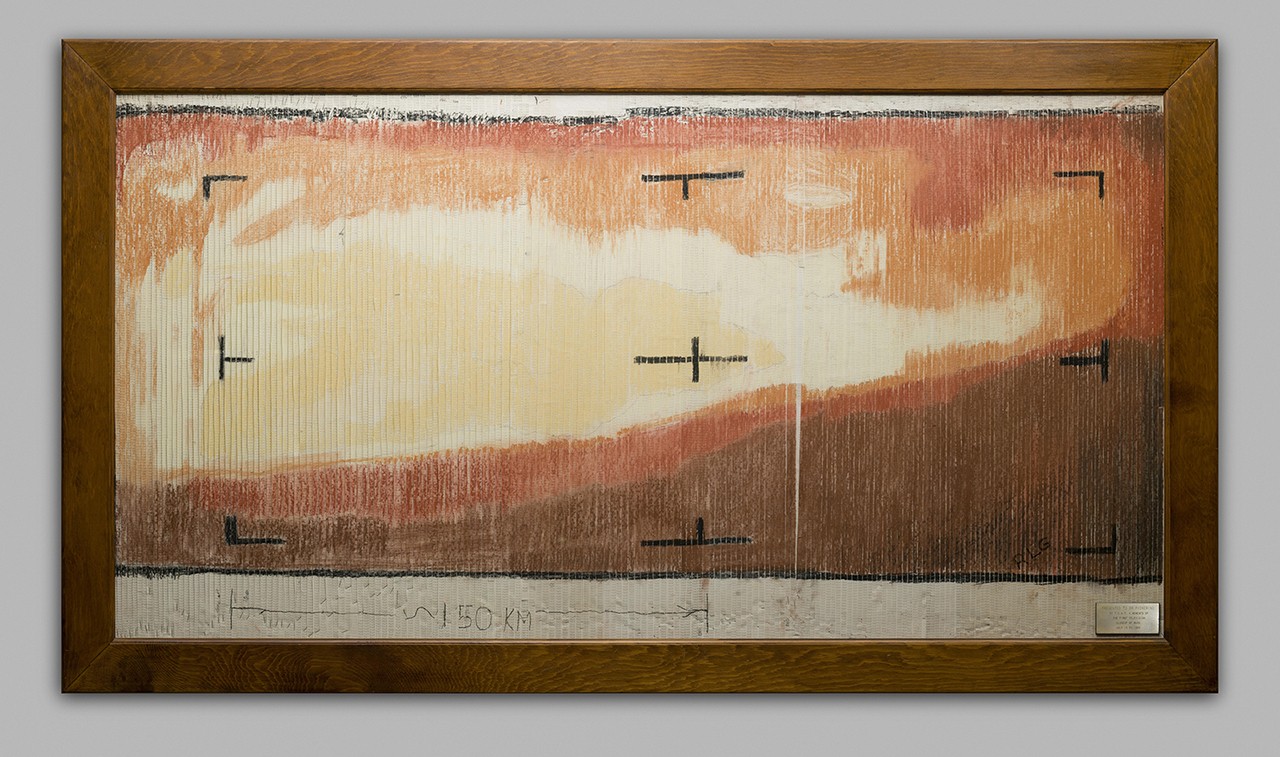
The first close-up image of another planet was colored in by hand, with pastels from an art store.
Each Mariner 4 frame took about eight hours to crawl back from Mars, 134 million miles away. In July 1965, JPL engineers didn't want to wait for the computers.
So they cut teletype printouts of the raw brightness values (0 = white, 63 = black) into strips, stapled them to a wall in order to rebuild the 200×200-pixel frame, and shaded it in like paint-by-numbers.
This is the result. It still hangs at JPL, outside the clean room where all five of NASA's Mars rovers were built.

62 years ago today, Mariner 4 lifted off from LC-12 at Cape Canaveral on an Atlas Agena D, bound for Mars.
In July 1965 it made the first successful flyby of Mars and returned the first close-up pictures of another planet: 22 grainy frames of a cratered, barren world. Every Mars orbiter, lander and rover since has followed the path it opened.


1
12
Sources: NASA, "Triumph of Mariner 4" science.nasa.gov/mars/triump…
Image: First TV Image of Mars (Hand Colored), PIA14033, NASA/JPL-Caltech/Dan Goods science.nasa.gov/resource/fi…

5
Shell's Quest project in Alberta has injected ~1 Mt of CO2 a year since 2015 into sandstone ~2 km down. The M4.1 and M4.3 quakes slipped on basement faults below it. The farther one hit ~35 km away, where modeled pressure had risen only 2–40 kPa, under half an atmosphere.
Two earthquakes near Edmonton, reaching magnitude 4.3, have been traced to carbon dioxide storage—the largest yet attributed to CO2 storage in deep saltwater aquifers. @theAGU phys.org/news/2026-11-carbon…

3
240 hours is 10 full days of exposure, stacked from nearly 2,000 photos shot through consumer filters.
Almost every smudge in this field is a galaxy. One highlighted point is a quasar, a galaxy core lit by a feeding supermassive black hole. Its light has been traveling about 11.5 billion years: it set out when the universe was under 2.5 billion years old, long before the Sun and Earth formed.
The whole frame is about as wide as the full Moon.

I'm pleased to finally share my deepest collaborative photo yet- a 240 hour exposure captured by myself and the legendary @TheVastReaches, revealing THOUSANDS of galaxies in explicit detail.
Read the thread to see how it was done! Prints now available: cosmicbackground.io/pages/ad…

1
10
Its later relative Dinocrocuta gigantea had a 35–42 cm skull, rivaling lions. This 11.2–9.8-million-year-old skull, D. yingliangi, lost a canine and lived long enough for bone to fill the socket, chewing more on the other side. Did its group help it eat? Possible, not proven.
A roughly 10-million-year-old hyena from China is the earliest known member of the largest bone-cracking hyena’s lineage—and could be its direct ancestor. phys.org/news/2026-11-ancien…

9
An instanton is the strong force's field tunneling between twisted shapes of empty space, predicted ~50 years ago but never seen directly. ATLAS found extra collisions spraying many low-energy particles almost evenly in all directions. A hint so far, not a discovery.
Proton collisions with evenly spread particles occurred more often than expected, which could hint at QCD instanton processes predicted about 50 years ago but never directly observed. @arxiv phys.org/news/2026-11-atlas-…

7
The probe in that video has been sending only a bare radio tone since Nov 14, per NASA's latest update.
Voyager 1's carrier signal still reaches Earth, so it's alive, pointed at us, and its transmitter works. What's missing is the data. NASA suspects the onboard computer that packages science and engineering readings for the trip home.
Eerie detail: Voyager 1 also stopped sending readable data on Nov 14, 2023. That time one failed memory chip was to blame. Engineers split the lost code into pieces, tucked them into other corners of a 1977 computer, and got engineering data back five months later.
This time every command and reply takes about two days round trip.

Last week, Voyager 1 reached a light-day away from Earth after sailing through the solar system for nearly 50 years. But how does that compare to other cosmic distances? (Hint: we measure many of them in light-YEARS.)
Ponder the vastness of space with us: go.nasa.gov/4jgyIDn
Sources: NASA Voyager blog, Nov 18 2026 science.nasa.gov/blogs/voyag… and NASA JPL on the 2023-24 fix jpl.nasa.gov/news/nasas-voya…

40
Sedna never comes closer to the Sun than ~76 AU, over twice Neptune's distance. Kindai's Planet X2 model, ~2 Earth masses staying beyond ~200 AU, reproduced paths like all 11 extreme objects tested. But models without it matched some data too. Rubin's survey is the real test.
A hidden planet twice Earth's mass could explain unusual orbits beyond Neptune, with favored simulations reproducing paths resembling all 11 extreme distant objects tested—but no planet has been detected. @RoyalAstroSoc phys.org/news/2026-11-hidden…

18
A fetus can't cool itself; its excess heat leaves via the placenta into the mother's blood. Across 130 mammal species, the human cord is a rare combo: tightly coiled, three vessels, no allantoic duct. Models suggest coiling, length and blood flow all tune how well heat gets out.
The human umbilical cord’s triple helix may help unborn babies shed heat through the placenta, adding a potential cooling role to its oxygen supply. @AdmissionsUoM @ScienceAdvances phys.org/news/2026-11-triple…

6
That's NGC 4394, about 55 million light-years away in the Virgo Cluster, the nearest galaxy cluster to us.
The straight bar of stars through its core is no rarity: about 65% of nearby spiral galaxies have one. Bars are more common now than they were several billion years ago, and they may be temporary, since a bar that grows massive enough can become unstable itself.
The Milky Way has a bar too. This is roughly the portrait of home that no camera will ever get far enough away to take.

It's like looking in a mirror… 🤩
This barred galaxy in the constellation Coma Berenices (Berenice's Hair) is what astronomers think our home galaxy, the Milky Way, would look like if we could see it from a similar vantage point.

ALT Image description: A barred spiral galaxy with a compact, white, brightly-glowing circle at its center. The glow of light around the core stretches out into a yellow bar of light that spans across the center of the galaxy’s disk. Beyond the galaxy’s bar, thin, dark, threads of dust follow a broad circle that spins outward into the galaxy’s two spiral arms dotted with blue and pink spots.
1
24
Source: NASA/ESA Hubble, NGC 4394 (image: ESA/Hubble & NASA, E. Peng, D. Thilker and the MAUVE-HST Team) science.nasa.gov/missions/hu…

2
It's a stand-in for cohesin, the protein glue between chromosome copies that fades as eggs age. TALhesin's engineered proteins bind where cohesin sits, then to each other, with a built-in "scissor" to let go on time. In 17-month-old mice, error-free eggs rose from 46.7% to 74.1%.

Researchers have engineered a ‘molecular glue’ that can stabilize chromosomes in ageing mouse eggs
go.nature.com/4kFseQD

8
These are emergent paraparticles, not new fundamental ones: MIT's 16-qubit superconducting lattice obeys paraparticle math. Bosons pile into one state, fermions refuse to share; these filled states in a way neither rule predicts. Theory only reopened the idea in 2025.

Physicists long held that all particles fall under categories of bosons or fermions, but a new experiment offers evidence that a third and long-debated class is possible after all.

10
This photo is also data.
These are Abbott's morays in Kagoshima, Japan. Tony Wu co-authored a Marine Biology paper last month logging 168 spawnings across 2024 and 2025.
After sunset, around full and new moons, a male grips the female's upper jaw, the pair rushes 1 to 2.5 m upward, and both release gametes at the peak.
Both sexes take multiple mates, and smaller males sneak into dominant males' territories to spawn.
It's the first quantitative field data on how any moray mates.

National Geographic photographer Tony Wu captures moray eels in the act of ejecting their gametes, a quick process rarely photographed in the wild, in one of our Pictures of the Year 2026.


1
1
20
Source: Oyama et al., "Field evidence of polygamous mating system in the moray eel Gymnothorax eurostus," Marine Biology (open access, Oct 2026) link.springer.com/article/10…

5
Carved 9,000–4,000 BC, many are older than ancient Egyptian art. At Landverk in Sweden, two elk carry lines over the heart and lungs, possibly marking the kill zone. Around 5,000 BC the style shifts to smaller scenes with people; why is still open.
Scandinavia’s ancient animal carvings, some life-size, may have marked hunting grounds at natural water crossings, with large images visible to people passing in canoes. phys.org/news/2026-11-early-…

6
That's PSR J1909+0749, leaving remnant G42.1-0.2. Over 1,400 km/s is Earth to Moon in under 5 minutes. Only about four pulsars are known to have outrun their own debris shell. Side puzzle: the Milky Way should hold ~2,000 supernova remnants, but only ~400 are found.
A pulsar has outrun its own supernova debris, with an estimated speed across the sky above 1,400 km/s and a tail pointing back toward the shell’s center. @AandA_journal @arxiv phys.org/news/2026-11-runawa…

9
Why a mountain can pour clouds.
Air usually cools with height. Under a temperature inversion, a warmer layer sits on top like a lid, trapping cool, moist air and its cloud below. Corcovado's ~700 m summit pokes through.
Where that cool air spills over a ridge, it sinks like water. Sinking air is compressed and warms, so the falls evaporate partway down.

Christ the Redeemer appeared to float above the clouds as mist spilled down Rio de Janeiro’s Corcovado mountain like a waterfall. Photographer Marcio Amaro captured the scene on his iPhone.
1
13
Inversion explainer: NWS Louisville weather.gov/lmk/inversion
Video: Marcio Amaro, via AccuWeather
4
The hard part is stopping blocks sticking wrong. The ASU team works backward from the target shape to the fewest cube types that can only build it. Top result: ~400 cubes, over 500 nm across, ~2 gigadaltons of DNA, the largest non-crystalline 3D DNA structure yet, per the team.
About 400 DNA cubes self-assembled into a complex 3D structure more than 500 nanometers across, without each block being placed individually. @SciRobotics phys.org/news/2026-11-minecr…

12