

Britain needs free markets, individual liberty, and a small state. Join our cross-party pressure group today! 🇬🇧
United Kingdom
Joined August 2025
- Tweets911
- Following211
- Followers1.5K
- Likes2.5K






Pinned Tweet
Join us today! Don't miss out on future events, and opportunities to influence our policy decisions 🗽 🇬🇧
sites.google.com/view/libert…


Libertarian Conservatives retweeted

Beggars can’t be choosers. If you are offered a job, and turn it down, you shouldn’t remain on the dole.

“No-one should be forced to do something they don’t want to do”, says KFC worker who had struggled to find work amid the NEETs crisis.
An independent review by Alan Milburn, commissioned by the government, has been published in full today. His recommendations aim to find solutions for almost a million 16-24 year olds who are neither in work nor full time education or training - but the government has said that some young people will lose benefits they are currently eligible for.


In 1997 handguns were banned in Britain. The next year homicides increased by 6.7%. Maybe the weapon wasn't the problem all along?

Who do you think should be the next Republican Presidential nominee?
#2028RepublicanPrimaries #presidential


3%JD Vance
44%Marco Rubio
35%Thomas Massie
18%Nikki Haley
34 votes • Final results 4
260


Ever wondered why British houses are so expensive?
The Town and Country Planning Act (1990): This modernised and consolidated local government's power immensely to deny planning applications. This also created huge bureaucratic backlogs and put heavy costs on smaller developers trying to enter the market.
The Housing Act (1996): Built heavily into modern planning frameworks, developers are legally obligated to fund extensive archaeological desk-based assessments and field evaluations before a single shovel hits the ground if a site holds potential historic interest. If artifacts are found, the developer must pay for multi-month excavations, introducing catastrophic, un-budgetable delays and carrying costs.
The Finance Act (1996): When building on brownfield sites, developers face heavy regulatory costs clearing "contaminated soil." The Home Builders Federation estimates this alone adds around £2,000 in regulatory costs per home built.
The Housing Act (2004): This legislation introduced mandatory licensing for Houses in Multiple Occupation. It forced landlords managing shared houses to pay heavy upfront local council fees, undergo inspections, and install mandatory fire doors, basins, and specific spatial partitions. The rules were dramatically expanded in 2018 to cover smaller properties, pulling tens of thousands of homes into a highly regulated, expensive compliance web.
The Planning Act (2008): A new set of laws which created the Community Infrastructure Levy, which is an upfront non-negotiable flat tax per square meter of newly built internal floor space. Adding extra costs to new developments.
The Building Regulations (2010): Part L altered how insulation, air-tightness, and heating systems are priced in the name of energy efficiency. Part O and S added mandatory requirements for solar shading, specialised glass, and high-voltage electric vehicle charging circuitry built directly into homes.
The Environment Act (2021): Legislation which made it a legal requirement for new housing developments to deliver a 10% increase in "biodiversity" compared to the pre-development's state.
The Building Safety Act (2022): It introduced a rigorous "Gateway" system overseen by the newly established Building Safety Regulator. The administrative cost, multi-month regulatory delays to get architectural plans validated, and stringent material verification rules have severely dented development margins on high-density urban apartment schemes.
If you're struggling to get on the housing ladder, these regulations as well as older ones can be blamed. Not to mention the various taxes are also a factor.
Fight for lower house prices, join the Libertarian Conservatives UK today!


From the 6th of November, you can face up to 2-3 years in prison for having a video of choking porn in your camera roll 🥴
Labour really have their priorities straight here

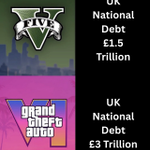
Whichever Chancellor manages to balance the budget and starts to reduce our national debt will go down as a hero.
The Chancellor shouldn’t temporarily keep the VAT cut on energy, he should make it permanent at the very least.
The Chancellor has announced 20 Million households will receive £100 directly into their bank accounts.
Inflation is on the way up then!
5
224
