

AI Product Builder & Founder | Built AI agents @ Kellogg AI Lab | Kellogg MBA '26 | Writing about how AI is transforming business, and what lies ahead
Joined June 2016
- Tweets3.5K
- Following468
- Followers211
- Likes5




Early friction in agentic shopping is to be expected. We are building a brand new trust layer between AI, merchants, and banks. Given how fast AI is moving, native wallets and payment rails will align soon, and going from high-intent search to one-click checkout will reshape how we buy online.

Agentic commerce is undeniably overhyped based on current usage
...but, I'd be willing to bet it's massively underhyped based on volume agents will drive in ~3-6 months.
And, if you're not optimizing your product (software, service, or physical good) for agents, you'll be left behind.
Why?
1. As Maia's demo shows - agents are much improved, but still nowhere near perfect. 99% of consumers will churn off an agent if there are any issues or delays. Browser use is still slow / buggy and the ecosystem of connectors / plug-ins available on these agents are nascent.
Similarly - saving down credentials, handling payments, etc. all have too much friction and uncertainty now. This will all be solved over time.
2. The VAST majority of consumers still are not using agents. Pick a person off the street in any city other than SF, and they have likely heard of neither Muse nor Instinct.
These products have (so far) done a fantastic job optimizing for the workflows / use cases of high income, tech-forward SV users. They are still early in doing things that are valuable for the mainstream user on a repeatable basis (retention), especially while being able to offer the product for free.
This will likely involve unlocking network effects (yes, some consumer agents now are multiplayer but usage is fairly low) and giving people ways to make money / spend time vs. save money / save time (@ekuyda's thesis!) Model costs coming down will help here too.
3. "Agents" right now generally refer to standalone harnesses built for consumers to use (Instinct, Muse, Fo, Tomo, Pally, Folk, Tab, Daimon and many others).
These products will continue to grow - and consumers will interact with agentic models more frequently via products like ChatGPT (now at 1.2B WAUs), that can now complete purchases instead of just recommending products.
As ChatGPT rolls out its wallet and more developers connect plug-ins, I could see a massive increase in % of LLM queries that lead to in-chat transactions. And, early data shows that AI-driven traffic is actually higher conversion and intent than non-AI commerce traffic.
1
30
Working with AI agents requires four shifts in how we operate:
1. Batch and dispatch large tasks asynchronously instead of micromanaging chat windows.
2. Audit outcomes, not lines: build strict verification tests and demand empirical proof.
3. Isolate the work in safe sandboxes for full end-to-end execution.
4. Don't outsource human-to-human communication to an agent.
Delegate the machinery. Own the architecture, the audit, and the human voice.

Finally summarized what I've been sending to friends in DMs View article

1
30
Prarthna retweeted

PREDICTION: Cloudflare CEO Matthew Prince (@eastdakota) says AI agents will change the business model of the Internet over the next decade:
"In five years, agent traffic is going to be 1000x human traffic."
"The Internet almost collapsed during COVID when traffic doubled."
"There's a lot more servers, routers, and bandwidth that has to get provisioned in order for that to work. The question is, who will pay for it?"
"My hunch is that something's got to change in terms of how the Internet works. Like some version of micropayments that every time you access a resource, your agent pays a ten-thousandth of a penny to be able to see the menu."
"Then there's probably some sort of trade where if you are willing to tell the restaurant what you're looking for, that price goes down, maybe it's free. In some cases, the site might actually pay you to come visit it."
"This will lead to the next version of advertising, which is how do you advertise to agents?"
We must separate three things: what the user authorized, whether that authorization exceeded bank rules, and whether the agent acted beyond both user instructions and bank rules.
Some banks allow limited agent access via APIs, while sharing raw logins breaks bank rules. In this report, no bank disclosed a verified instance of an agent defying user instructions.

There’s a world of difference between user-authorized agents (Muse, Instinct, Grokbot, etc.) and true unauthorized/rogue agents that could constitute cyberattacks.
Most of the activity described in the Axios story appears to be the former: customers sharing credentials with agents so they can take actions on their behalf. This may violate bank terms requiring humans to log in themselves, but these are in no way cyberattacks.
The direction banks should go is to support user-directed agents. For example, Amex is an authorized connection in Muse, making it easy for users to grant, limit, and revoke access.
Read-only permission levels are a sensible interim step. Several banks already support or are moving toward them. Full write access (with user credentials) is a different risk category and should be approached carefully.
Frightening the public by blurring the line between user-authorized agentic behavior and cyberattacks is irresponsible.
24
Delta, Chase, and Amazon are blocking AI agents. Here is what is actually at stake:
1. Defending the Attention Economy
Amazon generates over $50 billion annually from advertising, its highest-margin revenue stream. An AI agent operating via API strips away that visual real estate. It turns a high-margin retail media network back into a low-margin commodity warehouse. Blocking agents is an existential defense of the attention economy.
2. The Liability Vacuum
If a third-party AI agent hallucinates, gets prompt-injected, and wires $50,000 to an offshore account, who eats the loss? The user did not directly click the button, yet the user authorized the agent.
3. Walled Gardens Hold Leverage
You will not switch from Chase or skip a Delta flight out of a hub city just because they blocked your third-party wrapper. Instead, the giants will restrict you to their proprietary agents (Amazon Rufus, Chase's internal AI) by keeping their inventory and data behind first-party authentication.
4. The Trust Paradox
Many predict companies will eventually pay to be an AI agent's top recommendation. Why would you trust an agent that takes a kickback from Delta or Chase? Once an agent accepts placement fees, its loyalty shifts from the user to the sponsor.
5. The Death of Brand Equity
Brands exist as cognitive shortcuts for humans. Agents do not feel nostalgia or respond to visual prestige. They evaluate structured data: price, delivery speed, and reliability. As purchasing shifts to agents, brand equity depreciates rapidly.
6. "SEO for Agents" Kills the Website
Agents do not browse visual pages. A merchant only needs a machine-readable feed of inventory, pricing, and reviews exposed via an API. Websites become legacy artifacts for humans, and marketing budgets shift from creative agencies to data engineers.

Delta, Chase and Amazon are blocking AI agents.
The war on agents has begun, and here’s how it probably plays out:
Stage 1: Companies block agents because agents skip the ads and upsells.
Stage 2: Agents learn to act like humans, and it becomes an arms race.
Stage 3: The market splits. Companies that make money on sales let agents in, companies that make money on data charge for access, and the giants build their own agents.
Stage 4: A trusted middle layer for agent identity and payments becomes the standard way in.
Stage 5: Companies that welcome agents start winning customers from the ones that block them.
Stage 6: The agent blockers come back and let agents in on their own terms.
Stage 7: Everyone starts competing for agents with better prices, faster checkout and SEO built for agents.
Stage 8: The ads come back, and companies pay to be your agent’s first recommendation.
Stage 9: The agent war ends, and selling to agents becomes as normal as having a website.
1
76
Traditional software enablement allowed consultants to install a product, train the staff, and leave. AI integration is an ongoing operational relationship. The foundational prerequisites for AI are heavy. Companies must fix their data architecture and cloud infrastructure before agents can function effectively. Model capabilities evolve rapidly, making the integration layer a continuous service requirement.

There's a huge opportunity right now in being the deployment layer for AI into the economy. The amount of work it takes to change out workflows in enterprises tends to be far greater than anyone realizes or would prefer. Clearly this is what the applied layer of AI is going to look like in the form of software and agents, but also it opens up new services firms opportunities.
Legacy systems need to be moved to the cloud, data organization and access needs to be updated, software needs to be connected to agents in new ways, workflows need to be reengineered for agents, HITL needs to be figured out for the process, evals need to be generated and maintained, and the entire system needs to be continually updated as new models get released and new capabilities emerge. And the full list may even be longer.
AI is not the same as just deploying software. Software you generally did the implementation of an existing, well understood category of technology, then stepped back and the customer kept running. With AI agents, you're delivering actual work augmentation to the organization, which has a completely different set of complexities associated with it. You're no longer deploying tools that the company is merely enabled by, you're deploying work output in a process. Completely different implementation and enablement process.
As a result, this is going to open up lots of new kinds of firms and plays for existing firms to diffuse AI into organizations. We're going to see approaches by industry, by size of company, and by problem inside of companies. Traditional SIs will modernize and adapt (some will clearly not adapt as well), and new entrants will also be founded in this period that take advantage of this window. Great time to be an FDE or FDE firm.
1
34
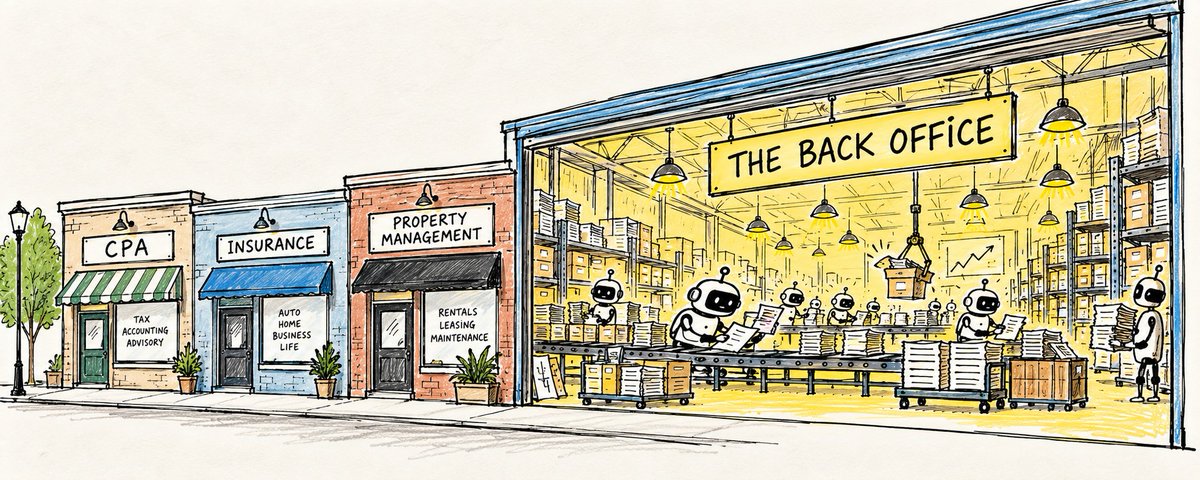
The AI roll-up thesis works if you pick the right target. Algorithms scale commodities. They choke on messy reality.
Where it breaks:
• Algorithmic real estate: Pricing models can't smell water damage or spot a weird floor plan.
• Automated bookkeeping: Small business data is so chaotic that tech-first firms often hire hundreds of accountants just to fix the software's mistakes.
Where it works:
• Uber: Driving from A to B is a pure commodity. The tech kills the friction.
• IT Support & Payroll: AI crushes standard support tickets and tax tables because the inputs are clean and binary.
The lesson: Buy businesses built on structured administration. Skip the ones selling bespoke judgment.
2
6
104
Prarthna retweeted
People have always paid to remove friction: washing machines, Uber, auto-pay. They may not call it 'productivity'.
Shopping is two things: a pleasure and a chore. Apparel and gifts are recreation. Detergent, refills and insurance renewals are chores. Build agents for the chores.
Best model: the agent researches, the human decides.

.@benthompson says consumer AI has a marketing problem because the average consumer doesn't actually want to be more productive.
"Tech companies are like, 'Let us book your flight for you!' I’ve had a personal assistant for 10 years. He does not come within an inch of booking my flights for me. That is crazy talk."
"I understand which ones are gonna be delayed. I know which seat I want to be on. So the fact that this is continually a demo is hilarious to me."
“Number two: people love shopping. They don’t want to be productive. They want to be entertained. One of the biggest forms of entertainment is shopping.”
"Also, there’s so much information on a product page. Companies have spent so much energy focusing on that. You look at apparel as a category. They’re going to tell you what size the model is wearing, and you want to know that, and you want to look at the different styles."
"The idea of having a personal agent that’s going and getting some of the information and bringing it back to you, and then you’re like, 'Well, what about this other thing? Tell me about this thing.'"
"And you have your eager tech company executive say, “Oh, I have an assistant that can do it for you!"
"And it’s like, no. Not only do I want to do it, I want to complain about it. I’m enjoying myself complaining right now, okay? Would you just let me be and live my life?"
45
Prarthna retweeted

Ben Thompson:
"I think Muse is good enough — and the overall agent experience impactful enough — that this will be the test of AI in the consumer space: if this doesn’t take off glorified search might be as far as we get....
Human scale, with computers, instead of computer scale, in place of humans."

Prarthna retweeted

My second conversation with Sarah Guo (@saranormous), founder of Conviction.
Sarah's been early to many of this generation's defining companies, and is constantly ranked at the top of the managers LPs most want to invest with.
She knows the small group of 250 people pushing the AI frontier and we discuss what she sees from that vantage point:
- What the people building AI actually believe right now
- How close we are to robots in the home
- The case against an AI monopoly
- Why she's bullish on bio x AI
- Building Conviction
@domcooke wrote the definitive profile of Sarah and Conviction for @colossusmag: "Sarah's Wager". Link in comments.
Enjoy!
TIMESTAMPS
0:00 Intro
1:08 Investing Through the AI Boom
12:06 What AI Researchers Believe
15:44 Compute, Capital & Robotics
24:03 How Sarah Makes Investments
39:24 The Case for Open Source
49:01 America’s Compute Independence
51:32 AI’s New Investment Markets
59:36 Finding Truth & What’s Next
Prarthna retweeted

This week I had the honor of speaking to Princeton’s entire incoming undergraduate class to address their AI anxieties. I had three messages for them — good news, bad news, and a note of optimism. Here’s a condensed version.
The good news
We have enough evidence now to conclude that the shrill predictions of rapid, massive job loss were misplaced. Even in a field like software engineering where AI has been rapidly adopted, its effect has been to shift, not replace the role of the human (see the “decide-execute-deliver” framework normaltech.ai/p/why-ai-hasnt…)
Similarly, the panic about what to major in is also misplaced. There will be enduring demand for computer science, philosophy, and just about everything else. (In fact, AI companies hiring philosophers has been a big recent trend.)
The bad news
AI seems to help senior people much more than juniors. I can use AI for coding because I spent 25 years learning how to code, which lets me supervise coding agents effectively. (See my post on the “growth cycle” vs the “dependence spiral” teapawt.org/random_walker/status/2…)
You are in a bind — you can’t offload your skill-building to AI, but you’ll graduate into a market where employers will expect you to get work done with AI. We never faced this dilemma. As a result we haven’t figured out how to revamp our classes to help you do both. You’ll have to help us figure it out. And you’ll need to somehow resist the constant temptation to turn to the shortcut machine.
The hope
My point is not that AI is bad for learning. It’s an incredibly flexible tool. Is the internet good or bad for learning? Depends — are you using it to find research papers or waste time scrolling? I use AI every day for learning. The key is to use it to increase, not decrease your cognitive load. To learn deeper, not faster. There is no learning without the cognitive sweat. I try to make sure I’m mentally exhausted at the end of the day. I do feel that AI lets me push myself harder than I ever could before, and I have a vision that as AI continues to advance it will enable human-AI “co-superintelligence“. (I talked about this at the end of my ICML keynote. normaltech.ai/p/what-will-be…)


There’s a big, under-appreciated reason why people may have very different experiences and opinions about using AI for work — are they using it for tasks they’re already an expert at, or tasks they can’t do themselves? The former leads to a *growth cycle* and the latter leads to a *dependence spiral*.
When I use AI to do something I’m an expert at, like coding, I treat it as a tool. I can build quickly, maintaining an understanding of the code, knowing that if necessary, I can fix the code myself. It feels empowering. It frees up my time to think about the complex, judgment-oriented parts of software engineering that I can’t or won’t delegate to AI. That means my own skills improve rapidly, and I get to climb the ladder of complexity and develop higher-level skills, much more so than when I write the code myself. I feel in control. I can lock in and achieve a flow state — when AI is working, I’m reviewing, building understanding, and planning the next steps. I never get the feeling that the tool is about to replace me. This is the growth cycle.
(Of course, the growth cycle is not automatic. I still need to exercise agency to use AI responsibly. But it’s the same challenge with any productivity-enhancing technology, and those who’ve navigated such transitions before are well-equipped to navigate it with AI as well.)
On the other hand, if I use it for tasks I don’t understand and haven’t learned to perform myself, I have no choice but to treat it as a superintelligence. If something breaks, the best I can do is ask AI to fix it and hope for the best. I generally can’t evaluate the quality of the output myself. The only way to find out if it's any good is if and when the work is ultimately reviewed by an actual expert. The experience is confusing, unsettling and disempowering. And forget about flow state. By over-relying on AI, I risk losing whatever skill I had at the task in the first place, even if it boosts productivity in the short term. This is the dependence spiral.
It’s no wonder that entry-level workers and students preparing to enter the workforce find themselves in a bind. To compete with the AI-enabled productivity of more seasoned workers, they must adopt AI themselves, but doing so risks the dependence spiral. I have some thoughts on solutions that I will share in later posts, but I think having a clear diagnosis of the problem is a useful first step.
Prarthna retweeted

AI power users are showing up outside tech. The fastest-growing Codex adopters since February:
Legal: 108x
Sales: 41x
Recruiting: 41x
Marketing: 26x
Healthcare: 24x
Charts of the Week: a16z.news/p/charts-of-the-we…

Prarthna retweeted

My husband asked me yesterday why is AI moving at lightspeed while robotics feels slower?
I think its a really interesting question and speaks to what unlocked mainstream AI over the last decade—and why physical robots can't easily tap into those same accelerants.
Prarthna retweeted

Sam Altman admits he was wrong on AI's timeline and says society and the economy will adapt more slowly
"I thought when we got to GPT-4, which was back in 2023, that very quickly after that there was going to be much more disruption, software businesses up for grabs right away, than it turned out to be."
"I think I was wrong about a few things, but one in terms of the speed: the economy just has so much inertia."
"People keep doing the same things, buying from the same company, wanting to use their tools the same way. I think this is actually a positive in many ways, and it's going to make this big transition go smoother and slower. I'm grateful for it."
"But it means we've all been too ambitious on timelines. Even with this incredible technology, society and the economy will adapt more slowly."

Sam Altman reveals building Codex was a "crazy kamikaze mission" to beat Claude Code and that most of the best coders he knows now use Codex.
"We were way behind Claude Code, and it seemed like a kind of crazy kamikaze mission to try to beat them with a coding app."
"The consensus is that this kind of thing never works, and you just move on to the next one. It's a fool's errand to try to win when someone else already has momentum in a particular product category."
"But we decided we thought it was really important. We asked a team to do it, and they performed a legitimate, unbelievable, very rare in the history of business thing."
"Now it is the product that most of the best coders I know use."
"That felt like an impossible thing, but if we hadn't asked the team, hey, we have a really important but extremely hard mission for you, it just wouldn't have happened."
Prarthna retweeted
Humans are the minority user of AI
Agents burn nearly 5x the tokens people do, up 14x since February
Charts of the Week: a16z.news/p/charts-of-the-we…

Prarthna retweeted

What if your dinner could fly over traffic instead of sitting in it? We are now scaling to provide Uber Eats more than 1 million autonomous deliveries a day. Uber is becoming an investor in Zipline. We’ve entered the scaling era for robotics and physical AI.
Prarthna retweeted

Absolutely insane. Major breakthrough today
Moderna used AI to design an mRNA cancer vaccine that succeeded in a phase 3 trial
It's not approved yet and it's just a treatment, but it's a step towards AI eventually curing cancer
It's incredibly sad people are trying to stop this innovation by (falsely) claiming AI data centers are drinking all our water
That AI is taking all the jobs
That AI is just a way for billionaires to get rich
All while the technology gets us closer and closer to cures for all diseases
I don't know which foreign country has convinced half of America that AI is the devil, but hopefully this "AI is drinking the water" trend ends sometime soon
We are on the cusp of greatness

Prarthna retweeted

Scoop: Stripe tells investors that "the singularity" has begun, and also shares some first-half performance data.
Read the letter: axios.com/2026/08/19/stripe-…

Prarthna retweeted

2/2 Second, on the messaging around AI. I do not agree that my messaging has been disproportionately negative. In fact it has been about equally balanced between risks and benefits: I’ve written one major essay about each, and even in interviews where I discuss the risks, I make sure to frequently mention the incredible benefits as well as proposing possible solutions to the risks (short clips from my interviews that end up on social media tend to be disproportionately negative, as that gets clicks). In fact, I wrote Machines of Loving Grace because I didn’t feel the AI industry was painting an inspiring enough picture of how the technology could radically transform the world for the better. The bulk of the essay is devoted to refuting skepticism of AI’s potential in health and biology, and showing why I think it will actually be possible to cure most human disease in ~5-10 years, as crazy as it may sound to ordinary people and frankly to biologists as well (I used to be one!). And, if you read my most recent essay (Policy on the AI Exponential), I discuss concrete proposals for how to streamline the FDA process to make sure the deluge of AI-accelerated drugs isn’t slowed down by the regulatory process. I feel the urgency here: I lost my father to Hepatitis C only a few years before the development of direct-acting antivirals (sofosbuvir), which cure 95% of patients and probably would have cured him.
I do agree that the public has a negative view of AI (and that this is a big problem), but I don’t think it is primarily caused by me or any other AI leader warning about AI’s risks. I think it is fundamentally a crisis of trust. I think that ordinary people don’t trust companies, governments, or the tech industry and always suspect that we are cooking up some new way to screw them over. The causes of this go back decades and AI is just the latest iteration of it. I don’t think that a glitzy marketing campaign with a positive spin (which some have advocated that Anthropic do) is the way to win back that trust — at this point, saying that AI will cure cancer is more a cliche than it is inspiring, and most people think it is deceptive. The thing that will work is *actually curing cancer*. I think by far the most accurate criticism of AI companies including Anthropic is that we haven’t yet delivered on our big promises to benefit the world. That is totally on us, and I think it’s the criticism you should be making, instead of all this stuff about messaging and marketing.
We are however doing our best to fix this: Anthropic is ramping up its efforts very quickly in biology and medicine, and we hope to have incredible results in the coming years and some early glimmers in the coming months. When we’ve actually accomplished something real, the whole world will hear about it, as loudly as possible, you have my word on that. But until then I don’t want to make empty promises, and in the meantime I feel compelled to speak honestly about the very real risks of AI and how to address them. Honesty is the right thing on the merits, and in terms of public credibility and trust it is no worse than, and may in fact be better than, an approach that ignores or distracts from risks which people instinctively understand are real.