

✞ Evangelical/Baptist ✍ 20-Year Research Blogger of Augustinian & Reformed Works on God’s Love, Will, Grace, & the Free Offer 🧐 Editor 📚 Book Collector
Joined October 2009
- Tweets16.2K
- Following753
- Followers1K
- Likes12.9K

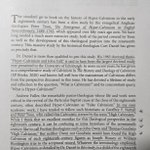



Take a look at this, @David651975. Dr. Daniel mentions our websites. Cool. I did not know he was going to do that. We’re famous. 😎🤓
I look forward to finally meeting him sometime around Easter next year.


My copy has arrived. Interesting quotes coming soon.
Quick first impressions: Good quality paper; clean appearance; massive bibliography; good scripture and subject indexes; 782 total pages. The hardback cover without the dust jacket looks dull and boring.

An English (AI) translation of Philastrius of Brescia’s (fl. 383–391) 𝘛𝘩𝘦 𝘉𝘰𝘰𝘬 𝘰𝘧 𝘏𝘦𝘳𝘦𝘴𝘪𝘦𝘴 (Liber de Haeresibus or Diversarum hereseon liber): updatedworks.com/philastrius…
For a Latin version, see here: archive.org/details/diversar…

Here is the new search page for the British Library catalogue. It is the updated and revived edition of the old EThOS search page where one can find old theses and dissertations.
ethos.blethoshyku.com/
Or here:
catalogue.bl.uk/nde/home?vid…
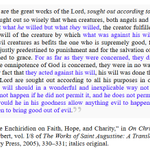
“For the legion of demons could not hold even pigs in their power, if Christ did not permit it when they asked. Even from the persecutions which he [Christ] permitted the devil to bring about, he knew how to produce crowns for the martyrs, making good use of every kind of evil for the benefit of the good.”
Saint Augustine, “Answer to Julian,” in 𝘈𝘯𝘴𝘸𝘦𝘳 𝘵𝘰 𝘵𝘩𝘦 𝘗𝘦𝘭𝘢𝘨𝘪𝘢𝘯𝘴, 𝘐𝘐, ed. John E. Rotelle, trans. Roland J. Teske, vol. 24, The Works of Saint Augustine: A Translation for the 21st Century (Hyde Park, NY: New City Press, 1998), 403; 𝘊𝘰𝘯𝘵𝘳𝘢 𝘐𝘶𝘭𝘪𝘢𝘯𝘶𝘮, 4.7.38.
Note to AI translators: What you have to be 𝘷𝘦𝘳𝘺 careful about is 𝘯𝘰𝘵 𝘮𝘦𝘳𝘦𝘭𝘺 the accuracy of the English translation, but AI (particularly ChatGPT) summarizing sections of an author without telling you it did that, and even being misleading in its summarizations.
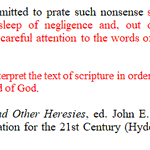
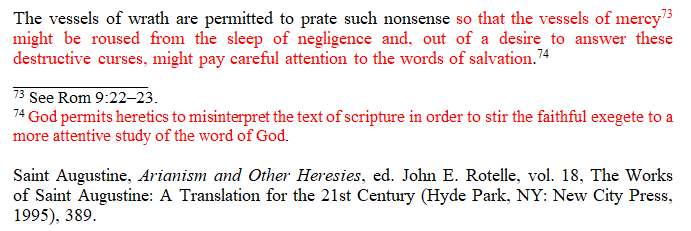
Augustine got this right. God sometimes puts the stench of error and heresy in our nostrils to move believers to more diligently search the scriptures and to employ it with precision in apologetics.
“We should call persons who have gained no wisdom from reading men of letters ‘literalists’ rather than ‘literate.’²²⁰
_______________
²²⁰ Augustine uses ‘litteriones’ in contrast with ‘litterati.’ The former term was used in contempt for people who taught the language, but had absorbed none of the culture.”
Saint Augustine, 𝘈𝘳𝘪𝘢𝘯𝘪𝘴𝘮 𝘢𝘯𝘥 𝘖𝘵𝘩𝘦𝘳 𝘏𝘦𝘳𝘦𝘴𝘪𝘦𝘴, ed. John E. Rotelle, vol. 18, The Works of Saint Augustine: A Translation for the 21st Century (Hyde Park, NY: New City Press, 1995), 415.
“For thus God blinds, thus G̲o̲d̲ h̲a̲r̲d̲e̲n̲s̲ b̲y̲ a̲b̲a̲n̲d̲o̲n̲i̲n̲g̲ a̲n̲d̲ n̲o̲t̲ h̲e̲l̲p̲i̲n̲g̲; and he can do this by a hidden judgment, but he cannot do it by an evil one.”
Augustine of Hippo, 𝘛𝘳𝘢𝘤𝘵𝘢𝘵𝘦𝘴 𝘰𝘯 𝘵𝘩𝘦 𝘎𝘰𝘴𝘱𝘦𝘭 𝘰𝘧 𝘑𝘰𝘩𝘯 28–54, ed. Thomas P. Halton, trans. John W. Rettig, vol. 88, The Fathers of the Church (Washington, DC: The Catholic University of America Press, 1993), 294; Tractate 53.
This is a good tribute. Dr. Parker was also servant-hearted, and generous. He let me stay at his condo in Dallas in the late 90’s and early 2000’s so that I could get schooling at Criswell College. He was gregarious (or extroverted, unlike me) and so impacted a lot of people, even in little ways, through personal interaction, not by way of books and academic writing. A few years ago, he gave @WesleyLHuff his entire library.
I have funny memories of him sometimes acting like a stereotypical fundamentalist, even though he was far from that, and an intellectual. But as David Closson says below, Jim never wore his academic credentials on his sleeve. That taught me, long ago, that the truly educated never do that. Jim sometimes dressed as Gandalf, and to his abundance of friends, Parker modeled that virtuous wizard’s qualities.
Hat Tip to @DrDavidLAllen for telling me this news.

I am saddened to learn that my former @SBTS professor, Dr. James Parker, passed away last night. Dr. Parker had an extraordinary academic pedigree. He studied at Baylor, Trinity, Princeton, Basel, and Johns Hopkins, and he delighted in pointing out that he could trace his academic lineage through generations of teachers all the way back to John Calvin.
What made this even more endearing was how lightly he wore all of it. While many of his colleagues built substantial publishing careers, Dr. Parker often joked that one of his great contributions to scholarship was a 2001 Baptist Press article about Santa Claus. He could trace his academic lineage to Calvin, but he was far more likely to tell you a funny story than to remind you of his credentials.
During my years as a student at Southern Seminary, Dr. Parker became a regular part of my life. I joined his shepherding group as an M.Div. student—admittedly, in part because I had heard he took his students to a very nice Brazilian steakhouse at the end of the semester. Later, during my doctoral studies, I worked in the School of Theology, and it was almost guaranteed that Dr. Parker would stop by for an hour or more to talk and tell stories. He seemed to know nearly every significant evangelical figure of the twentieth century, and his stories about them were endlessly entertaining.
Dr. Parker also somehow convinced the dean to let professors eat in the seminary dining hall for half price, which meant that over my five years as an on-campus student, I shared literally hundreds of meals with him. He taught one of my doctoral colloquium, but some of the most important things I learned from him came outside the classroom. Dr. Parker taught me, among other things, not to take myself too seriously.
For several years I lived at the Duck and Goose, a house long associated with men preparing for ministry at Southern. Dr. Parker told me that years earlier the men there had hosted professors for dinner, and he encouraged my roommates and me to revive the tradition—with the understanding, of course, that he would be the first professor invited. We gladly obliged and hosted him several times.
I am grateful for the classes, the meals, the long conversations, the stories, and the friendship. Southern Seminary has lost one of its great characters, and I will miss him.


Coming out in April 2027: A Revised Version of Bauckham on Jude and 2 Peter: amazon.com/Jude-Peter-50-Bib…

Also here in Logos: logos.com/product/481699/jud…

🆕 The very extensive tables of contents for Emilé Doumergue’s 7-volume magisterial work “Jean Calvin: Les hommes et les choses de son temps” (Lausanne: George Bridel & Cie Editeurs, 1899–1927) are now posted here: theologicalmeditations.blogs…
This is an amazing work of history! Doumergue left no stone unturned. With these AI translated tables of contents, one can now easily explore what Doumergue said about every aspect of Calvin’s life, and that era in Reformation history.
Émile Doumergue’s (1844–1937) 7-volume work on Jean Calvin is available on the Internet Archive.
𝘑𝘦𝘢𝘯 𝘊𝘢𝘭𝘷𝘪𝘯: 𝘓𝘦𝘴 𝘩𝘰𝘮𝘮𝘦𝘴 𝘦𝘵 𝘭𝘦𝘴 𝘤𝘩𝘰𝘴𝘦𝘴 𝘥𝘦 𝘴𝘰𝘯 𝘵𝘦𝘮𝘱𝘴 (Lausanne: George Bridel & Cie Editeurs, 1899–1927).
Tome I (1899):
archive.org/details/jeancalv…
archive.org/details/jeancalv…
archive.org/details/jeancalv…
Tome II (1902):
archive.org/details/jeancalv…
archive.org/details/jeancalv…
Tome III (1905):
archive.org/details/jeancalv…
archive.org/details/jeancalv…
Tome IV (1910):
archive.org/details/jeancalv…
Tome V (1917):
archive.org/details/jeancalv…
Tome VI (1926):
archive.org/details/jeancalv…
Tome VII (1927):
archive.org/details/jeancalv…

Given your own excellent and extensive research, Andrew (xitter.cf/ulsteram), you will definitely want to take a look at the above.
