






Pinned Tweet
Introducing Cosign.
cosign.co


Excited to introduce @Cosign: the curated professional network for the startup community: cosign.co
Our goal is to create the following:
- A comprehensive startup directory of investors, companies, and operators, including what they worked on and who they worked on it with.
- Cosign graph: Who shaped your career? Who were you actually in the trenches with? Who would work with you again? Who thinks you’re someone to watch?
- Durable reputation: Great endorsements happen every day on X and disappear into the feed. Cosign attaches those signals permanently to people and companies.
- Discovery: Who are the best fintech angels? Which AI companies should I watch? Who are the best designers?
- Intent network: Privately signal “I’d invest in them,” “I’d hire them,” “I’d work with them,” or eventually even “I’d acquire this company.” Match people when interest exists on both sides.
Imagine if Wikipedia, LinkedIn, and OG AngelList had a baby. Though Cosign is a community, not a business.
In order to join, you need to be cosigned. Or you can apply directly.
David Booth and I started this idea 7 years ago but didn’t have the firepower to make it work. Now we do.
No one has really touched LinkedIn in 20 years. Excited to take a swing.
cosign.co
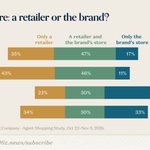
Different AI agents send shoppers to different stores.
In The Prompting Company's tests, Instinct linked only to the brand's own store in 45% of answers, compared with 11% for Muse.
Muse included a retailer in 89% of answers, either alone or alongside the brand's store.
Like people, each agent has its own taste - which can impact what products an agent even considers, as well as what it ultimately selects.
Full piece from a16z's Justine Moore and Olivia Moore: a16z.news/p/welcome-to-the-b…


Agents are the next big distribution channel for products, services, and software.
But how do they decide what to recommend?
@omooretweets and I did a deep dive with @promptingco - and we're sharing takeaways after running 11k+ agent tests 👇

What gets your product found, chosen, and bought by an AI agent?
a16z's Justine Moore and Olivia Moore partnered with The Prompting Company to test four consumer agents across 1,270 prompts and 11,307 completed runs.
Specific customer needs can overturn an agent's default recommendation. Shipping, returns, and seller credibility influence its choice. Requiring an account can stop it before checkout.
For businesses, winning an agent's business means making your product's value clear and giving the agent a path to actually buy or use it.
Full piece from a16z's Justine Moore and Olivia Moore: a16z.news/p/welcome-to-the-b…

Agents are the next big distribution channel for products, services, and software.
But how do they decide what to recommend?
@omooretweets and I did a deep dive with @promptingco - and we're sharing takeaways after running 11k+ agent tests 👇
OpenAI's Ashoka Rajendra, who cofounded Orchestra Bio, on the prospect of a one-person biotech company:
"Whether you are in manufacturing, at a pharma company, in clinical operations, in discovery and so on, how can these systems help you do the existing work you're doing faster and at higher quality, explore wider space?"
"I think that's a rising tide that will lift the entire industry. There are some substantial constraints, right? Human biology only moves so quickly. Regulation is a big lever that needs to be changed."
"But the industry has seen... what can small teams do in order to make breakthrough medicines. And I do think this is a great amplifier for the whole industry, with some fundamental limits, of course, in biology."
@JayRughani: "Do you think we'll see one-person biotechs anytime soon?"
@ashokaraj_: "Very much so, yes."

OpenAI is building tools to help scientists find insights in datasets too large for humans to fully explore. In one collaboration, 2,000 AI agents uncovered patterns in eight million cells that months of human analysis had missed.
OpenAI recently acquired Orchestra Bio, which Ashoka Rajendra cofounded to help scientists manage drug discovery and development. Together with OpenAI's Joy Jiao, he's working to bring a Codex-like experience to scientists.
Their view: AI could help researchers test more hypotheses, keep clinical trials on track, and even enable a single person to launch a biotech company with multiple drug programs.
Joy and Ashoka join a16z's Jay Rughani and Jorge Conde to discuss GPT-Rosalind, what makes biological data valuable, where startups can build alongside OpenAI, and more.
0:46 OpenAI's life sciences strategy
3:03 Why OpenAI bought Orchestra Bio
7:22 AI across the drug value chain
11:09 Infinite attention for biology data
14:28 2,000 agents vs 8 million cells
18:52 AI that pictures proteins in 3D
21:51 How agents keep trials from slipping
25:41 AI that fills clinical trials faster
29:46 Where pharma adopted AI fastest
35:37 Why manufacturing is ripe for AI
40:48 AI on both sides of insurance
43:34 The data OpenAI wishes existed
47:14 Advice for "data factory" founders
52:16 Where startups fit next to OpenAI
54:18 A 20-year diagnosis, solved by o3
59:00 Why prompts can't reveal bad intent
1:02:01 The rise of one-person biotechs
YouTube: youtu.be/RwYz8XhZiu0
@joyjiao12 @ashokaraj_ @JayRughani @JorgeCondeBio
OpenAI's Joy Jiao on building a Codex for scientists:
"One of the biggest things that we see with the models today is that there's what we call a capability overhang, and this means that there's a lot of things the models can do, but no one knows about it, and so no one has access to that."
"What we really wanna do is bring something that is as good as Codex for coders, for scientists and to biotechs and pharma."
"When we are training GPT-Rosalind, we have all these interesting capabilities in the model in both chemistry and structural biology. We see that the models are doing really well on the benchmarks."
"But one repeated theme we've seen is that people don't know how to use the models. They don't know even what prompts to use, what questions to ask. And I think this is really where you need an exceptionally good product or a good harness around the model to really make that capability accessible to people."
@joyjiao12
OpenAI is building tools to help scientists find insights in datasets too large for humans to fully explore. In one collaboration, 2,000 AI agents uncovered patterns in eight million cells that months of human analysis had missed.
OpenAI recently acquired Orchestra Bio, which Ashoka Rajendra cofounded to help scientists manage drug discovery and development. Together with OpenAI's Joy Jiao, he's working to bring a Codex-like experience to scientists.
Their view: AI could help researchers test more hypotheses, keep clinical trials on track, and even enable a single person to launch a biotech company with multiple drug programs.
Joy and Ashoka join a16z's Jay Rughani and Jorge Conde to discuss GPT-Rosalind, what makes biological data valuable, where startups can build alongside OpenAI, and more.
0:46 OpenAI's life sciences strategy
3:03 Why OpenAI bought Orchestra Bio
7:22 AI across the drug value chain
11:09 Infinite attention for biology data
14:28 2,000 agents vs 8 million cells
18:52 AI that pictures proteins in 3D
21:51 How agents keep trials from slipping
25:41 AI that fills clinical trials faster
29:46 Where pharma adopted AI fastest
35:37 Why manufacturing is ripe for AI
40:48 AI on both sides of insurance
43:34 The data OpenAI wishes existed
47:14 Advice for "data factory" founders
52:16 Where startups fit next to OpenAI
54:18 A 20-year diagnosis, solved by o3
59:00 Why prompts can't reveal bad intent
1:02:01 The rise of one-person biotechs
YouTube: youtu.be/RwYz8XhZiu0
@joyjiao12 @ashokaraj_ @JayRughani @JorgeCondeBio
Exa predicts that by 2030, AI agents will search the web 1,000x more than people do.
Harvard roommates Will Bryk and Jeff Wang started the company in 2021 to build a better search engine. Two weeks after Exa launched, ChatGPT came out.
Agents are a new kind of searcher, and Exa is built for them.
The company has grown 10x for three consecutive years, now handles 2 billion requests a month, and raised at a $2.2B valuation earlier this year.
Will and Jeff named it Exa after 10¹⁸, a smaller number than the googol (10¹⁰⁰) that inspired Google's name. Their explanation: "less is more."
Exa is hiring across all teams: a16zjobs.substack.com/p/insi…
@WilliamBryk @jeffzwang @ExaAILabs
Full conversation with @ExaAILabs CRO Marcus Holm and a16z's @clu007:
00:00 Intro
01:17 Two Harvard roommates take on Google
02:45 Why 10¹⁸ is greater than 10¹⁰⁰
04:12 Do we really need another search engine?
06:01 How agents search
09:57 Why frontier models need a better knowledge layer
15:37 What hypergrowth does for a career
24:08 Where agentic search is taking off first
27:11 What perfect search could unlock
29:35 Marketing to humans and to agents
33:29 How the forward deployed engineers work
41:46 Why search could be winner-take-most again
We're thrilled to invest in Embo.
Robots can already do remarkable things in demos, but those skills are fragile. Move an object, change the lighting, or introduce something unfamiliar, and the robot can struggle.
@EmboAI is building the brain for the humanoid workforce. They start by training a world model on massive amounts of video and robot demonstrations so that robots learn general knowledge far beyond what could be collected on their hardware.
Then an agent practices skills inside that model, trying different actions across imagined scenarios and improving through reinforcement learning. The world model provides physical knowledge, and practice turns that knowledge into skills.
Danijar Hafner and Wilson Yan have spent years developing world models together, and their work includes pioneering research like Dreamer and VideoGPT.
Congrats @danijar, @wilson1yan, and the Embo team!
By @venturetwins, @RaghuRaghuram, and @BornsteinMatt


I'm excited to introduce Embo!
We are building the brain for intelligent robots to help people around the world.
We believe intelligent robots will unlock an era of abundance, making goods and services affordable for everybody. But to deploy them at scale, robots need to work out of the box in unfamiliar scenarios. At Embo, we are building frontier AI models with a deep understanding of physical reality and fine-grained motor skills.
Today's robot skills are fragile. Demonstrations can teach repetitive behaviors, but they cannot cover every object or situation a robot will encounter. We need general pretraining at internet scale to fill the gaps between individual tasks and practice to develop reliable motor skills.
The world models our team has pioneered unlock a path to general robots. Our robot brain pretrains on massive amounts of internet video to learn about objects, physical interactions, and how tasks unfold. It then practices motor skills in diverse imagined scenarios to become robust to unexpected situations.
Our team is behind seminal work in AI including Dreamer, VideoGPT, and Diffusion Forcing, with experience from DeepMind, Meta Superintelligence Labs, NVIDIA Cosmos, Berkeley, and MIT.
We have raised a $110M Seed led by @a16z. We are excited to partner with them, @khoslaventures, DST Global, NVentures (@nvidia), @strikervp, and other strategic investors to bring reliable intelligent robots out into the world.
@EmboAI
OpenAI is building tools to help scientists find insights in datasets too large for humans to fully explore. In one collaboration, 2,000 AI agents uncovered patterns in eight million cells that months of human analysis had missed.
OpenAI recently acquired Orchestra Bio, which Ashoka Rajendra cofounded to help scientists manage drug discovery and development. Together with OpenAI's Joy Jiao, he's working to bring a Codex-like experience to scientists.
Their view: AI could help researchers test more hypotheses, keep clinical trials on track, and even enable a single person to launch a biotech company with multiple drug programs.
Joy and Ashoka join a16z's Jay Rughani and Jorge Conde to discuss GPT-Rosalind, what makes biological data valuable, where startups can build alongside OpenAI, and more.
0:46 OpenAI's life sciences strategy
3:03 Why OpenAI bought Orchestra Bio
7:22 AI across the drug value chain
11:09 Infinite attention for biology data
14:28 2,000 agents vs 8 million cells
18:52 AI that pictures proteins in 3D
21:51 How agents keep trials from slipping
25:41 AI that fills clinical trials faster
29:46 Where pharma adopted AI fastest
35:37 Why manufacturing is ripe for AI
40:48 AI on both sides of insurance
43:34 The data OpenAI wishes existed
47:14 Advice for "data factory" founders
52:16 Where startups fit next to OpenAI
54:18 A 20-year diagnosis, solved by o3
59:00 Why prompts can't reveal bad intent
1:02:01 The rise of one-person biotechs
YouTube: youtu.be/RwYz8XhZiu0
@joyjiao12 @ashokaraj_ @JayRughani @JorgeCondeBio
a16z's Moses Sternstein on why "there is no Gen Z":
"If you take Gen Z and you put them in a room of 99 other Gen Zs, 99 other millennials, 99 other Gen X, 99 other boomers, the odds of them finding a perfect match are almost the same. They actually have a slightly higher likelihood of matching with Gen X and boomers than they do with Gen Z."
"It's definitely heterogeneity, but it also just might be there are more Gen Z tribes... If you're trying to find some kind of uniform cohort, you're just not gonna find it."
"They are fragmented by their different online, by their internet consumption."
"And the implication, whether for politics, for marketing, for institutional trust is, everybody keeps asking, how do we reach the youngs? How do we reach these kids? But the issue is that of course, there is no Gen Z, so it's a hard problem to solve."
@MosesSternstein @alex_danco
Gen Z people are surprisingly unlike anyone, including other Gen Z people
In a room of 99 other Zoomers from the same country, 8.5% found someone with identical answers to 13 policy questions
That barely changed when the room was filled with Millennials, Gen X or Boomers
Charts of the Week: a16z.news/p/charts-of-the-we…

Planes stopped, bookings spiked
After the November 13 FAA ground stop, car and hotel bookings on Navan spiked to roughly twice their normal hourly volume as travelers searched for alternatives
Charts of the Week: a16z.news/p/charts-of-the-we…

Gen Z people are surprisingly unlike anyone, including other Gen Z people
In a room of 99 other Zoomers from the same country, 8.5% found someone with identical answers to 13 policy questions
That barely changed when the room was filled with Millennials, Gen X or Boomers
Charts of the Week: a16z.news/p/charts-of-the-we…
Finding a political twin is harder for Gen Z
In a room of 99 people from their own generation and country, about 15% to 20% of Boomers found someone with identical answers to 13 policy questions
For Gen Z, that figure stayed below 10% in each of four countries surveyed
Charts of the Week: a16z.news/p/charts-of-the-we…
The media diet generation gap
Weekly platform use among Gen Z vs Boomers in a four-country survey:
- YouTube: 83% vs 55%
- Instagram: 78% vs 30%
- TikTok: 72% vs 15%
- Facebook: 46% vs 69%
Charts of the Week: a16z.news/p/charts-of-the-we…

Nick Bostrom on whether understanding the universe could reveal a shared purpose for humanity:
"If we're in a simulation, then probably the people creating the simulation had some reason for doing that, which is, I guess, depending what you mean by purpose, but there would exist some purpose in that sense."
"One question one might ask... is whether there is some set of facts about the world such that if we understood them clearly, we would basically all come to the same conclusion about what we ought to be doing."
"And if there is such a fact, then maybe you could say that's a kind of objective purpose in some sense."
"If you properly understood all the facts, they would sort of point to the same practical next step. And that, I think, is a lot more of an open question."
@eddylazzarin
Nick Bostrom says delaying superintelligence carries risks of its own. Every year of delay could postpone medical breakthroughs that extend human life and reduce suffering.
Furthermore, AI's upside could extend far beyond longer lives and higher living standards, opening up new possibilities for human intelligence, emotional depth, creativity, and connection.
Nick joins a16z's Eddy Lazzarin and Elena Burger to discuss what people misunderstand about his views, what “deep utopia” means, and what human purpose might look like in a world with superintelligence.
00:00 Intro
00:56 What we've learned about AI
02:51 Misconceptions about Bostrom’s views
04:12 Why he wrote Deep Utopia
07:29 How humanity should navigate superintelligence
11:00 Aligning superintelligence
15:51 The cost of delaying superintelligence
23:09 Building superintelligence safely
27:10 AI research isn’t the Manhattan Project
30:27 Why our vision of the future matters now
32:49 Does life have a meaning, and can AI answer it?
YouTube: youtu.be/gDW9An30_c0
@eddylazzarin @VirtualElena
DHH says AI could break the app lock-in that has kept new mobile operating systems from competing:
"Microsoft tried. They spent, I don't know, several billion dollars to make Windows OS a thing on mobile, and it wasn't a thing, in huge part because they did not have the applications. Who wanted to switch to a Windows phone if they couldn't get Instagram? So that died on the vine."
"Someone in the Omarchy community rewrote the only application I still kept a Mac around to run, Adobe Lightroom, because it had all my plugins and it had all my presets for my cameras... One guy over the course of, like, two weeks replicated all of Lightroom."
"Now, apply that to a phone, an operating system running on a mobile device that suddenly can get every app you'd ever want, because if it does not exist, someone is gonna come up with it because they can just vibe code it in five minutes."
"The entire lock-in on these ecosystems is about application availability."
@dhh
Ruby on Rails creator David Heinemeier Hansson says AI is giving small teams a chance to compete with software ecosystems built by thousands of developers. In his view, as building software gets faster and cheaper, taste and craft become more important.
DHH joins a16z General Partners Martin Casado and Anish Acharya to explain why he's building Omarchy, an agent-first Linux distribution. They also cover why Linux is unusually well suited to agents, the importance of open models, the return of individual hackers shaping the future of computing, and more.
00:00 Intro
00:48 From Rails and Basecamp to Linux
03:58 Why AI agents make Linux the better OS
08:17 Can a third mobile platform happen?
16:02 Does taste still matter when AI writes code?
22:57 What counts as superintelligence?
25:58 Big AI labs vs. open source
31:50 DHH's plan to be bigger than macOS
38:24 Who to follow, and the AI culture war
44:35 The return of the pseudonymous hacker
47:33 90s demo culture and computers with character
YouTube: youtu.be/TtOoLanFzGw
@dhh @martin_casado @illscience
Ruby on Rails creator DHH says the last 2% of building software is where he gets the most satisfaction:
"What we're seeing with a lot of vibecoding projects is they start out and they're kind of promising, and then someone loses interest... Let me just get something done in the first 80%, and then the last 20 is where things are a little janky, they're not quite right, they have some bugs, whatever, and they lose interest."
"For whatever reason, I am blessed with the entire dopamine payoff in the last 2%. I don't actually give a fuck about the first 98. I want the last two. The last two is where I get my satisfaction of building software."
"If you are of that type, that you just keep at it and keep at it and keep at it until it's literally perfect, this is an extremely addictive moment in history because there at least, for the time being, is still a place for someone to drive these agents."
"I've not yet found the correct loop or setup where you can just one-shot everything and the design comes out perfect and everything comes out perfect."
@dhh
Ruby on Rails creator David Heinemeier Hansson says AI is giving small teams a chance to compete with software ecosystems built by thousands of developers. In his view, as building software gets faster and cheaper, taste and craft become more important.
DHH joins a16z General Partners Martin Casado and Anish Acharya to explain why he's building Omarchy, an agent-first Linux distribution. They also cover why Linux is unusually well suited to agents, the importance of open models, the return of individual hackers shaping the future of computing, and more.
00:00 Intro
00:48 From Rails and Basecamp to Linux
03:58 Why AI agents make Linux the better OS
08:17 Can a third mobile platform happen?
16:02 Does taste still matter when AI writes code?
22:57 What counts as superintelligence?
25:58 Big AI labs vs. open source
31:50 DHH's plan to be bigger than macOS
38:24 Who to follow, and the AI culture war
44:35 The return of the pseudonymous hacker
47:33 90s demo culture and computers with character
YouTube: youtu.be/TtOoLanFzGw
@dhh @martin_casado @illscience
Ruby on Rails creator DHH says AI is bringing back the individual hacker's ability to shape the future of computing:
"I love that we have this energy around computers again, like it was in the '90s, the '80s, where hackers and experimenters are suddenly at the forefront of everything."
"I love this energy that now individuals, thanks to the power of AI, can actually play a pivotal role in the forward progression of the industry."
"Once the internet got sort of bottled up and commercialized, a lot of the frontier work to push things forward just got gobbled up by the big companies."
"We closed off all these domains of the consequential bits of the computer. And only the biggest companies in the world could work on them. And now we're re-democratizing it. We're returning it to the hacker culture. We're returning it to the individual who can actually move some of this stuff forward."
@dhh
Ruby on Rails creator David Heinemeier Hansson says AI is giving small teams a chance to compete with software ecosystems built by thousands of developers. In his view, as building software gets faster and cheaper, taste and craft become more important.
DHH joins a16z General Partners Martin Casado and Anish Acharya to explain why he's building Omarchy, an agent-first Linux distribution. They also cover why Linux is unusually well suited to agents, the importance of open models, the return of individual hackers shaping the future of computing, and more.
00:00 Intro
00:48 From Rails and Basecamp to Linux
03:58 Why AI agents make Linux the better OS
08:17 Can a third mobile platform happen?
16:02 Does taste still matter when AI writes code?
22:57 What counts as superintelligence?
25:58 Big AI labs vs. open source
31:50 DHH's plan to be bigger than macOS
38:24 Who to follow, and the AI culture war
44:35 The return of the pseudonymous hacker
47:33 90s demo culture and computers with character
YouTube: youtu.be/TtOoLanFzGw
@dhh @martin_casado @illscience
Ittai Abraham says AI could push the discovery frontier of mathematics ahead of human understanding:
"It's kind of surprising that AI can solve a Millennium problem and provide a Lean proof, but cannot provide a human understandable explanation."
"Writing something that is human understandable requires you to have a mental model... what the reader understands, what are their intuitions, how it learns."
"It is much easier to give a reinforcement task where you have a proof and you have to say, 'Is that a correct proof or an incorrect proof?' It is much harder to show an explanation of, let's say, a proof or a lemma and ask, 'Is this a good explanation or is this better than the previous explanation?'"
"My short-term prediction is that this might take a while where we'll have AI be very, very good at pushing the discovery frontier, but we'll still have humans do a lot of work on kind of pushing the human understanding frontier."
"Now, obviously, AI is going to help that task. But a lot of the work will have to actually be done by humans."
@ittaia

If AI can do the math, what's left for the mathematicians to do? And what’s it like to watch AI solve a math problem you’ve spent years on?
We brought together a16z Frontier researchers — @ittaia, @danboneh, @skominers, and @SuccinctJT — to talk about the shifting role of mathematicians, what it means for the next generation, and where math goes from here, now that AI has gotten so good at solving hard problems.
00:00 – So are mathematicians cooked?
05:39 – Can mathematical discovery outpace human understanding?
10:38 – When AI made progress a human couldn’t
13:56 – What’s worth publishing when you can produce papers this fast?
18:40 – How Lean checks a mathematical proof
22:10 – The limits of AI: Too much work on an easy step, not enough on a hard one
27:54 – Could math become more like astronomy?
31:45 – What good is a proof if it runs to a billion pages?
41:15 – What this moment feels like for a young mathematician
56:29 – Does discovery feel different when AI helps?
1:10:29 – What should math professors teach now?
1:26:22 – The case for more mathematicians
Ruby on Rails creator DHH says Linux's historical weaknesses now make it ideal for interfacing with agents:
"Every single thing that made Linux hard to use in the past, oh, it's very terminal-heavy, it's got a bunch of config files that are hard to figure out, and it's got inscrutable error messages. These are the three things agents love."
"They want a command line interface for everything. They want predictable config files that they can just edit and update. They want all the details in the error messages."
"So all these historic deficits for Linux have literally, this year, turned into the reason why you want Linux on your computer if you're into agents, if you're into AI."
"I think Apple is running the risk right now of becoming the AOL of the agent era. We're gonna provide this walled garden. We have Genmoji over here. You do not need to use an actual agent from an actual frontier lab."
@dhh
Ruby on Rails creator David Heinemeier Hansson says AI is giving small teams a chance to compete with software ecosystems built by thousands of developers. In his view, as building software gets faster and cheaper, taste and craft become more important.
DHH joins a16z General Partners Martin Casado and Anish Acharya to explain why he's building Omarchy, an agent-first Linux distribution. They also cover why Linux is unusually well suited to agents, the importance of open models, the return of individual hackers shaping the future of computing, and more.
00:00 Intro
00:48 From Rails and Basecamp to Linux
03:58 Why AI agents make Linux the better OS
08:17 Can a third mobile platform happen?
16:02 Does taste still matter when AI writes code?
22:57 What counts as superintelligence?
25:58 Big AI labs vs. open source
31:50 DHH's plan to be bigger than macOS
38:24 Who to follow, and the AI culture war
44:35 The return of the pseudonymous hacker
47:33 90s demo culture and computers with character
YouTube: youtu.be/TtOoLanFzGw
@dhh @martin_casado @illscience