

Only on X, don’t trust fake accs AI/Semi Supply Chains Research Nothing is investment advice. No paid promos; may trade/hold names disc, views my own.
Not Financial Advice
Joined July 2025
- Tweets7.8K
- Following212
- Followers1.1M
- Likes16.8K
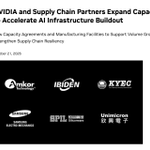



$NVDA today announces capacity agreements with substrate, packaging, testing and optical engine suppliers.
- Substrate agreements with Ibiden, Samsung Electro-Mechanics and Unimicron to expand by 2.5x
- $AMKR to increase advanced packaging capacity by more than 300% by the end of 2028, with a new $1.3B agreement
- Multibillion dollar capacity reservation advance to support Ibiden's plant in Japan
- "By 2028, production allocated to $NVDA is projected to account for a significant portion of Samsung Electro-Mechanics' total annual package substrate production capacity"
- KYEC with $1.1B capacity reservation in advance
- SPIL for optical engine capacity for CPO by 15x by H2 2027 and double that for 2028
Well, that's a lot of news. As Jensen Huang puts it: "Demand is extraordinary. Capacity is the constraint."


Yeah not sure how anyone thinks it's over on AI semis like $NVDA GPUs, memory, to photonics, after $SPCX earnings.
- Previous Q4 capex outlook ~$18.4B... Now $35–40 billion Q4 capex guidance, basically doubling previous outlook
"Q3 and Q4 capex should be similar to Q2's $18.37B" from CFO in August.
-Elon: "If everything goes right, we’ll have 20 gigawatts of incremental power next year"
"High confidence of 10 GW next year, and 20 is difficult but not impossible
- "I’m being as precise as possible about this. It is absolutely insane to be deploying and providing the power and all of the electrical equipment, the cooling, the batteries, the networking, and everything else that’s needed to turn on 220,000 GB300s a month"
You're gonna need a lot of HBM, power, networking/optical components to make all of this happen.
- Elon projects SpaceX could exit 2027 with an ARR of "$500 billion and $1 trillion by the end of 2027
When you see $SPCX double capex outlook next quarter, target another 10GW deployment by next year, and all the procurement needed to turn on 220,000 GB300's a month...
Hard not to be bullish on AI semis.

Exciting, $SIVE gets their first production orders for CW DFB lasers with LiDAR.
“We are pleased to see this strategic program advance from design-win to production”.
With opportunity for expansion given the speculated customer $AEVA is moving into CPO/NPO optical sources for hyperscalers and leveraging existing technology.
But this is great commercial validation of technology and execution so far.
That’s 1 qualification converted of many more to come, especially for AI DCs from $GFS to $JBL.


Feels like the public interpretation is all wrong…
I’m pretty sure $MSFT backing out on NScale deal is bullish for Neoclouds like $NBIS or even $IREN with energized capacity with Microsoft?
Pretend Microsoft just ate a bunch of Chipotle burittos:
- They order toilet paper delivery scheduled Q1 2027
- NScale says: sorry 3-4+ year delay of the toilet paper (into 2030’s) because of UK grid constraints
- Microsoft still urgently needs toilet paper so they will get it elsewhere
The cancellation does send warnings about what happens if a Neocloud can’t execute on contracted demand.
But that just makes the other toilet paper sellers more valuable since Microsoft will go elsewhere for supply.
Last major $SIVE disclosure was 100M CW DFB laser capacity Q4 2027. And a new foundry partner (that makes 2 including Win Semi).
Expected $JBL revenue coming in H1 2027 (with lasers for Jabil's 1.6T LRO scaling up H2 2027).
There's channel checks along the way like CIOE where Sivers was engaged with Chinese pluggable makers + laser ASPs being raised.
70mW/100mW ranges were the most tight to Chinese pluggable makers, which was surprising.
Biggest industry read through was $LITE selling out into 2029, making agreements for 2030, and having hyperscalers pay for capacity expansion for 2031.
I don't think anyone has enough information to do any sort of accurate modeling for $SIVE like you can for $AAOI given they don't release product breakdown + capacity targets by quarter.
The 200mW NPO lasers Sivers is sampling is likely different ASP than your 70mW lasers shipped to pluggable makers. And your custom CPO lasers are different pricing too.
Like all sampling/qualification players from $AEHR to $AAOI back in 2025, usually the risk/reward comes in whether qualifications convert and what new customers they have, which is always a risk.
In a bull case, if $SIVE comes online with 300m laser supply (2:1 implied ratio, already has "tremendous" supply online from likely US fab) during a structural shortage.
Pluggable players like $JBL, 6 other vendors.
$GFS as the reference design laser for their CPO/NPO platform.
Your minor players vendors like $POET, $AEVA and other players end up scaling.
And all the other custom products they hinted they were working on in the past for CPO years back.
I think the probability that they cook is higher since there's so many ongoing qualifications during a bottleneck.
We've already seen ownership changes from Swedish investors to US/International retail from $SIVE shareholder disclosures.
My guess is that trends institutional from retail before US listing next year amid the market correction.
Think people forgot institutions have already financed their expansion, which was a 700M SEK round 100%+ ago (multiple times oversubscribed).
And that $SIVE uses primarily external fabs, so it's not the same as a lot of the major financing concerns affecting Neoclouds.
Anyway, up to management execution, I'm not running Sivers so no clue what other companies are working with them now, whether it's Cambridge or some other US player like Semtec.
TLDR:
- Just need to wait for earnings for more disclosures around qualifications + partners, only so much public can guess from channel checks and supplier mapping.
Not quite the same as $LITE CEO where you can see the guy on Fox news or Bloomberg interviews every week (which is a good thing)

What about SIVE? @aleabitoreddit ? Could you please do a post on it with current views vs price action and thesis?
$LITE CEO interview on demand, counterparty + financing risk:
- "CFO of $GOOGL came on and reported capex going up Y/Y, we expect hyperscalers for report an increase in capex in earnings.
Based on what we see, we see their spend going up."
- "The purchase agreements we have, to a large degree, are noncancellable."
- The difference between Lumentum and companies like $AVGO, "we are not as dependent on AI datacenter buildout going forward"
There's a conversion between electrical products to optical products" creating structural demand.
Q: When do you see able to see yourself having more inventory? (catching up to surge in demand)
- When we look at demand, there is "no end in sight"
TLDR:
Financing risk and demand aren't equally distributed across AI supply chains. But markets are just selling everything off together.
As for photonics in specific, I said this before, but increasing optical content per XPU + CPO/NPO adoption keeps going up so we'll likely see sector spend go up, even if aggregate capex goes down.
There's the usual "no end to demand in sight" commentary, but $LITE does have capacity commitments into 2029 now... and are negotiating for 2030. (with new information that most of which are likely hyperscalers + non-cancellable)
So doesn't quite sound like it's all over for the AI trade, especially photonics.

Just some words of emotional support for your SK Hynix, $SNDK, $MU fanclub.
$DELL CEO on memory, suggested: "It's a 4 year problem because there's just not enough supply"
Factories take about 4 years to build, meaning new production would emerge 2029 or 2030.
and that semiconductor shortages could worsen in 2027 stating:
"I do think it gets worse next year in terms of demand and supply".
I think it's strange we're getting unprecedented forward visibility with memory... as $GOOGL and richest hyperscalers seek LTAs into 2035.
And a major sector crash as well over durability/financing concerns.


$GOOGL is now discussing deals to extend their memory LTAs through 2035 from KeyBanc channel checks.
Samsung already has 70% of their capacity allocated through 2031, and this move would suggest a more durable cycle for $MU, $SKHY, and the others.
They also expect HBM prices up 80% to 100% in the Q1 2027.
Having all your capacity potentially allocated out into 2035 via LTAs would ease a lot of memory durability fears.

Glad we finally got a word too from $NVDA Jensen Huang today from an event at Stockholm...
About $CRWV amid the broader Neocloud selloff.
When asked about the markets reactions to Coreweave, Jensen responded:
- "Coreweave's strength is improving every day, I'm optimistic"
- "The cost of capital is actually decreasing"
On whether Nvidia needed to provide a financial backstop:
- Jensen said he did not see a need for Nvidia to backstop CoreWeave
I'm personally not too positive about $CRWV relative to $NBIS and the others... but any copium helps from the man himself with market sentiment.


$GOOGL is now discussing deals to extend their memory LTAs through 2035 from KeyBanc channel checks.
Samsung already has 70% of their capacity allocated through 2031, and this move would suggest a more durable cycle for $MU, $SKHY, and the others.
They also expect HBM prices up 80% to 100% in the Q1 2027.
Having all your capacity potentially allocated out into 2035 via LTAs would ease a lot of memory durability fears.
$TSM released earnings today. I was more curious about commentary given recent the market panic.
For analyst Q&A rounds:
Q: Citi explicitly challenged TSMC on AI financing, HBM, CoWoS, lasers and the risk of overbuilding capacity
A: $TSM assessed CSP capex, DC construction conditions, customer financial conditions, and supply of critical components.
Management's conclusion is still that "demand exceeds supply". As well as that AI accelerator revenue growth could exceed its previous 50%+ CAGR projection through 2029.
This is a more meaningful statement since it addresses some concerns regarding recent selloff.
Q: JPM asked if wafer supply could be tighter in 2027 than in 2026 (demand visibility)
A: Wei (Chairman/CEO) stated $TSM even sends staff to verify DC construction progress on site. And after assessing all the factors, TSMC believes gap between supply and demand remains substantial.
It could not determine whether the extent of the gap given customers continues to increase demand.
Q: On pricing power:
A: Wei responded that there is "no ceiling on TSMC's profitability" but that profits will not surge dramatically overnight.
(Source: NextApple, Taiwanese press)
Regarding earnings, very strong: as usual
- TSMC record profits of $23.6B (68% Y/Y growth), and revenue jumping to $46.72B, beating expectations.
- Q4 Guidance was $52.3-$54.3B revenue off 65-67% gross margins.
TLDR:
- No signs of any slowdown or collapse as AI demand far exceeds supply for foreseeable future. $TSM is probably the fundamental proxy/canary to how the overall AI semi trade is doing.
- On financing concerns and fear of overcapacity showing up in semiconductor demand:
$TSM specifically examined the risks investors are concerned about now and assessment still points to unmet demand.
During the Q&A session, Wei said AI demand was "very, extremely strong," with absolutely no signs of slowing.
Underlying AI semi supply chain growth is healthier than recent market panic suggest.

It's interesting to see Elon interacting with finance X accounts out of the blue.
Then amplifying $CRWV financing concerns, Chinese memory flooding, to AI investors being gamblers recently.
With $SPCX and $TSLA, I do think Elon is a visionary but from how it looks from the outside...
Amplifying concerns about competitors does make their financing more difficult as a self-fulfilling prophecy.
And multiple posts about Chinese memory flooding after calling Samsung/SK Hynix pricing extortion does harm these supplier valuations...
The economic incentives of doing so probably benefits Tesla/SpaceX more in the long run, even if everything goes down together.
There's merit to a lot of things (I've been voicing Coreweave concerns about debt interest + rate hikes for the longest time...).
But much like high end memory flooding to nuances of "No crying in a Casino" when the $AVGO CEO comments were regarding OpenAI ARR datapoints... were missed.
You can throw rocks at others when a glass house is propped up by passive index flows

Guess like we found out why Elon has been going on a crusade against memory in his recent posts.
$SKHY and Samsung have been price hiking memory too much?

$AGLT (Agility Robotics) has cleared SEC review for public listing through $CCXI
If you want an estimate timeline:
~Oct 13 (today): SEC S-4 declared effective
~Nov 2nd (shareholder vote): for merger approval
~November: Merger closing and ticker goes live for trading.
Company’s official statement was:
“The business combination remains subject to approval by Churchill XI shareholders and other customary closing conditions, and is expected to close in November 2026.”
So likely less than a month away for the first pure play US humanoid company to go live!


One step closer to Nasdaq: the SEC has declared effective our Form S-4 for the proposed business combination with Churchill Capital Corp XI (Nasdaq: CCXI).
Expected ticker: AGLT
Read the announcement: agilityrobotics.com/content/…

Physical AI + Humanoids are the next progression of AI.
$NVDA CES 2025 projections and Elon's prediction on $TSLA + 1 Billion humanoids in the next decade, seems to be speeding up.
New statement from Unitree CEO after testing GPT-6 on their humanoid program was that:
- In August, before GPT-6's release, Wang said the industry could take two to three years at its fastest pace, or as long as a decade, to reach its "ChatGPT moment"
- Now, OpenAI's GPT-6 model prompted expectations that a breakthrough could happen "within 1 or 2 years"
- He defined that moment as robots being able to complete around 80 per cent of tasks in 80 per cent of unfamiliar environments using voice or text commands.
- "It's possible that, say, a GPT-7 model released next year could directly crack the problems of embodied intelligence"
- "The whole embodied intelligence industry has been shaken up after the release of GPT-6"
Just looking at some benchmarks on robotic hand manipulation, "On the bowl task Astra placed the block in 19 of 20 trials, against Fable 5.1's 8 of 20".
But for the puzzle task "Astra completed the insertion 2 times in 20 against Fable 5.1's 2 in 20"".. so we're getting there.
But going from 2-3 years (potentially to a decade), and compressing that down to 1 or 2 years (to achieve 80%+ of tasks in unfamiliar environemnts) is a significant change in outlook.


So spent some more time to look at more DBS conference material:
- "Two semiconductor giants, $AVGO and $INTC, both stated that breakthroughs in AI will keep demand for chip investment elevated for at least another 2 years. As current supply is insufficient to meet market demand."
- "Current chip production capacity is already far from sufficient to meet demand, and $AVGO CEO expects the shortage to become even more severe in the future." (HKEJ)
- "Regarding OpenAI, Hock Tan stated that the market had misinterpreted the company because its underlying fundamentals remained strong.
He argued that investors who sell based on a single short-term data point [$50B ARR] are "essentially no different from people gambling in a casino." (eg. Hong Kong Economic Journal):
- Commenting on investors' disappointment in OpenAI’s latest revenue forecast: "by itself, not that bad" on their $50B ARR. (Business Times)
And connected investors' disappointment to a failure to understand the business and excessive expectations like a casino.
- Tan rejected the proposition that OpenAI was overvalued. It quotes him saying:
"It’s almost like they are in a casino gambling" in regards to investors' unrealistic expectations and lack of understanding on OpenAI.
- Hock Tan if OpenAI and Anthropic achieve widespread market adoption: their attractiveness would substantially strengthen their bargaining power when raising capital.
But cautioned elevated global interest rates could make capital requirements a constraint for future growth.
- The real driver, he said, is whether frontier AI companies can create models that generate enough value and returns to justify the buildout. (which is fair)
- Most companies are wasting money on tokens. He also warned that most companies just waste money spending tokens like kids in a video arcade.
This part was the most badly worded by Hock Tan given he's running $AVGO.
But Western media commentary narrowed this down to:
- "Shortage of capital now, AI Investors are gamblers".
In the conference, Broadcom's CEO was actually defending frontier lab valuations and giving cautiously bullish statements about AI infrastructure demand.
While citing rising interest rates as a potential constraint that larger revenue or adoption could overcome.
Cherry picking quotes out of context disorts the actual messaging.
TLDR:
- Large and elevated AI semi demand, semi supply insufficient to meet market demand. At least another 2 years of elevated spend
- OpenAI valuations defensible, people who sell based on extreme expectations for the company are like casino gamblers.
- Tan stated markets had misinterpreted OpenAI's ARR because its underlying fundamentals remained strong.
- Frontier labs if they achieve widespread adoption / revenue would strengthen capital raising, which overpower headwinds from raising interest rates.
Lot of $AVGO CEO remarks looks heavily nuanced, which Western media coverage distored.


