

Founder of @Bitcoinreach #Bitcoin Magazine Contributor @rootstock_io ambassador #bitcoin Maximalist #psychopathic Remanent. I don’t offer any financial advice
Bulawayo, Zimbabwe
Joined November 2016
- Tweets10.8K
- Following3.7K
- Followers7K
- Likes44K





Pinned Tweet
Happy Africa #Bitcoin day from Zimbabwe 🇿🇼. – at Bulawayo, Zimbabwe


Alexandria The Great 🌋⛏ retweeted

If this was a black African girl step-dancing in 🇮🇪Ireland, Irish people would never call her a "daughter of the soil." One of the most infuriating things about black Africans is how welcoming & open we are to people who would never return that same warmth.

Account abstraction can make Rootstock transactions feel less like managing keys and more like using an app. Programmable wallets can enable gas sponsorship, batched actions and custom spending rules, reducing friction for everyday Bitcoin finance.

Account abstraction lands on Rootstock with Cardamom.
🔗 rootstock.io/blog/rootstock-…
Before you start signing, here’s the one thing @SDLerner and Shreemoy want you to know,
30-second blocks mean Rootstock can process activity in parallel with Bitcoin’s 10-minute block cycle. That’s 20 Rootstock blocks per Bitcoin block, enabling faster confirmations and more responsive BTCFi applications.

What if a smart contract could come with verifiable proof of how it was deployed? 👀
That’s one use case for @rootstock_io Attestations.
Instead of relying only on claims, developers can create on-chain records that others can independently inspect.
Let’s break it down.

It goes beyond deployment records.
Attestations can also support claims about contract verification or token transfers.
Applications can then use this information to build richer verification flows instead of treating every claim as equally trustworthy.
Imagine deploying a DeFi protocol on Rootstock.
You could create an attestation recording details like the contract address, deployer and transaction.
That gives users and other developers a way to check the deployment record on-chain.
Alexandria The Great 🌋⛏ retweeted

No one can convince me that black South Africans don't have the lowest average IQ on the continent.
Perhaps we blamed the Boers too harshly for apartheid. How can you coexist with such individuals?

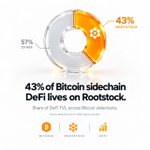
So @Rootstock_io just shared a number worth a look: 43% of DeFi TVL across Bitcoin sidechains sits on Rootstock, per DefiLlama as of Oct 21.
That's more than any other single Bitcoin sidechain. The other 57% is split between all of them.

Their explanation is longevity. Rootstock has been live since 2018 and says it has had 100% uptime. It's secured by Bitcoin's proof of work through merged mining.
In DeFi, people tend to put money where nothing has broken yet.
Alexandria The Great 🌋⛏ retweeted

Account abstraction lands on Rootstock with Cardamom.
🔗 rootstock.io/blog/rootstock-…
Before you start signing, here’s the one thing @SDLerner and Shreemoy want you to know,
LABITCONF brings together 300 international speakers and has drawn 10,000 attendees. 🇦🇷 For @rootstock_io, it’s an opportunity to showcase Bitcoin-native DeFi, connect with developers, and show how Bitcoin can power financial applications beyond payments.


Bitcoin’s block subsidy fell from 25 BTC in 2012 to 3.125 BTC in 2024. Yet at each halving’s approximate BTC price, the new block subsidy was worth $309, $8,137, $53,569 and $199,500, respectively. Fewer coins, vastly higher dollar value.
Fiat supply is decided in meetings. Bitcoin’s was decided in 2009.
Every 210,000 blocks, the reward miners earn for a new block is cut in half. The next cut is in 2028, and everyone already knows the number: 1.5625 bitcoin:native.
Over 20 million of the 21 million bitcoin are already mined.
The last fraction won’t be mined until around 2140.

Foundry, AntPool, F2Pool, ViaBTC and Luxor. These aren’t obscure miners. Pools representing 83.96% of Bitcoin’s hashrate also merge-mine Rootstock, with some operating at or near 100%. That’s a powerful connection to Bitcoin’s existing mining infrastructure.

How do Bitcoin miners secure @rootstock_io without buying extra hardware? Both chains use the same double SHA-256 proof of work, so one piece of hashing work can count for both.

The pool adds a commitment to the Rootstock block inside the Bitcoin job. Rootstock's difficulty is lower, so any solution that meets Bitcoin's also meets Rootstock's. The miner submits a proof to a Rootstock node and earns fees on top.
Quick one: where does $rBTC on @rootstock_io come from? All 21M rBTC exists from day one. Nothing gets minted when you bridge.
