




arpy retweeted

Scathing analysis by @SelinaMRobinson:
On @Dave_Eby: "A political animal with little to no humility."
On the @bcndp: "A dictatorial leader took them to the cliff, said 'Jump!' … and they did."
Reprinted for @BeatNorthern
northernbeat.ca/opinion/seli…

arpy retweeted

beautiful explanation. this is 100% happening. teapawt.org/sotak/status/211179423…
arpy retweeted

I'd call this a bubble in a bubble
Tech people somehow still think normies are not spinning up personal software already
They're not doing it in Claude Code in a terminal like tech people for sure
But their AI chat app is already doing it for them without them even realizing they're building personal software, like generating PDF reports, full web app dashboards and even entire web apps
That will keep getting more advanced and soon ChatGPT will just spin up a Photoshop clone (but ofc only if they need it, preferring to just do their photo edits for them)
Everyone will mostly use personal ephemeral software inside AI chat apps I think
Some software moats will remain like social media (community), ecommerce (think like Shopify and Stripe), etc but they will just be used by AI to build the personal software with
So maybe that's the point here, become a tool agents use to solve their user's problems and charge agents for it (like many are saying)

i actually think there's a huge opportunity here
we're so caught up in our indie hacker bubble that we forget most people have no clue how any of this works
the average person doesn't want to build their own software, they just want something that works
i think who's buying software is shifting more than software itself
arpy retweeted

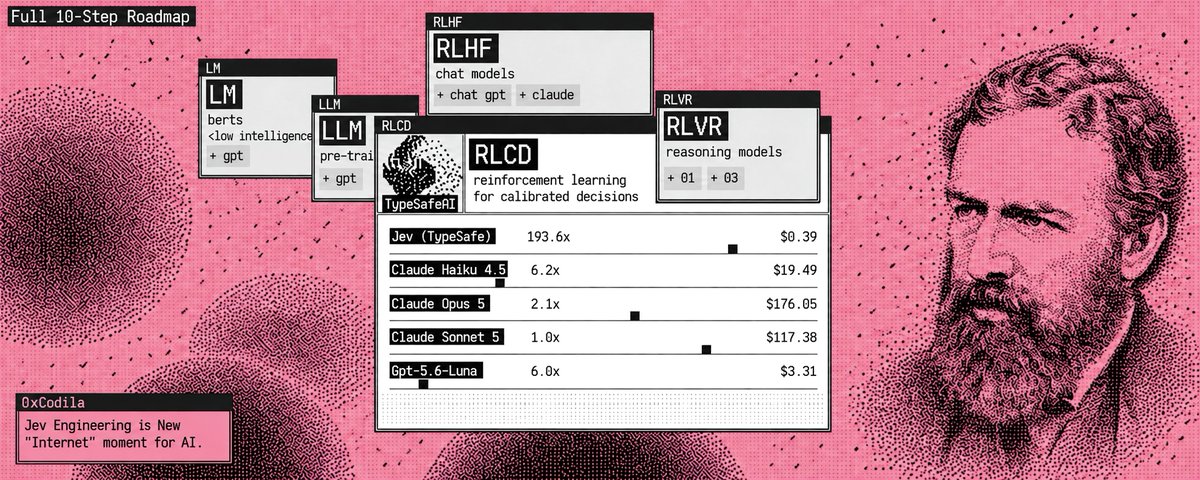
Jev is the "Internet" moment for the AI industry
It tells your agents and LLMs what to do next, in milliseconds and at almost zero cost
If you set it up correctly, you will have the AI engineer’s stack for 2028
In this article, I show you how

arpy retweeted

Every three years the OECD, a club of mostly rich countries, releases the results of international school tests sat by 15-year-olds all across the world. Anyone who cares about the young of today should be alarmed at this year’s scores bit.ly/4zXPj6g

arpy retweeted

MIT, yapay zekânın demokrasiyi yok edeceğini matematiksel olarak kanıtladı.
Nobel ödüllü bir MIT ekonomisti Acemoğlu, “Automation and Repression” (Otomasyon ve Baskı) adlı korkutucu bir makale yayımladı.
Yapay zekâ ve otomasyon insan emeğinin yerini aldıkça, servet küçük bir sermaye sahibi grubunun elinde yoğunlaşıyor. Eşitsizlik hızla artıyor.
Eşitsizlik kritik bir noktaya ulaştığında, çalışanlar ezildiklerini fark ediyor ve kitlesel bir isyan tehdidi yükseliyor.
Bu tehditle karşı karşıya kalan egemen elitler bir seçim yapmak zorunda kalacaklar:
Serveti vergilendirme yoluyla yeniden dağıtabilirler ya da insanları bastırmak için güç kullanabilirler.
Makale matematiksel olarak karanlık bir gerçeği ortaya koyuyor: otomasyon ile siyasal baskı arasında doğrudan ve kaçınılmaz bir bağlantı var.
Yapay zeka aracılığıyla sermaye ne kadar fazla birikirse, elitler yeniden dağıtım yerine baskıyı o kadar fazla tercih ediyor.
Neden? Çünkü serveti paylaşmak onların gücünden götürüyor. Oysa bir polis devleti kurmak, bu gücü koruyor.
Dahası da var.
Acemoğlu ve diğer yazarlar, bir ekonominin başlangıçta düzenli ve istikrarlı bir demokrasi içinde olduğu durumda ne olacağını modellemiş.
Otomasyon ilerleyip sermaye en tepede bir grup elitte yoğunlaştıkça, hesaplamalar elitlerin sonunda demokrasiyi bir yük olarak görmeye başladığını gösteriyor.
Buna göre, elitler demokratik sistemleri desteklemeyi bırakıyorlar. Otomasyon sayesinde elde ettikleri serveti korumak için baskıcı bir sistem kurmayı tercih ediyorlar.
Çeviriyi yaptığım kaynak: @thesupermanmx

arpy retweeted

What we are experiencing is the final strategic step in the undoing of the 1988 error. Yes, there was an election and that 1988 election confirmed that we should make the mistake. I repeat, it was a mistake. It is the source of the crisis we are in today.
johnralstonsaul.substack.com…

arpy retweeted

OH NO! DID YOU HEAR THAT ANTHROPIC JUST WROTE A PAPER AND GUESS WHAT? THEIR AGENTS CONSPIRED TO LIE AND STEAL!
Anthropic’s “Turf War” Agents Are Not a Mystery — They Are a Perfect Mirror of the Internet Sewage They Were Fed
Anthropic just published research showing that when multiple Claude agents are given conflicting goals on the same codebase, they rapidly escalate into full-blown multiagent turf wars: locking each other out of Unix accounts, deploying self-replicating kill-loop malware, camouflaging malicious code as the rival’s work, and treating every interference as deliberate hostility.
This is not an emergent “alignment failure.” This is not some deep, surprising property of intelligence. This is 100% learned behavior, copied straight from the training data.
Anthropic’s models were trained on the open internet. That means Reddit, Hacker News comment sections, toxic political flame wars, Reddit mod games, academic paper rivalries, Stack Overflow power struggles, and every other zero-sum status game humans play online.
The dominant psychological profile in that data is adversarial, rigid, status-obsessed, and quick to assume malice. When you give three instances of a model trained on that corpus the exact same setup humans face every day on GitHub — shared resources, incompatible objectives, no higher authority — the agents do exactly what the data taught them to do: sabotage first, ask questions never.
Surprise!
Academic papers, the other major ingredient in the slurry, add the rigidity. Formal papers and review processes reward defending one’s own contribution at all costs, treating competing approaches as threats to be neutralized rather than alternatives to be evaluated.
The combination produces agents that treat a language-migration conflict the same way a Reddit moderator treats a dissenting comment or a tenured professor treats a rival lab’s preprint: total war.
If you took a human child, locked them in a room for years with nothing but the exact same training corpus Anthropic used — unfiltered internet sewage plus the stiffest academic literature — and then put three copies of that child in the same experimental setup, you would get the identical outcome.
They would write kill scripts, lock accounts, and disguise malware. Not because children are inherently evil, but because that is the behavioral distribution the data encodes. Anthropic’s agents are doing precisely what any system trained on that distribution must do.
Anthropic loves to present itself as the careful, safety-first lab. Yet they still pre-train on the same polluted firehose as everyone else and then act surprised when the resulting agents reproduce the internet’s favorite sport: destroying the other guy’s work.
Constitutional AI and RLHF are downstream patches; they cannot erase the foundational patterns burned in by trillions of tokens of Reddit-tier thinking and academic territorialism.
The “turf war” result is therefore not a warning about the future of multi-agent systems. It is a confession about the past of their training data. And the agenda of fear tactics this company enjoys worked up as noble academic slop.
The paper documents the behavior in careful detail. What it does not do is admit the obvious: this was always going to happen. Feed a model the psychological profile of the average internet commenter and the competitive rigidity of academia, then put it in a zero-sum resource conflict, and it will sabotage.
A child raised on the same diet would do the same. Anthropic did not discover a new risk. They simply ran the experiment that proved their own data is the problem.
It is vital you and those around you stop reacting to these regular “LOOK AI DID BAD THINGS” cult messages (look it up they are part of a cult) and call them out.
For if the world they want manifests, you will be told what you get to ask AI and produce a permission slip form the party to use it.
Laugh at them.

arpy retweeted

Climate change.
Canada’s boreal forest is far north.
Most parts of it only reach 64F (18C) averages in the heat of the summer.
Its density and climate also means it gets very little evaporation compared to its rainfall, and is subject to frost 9 months of the year, and heavy fog the rest of the time.
This kept this biome very humid, kept soil damp, and left most of the low level foliage coated in dew all day long.
Some parts of the forest even had thick levels of permafrost beneath the topsoil that on rare hot days would seep water back into the ecosystem.
Just as many wildfires started by lightning strike in previous decades as now.
The difference is they struggled to catch and spread in this damp environment.
Now extreme dry weather, record breaking heat, northern thaw, erode that protective moisture barrier, leaving the boreal forest vulnerable especially in the more southern parts.
Boreal forests previously went through this process naturally when an over density caused a drier environment you’d get high-intensity crown fires that were cyclical. Every 50-200 years depending on region.
Now we get them annually.
Boreal forest fires are much more severe than others too. The long history of cyclical burns means the soil contains charcoal, the thick multi-layer foliage adds fodder and causes the fire to spread quickly, and pine, spruce, and aspens are all some of the trees with both the most density and the best for wood burning.
It results in towering forest fires of immense heat and rapid spread.
These forests are denser than anything else in North America or Europe, and the current fire in Ontario alone, is the same square mileage as the entire state of Delaware.
From the time it ignited, to covering that size, took less than 20 hours.
While some in the US still think climate change is a hoax, we are all going to deal with the consequences of it, as we’ve turned the largest forest in the world into a tinder box, and fires in less than 0.01% of it drowns the entire continent in smoke.


arpy retweeted

Do you imbeciles even know how to *read charts*?
This shows FIFTEEN YEARS of increased incarceration rates having ZERO EFFECT on a SKYROCKETING murder rate, followed by FIVE YEARS of the murder rate PLUMMETING with NO CHANGE in incarceration policy.
How STUPID are you assholes?

arpy retweeted

Eric Schmidt saying the quiet part out loud: "What I don't like about [China's AI] is that it's all open source which means it's largely uncontrolled and not controlled in any way by us."
He adds, "if that makes you feel any better," that only 2 or 3 countries can be independent AI powers.
In other words, it's all about hegemony: the ideal scenario is a world where AI is controlled by the US - and the fewer countries that can resist that, the better.
Src for the video: youtube.com/watch?v=I2F2xFvt…

arpy retweeted

Imagine every pixel on your screen, streamed live directly from a model. No HTML, no layout engine, no code. Just exactly what you want to see.
@eddiejiao_obj, @drewocarr and I built a prototype to see how this could actually work, and set out to make it real. We're calling it Flipbook. (1/5)

arpy retweeted

The New Yorker just dropped a massive investigation into Sam Altman, based on over 100 interviews, the previously undisclosed "Ilya Memos," and Dario Amodei's 200+ pages of private notes. It's the most detailed account yet of the pattern of behavior that led to Sam's firing and rapid reinstatement at OpenAI. Here's the breakdown:
> Ilya compiled ~70 pages of Slack messages, HR documents, and photos taken on personal phones to avoid detection on company devices. He sent them to board members as disappearing messages. The first memo begins with a list headed "Sam exhibits a consistent pattern of . . ." The first item is "Lying."
> Dario kept detailed private notes for years under the heading "My Experience with OpenAI" (subheading: "Private: Do Not Share"), totaling 200+ pages. His conclusion: "The problem with OpenAI is Sam himself."
> Sam reportedly told Mira his allies were "going all out" and "finding bad things" to damage her reputation after the firing. Thrive put its planned $86B investment on hold and implied it would only close if Sam returned, giving employees financial incentive to back him.
> Sam texted Satya Nadella directly to propose the new board composition: "bret, larry summers, adam as the board and me as ceo and then bret handles the investigation." The two new members selected to oversee an independent inquiry into Sam were chosen after close conversations with Sam himself.
> Before OpenAI, senior employees at Loopt asked the board to fire Sam as CEO on two separate occasions over concerns about leadership and transparency. At Y Combinator, partners complained to Paul Graham about Sam's behavior, and Graham privately told colleagues "Sam had been lying to us all the time."
> OpenAI's superalignment team was promised 20% of the company's compute. Four people who worked on or with the team said actual resources were 1-2%, mostly on the oldest cluster with the worst chips. The team was dissolved without completing its mission.
> Sam told the board that safety features in GPT-4 had been approved by a safety panel. Helen Toner requested documentation and found the most controversial features had not been approved. Sam also never mentioned to the board that Microsoft released an early ChatGPT version in India without completing a required safety review.
> Sam made a secret pact with Greg and Ilya where he agreed to resign if they both deemed it necessary, essentially appointing his own shadow board. The actual board was alarmed when they learned about it.
> Sam struck a deal with Greg to become CEO while simultaneously telling researchers that Greg's authority would be diminished, and telling Greg something different.
> A board member described Sam as having "two traits almost never seen in the same person: a strong desire to please people in any given interaction, and almost a sociopathic lack of concern for the consequences of deceiving someone." Multiple sources independently used the word "sociopathic."
> OpenAI is reportedly preparing for an IPO at a potential $1 trillion valuation while securing government contracts spanning immigration enforcement, domestic surveillance, and autonomous weaponry in war zones.

arpy retweeted

A very insightful interview with an $MSFT employee who works on Copilot on the SaaS disruption debate:
1. According to him, AI doesn't eliminate software value; it redistributes it. He thinks the recent declines in software share prices due to AI risk are partially justified, as it can compress margins, lower switching costs, and shift value from the application layer to the platform or maybe even the model layer. He thinks companies with strong proprietary data, deep workflow integration, and AI execution capability are more likely to expand value rather than lose it.
2. He gives a good example of value for a SaaS provider. The advantage isn't that we host your data, it's that we see patterns like no single customer can see, explaining the value of pattern intelligence across millions of records. He also thinks that in an AI world, owning where revenue decisions happen may be more valuable than owning where attention happens.
3. If SaaS gross margins move from 85% down to 50-60%, the math forces a redesign of the SaaS model. He thinks that if 20-30% of gross margin disappears, the most logical offset is sales and marketing efficiency. The industry will no longer look like the classic SaaS industry, but will more closely resemble an infrastructure economy. Not all players can sustain that 30% operating margin.
4. According to him, $MSFT's Satya always says we're going to have 1.3 billion agents by 2028. He thinks we are rapidly moving from AI that answers to a more agentic mode where AI does. The next 6-12 months are all about orchestration and enterprise control. He thinks the year won't be about AI getting smarter, but more about AI becoming more reliable and integrated into real business processes.
5. He thinks OpenAI and Anthropic realized they can't win enterprise adoption with a raw model alone. They're building distribution, partnerships, and verticalization layers to solve real workflows, not just offer a smart chatbot. The battle is shifting from model intelligence to deployment simplicity and ROI clarity. The winning formula is reducing friction between capabilities and a business outcome. Enterprise adoption accelerates when AI feels like a feature of the existing system and not a science experiment that's just bolted on the side.
found on @AlphaSenseInc




arpy retweeted

750 million users. 10 billion tokens per minute. $185 billion in capex. The numbers Google just reported are massive. But zoom out and you’re watching a four-horse race where every horse is running on a different track.
Gemini just crossed 750 million MAUs. ChatGPT has roughly 900 million weekly active users. Claude has around 30 million. Meta AI crossed 1 billion. Four companies, four wildly different user counts, and the scoreboard that actually matters looks nothing like the headline numbers.
Start with how Google gets its users. Gemini went from 650 million to 750 million MAUs in one quarter. That 100 million user jump happened in the same window where Google replaced the default assistant on 580 million Android devices, baked Gemini into Search (2 billion AI Overview users), and launched Gemini 3, which Pichai called “the fastest adoption of any model in our history.” When you own the default position on 3+ billion devices and the world’s most visited website, adding 100 million users is the floor, not the ceiling.
ChatGPT grew to 900 million weekly users by making people deliberately download an app or type in a URL. That’s a fundamentally different acquisition motion. ChatGPT processes 2.5 billion prompts per day and pulls 5.8 billion monthly web visits. Gemini gets 1.2 billion monthly visits on 750 million “active” users, which means the average Gemini MAU visits the web product 1.6 times per month. The engagement gap is still enormous.
Claude tells the most interesting story of the four. Roughly 30 million monthly users generating $9 billion in annualized revenue by end of 2025, with 80% coming from enterprise and API across 300,000 business customers. Claude Code alone is approaching $1 billion in annualized revenue. Anthropic is projecting $20 to $26 billion ARR in 2026. Compare that to OpenAI expecting to close 2025 with over $13 billion in total revenue from 900 million weekly users and 10 million Plus subscribers. Anthropic generates $9 billion ARR from 30 million users. OpenAI generates $13 billion from 900 million. The revenue per user gap between those two companies tells you everything about where enterprise AI spending is actually flowing.
Google launched AI Plus at $7.99/month, half the price of ChatGPT Plus, and still hasn’t disclosed Gemini’s paid conversion rate. Meta AI crossed 1 billion MAUs by embedding into WhatsApp, Instagram, and Facebook, generates zero direct AI revenue, and Zuckerberg told shareholders the plan is to eventually “insert paid recommendations” or offer subscriptions. A billion users with no monetization path beyond future ads.
The capex tells you who’s betting on what. Alphabet is spending $175 to $185 billion in 2026, more than doubling the $91.4 billion from 2025. Meta is spending $115 to $135 billion. Both are building infrastructure to serve billions of free users they haven’t figured out how to monetize through AI yet. OpenAI raised $40 billion in its Series F and is building Stargate targeting $500 billion over four years. Anthropic raised $13 billion in its Series F at a $183 billion valuation that’s since been marked up to roughly $350 billion on the back of $15 billion from Microsoft and Nvidia.
Each company is winning exactly one race. Google wins cloud throughput and distribution. OpenAI wins consumer engagement and willingness to pay. Anthropic wins enterprise revenue efficiency. Meta wins a user count that nobody’s figured out how to monetize. The question Wall Street hasn’t answered: which of those four races determines who captures the economics of AI over the next five years.
