
🩺 Radiologist | 🇮🇳 India lover | 🛑 Unapologetic Indian civic sense critic. I post mostly on civic sense , Process improvements and Urban Infra
Joined May 2011
- Tweets252
- Following63
- Followers23
- Likes106







A petition to approve Heavy Metro for Coimbatore .Your endorsement (by way of signature) will go a long way !
change.org/Metro_For_Coimbat…
Similar cities have got Metro .
Center has got it wrong with outdated 2011 data . An industrial hub like Coimbatore deserves Metro . Do sign !
#CoimbatoreMetro #Coimbatore #CMRL @MoHUA_India @CMOTamilnadu @cmrlofficial @simplicitycbe

Stop Using 2011 Data to Block Coimbatore's Metro! Approve the Metro Now! - Sign the Petition! c.org/QZKYjqdvMS via @ChangeOrg_India

19
Should we be proud of Indian Railways now ? Definitely yes
Should we be ashamed of erstwhile Railways before 2014 ? Definitely no
Those are the parents , this is the child .
I am sure we are not ashamed of our parents 😀 just because they didn’t know as much as we might today . We are what we are because of them .
No offence meant but we take old things too much for granted . Nothing comes out of the air .
That said our railways are improving at a rapid rate . But still a long way to go before we catch up with countries like Switzerland .
Looking forward !

106


The walkable city - Zero cost cure for India's health crisis
There is an easy, zero-cost way to make the average Indian healthy - make him or her to walk .
Unfortunately our cities are not meant to be walked . They either do not have pavements or if there are pavements, they will be encroached .
European cities are highly walkable . And that is because of the way they are designed .Most European layouts fall into four design patterns:
* The medieval layout - Disorganized but narrow streets allow only walking . Eg Venice , Florence etc
* The Radial grid- There is a central core from where spokes ( streets ) go out . Concentric Circular ring roads called boulevards (in Paris for eg) connect the spokes and its easy to walk to any place without going to the center
* Gridiron or American style grid - The newer cities like Barcelona use this . So there will be linear blocks which are connected to each other. Easy to walk.
* Linear Ribbons - where cities grow in a straight continous line for eg Genoa . A single tram or metro runs like a spine and residents can walk from any transit station
Most cities also use the 15 minute concept - All essential needs like groceries , schools and parks are within a 15 minute walk .
In fact many traditional streets are converted into pedestrian only zones forcing one to walk.
🇮🇳 Can we do this in India ?
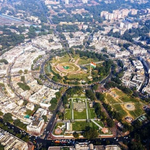
Yes. We have an example in Connaught Place in New Delhi which is designed in a radial grid pattern around the Central park .
Seven major radial roads act as the spokes .These radial roads are connected by three concentric rings - The inner , middle and Outer ( Connaught Circus ) circles .
So that makes it easily walkable , right ? Wrong .
The inner and middle circles are treated like open air parking lots .
The Radial roads like Janpath and Parliament street have fast moving traffic and absence of pedestrian first concept makes it risky to walk .
So the infra is there but systems are not .
And this can be corrected . How ? Systemic fixes .
By sending the parked cars to the outer ring , making inner circle pedestrian only - no cars , and creating pedestrian crossing on the radial roads.
How can we create walkable spaces in cities that do not have this design and are chaotic ?
* Implement Barcelona's Superblock model . Group existing neighbourshoods into a 3 x 3 block clusters . Heavy traffic like buses and fast vehicles like cars are forced to use only the outside of the block . Inner streets are restricted to residents and slow moving vehicles .
* Regulate parking .We can regulate randomly parked cars and allow them to park only on parking zones or multilevel parking garages on the periphery of a commercial or residental zone.
* Table top pedestrian crossing .Raise the pedestrian crossing to the level of the pavement acting as a massive speed bump . Vehicles will be forced to slow down.
* De encroach pavements . Create Vendor zones . Essentially what Bengaluru is doing right now .
We are lacking in what is called tactical urbanism and retrofitting . Basically make low cost changes in existing spaces .
Give preference to pedestrians . Not to vehicles!
Images show
1. Connaught place with the radial grid design
2. Barcelona superblocks
3. Table top pedestrian crossing
#UrbanDevelopment #StreetsForPeople
@MoHUA_India @CMOTamilnadu


2
210
The one thing that was an eye catcher to me in Europe was the way the Railway stations are designed .
In Paris for eg they call the various platform groups as Halls .
So Hall 1 would contain a few platforms and Hall 2 few more and so on .
One striking thing in all the Railway stations which I saw was how there were no shops on the platforms .
Trains would come in - wait few minutes even if it was a terminal station - and start off to the next destination .
Shops of all kinds were in the common concourse from where the platforms could be reached .
I was wondering if we had these type of stations in India and was pleasantly surprised when I read about the Rani Kamalapati Railway Station in Bhopal . This is a Public private partnership model.
It has airport style air-conditioned concourses , declutterred platforms , plush lounges and Dedicated retail outlets separate from the platforms .
If we could get one right , how difficult is it to get more?
#Infra #RailwayStation @RailMinIndia

SC is actually correct about the stress of an additional language on students when introduced in 9 th .
Going one step further why even from the 6 th ?
Why can’t there be an option for interested students to choose to study a third language instead of making three languages mandatory for all students .
Why impose it upon kids ?
Instead they can be taught civic sense as a subject . That will help the country more in the long run than a third language .
In fact not optional . Make civic sense mandatory as a subject .

This is heart warming .
But process reforms are exactly what is the need of the moment .
RTO is a one time thing but there are many industries when periodic inspection are required .
These officials will get back at that time .
No one will feel like complaining at that time because they would just want their job done .
Process reforms need to be done .
The reason why MSMEs find it difficult is precisely because of so much requirements .
Licenses take months to get approved and do so only after bribe.
It’s nice to see an official explicitly say tho Do not pay any money to anyone .
Great going !

My Experience with the RTO: Today vs. 8 Years Ago
It was 1996 when the Tamil movie Indian was released. It focused heavily on the deep-rooted corruption within RTO (Regional Transport Office) offices in Tamil Nadu. The movie was supposed to sound the alarm and raise public awareness to help reduce corruption. Instead, bribery became more normalized than ever before. For the past 30 years, it felt like only middlemen could walk into an RTO and actually get anything done.
In 2018, when we moved back to India from the US, I had a naive mindset and a strong will not to pay bribes. I had purchased a used tractor for agricultural use. Despite having all the proper paperwork, I had to make at least a dozen trips to the RTO office, spending several months waiting before I finally succeeded. I made it my mission to persist and win. I did eventually succeed in registering the vehicle, but it came at a heavy cost to my time and emotional well-being. At the end of the grueling process, the assistant to the RTO laughed as he signed the papers and asked me to at least buy a flag for ₹50.
Since then, I evolved into a "normal" Tamilian because survival comes first. Bribes had simply become a normalized part of life.
Even after the 2026 election results and @TVKVijayHQ public stance against bribery, I still didn't voluntarily choose to go to the RTO office myself this time.
However, I went today because a middleman told me, "Sir, please go yourself, as middlemen are no longer encouraged inside the offices." To my surprise, I walked in alone with the paperwork from my dealership. The entire process took two and a half hours. All of the staff members were courteous, except for the brake inspector. He reminded me of the movie Indian—he easily could have worn me down, but I persisted, driven by the hope given to us by our CM, @TVKVijayHQ sir.
What gave me real hope, though, was the RTO officer himself. As he signed the papers, he explicitly told us, "You will be given a username and password to pay online. Please do not pay any money to anyone else." I never imagined I would hear those words inside an RTO office in my lifetime.
Today, I got the work done with absolutely zero bribes. A huge thanks to Thiru. Vijay Avl and the people for electing him as our CM.
I will write a separate post soon detailing where process reforms are still required based on my experience. Many British-era rules still exist; changing them will reduce corruption to an even greater extent.
@raavanamavan7 @CMOTamilnadu @VigneshTvkCbe @arunraajkg @BussyAnand @RameshOffcl @makkal_saatchi
1
91
Metro Rail - Who gets it and Who doesn't and Coimbatore's 15 year wait
Some massive growth industrial tier 2 cities with higher GDP and population - No metro
Some other tier 2 cities with lower GDP and population - Have metro
Somethings off.
And thats because of an outdated policy of 2017.
Lets see how a metro gets approved .
States submit a DPR ( Detailed Project Report ). Center decides if metros are needed based on its 2017 policy . TN submitted a DPR for coimbatore metro in 2025 which was rejected based on this policy.
Now lets see how an outdated policy can affect a growing Industrial city like Coimbatore
15 year old census mismatch
Center approves metro for cities only with population of more than 20 lakhs - based on the 2011 census . Taken 15 years back.
Coimbatore actually has a metropolitan population of around 31-34 lakhs today and there is constant influx of migrants.
Also Coimbatore's urban population in 2011 was already around 21.4 lakhs, above the 20 lakh mark. The 15.84 lakh figure quoted might have been the corporation limit.
The single direction misunderstanding
The policy requires 15000-30000 users in one peak hour in one direction . The Policy assumes travel in one direction- from suburbs to center- for eg like Mumbai .
This doesn't work in Coimbatore . Coimbatore has growth across multiple areas . So peak traffic cannot happen in just one direction . Happens radially in multiple directions. People don't just travel from the suburbs to the city in one direction
The metrolite short term solution
Center suggested Metrolite based on the policy.
While Metro is the full shebang -Multiple coaches, Stations and tracks above ,on and below ground -Metrolite is Just 3 coaches at one time and on the ground . Costs 40 % of metro with travel speeds of 60 km/h.
10 years down the lane the metrolite will be a liability . Making it difficult to upgrade to a Metro.
Why Coimbatore has earned Metro
Economically Coimbatore is the second largest engine in TN. estimated GDP for 2025-26 is between 40 to 50 billion USD.
Coimbatore is a Manufacturing ,Textile , Engineering and IT hub . Its also a Education and healthcare hub.
Huge migrant population come to work in the around 25000 MSMEs . These population have their names registered in their states.
Students and Workers and Professionals need a mass transit system . Not a failure model like Bus Rapid Transit system but an actual metro .
Coimbatore also figures in top bracket for higher education ,healthcare and huge migrant workers population in the around 25000 MSME . Large numbers of potential metro users.
An outdated policy should not handicap and paralyze a top tier 2 city .
There is another tier 2 city caught in the 2017 trap -Madurai .
But Bhopal, Indore , Agra and Vizag have got thru with similar statistics as Coimbatore .
@MoHUA_India #CoimbatoreMetro

The Nasoni - supplying water in Rome since 19 BC
Visitors to Rome do not have to buy water to drink . All they need is a water bottle . Rome has about 2500 continuously running public drinking fountains on the streets, called Nasoni ,which delivers cool drinking water .
The fountains are basically cast iron cylindrical structures containing the pipe and were introduced by Rome's first mayor Luigi Pianciani in the 1870's.
The water flowing to these fountains however comes through ancient routes called aqueducts, some as old as 2000 years ago .For eg If you drink from a fountain in the historical center of Rome, the water is coming directly from the Aqua Virgo aqueduct, which was built by Marcus Agrippa in 19 BC .
There are no mechanical pumps in case you were wondering. Just Gravity and Micro-Slope. Engineers carved stone channels that decreased in elevation by 1 to 2 meters for every kilometer traveled.
When an aqueduct reached the city walls, it emptied into a massive brick distribution tower called Castellum Aquae . From here, gravity forced the water down into a subterranean network of lead and clay pipes from where water reached the street fountains .
There is no tap for the fountain and the water flows 24/7 -that looks like a massive waste of water. But if one were to put valves or taps on all 2,500 fountains to stop when not in use, the pressure would quickly build up, bursting the vintage underground pipe network.
Continuous movement keeps the drinking water completely fresh, cool, and free from bacterial growth or stagnation.
Just to clear things up, the water isn't wasted. The overflow from the fountain drains into Rome's underground sewer system.
Can we do this in India ? If not the ancient way at least the modern way .
Image source for the aqueduct channel : LeoPatrizi / Getty Images


Traffic chaos in cities isn't just due to a big population; it's also the result of bad engineering.
There may be lanes drawn, roads may be wide, but still—traffic jams and chaos. Let me give you an example from what I see in my daily commute in my tier-2 city.
The Signal-Less Corridor
To eliminate traffic signals on arterial roads, so traffic keeps moving, unmanned U-turns were placed at periodic intervals. Globally, this Median U-Turn system is a highly successful standard known as the "Michigan Left." But it only works because there are pocket lanes, specialized turn radii, and specific lane markings.
You guessed it. None of these exist in our cities. Or they exist only partially.
How we have implemented the system is, we have removed one moving traffic lane at the U-turns. All of a sudden, without warning, the right-most lane that is supposed to be the fast overtaking lane is forced to act as a turning lane where vehicles must come to a stop. So a 3-lane road, for eg, becomes a 2-lane moving traffic road.
To manage this situation, makeshift iron barricades have been deployed on the right-most lane, creating:
1. A severe bottleneck where turning cars meet accelerating traffic on the opposite right-most lane.
2. A scenario where vehicles that did not want to turn, but were already on the right-most lane, now suddenly have to change over to the middle lane (on a 3-lane road) or to the left lane (on a 2-lane road).
So you see how it pans out at U-turns. Utter chaos. Potential accidents. Traffic jams. Roadblocks for up to 100 to 500 meters downstream.
So how do we solve this?
It's actually very simple.
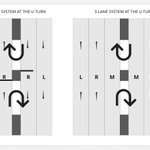
1. We need to identify spots for U-turns at a minimum of 800 m to around 1 - 1.5 km ( in cities) , where the road is extra wide and add one innermost (or right-most) lane on either side, carving it out partly from the median (which is quite wide—especially under flyovers).
So a 3-lane road becomes a 4-lane road, and a 2-lane road becomes a 3-lane road. This extra innermost lane is dedicated only to vehicles that are going to turn, and it should start around 100 meters before the actual U-turn.
2. There should be an LED signal at the top at the point where the 100 m pocket lane starts —maybe a constantly glowing orange signal with a board indicating that there is a U-turn 100 meters ahead. The other lanes to the left can then operate as usual without any traffic slowdown.
Before taking the U-turn, this 100-meter pocket allows vehicles to safely slow down and form a structured queue.
3. On the opposite side, the parallel 100-meter-long inner lane gives turning vehicles room to speed up and match speeds before joining the fast traffic in adjacent lane. Placing rumble strips at the start of the 100-meter pocket will also naturally alert drivers about to take the U-turn.
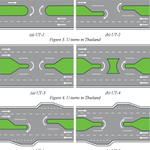
I have drawn this system for a 2-lane road. Do check it out. The right side image is the modification which will help prevent traffic congestion.
This system removes the need for iron barricades entirely and allows traffic to continue without slowing. There is no chaos at the U-turns, and it actually serves the purpose for which it was placed. Most importantly, it prevents traffic congestion from backing up 100 meters or even 500 meters down the highway.
@Cbe_Dist_Police @CbeCorp @NHAI_Official #Coimbatore #TrafficEngineering #CivicSense

Here is a link to an article I found from 2014. How Thailand has designed their U turns
semanticscholar.org/paper/Th…

19
Its a welcome move .
The point is not that a new rule has been introduced .
The point is : How will it be enforced ?

Chennai Metro new rule: Playing music without earphones can attract Rs 2,500 fine
#chennai #chennaimetro #cmrl #chennaimetrofine #chennaimetropenalty #tamilnadu @ANISHMONDAL1
indianexpress.com/article/in…

1
64
The day politicians stop worrying if what they do this term will prevent their coming into power the next tenure is the day India will progress ! That is what differentiates statesmen from politicians .

This system will be implemented in whole nation 😳
The Tamil Nadu government has tightened restrictions on political activities inside government schools, directing that political party members and private individuals should not enter classrooms or conduct political events on school premises. Events held in government schools must maintain political neutrality and have educational relevance. The issue gained fresh attention after the headmistress of a Panchayat Union Middle Girls’ School in Krishnarayapuram, Karur district, allegedly showed a live telecast of Chief Minister C. Joseph Vijay’s public meeting to students during school hours on Friday. A video showing uniformed students watching Vijay’s speech on a classroom projector went viral on social media. Following the controversy, the headmistress was suspended. Tamil Nadu School Education Minister Raj Mohan said the screening was the headmistress’s own decision, indicating that there was no government direction to show the Chief Minister’s event to students.
83
The food licensing and safety process in our country is perfectly streamlined.
Submit the paperwork online, pay the fee with an ‘add on’ and you are officially certified to make food or food products and feed millions of people. It is a system built on pure, unadulterated trust.
Once that piece of official paper is issued, the regulatory machinery gracefully retreats into the background . There are no intrusive periodic audits or unannounced visits to disturb logistics. The system respects privacy far too much to check whether the warehouse is storing Food products next to cleaning chemicals or letting organic eggs peacefully expire.
And then when a crisis inevitably comes up and consumers start posting pictures of expired products , the authority handles it with the highest level of decorum. They don't shut operations or seize the inventory. They issue a formal "notice" requesting a detailed explanation within some days.
It is a flawless paperwork loop. The consumer gets affected , the regulator sends an officially worded warning, the company files a compliance report agreeing to take necessary steps as asked by the authority, and the license remains completely untouched. It’s All in a days work .
You realize very quickly that the food safety department isn't a shield or a weapon ; they are just a very polite onlooker whose hands are tied by their own bureaucracy and some ‘add ons ‘. They are adept at sending notices and asking explanations all the while clearly mentioning that no legal action will be taken based just on the consumers complaints . Great !
Best to buy at the kirana store and eat food cooked at home .
#FoodSafety
#ConsumerRights
#SystemFailure
Consumer complaints about expired, contaminated and damaged food products prompted the food regulator to seek explanations from the quick commerce platform over its quality checks and food safety practices. indianexpress.com/article/he…

74
Considering heavy case load, Supreme Court proposes use of the honorific term "Your Lordship" in District Courts too
The move specifically targets District Courts, where the real backlog is happening — over 85 percent of the 5.5 crore-plus cases pending nationwide. Sources say the honorific upgrade is the necessary boost needed to push cases faster.
Lawyers are being trained in how to use the new term, and it is the juniors' duty to remind the seniors in case they stop with just "Your Honour."
Registry data also revealed the average case now outlives the judge who first heard it, the lawyer who filed it, and in few instances, why the case was filed in the first place.
A family that has been attending hearings for the same property dispute since 2001 said the case has become a family get together, with grandchildren now attending in place of the original petitioners. In fact there are talks of a reunification and out of court settlement due to the constant interaction.
A group of law students on a court visit as part of their curriculum reportedly asked if they could "come back next year to see how the same case is going," describing it as a "long-term learning opportunity."
In a related development, the court also clarified its 2026-27 academic-style calendar: winter break, summer vacation, and now a proposed "monsoon recess," on the grounds that "even litigants deserve a break."
#Satire #JudicialBacklog #LordshipCulture
