
Melbourne, Victoria, Australia
Joined February 2012
- Tweets188
- Following316
- Followers121
- Likes369


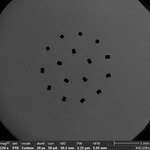

A couple of years ago we built square and rectangular apertures for our Krios cryo-TEM. Out now on BioRxiv is our workflow for acquiring montage tomography with them (biorxiv.org/content/10.64898…). Apologies for the burn, when you acquire a whole lamella you have to focus somewhere!
The workflow runs through SerialEM and can do both square and standard round beams, just draw a polygon around your cell/lamella and the script will design an acquisition scheme. Make sure your view and record presets are well aligned first ;) github.com/HamishGBrown/Stit…

Thanks to Srujan Shetty Kundapura from @DebnathGhosal's lab for providing such an excellent sample for the paper, neurons derived from the immortalized human BE(2)-M17 neuroblastoma cell line. The approach is excellent for these cells which grow in irregular shapes.
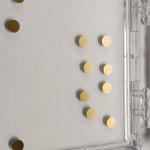
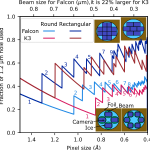
Out now in #NatureMethods our publication on square and rectangular beams for low dose #cryoTEM. We develop an aperture plate design that gives square and rectangular beams to match the Falcon IV and #Gatan K3 cameras in our Krios G4. rdcu.be/dADZm

It turns out there were others out there dreaming of square apeture plates, see the work of @eydchua et al.. xitter.cf/rita_strack/status/174…

Second, did you know I cover a lot of cryoET for the journal along with @DrArunimaSingh? Because it's where imaging and structural biology meet!
Take a look at this relatively simple idea with nice implications for montage imaging! Square beams! nature.com/articles/s41592-0…


Out on the BioRxiv today from us at the @Bio21Institute, square beams to fulfill your #cryoEM dreams. We present designs for cryo-EM apertures that allow square or rectangular beams to match your camera. biorxiv.org/content/10.1101/…

We didn't realise that Eugene Chua and Alex De Marco and colleagues were also playing in the same space, our submission comes hot on the heels of theirs so check out that too: biorxiv.org/content/10.1101/…


Most bots on twitter can pass the Turing test (convince you that they're human) and most humans on twitter can do the reverse, discuss... en.m.wikipedia.org/wiki/Reve…
