

Founder @Onehousehq — Data Infra for Agents. Creator of @apachehudi, built the first #DataLakehouse @Uber. Databases, Dist. Systems. LinkedIn, Confluent.
Joined April 2009
- Tweets1.4K
- Following235
- Followers1.9K
- Likes833







Spark on Kubernetes at scale is hard. Onehouse runs a lot of it, and tomorrow we're sharing what we've learned.
In most places, the knowledge required to get all of this right lives across the data team and the Kubernetes/infra team.
We've collected a list of things that looked simple at first, but hard in production:
- OOM kills
- Shuffle storage
- Spot interruptions
- Autoscaling
- Long-running drivers
- Cluster upgrades
- Keeping streaming jobs alive while the infra underneath changes
Most of it lives in the gap between the data team and the infra team.
Webinar tomorrow. Bring your worst production problem.
Link in comments.

sign up link: onehouse.ai/events/webinars/…


Last week, I posted on why warehouses still default to closed formats. What I learned: they won't flip the default. Open formats are opt-in.
So the fix is with the users. Give every open format (Delta, Hudi, Lance, Vortex, ClickHouse, DuckLake) the same consideration on performance and flexibility that you give the closed ones.
Your data will thank you.
Back to building on open formats.

ALT A man in a field checks his watch repeatedly, while a skeleton lies nearby, humorously illustrating waiting for open file formats.
I like that the ChatGPT Mac app has a built-in markdown editor. It definitely reduces friction in review cycles.
Last week, Databricks CEO Ali Ghodsi and I debated Iceberg and open table formats on a post. Then I caught myself.
Why are we debating each other while Snowflake, BigQuery and Redshift still default customers to closed formats?
Two years of Iceberg announcements. Still no public retirement date for their closed formats.
Open-source projects get scrutinized for interoperability on every release. The largest warehouses should meet the same bar.
We’ve spent a decade building open formats and data lakes. I think it’s time we asked.

ALT Anakin and Padmé meme. Snowflake, BigQuery and Redshift in 2024: “The future is open. Use Iceberg.” Data community: “So you’ll retire your closed formats?” The same warehouses in 2026 say nothing, and the data community asks: “You’re still planning to retire them... right?
My thoughts and receipts are in the blog onehouse.ai/blog/snowflake-b…

To squeeze the performance out of our runtime components, we implemented a good amount of concepts from - SEDA: an architecture for well-conditioned, scalable internet services dl.acm.org/doi/10.1145/50205…
The seminal work at MIT around writing high-performance server software and the gift that keeps on giving.


Muse, Dots, Grok bot.
Eagerly awaiting the consumer AI/agent app explosion, to watch agents melt our databases at scale.


🙄 This is just confusing at so many levels.
First: historical data is several times larger than live data. How would a single-node SQL engine crunch all that data volume? Amazon itself sells three distributed SQL engines, last time I checked
Second: you can easily have your agent hit both Aurora and Athena and solve this problem today. What's broken?

A painful part of working with your data has always been that your live data and historical data are stuck in separate systems: the order a customer just placed lives in your database, while their last five years of orders sit in a data lake in S3.
And answering a real question usually needs both at once (is this a normal purchase for them, or should we flag it?), and to do that you had to move the data together first, copying history out of the data lake into your database (or the other way around), because the database couldn’t read it where it lived.
That meant guessing ahead of time which data you’d want, keeping a second copy of it all, building pipelines to move it, and constantly syncing so the two didn’t drift apart. A lot of plumbing, and slow going, all before you could answer one question. And even then, the answers were only as fresh as your last sync.
That now changes with Aurora PostgreSQL, which can call your live data and historical data in S3 together, in a single query. No copying, no pipelines to keep in sync.
And it’s fast, because we’ve built in DuckDB, a popular open source engine that’s really good at reading and analyzing data right where it’s stored. DuckDB reads the open formats like Parquet and Iceberg already sitting in your data lake, so there’s nothing to convert or move.
As folks build AI agents into their apps, the data their agent needs will depend on the task in front of it. Being able to query that specific data live, instead of copying it over just in case, is gonna be a big help for builders. aws.amazon.com/blogs/aws/ama…

🚀 Introducing the Onehouse AI Gateway: model routing + MCP tool governance, without lock-in, wherever your data lives.
🔧 What is it?
A unified inference + MCP gateway with shared access controls and built-in observability at no extra-costs. Get blazing-fast SQL tool access to any open table. Swap models, connect any catalog, and deploy the gateway right next to your data or your agents.
💡 Why it matters
Snowflake’s Cortex AI Gateway routes only to Snowflake-hosted models. Databricks supports external providers, then charges $0.10/GB for inference logs and usage tracking. With Onehouse, you can use any model provider and store traces in open formats on infrastructure you control.
⚙️ How you use it
Add provider credentials (OpenAI, Anthropic, etc.), define model aliases, set fallback and traffic-splitting rules, and apply user/group access controls. Then point Claude Code or Codex at the gateway and go.
📊 We’re already running it on our own data lake. The blog has the full details.


This will be very useful for day-to-day automations

NetApp previewed AI Data Engine integrations with Onehouse at Insight today. Read together with Novus, their new fast file system for AI, it brings modern lakehouse compute to data centers and Neoclouds.
The last decade of lakehouse innovation has mostly stayed locked inside the three major clouds. BigQuery, Snowflake, Databricks all require their managed services.
Onehouse runs on open formats and containerized on any Kubernetes cluster. Same speed or faster, with maximum portability.
This integration unlocks three patterns:
1️⃣ Data centers running Hadoop-era stacks finally get a path to faster Spark and interactive queries on existing storage, without migrating.
2️⃣ Neoclouds generate massive volumes of training and trace data but have no real data platform. Agent traces need to be joined with outcomes and curated into training datasets. That's exactly what a lakehouse handles well.
3️⃣ NetApp storage systems hold decades of enterprise documents and archives. AI can analyze unstructured data at GPU speeds, without blocking on human data entry.
What would you build if you could query all the files in your filers and NFS mounts alongside your business data?
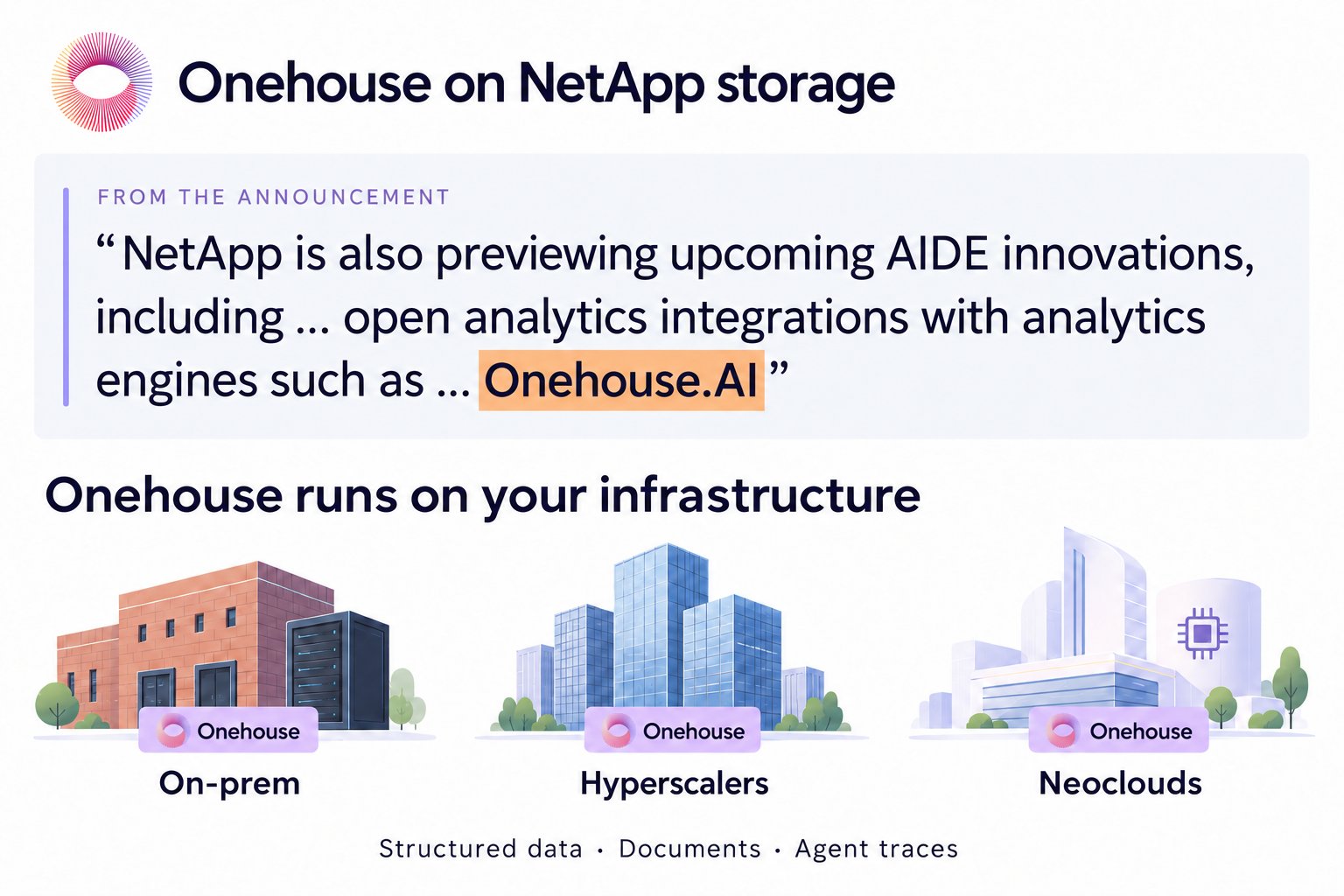
Onehouse's unstructured data processing capabilities. Parse documents, images, and files to generate vector embeddings in lakehouse tables, so AI can process them at GPU speeds. quanton.dev/blog/rag-on-docu…

Always wondered about this. Need to try on a few repos where CI is crawling

OpenClaw deleted around 400k LOC of its own tests without much change in code coverage. Modern models just love writing tests for every tiny change, even if they aren't useful. This skill helped. github.com/openclaw/openclaw…
