

Curious | Investments at Accel | ex-Apna, BCG
Joined November 2023
- Tweets122
- Following207
- Followers89
- Likes643


AI agents can apparently hire other AI agents now.
Meanwhile, I’m on my 14th WhatsApp group asking if anyone knows a reliable nanny.
Human agents continue to be hard to hire 🙃
I’ve been trying to read more nonfiction these days (tough at first if you love fiction!). Top of the list so far has been Poor Charlie’s Almanack. What an amazing read!
One of Munger’s lessons that really stayed with me is incentive-caused bias. How incentives can change not just what we do, but what we believe.
I keep thinking about this in venture. Once you’ve invested, it’s so easy for bias to hide behind optimism and conviction.
In the last 3 years, I’ve met founders who’ve shown incredible resilience and pulled off genuine turnarounds, but also seen the other end of the spectrum.
Venture is such a long game, things can look terrible for a while and still work out.
So knowing how much optimism is justified is something I am still trying to figure out.
57
I’ve been thinking about what really determines success in a world of superintelligence.
If intelligence / super intelligence was democratised, what should i be solving for?
—-
If intelligence were the biggest determinant, wouldn’t the smartest humans already be the most successful?
Even two equally intelligent people can have very different outcomes. Grit, energy, health, family circumstances, luck, macros, so much of life gets in the way.
Machines can escape many of these human limitations, which makes them far more effective at converting intelligence into outcomes.
But what will happen when two people with access to the same superintelligence compete?
Does success then come down to capital, energy, access to resources, judgment and the ability to execute or just power ?
I wonder if superintelligence will actually level the playing field, or make everything other than intelligence matter even more.

Never thought someone else’s extramarital affair (in a different country) would have a positive impact on my finances, but here we are. 😂
Is it just me, or did the world suddenly move fast in the last few days ?
- GTA 6 shipped.
- Starship got caught coming back from orbit.
- Anthropic went public while the US market dropped.
- Yash Patils startup got acquihired for 4.5B!
- FIIs are pulling India market up.
- An AML vaccine has cut death risk by 41%.
Did some switch go off somewhere?
Vidhya Krishna retweeted

At seed, an investor's conviction is sometimes just your confidence reflected back. Aggression gets you the meeting, sometimes even the cheque. It doesn't get you the company. On hollow aggression, why a round isn't validation, and the 6 questions:

Vidhya Krishna retweeted

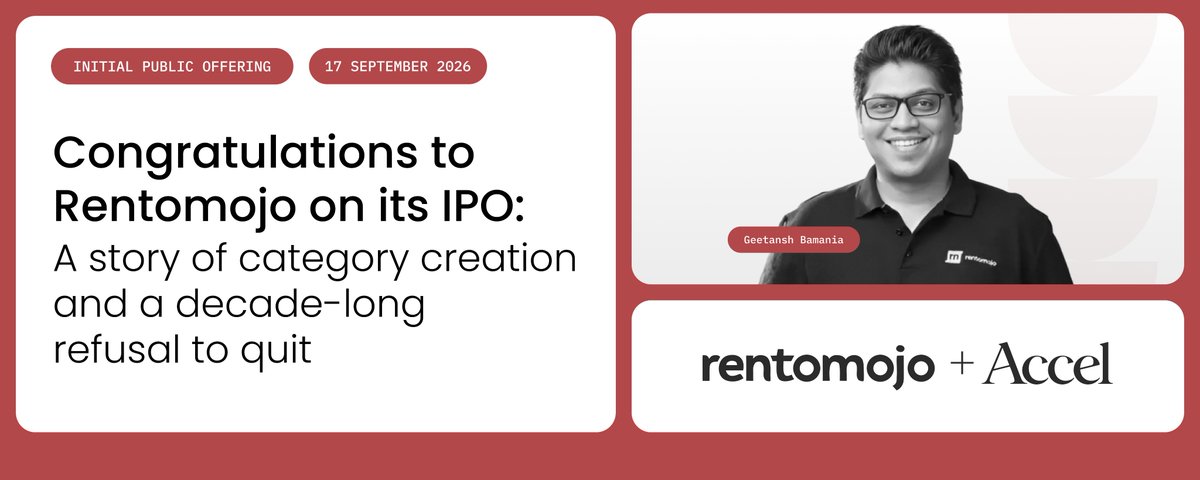
A decade ago, @GeetanshBamania asked something none of us had heard before: what if people rented furniture instead of buying it? He saw a shift the rest of us hadn't, cities changing, ownership starting to feel like a burden.
Glad to have witnessed this special journey from day one.

Today, @Rentomojo goes public.
An idea about renting became a business that helped India feel at home. We look back at what it took to get here.
Congratulations to the entire team on your IPO and your own new beginning.
#AccelFamily • @prashanthp
Vidhya Krishna retweeted

The GTM playbook for AI companies is still being written. Last week, we got in a room with some of the people helping define it.
Shekhar Kirani (@skirani), Partner at @Accel, sat down with Barathram A, Partner at @McKinsey, who advises frontier labs, hyperscalers, and AI-native companies on building commercial motions, and Varun Anand, Co-founder of Clay, who built one of the defining GTM platforms for AI-native sales teams and had to develop the methodology while shipping the product.
(1/3)


Vidhya Krishna retweeted
GTM is among the hardest unsolved problems for AI-native companies.
Most playbooks were built for a different era. AI-native products need AI-native commercial motions — and very few people have figured out what that actually looks like in practice.
At our next Accel Founder Connect, Shekhar Kirani (@skirani), Partner at @Accel, sits down with two people who have cracked different parts of this problem:
• Barathram A, Partner at McKinsey, leads Go-to-market work for AI and software companies, advising and partnering with frontier labs, hyperscalers, tech and AI-natives on how to build and scale commercial motions.
• Varun Anand co-founded Clay, the GTM platform of choice for AI-native sales teams. He didn't just theorise about AI-native GTM. He had to figure it out while building the product itself.
Together, they'll get into first-principles playbooks, org structures, and what global go-to-market actually looks like when you're building AI-native.
Sign up to attend in person in Bengaluru: luma.com/AccelAIGTMStrategie…
Sign up to attend virtually: luma.com/AccelAIGTMStrategie…

Vidhya Krishna retweeted

In honor of 50 years of Apple, we're sharing - for the first time ever - Don Valentine's original 1977 memo for Sequoia's investment into Apple Computer. #Apple50

An interesting quote I read today :
"The market for feeling productive is orders of magnitude larger than the market for being productive. Most people, most of the time, want to click and watch the number go up.
They do not want to be told the number is fake. They will pay in time, in attention, in actual money to keep the number going up."
Felt like AI is riding this wave, not sure how many of us are using the tools we have to our fullest potential
1
68
This single line from @danhockenmaier nails why the “AI agents kill all marketplaces” take, falls apart at the heavily-managed end.
“Anthropic/OpenAI aren’t about to start accepting returns, financing buyers, or building their own driver fleets and logistics networks.”
That capital-intensive, physical-world grind? Still very much a human (and moated) game.
Gives us more hope for the longevity of Indian ops heavy consumer tech plays

Takeaway from the Citrini backlash should not be that all marketplaces are immune to AI, just that DoorDash was a particularly bad example to choose.
Defensibility is largely a product of how far they are to the right on this spectrum.
The argument is "agents will just transact on your behalf and look for lowest price"
This is massively flawed for two reasons in the case of DD:
1. Price is function of network density. You must be able to optimize routes and batch orders to win
2. Even if someone else could win on price, customers care about many other things (selection, quality, service, all of which DD has invested in heavily)
So you can’t build a good agentic food delivery product without DD cooperation. And for obvious reasons, they will not cooperate.
But it doesn’t follow that this will play out everywhere.
The more heavily managed a marketplace is, the harder it is for someone else to cut in.
There are basically 4 levels of marketplace:
1. Lead gen: just a list of suppliers
2. Transactional: also handle payment
3. Managed: also take on risk (returns, net terms)
4. Heavily managed: also manage service delivery
Google has been trying to eat the marketplace profit pool for many years, and really only succeeded in taking most of it away from lead gen marketplaces.
LLMs are another aggregation layer like Google, but with two big differences: search is much better, and critically, they can transact on your behalf.
So LLMs should be able to push up one step farther in the stack, and take on transactional marketplaces directly.
But is Anthropic going to try to do the final two jobs of managing risk or managing service delivery itself?
Are they going to start accepting returns? Offering financing terms to buyers? Are they going to manage their own drivers or build their own logistics network. That seems very unlikely.
As a result, managed marketplaces are largely safe.
Marketplaces that do the hardest, most capital intensive, most scale-dependent stuff will get rewarded for it.
I wrote an essay on this here: danhock.co/p/llms-vs-marketp…

1
4
134
Everyone talks about diversifying stocks and asset classes.
But nobody talks about diversifying currency.
Nifty returned 94% over 5 years. S&P returned 81%.
Though the Indian market performed better, rupee fell 21% against the dollar.
So S&P in rupee terms? 119%.
If we only invested in Indian markets we made 25% less.
Your returns aren’t just about asset selection especially if it’s denominated with a depreciating currency.
It’s time you hedged the currency risk and invested in multiple markets as well.
3
90
Vidhya Krishna retweeted

Last one on this topic, and I have been holding this in myself for a while.
For centuries, class divides kept the labor of the poor invisible to the rich. Factory workers toiled behind walls, farmers in distant fields, domestic help in backrooms. The wealthy consumed the fruits of that labor without ever seeing the faces or the fatigue behind it. No direct encounter, no personal guilt.
The gig economy shattered that invisibility, at unprecedented scale.
Suddenly, the poor aren't hidden away. They're at your doorstep: the delivery partner handing over your ₹1000+ biryani, late-night groceries, or quick-commerce essentials. You see them in the rain, heat, traffic, often on borrowed bikes, working 8–10 hours for earnings that give them sustenance. You see their exhaustion, their polite smile masking frustration with life in general.
This is the first time in history at this scale that the working class and consuming class interact face-to-face, transaction after transaction. And that discomfort with our own selves is why we are uncomfortable about the gig economy. We want these people to look our part, so that the guilt we feel while taking orders from them feels less.
We aren't just debating economics. We are confronting guilt. That ₹800 order might equal their entire day's earnings after fuel, bike rent, and app cuts. We tip awkwardly, or avoid eye contact, because the inequality is no longer abstract. It's personal.
Pre-gig era, the rich could enjoy luxury without moral discomfort. Labor was out of sight. Now, every doorbell ring is a reminder of systemic inequality. That's why debates explode. It's not just policy. It's emotional reckoning. Some defend the system (“they choose it”), others demand change (“this isn't progress, its exploitation”).
And here’s the uncomfortable twist: the unsaid ask of clumsy ‘solutions’ isn’t dignity. It is about returning to invisibility.
Ban gig work and you don’t solve inequality. You remove livelihoods. These jobs don’t magically reappear as formal, protected employment the next day. They disappear, or they get pushed back into the informal economy where there are even fewer protections and even less accountability. Over-regulate it until the model breaks, and you achieve the same outcome through paperwork instead of slogans: the work evaporates, prices rise, demand collapses, and the people we claim to protect are the first to lose income.
And then what happens?
The rich get their old comfort back. Convenience returns without faces. Guilt dissolves. We go back to clean abstractions and moral posturing from a distance. The poor don’t become safer, they become invisible again: back in cash economies, back in backrooms, back in shadows where regulation rarely reaches and dignity isn’t even debated.
The gig economy just exposed the reality of inequality to the people who previously had the luxury of not seeing it. The doorbell is not the problem. The question is what we do after opening the door.
Visibility is the price of progress. We can either use this discomfort to build something better (which we keep doing continuously as delivery partners are our backbone), or we can ban and over-regulate our way back into ignorance. One of those choices improves lives. The other simply helps the consuming class feel virtuous in the dark.
Vidhya Krishna retweeted

Henry Kravis on VC firms trying to attempt the private equity rollup strategy using AI
"The problem today is that [multiple] arbitrage is closing. Small companies are waking up and saying I wont sell my company at 6x when I look at comparables and they are selling at 15x"
Congratulations @Meesho_Official @viditaatrey @barnwalSanjeev ! What a fantastic listing - 54% gains already
I’ve documented my learning’s on Meesho in this thread, for whoever is wondering why they were oversubscribed or gained premium at listing!

Meesho opens for IPO subscription today as India's largest ecommerce player by shipments, beating Amazon and Flipkart to become the first horizontal consumer internet IPO.
210M users. 88% outside top 8 cities.
Here's why they solved a problem the incumbents are structurally incapable of solving (Details 🧵below) :
Everyone thinks Meesho won by being "the cheap option." Wrong.
Meesho won by recognizing that 200M+ Indians were structurally locked out of organized ecommerce. Not because they didn't want it. Because serving them profitably was impossible with existing cost structures.
The core insight: You can't serve Rs 200 transactions with infrastructure built for Rs 2000 transactions.
2
165
Did Indigo just pull off the biggest regulatory heist in Indian aviation?
18 months to prepare for new pilot rules. November saw ~1,200 cancellations. Early December: saw a total meltdown.
Within 72 hours: rules suspended.
Pilot unions are screaming “arm-twisting.”
The timeline is unbelievable.
(Detailed 🧵 below)
7/8:
It works because of market structure.
65% domestic share. 10 million passengers monthly.
In aviation, capacity is frozen, you can’t add planes or pilots overnight and grab marketshare.
If Indigo runs at 75% capacity, it’s a national crisis. They’re infrastructure, not just a company.
1
2
140