

RL researcher who sometimes blogs at https://xitter.cf/t.co/aqIlg3lANW. Formerly @OATML_Oxford, now DeepMind.
Oxford
Joined October 2012
- Tweets216
- Following449
- Followers2.9K
- Likes1.4K





Clare Lyle retweeted

Just thinking about how, when my coauthors and I published "The Malicious Use of Artificial Intelligence," some people were annoyed by us talking about sci-fi scenarios like automated hacking and spear phishing, lethal autonomous drones, etc.
arxiv.org/pdf/1802.07228
Just in time for back-to-school, I've (finally) posted notes from my lecture on continual learning at @EEMLcommunity this summer: clarelyle.com/posts/2026-09-…
Clare Lyle retweeted

1/ Today, we introduce Faraday, a 27B-parameter AI Scientist that extends the capabilities of coding agents with a layer of scientific intuition. Trained via long-horizon RL, Faraday outperforms Claude Opus 4.8 and GPT-5.5 on the task of replicating research papers. 🧵

Clare Lyle retweeted
We’re excited to introduce Inherent, a lab designed from scratch to build AI agents that discover new knowledge.
The coming era of machine-driven scientific inquiry demands a new kind of research institution and a new kind of AI.
To achieve our mission, we live within the experiment, recursively self-improving the entire research organisation. We investigate questions including:
- What does ‘AI taste’ look like in the sciences, and how can we build an institution that embraces this new aesthetic of discovery?
- What new kinds of human-machine teaming will make the most of AI that can truly innovate?
- How can we build recursive self-improvement at the collective level that continually increases human agency over outcomes?
We have just closed a $50m seed round led by @IndexVentures and @radicalvcfund, with participation from other outstanding investors including NVentures (@nvidia's venture capital arm), @buildexante, Metaplanet, Macroscopic, @MythosVentures, Charlie Songhurst, @chalfs, @jluan, @dwarkesh_sp, @Thom_Wolf, @j_foerst and @maxjaderberg. We are advised by @matthewclifford.
Inherent is a Public Benefit Corporation headquartered in London.

Coming soon to an RLC near you! 🎉


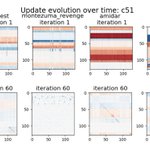
Really great work by our team's student researcher @mcbeukman! It turns out that having a trainable network doesn't matter if you're training it on the wrong objective 🤯
Excited to be speaking at the @thought_channel Conference on the Mathematics of Neuroscience and AI in Rome this summer! neuromonster.org
With @RMBattleday, @jcrwhittington, and others

Clare Lyle retweeted

for the first time, eeml treads mountainous terrain 🏔️ while being very close to the seaside 🌊
not to mention it's the best AI summer school in EE & beyond!
come join us, it'll be amazing!
@clarelyle @dorothychou @ninamiolane @sedielem @apsarathchandar @re_rayne @fedzbar


Super excited to be presenting this work at @NeurIPSConf this week! Stop poster #512 in the Thursday afternoon poster session to find out more 😊

Thrilled to share our new #NeurIPS2025 paper done at @GoogleDeepMind, Plasticity as the Mirror of Empowerment
We prove every agent faces a trade-off between its capacity to adapt (plasticity) and its capacity to steer (empowerment)
Paper: david-abel.github.io/plastic…
🧵🧵🧵👇

Come for the beautiful diagrams, stay for the very nice symmetry between plasticity (how much the environment can affect the agent) and empowerment (how much the agent can affect the environment)
Thrilled to share our new #NeurIPS2025 paper done at @GoogleDeepMind, Plasticity as the Mirror of Empowerment
We prove every agent faces a trade-off between its capacity to adapt (plasticity) and its capacity to steer (empowerment)
Paper: david-abel.github.io/plastic…
🧵🧵🧵👇
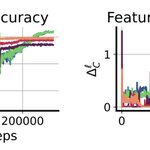
What do grokking and plasticity have in common? We show in our @CoLLAs_Conf paper that the same underlying mechanisms that facilicate grokking can help to mitigate primacy bias in nonstationary settings. In other words, if you can grok, you can continually learn!

It also works well to close the generalization gap in warm-starting settings, again provided the learning rate increase is large enough to affect various measures of feature-learning in the network.

Shout-out to my fantastic co-authors @g_sokar, András György, and Razvan Pascanu.
Paper link: arxiv.org/abs/2507.20057

🚨 New paper alert! 🚨 Rafał Surdej 🎤,
@m_bortkiewicz, and @MatOstasze managed to get trainable activation functions to work in nonstationary learning problems and they actually help 🤩


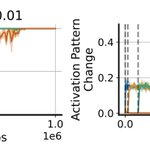
🚀 Excited to announce our paper "Balancing Expressivity and Robustness: Constrained Rational Activations for RL" will be an *oral* at #CoLLAs2025!
We study how trainable rational activations boost expressivity in RL but can also harm stability:

PSA: if you work on plasticity loss you should read "Transient Non-stationarity and Generalisation in Deep Reinforcement Learning" by Igl et al. It's super relevant but suffers from an unfortunate lack of SEO due to predating the "plasticity loss" nomenclature.
In particular, it has a bunch of really insightful experiments and a clean way of doing resets that can be helpful for improving generalization and diagnosing whether plasticity is a bottleneck for your agents.
Paper link: openreview.net/forum?id=Qun8…