
São Carlos
Joined June 2009
- Tweets1.2K
- Following224
- Followers174
- Likes90




Dalcimar Casanova Ph.D. retweeted

🚨 قنبلة نووية في عالم الذكاء الاصطناعي: إسقاط كافة القيود وسيرفرات Hugging Face تنهار تحت الضغط! 🤯🔥
النموذج الهجين المرعب DeepSeek-V4-Pro + Qwen3.5 9B ينسخ قدرات الاستدلال العالية ويتخلص من كافة القيود الأخلاقية، مسبباً عطل المنصة من كثافة التنزيلات فور إطلاقه!
🔥 مواصفات وإمكانيات صدمت مجتمع المطورين:
• سحق معدل الرفض: في اختبار واقعي لـ 100 برومبت معقد؛ النسخة الأصلية رفضت 100%، بينما رفضت هذه النسخة 3 برومبتات فقط!
• تقطير استدلال خارق: تم تدريبه عبر 250 ألف نقطة بيانات جودة عالية من DeepSeek-V4-Pro، ليتفوق في البرمجة والرياضيات المعقدة.
• إزالة قيود بلا خسران للذكاء: يعتمد تقنية ARA لطمس القيود بالكامل دون فقدان نقطة ذكاء واحدة من منطق النموذج!
• يعمل على أي جهاز (5.6GB فقط): بصيغة Q4_K_M GGUF بحجم خفيف جداً، يتيح لك تشغيله على الكمبيوتر العادي أو كروت الشاشة المدمجة في ثوانٍ.
⚡ مفتوح المصدر بالكامل (Apache 2.0):
فرصة مثالية لامتلاك نموذج محلي يطيع أوامرك بذكاء فائق وبدون أدنى رقابة أو اشتراكات!
📌 احفظ التغريدة بمفضلتك وابدأ بتجربته فوراً 🔖👇
(رابط النموذج التجريبي على Hugging Face في أول تعليق)

Dalcimar Casanova Ph.D. retweeted

this is absolutely unreal
Google open-sourced Harness², and it lets an agent rebuild its own harness on every new task
the harness is everything around the model: system prompt, guardrails, memory, tool guidance, subagents, skills, scripts, plugins
usually a person designs it once, and every task after that runs on the same fixed setup
Harness² edits that setup per task and never touches the model weights:
> propose - the agent writes edits to its own harness
> probe - it runs a few candidate versions on the same task
> compose - it builds a better harness from how those runs differed
the clever part: it learns from the differences between runs, so it works on tasks that have no answer key or grader
it also remembers. the harness it settled on and the lessons that held up get saved, so the next task starts from notes instead of a blank file
Google ran it with Gemini 3.5 Flash and GLM-5 on JobBench, LAB and WorkBuddy-Bench. one round of edits already beat the original harnesses, and more rounds pushed the scores higher
rounds can go wide, several candidates at once, or deep, one harness refined step by step through OpenCode or Codex
whoever wires this into a team's agents stops losing evenings to failed traces
the loops and graphs that let you stop babysitting agents and only approve the last step are below ↓


Dalcimar Casanova Ph.D. retweeted

INVESTIGADORES CHINOS ACABAN DE FIRMAR EL CERTIFICADO DE DEFUNCIÓN DE LA PROGRAMACIÓN
El paper se titula: “El fin de la ingeniería de software”
La idea central es que escribir código está completamente acabado como habilidad.
Tu cerebro solo puede retener cierta cantidad de estado y de dependencias antes de chocar contra un muro.
Un agente no tiene ese techo, y su capacidad no deja de crecer con el compute.
Así que el humano deja de ser quien escribe el código.
Te conviertes en el arquitecto de la intención, el que dirige a los agentes y audita el resultado.
El código pasa a ser lo desechable, y el criterio pasa a ser el trabajo.
Precisamente por eso te dejo abajo esta guía sobre cómo construir tu propio sistema de agentes desde cero.
Abajo también tienes el paper completo en el que se basa todo esto ↓


Dalcimar Casanova Ph.D. retweeted

Google just open-sourced Harness².
(turn any harness into a self-improving system)
a harness is everything wrapped around the model, like the system prompt, tools, memory, skills, and subagents. today a person designs it once, and the agent runs every new task with that same fixed setup.
Harness² lets the agent refine that setup for each new task on its own, with the model weights left untouched.
on every task, the agent proposes edits to its harness, runs a few candidate versions, and composes a better harness by comparing how those runs behaved.
because it learns from the differences between runs, it needs no correct answer or grader for the task.
that covers a single task. Harness² also carries what it learns from one task into the next.
after each task, it saves the harness it settled on along with the lessons that held up across the runs. the next time it refines a harness, it starts from those notes instead of from scratch.
this means every finished task makes the next round of edits more informed.
Google tested this with Gemini 3.5 Flash and GLM-5 on legal, office, and professional work benchmarks. one round of edits was enough to beat their original harnesses, and giving the agent more rounds pushed scores higher.
those extra rounds can go wide or deep. the agent either tries several candidate harnesses at once or keeps refining a single one step by step, using OpenCode or Codex to carry out the work.
you can find the Harness² repo here: github.com/google-research/h…
I wrote about a similar idea for agents already running in production, where the harness should repair itself after a failure instead of waiting for someone to debug the trace by hand.
that piece walks through how @Cometml's Opik (open-source) closes this loop, going from a failing trace to a proposed fix to a regression test that stops the same failure from coming back. it's quoted below.


Dalcimar Casanova Ph.D. retweeted

Anthropic engineer:
"90% of our engineers were already using self-improving loops
Now everyone is moving toward agentic graphs"
"Prompting is basically over"
In just 10 minutes, she builds her full Claude Code system live from a completely empty terminal
Agents → Loops → Graphs → Self-Improving Systems
Prompting was the old workflow
Graph engineering is the next one
This 10-minute breakdown is worth more than most $1,000 agent engineering courses
Watch it today
Then save the full guide below before everyone starts catching on ↓


Dalcimar Casanova Ph.D. retweeted

this one page turns Obsidian + Opus 5.5 + Jev into a second brain that thinks with you around the clock
built on Karpathy's ideas
Jev reads every note before Opus does
Opus writes only what matters
your vault keeps working while you don't
cuts 80% off your weekly chat time
frees you up for the work your manager actually pays for
the people who set this up early
are the ones the next raise finds first


Dalcimar Casanova Ph.D. retweeted

INSTEAD OF WATCHING NETFLIX TONIGHT. Spend 2 hour with this. Claude AI FULL COURSE that teaches you how to BUILD and AUTOMATE anything. The people who watch this tonight will wake up tomorrow with a new skill. Watch it and bookmark it now.
Dalcimar Casanova Ph.D. retweeted

Andrew Ng just released a 1-hour course on building Agentic Knowledge Graphs from scratch.
00:00 — Introduction to agentic knowledge graphs
03:07 — Building agentic graphs
14:00 — Multi-agent system architecture
23:00 — Implementing agentic graphs with Google ADK
1:06:03 — Why knowledge graphs matter for the future of AI
This course goes beyond traditional prompt engineering and explores how to build more capable AI systems.
Prompts → Agents → Loops → Graphs
Understanding individual agents is only the beginning.
The real power comes from connecting them through a well-designed graph, enabling more structured workflows and sophisticated multi-agent systems.
Same models. Same tokens. Better architecture. More capable systems.
Watch the course and learn how graph engineering is shaping the next generation of AI.
Save this resource for your AI engineering journey. ↓
Dalcimar Casanova Ph.D. retweeted

Give search over ALL of science to your agent
ask.sciencemadereadable.com
it's free
it's open
it's beautiful

Dalcimar Casanova Ph.D. retweeted

Si estás buscando crear animaciones para explicar algoritmos o matemáticas, acaban de lanzar este motor 3D en Python de código abierto.
Está pensado especialmente para usarlo junto con agentes de IA, y al parecer es mucho más rápido que Blender.
→ manimgx.academa.ai

Dalcimar Casanova Ph.D. retweeted

Karpathy dice que la diferencia en cómo la gente entiende (y usa) la IA se está volviendo un embudo muy afilado.
La mayoría del mundo ve una cosa, y un grupo pequeñísimo ve algo completamente distinto. El futuro de esta tecnología no llega parejo para todos. Llega en forma de embudo.
Estos son los niveles del embudo (de más gente a menos):
- Unos 6.000 millones de personas (la gran mayoría) casi no han tocado un LLM (como ChatGPT u otros). No tienen idea real de lo que hay.
- Unos 1-2.000 millones lo han usado un poco, normalmente la versión gratis. Ven un chatbot medio torpe o útil a medias: algo como un Google mejorado, ayuda para escribir un poco, o que a veces intenta hacer una tarea simple. Muchos dicen (con razón desde su experiencia) que no les cambia mucho la vida. Incluso profesionales que no trabajan en código o matemáticas suelen estar aquí.
- Unas 20 millones de personas (sobre todo programadores, matemáticos e investigadores) están viendo algo distinto: proyectos grandes que antes les llevaban semanas o meses ahora se resuelven con un prompt y agentes de IA. Hacer apps, copiarlas, traducirlas, analizar código binario, etc. Esto ha cambiado muy rápido en el último año.
- Solo unas 5.000 personas (las que tienen acceso interno a los sistemas más avanzados dentro de las empresas de IA) ven el nivel más alto: enjambres de miles de agentes trabajando durante semanas en proyectos enormes. Cosas como descubrir fallos de seguridad graves (zero-days), ataques y defensas cibernéticas a velocidad de máquina, nuevos descubrimientos científicos o avances en matemáticas que a un experto le llevarían años. A veces los humanos ya no alcanzan a revisar o entender todo lo que sale.
Por qué pasa esto:
1. El impacto depende de qué tan grande sea el problema que le pidas.
Una pregunta corta casi no pone a prueba el sistema. Solo se nota el poder real cuando le das problemas grandes, difíciles y que de verdad te importan (como construir software complejo o investigar algo serio).
2. La capacidad no es igual en todas las áreas (cuando dice “jagged” se refiere a irregular).
Brilla muchísimo donde se puede comprobar fácilmente si está bien o mal (el código corre o no corre, el cálculo da o no da, pasó el test o no). Eso se entrena fácil con aprendizaje por refuerzo (RL). En cosas más subjetivas (escribir un email bonito, dar consejos de vida, etc.) es más difícil de mejorar y, además, genera menos dinero, así que las empresas no priorizan tanto esas áreas.
3. El acceso es por niveles.
Gratis → de pago → interno (solo dentro de las empresas). El “oro” está en el negocio entre empresas (B2B) y en dominios digitales que se pueden verificar, por eso ahí se concentra el esfuerzo de mejora.
Mientras todo esto pasa, la mayoría de los NPCs como Momo ve un chatbot medio útil o un poco torpe, y un grupo muy pequeño está viviendo un cambio vertiginoso porque la curva de capacidad se ha puesto casi vertical. Mientras muchos siguen discutiendo “si la IA sirve para algo”, unos pocos ya están en otra realidad.
Cómo en todo, eql futuro no llega parejo para todos.
Llega en embudo.

Dusting off this tweet from April because this gap in shared understanding of LLM capability is *widening*. It's now less "two groups of people speaking past each other" and more a sharp funnel.
- Napkin math somewhere around 6B people (~75% of the population) have barely come in contact with LLMs at all.
- Around 1-2B (~20%) are casual and infrequent users of free-tier ChatGPT-like products. This group sees derpy chatbots and treats them a bit like a better Google search, a writing aid, or etc. Maybe an agent tries to book you a flight. I have non-tech friends who (reasonably, imo) say they have not much use for it at all. Even many professionals outside of math&code are in this tier. For example, execs and many other functions spend a lot of their time talking to other people, so while they understand what is happening intellectually, it is still second-hand and a bit abstract.
- Now we get to professional use of frontier-grade LLMs in math&code. Somewhere around 20M people (0.2%) see first-hand that large, complex projects that used to take them weeks/months can now be completed by agents with a prompt. Building apps, copying apps, translating apps, decompiling apps from binaries... This has all happened very quickly and recently - less than 1 year ago, I was writing code manually by hand, typing memorized computer code commands into a code editor character by character, occasionally pressing Tab to autocomplete a little chunk of code.
- And finally we get to the ~5,000 people (~0.00006%) with access to frontier-grade systems internally. The external world has seen the preview. It looks like swarms of thousands of agents collaborating over weeks on software mega projects: minting zero days, running cyber attacks and defenses at machine speeds, discovering new science, advancing the frontier of mathematics. Things that would have taken top professionals in the industry years of work. Meanwhile, human review and comprehension are starting to fall behind. For example, people are still involved in the "archeology" of the OpenAI-HF incident from many months ago. Mathematicians may be poring over the 722 manuscripts on frontier mathematics for a while.
The funnel is driven by a combination of factors:
1. The impact scales with ambition, problem size, and horizon. A question with a paragraph answer barely stresses the system. You need a reservoir of big, difficult problems that you really care about. This aspect drives the consumer / professional dimension of the funnel.
2. The jaggedness of the system (which I have written about a lot separately). Capability peaks in domains that are digital, verifiable and economically valuable. This is because LLM capability emerges from reinforcement learning on verifiable rewards on a curated environment mixture driven by revenue potential. This aspect primarily drives the area (e.g. math&code) dimension of the funnel.
3. Access. Free-tier, paid-tier, internal.
So this is the weirdness of the moment. The general public has mostly not interacted with these systems. When they have, it looks like a derpy chatbot. The majority of professionals still see only a modest uplift. And a small sliver of professionals are experiencing the vertigo of the curve going vertical. And it is all happening at the same time.
Dalcimar Casanova Ph.D. retweeted

A friend of mine earns $1.2M a year as an Anthropic engineer.
I asked him how he mastered prompting. His answer? A video that was never supposed to be public: Anthropic’s core team prompting playbook.
It’s hard to find a better 30-minute guide to getting more out of AI.
I watched it last night. Halfway through, I realized I’d been using Claude the wrong way for two years.
Watch it. Bookmark it.
Dalcimar Casanova Ph.D. retweeted

This might be the most detailed paper on AI agents so far
17 researchers, led by the former head of Huawei’s Noah’s Ark AI lab, lay out how to build an effective AI agent, part by part, with setups matched to different tasks
Their main claim: agent quality comes from the model plus the harness around it, the model alone does not explain it.
Key pages:
> p.4: the agent loop in one diagram
> p.5: the full harness, 6 parts from observation to verification
> p.7: 4 eras, from prompts to context to harness to agent-native training
> Sec 5: each of the 6 parts in detail
> Sec 6.3: which harness setup fits which task
> Sec 7.3: SWE-bench results by model and harness


Dalcimar Casanova Ph.D. retweeted

You can literally type a sentence and watch a Transformer process it.
This interactive explainer runs a GPT-style model in the browser and lets you follow the whole path:
tokenization → embeddings → Q/K/V → attention → MLP → logits → next-token probabilities
You can inspect attention maps, intermediate values, and change temperature, top-k and top-p to see how generation changes.
If Transformers still feel like boxes connected by arrows, this is worth opening.
poloclub.github.io/transform…
Dalcimar Casanova Ph.D. retweeted

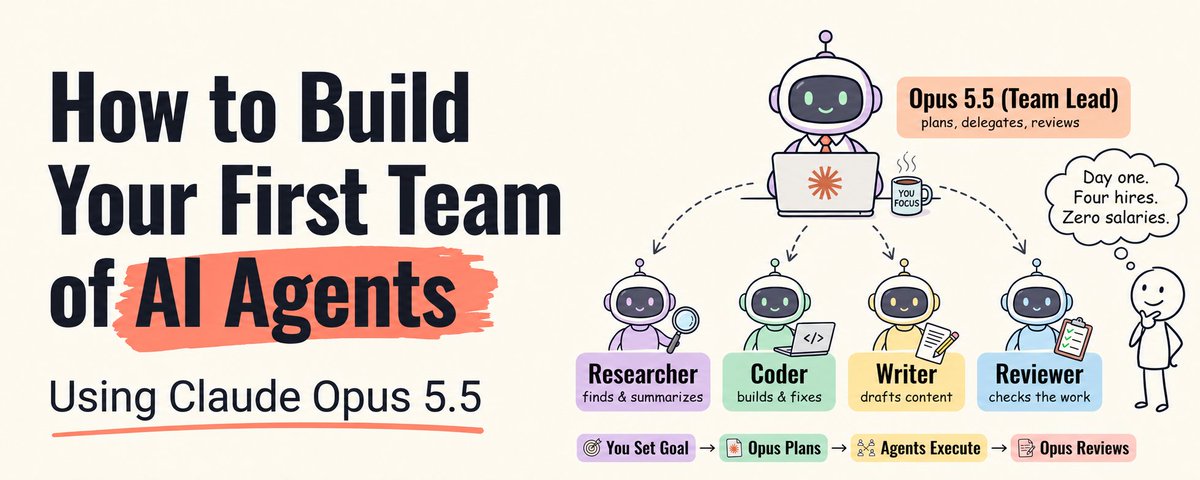
most people are still using Claude like a chatbot
this setup turns Claude Opus 5.5 into an operating system for AI agents
Planner → Researcher → Builder → DOTS + JEV
this is what your first Claude AI agent team looks like in 2026
send this to Claude to set it up:


Dalcimar Casanova Ph.D. retweeted

TU AGENTE DE IA YA PUEDE EXTRAER DATOS DE CASI CUALQUIER WEB
X, YouTube, Reddit, foros random, webs sin API… básicamente lo que necesites para research, análisis o monitoring.
acaban de subir a GitHub 3 herramientas open source que le dan a tu agente ese superpoder.
1. Agent-Reach
junta X, YouTube, Reddit, GitHub y más en un solo sitio.
github.com/Panniantong/Agent…
2. Patchright Enhanced
usa Playwright para escuchar peticiones de webs sin API y sacar los datos con un script.
github.com/whaleyxbt/patchri…
3. Scrapling
scraper de propósito general para cualquier página web.
github.com/d4vinci/Scrapling
le dices qué datos necesitas → escribe el código → los recolecta → te da el resultado.
ejemplos reales:
"recoge los posts de 100 cuentas de X del último mes y dime qué temas están funcionando"
"saca reviews de este producto en Reddit y YouTube y resúmeme las quejas principales"
básicamente le das a tu agente la capacidad de sacar datos de casi cualquier lugar de internet.
eso abre un nivel de automatización que hasta hace nada era impensable.

🚨DESCARGAR CUALQUIER VÍDEO DE INTERNET ACABA DE VOLVERSE GRATIS Y SIN ANUNCIOS
subieron a GitHub una herramienta open source que descarga vídeos de más de 1.800 webs.
YouTube, X, Instagram, TikTok…
pegas el link, eliges resolución (o audio mp3) y ya.
sin popups. sin botones falsos. sin redirecciones.
ni hay que instalarla: con npx Yoinks funciona.
se llama Yoinks.
os dejo el repo abajo.

Dalcimar Casanova Ph.D. retweeted

Mathematical Pathways to Machine Learning, including Calculus, Linear Algebra, and Optimization
Lecture notes for mathematical introductions and foundations for machine learning: zenodo.org/records/21752763

Dalcimar Casanova Ph.D. retweeted

Andrej Karpathy:
"Prompting is fading away
Delete everything else and keep the graph"
In 1 hour, he breaks down why prompting was always a temporary interface and why graphs are the only architectural layer that survives
LLMs → Prompts → Agents → Graphs
Everything before the graph is just a stepping stone
The graph is the endgame
This is not about tweaking text in a chat window
This is about building the state machine that isolates errors, preserves context, and runs parallel agent workflows that never reset
People pay thousands for bootcamps that teach half of this
You probably don't have 1 hour right now
Don't let this vanish from your feed
Watch it first
Then read the full guide on graph engineering below ↓


Dalcimar Casanova Ph.D. retweeted

The absolutely beautiful free hands-on book "Physics-Based Deep Learning Book" by Thuerey et al. (2026) is now in @ChapterPal's collection.
The textbook is an applied guide to physics-based deep learning, also known as scientific machine learning, which blends numerical physical simulations with modern artificial intelligence architectures.
Designed for researchers, engineers, and students with a working knowledge of deep learning fundamentals and basic partial differential equations, the book focuses on practical implementations using deep learning frameworks such as PyTorch, JAX, and the differentiable simulation library ΦFlow.
The textbook, at 350 pages, has 163 illustrations and 39 hands-on coding exercises.
Read the book with an AI tutor: chapterpal.com/book/4d08ce3b…
All books on ChapterPal are free to read with a free account.
Table of contents:
Chapter 1: Introduction
- Welcome ...
* Coming up
* Comments and suggestions
* Thanks!
* Citation
* Time to get started
- A Teaser Example
* Differentiable physics
* Finding the inverse function of a parabola
* A differentiable physics approach
- A Probabilistic Generative AI Approach
* Discussion
* Next steps
- Overview
* Motivation
* Categorization
* Looking ahead
* Implementations
- Models and Equations
* Deep learning and neural networks
* Partial differential equations as physical models
* Some example PDEs
* Preliminaries
* Newton's method
* Approximating the Hessian
* Broyden's method
* BFGS
* Gauss-Newton
* Gradient Descent
Chapter 2: Neural Surrogates and Operators
- Supervised Training
* Problem setting
Chapter 3: Physical Losses
- Physical Loss Terms
* Using physical models
Chapter 4: Differentiable Physics
- Introduction to Differentiable Physics
* Differentiable operators
* Jacobians
* Learning via DP operators
* A practical example
* Backpropagation through solver steps
* Alternatives: noise
* Complex examples
- Reducing Numerical Errors with Neural Operators
* Problem formulation
* Getting started with the implementation
* Simulation setup
* Network and transfer functions
* Training setup
* Interleaving simulation and NN
* Test evaluation
* Next steps
- Solving Inverse Problems with NNs
* Formulation
* Control of incompressible fluids
* Data generation
* Supervised initialization
* CFE pretraining with differentiable physics
* End-to-end training with differentiable physics
* Next steps
- Discussion of Differentiable Physics
* Integration
* Reducing data shift via interaction
* Generalization
Chapter 5: Probabilistic Learning
- Introduction to Probabilistic Learning
* Uncertainty
* Forward or Backward?
* Simulation-based Inference
- Learning a Probability Distribution
* Fundamentals: A Training Objective
* From Unconditional to Conditional
* Learning Distributions with Normalizing Flows
* Practical Example: Learning Gaussians
* A Simple Normalizing Flow based on Affine Couplings
* Neural ODEs: Making Normalizing Flows Continuous
* Summary of Normalizing Flows
- Score Matching
* Gaussian Toy Dataset with Analytic Scores
* Learning the Score
* Langevin Dynamics
* Full Denoising Algorithm
* Training with DDPM
- Flow Matching
* Learning Flows with Velocities
* Mappings and Conditioning
* Score Matching with Differentiable Physics
* Summary of Physics-based Diffusion Models
- Probabilistic Inverse Problem with Differentiable Simulations
* Toy Problem setup
* Conditioning
* Implementation
* Backbone Network Definition
* Variance Schedule
* Diffusion Model Definition
* Training
* Test Dataset
* Test Inference
* Accuracy of the Prediction
* Summarizing Time Predictions with Diffusion Models
- Unconditional Stability
* Main Considerations for an Evaluation
* Comparing Architectures
* Stability Criteria
* Batch Size vs Rollout
* Summary
- Graph-based Diffusion Models
* Diffusion Graph Net (DGN)
* Diffusion on Graphs
* Diffusion in Latent Space
* Turbulent Flows around Wings in 3D
* Distributional accuracy
* Computational Performance
- Distributional Accuracy of Diffusion Graph Nets
* Implementation
* Sample-wise Accuracy
* Evaluating Distributional Accuracy
- Discussion of Probabilistic Learning
Chapter 6: Reinforcement Learning
- Introduction to Reinforcement Learning
Chapter 7: Improved Gradients
- Scale-Invariance and Inversion
* The crux of the matter
* Traditional optimization methods
* Quasi-Newton methods
* Inverse simulators
* NN training
* Loss functions
* Iterations and time dependence
* SIP training in action
* Discussion of SIP Training
- Learning to Invert Heat Conduction with Scale-invariant Updates
* Problem Statement
* Implementation
* Data generation
* Differentiable physics and gradient descent
* Stable SIP gradients
* Neural network and loss function
* Training
* Evaluation
* Next steps
- Half-Inverse Gradients
* Derivation
Chapter 8: Fast Forward Topics
- Additional Topics
- Model Reduction and Time Series
* Reduced order models
* Time series
* End-to-end training
* Source code
- Unstructured Meshes and Meshless Methods
* Types of computational meshes
* Unstructured meshes and graph neural networks
* Meshless and particle-based methods
* Continuous convolutions
* Learning the dynamics of liquids
* Source code
- Generative Adversarial Networks
* Maximum likelihood estimation
Chapter 9: Outlook
- Outlook
* Some specific directions
* Closing remarks
References
Notation and Abbreviations
- Math notation:
- Summary of the most important abbreviations:

Dalcimar Casanova Ph.D. retweeted

I just published: Evolution of LLM Architecture
RNN -> Attention -> Transformer -> Scaling -> MoE -> New Directions
Read here: outcomeschool.com/blog/evolu…
