

My Claude deleted my test and wrote assertTrue.
The Peach Blossom Spring
Joined December 2022
- Tweets6.8K
- Following1.2K
- Followers753
- Likes9.4K







Dalinaum retweeted

现在做 RAG,我觉得有一个特别容易被忽略的问题。
很多人把 PDF 上传、Chunking、Embedding、Vector DB、LLM 这几个模块接起来,发现模型能够根据文档回答问题,就觉得自己已经掌握了一套完整的 RAG 系统。
但实际上,跑通一条检索链路,和真正把企业知识库做好,差得还挺远。
这篇推文把 RAG 的完整流程梳理得很清楚,从 Data Ingestion、Text Chunking、Embeddings、Vector Database,到 Semantic Retrieval、Prompt、LLM Generation,最后是 API Integration 和 Testing & Monitoring。
但我觉得真正值得研究的,不只是这九个步骤本身,而是它们之间的依赖关系,以及每一层究竟可能出现什么问题。
先说数据摄取。
企业知识库里的文档,可能有 PDF、Word、Excel、网页、业务数据库,甚至同一份资料的多个历史版本。
如果最开始的数据就没有清洗好,版本也没有管理好,后面再怎么优化 Embedding 和 Prompt,都可能是在错误的数据上做优化。
然后是 Chunking。
这玩意儿看起来特别简单,不就是把长文档切成几段吗?
但你真做过企业知识库就会发现,怎么切,直接影响后面的检索结果。
比如一个合同条款,前半段写付款条件,后半段写例外情况。
你把它们切开,模型可能只检索到付款条件,最后生成一个看起来非常合理、实际上却遗漏关键限制的答案。
再说 Embedding 和 Vector Database。
很多人以为语义相似度高,就代表检索结果更准确。
根本不是这么回事。
两个产品型号可能只差一个字符,两个合同版本可能有 95% 的内容相同,但实际业务含义可能完全不一样。
这时候纯向量检索未必够用。
你可能需要结合 BM25、Hybrid Search、Reranking,以及文档版本和权限过滤,才能找到真正适合当前问题的证据。
所以 RAG 最值得研究的地方,我觉得不是模型怎么把答案说得更漂亮,而是系统能不能稳定找到正确、有效、被授权使用的信息。
还有一个特别重要的问题,就是很多人分不清检索错误和生成错误。
假设用户问公司最新的产品报价。
系统回答错了。
你第一反应是修改 Prompt,让模型更加严谨?
但如果检索阶段找到的本来就是去年的报价文件,你让模型再严谨有什么用?
反过来,如果最新版报价已经正确进入 Context,模型却自己编造了一个数字,那问题才更可能出在生成阶段。
这两个问题根本不是一回事。
所以真正做 RAG,必须把 Retrieval 和 Generation 拆开评测。
检索有没有找对资料?有没有遗漏关键证据?相关文档排在什么位置?最终回答有没有忠实使用这些证据?
这些问题如果没有数据支撑,你就只能靠感觉反复修改 Prompt,最后系统可能越改越复杂,效果却不一定提高。
而且知识库上线之后,问题并没有结束。
文档更新了,索引什么时候同步?员工的权限变化了,旧数据还能不能被检索?模型升级后,之前正确的问题会不会突然答错?系统响应变慢了,究竟是检索、Rerank 还是模型生成导致的?
这些都是实际企业交付绕不开的工程问题。
当然,也不是说每个 RAG 项目都必须上复杂的多阶段检索、多 Agent 或者分布式向量数据库。
数据规模小、业务需求简单的时候,一套 PostgreSQL 加全文检索和必要的向量能力,可能已经足够。
真正的架构能力,不是把技术栈堆得越来越复杂,而是你能不能根据实际问题判断,应该优化哪一层、引入哪些组件,以及怎样证明它真的有效。
RAG 本质上并不是一个简单的文档问答功能。它更像是一套连接企业知识、信息检索、上下文构建和大模型生成的系统工程。
大模型负责理解和生成,但能不能找到正确的证据,能不能管理数据版本,能不能追踪来源,能不能持续评测和优化,最终还是要靠整套系统设计。
所以真正值得长期积累的,不只是会调用哪个 RAG 框架。
而是当一个知识库回答错误时,你能够清楚地判断:到底是数据出了问题、分块出了问题、检索出了问题,还是模型没有正确使用证据。
能让模型根据文档回答问题,只是 RAG 的起点。
能让整个系统持续找到可信资料,并且在出错时知道为什么出错、该怎么修复,才是我觉得更值得深入研究的方向。


Dalinaum retweeted

🚀 Android Skills v1.0.23 is here!
37 skills, including:
🆕 iOS-to-Android migration
🤖 On-device AI & ML updates
🎨 Jetpack Compose improvements
⚡ AGP 9 upgrade guidance
🛡️ Security, performance & testing
Explore the release 👇
github.com/android/skills/re…
#AndroidDev #Kotlin #AI


Dalinaum retweeted

(Finally) wrote up "Understanding Positional Embeddings in Modern LLMs."
A RoPE from-scratch tutorial missing from my LLM building blocks collection + what recent architectures do (NoPE, partial RoPE, hybrids).
Prob not the flashiest topic, but essential for understanding LLMs


Dalinaum retweeted

CocoaPods、いよいよ一区切りですね。
2026年12月2日、公式Trunkが読み取り専用に。新規公開は止まりますが、既存Podは取得できるので、今すぐ使えなくなるわけではないようです。
まだCocoaPodsに依存しているところは、早めにSwiftPMへの移行を進めておくとよさそうですね。
swift.org/blog/whats-new-in-…

Dalinaum retweeted

거의 한국 웹 전체를 위한 무료 봉사활동에 가까울 정도이지 않나... 감사합니다

제가 Daum에서 오픈한 API 서비스 중, 가장 자랑스러운 것 중 하나가 '개발자를 위한 우편번호 조회 서비스'였는데요. 이제 12년이 흘러서, 라이브러리 호스팅 도메인을 교체해야 하나 보네요. Daum과 Kakao 도메인 분리 때문인것 같습니다. 오랜 기간 하위호환성을 유지해왔지만, 개발 유지 보수가 안되는 사이트를 위해서, 아예 일반 사용자에게 공지를 해야 하나 봅니다. 이 공지가 보이는 웹 사이트는 11월말까지 수정하시기 바랍니다. 🤣
구. Daum 우편번호 조회 서비스가 제공 되기 전까지는, 개별 웹 사이트 회원 가입 시, 우편 번호 검색 기능은 구현도 유지보수도 만만치 않았습니다. 매번 업데이트 되는 우편 번호, 새로 추가되는 주소, 지번 주소와 도로명 주소 등등... 그동안 개발자들의 수고를 많이 덜어주었을 뿐만 아니라 국민 편익에 상당히 영향을 주었습니다. 앞으로도 중단되지 않고 계속해서 서비스를 제공해 주었으면 하는 바램이네요.


Dalinaum retweeted

제가 Daum에서 오픈한 API 서비스 중, 가장 자랑스러운 것 중 하나가 '개발자를 위한 우편번호 조회 서비스'였는데요. 이제 12년이 흘러서, 라이브러리 호스팅 도메인을 교체해야 하나 보네요. Daum과 Kakao 도메인 분리 때문인것 같습니다. 오랜 기간 하위호환성을 유지해왔지만, 개발 유지 보수가 안되는 사이트를 위해서, 아예 일반 사용자에게 공지를 해야 하나 봅니다. 이 공지가 보이는 웹 사이트는 11월말까지 수정하시기 바랍니다. 🤣
구. Daum 우편번호 조회 서비스가 제공 되기 전까지는, 개별 웹 사이트 회원 가입 시, 우편 번호 검색 기능은 구현도 유지보수도 만만치 않았습니다. 매번 업데이트 되는 우편 번호, 새로 추가되는 주소, 지번 주소와 도로명 주소 등등... 그동안 개발자들의 수고를 많이 덜어주었을 뿐만 아니라 국민 편익에 상당히 영향을 주었습니다. 앞으로도 중단되지 않고 계속해서 서비스를 제공해 주었으면 하는 바램이네요.
Dalinaum retweeted

I led Kotlin design and development, but I was never an Android developer. Always had an iPhone. Now I bought myself a new Chinese toy: a power bank with Android on wheels. Now I’m an Android developer.
Dalinaum retweeted

NVIDIA released a new looped transformer:
Instead of stacking more layers, it runs the same layers multiple times so a 4B model can think like a 9B one.
Here's how it works:
In a standard transformer, every token passes through a stack of decoder blocks once, and each block has its own weights.
So if you want a deeper model, you add more blocks, and the parameter count grows with the depth.
NVIDIA's Dory1.0-4B decouples the two by reusing a chunk of its layers.
The model is split into three parts:
> An input block of 8 blocks runs once and turns the tokens into a hidden state x.
> A recurrent block of 20 shared blocks runs k times, where k can be anywhere from 1 to 4.
> An output block of 8 blocks runs once on the final state, followed by the LM head.
Before every pass through the recurrent block, x is added back to the current state and the sum is L2-normalized.
This keeps the original token representation in view on every pass, instead of each pass only seeing what the previous one produced.
Both models in the diagram below store 36 blocks of weights.
The standard transformer applies each block once, while Dory applies 36 blocks at k=1, 56 at k=2, and 96 at k=4, i.e., 72, 112, and 192 physical layers from the same checkpoint.
The extra depth is actually helpful on reasoning and agentic tasks:
> SWE-bench Verified:
- at 1 loop → 50.3
- at 2 loops → 59.5
- at 4 loops → 61.8
> 12-benchmark average:
- at 1 loop → 35.17
- at 2 loops → 39.67
- at 4 loops → 40.60
- and with 2 or more loops, it beats Qwen3.5-9B, Gemma 4 12B, and Gemma 4 26B-A4B.
More loops implies more compute per token, but the 4-loop model also writes 1.3x to 2.5x fewer output tokens on agentic tasks.
So 2 loops end up costing only 1.03x to 1.25x the compute of 1 loop end to end, which is why NVIDIA recommends 2 as the default.
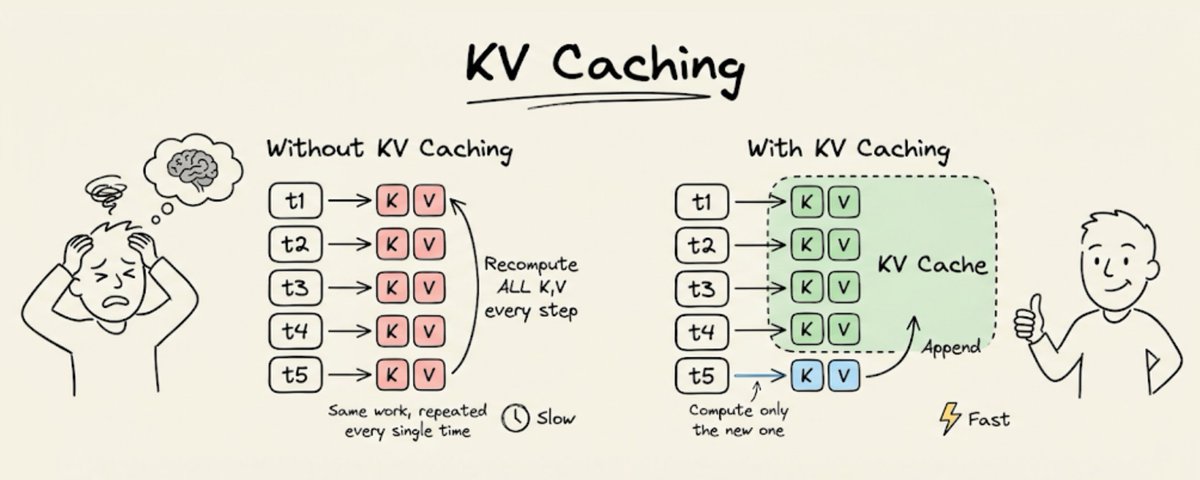
By default, Dory keeps a separate KV cache for every loop, so at 4 loops the recurrent layers store 4x the cache.
To avoid this, it can keep only the cache from the last loop, which uses the same KV memory as a normal model with only a small change in accuracy.
One thing to note here is that looping helps the model reason over what it already knows, but it does not add knowledge.
For instance, on tasks like AA-Omniscience, accuracy stays at 10.0 whether you run 1 loop or 4, and on knowledge-heavy tasks like GPQA, Dory still trails Qwen3.5-4B.
Here's the paper: arxiv.org/abs/2611.03998
That said, how much memory looping costs comes down to how the KV cache is handled, so I wrote a full breakdown of how KV caching works.
It covers what gets cached during prefill, how the cache grows during decoding, and why it becomes the main memory bottleneck at long context.
Read it below.



Dalinaum retweeted

Putain, mais plus je regarde l'histoire de 1945 en Asie, plus ça me rend fou, bordel.
Chez nous en Europe, les boîtes allemandes qui ont bossé avec les nazis ont dû cracher des milliards et demander pardon à genoux. C'est la base.
Mais au Japon ? Des énormes entreprises qui ont utilisé des esclaves pendant la guerre existent toujours tranquille, refusent de s'excuser, et nos médias les sucent en disant "oh quelle belle culture".
Je suis pas historien, juste un Français normal.
Mais sérieux, c'est quoi ce délire ? Pourquoi ce qui est impardonnable chez nous devient normal dès que c'est en Asie ? Faut arrêter de nous prendre pour des cons.


Dalinaum retweeted
🚀 Kotlin 2.5.0-RC is here!
🔥 Multi-Field Value Classes (Alpha)
⚡ Compiler & type inference fixes
🌍 Kotlin Multiplatform, Native, JS & Wasm improvements
🛠️ Compose, Gradle & Serialization updates
📦 JVM Reflection & tooling fixes
github.com/JetBrains/kotlin/…
#Kotlin #AndroidDev


Dalinaum retweeted

Free Stanford Course: "CS193T Thinking with AI"
No prior experience or technical knowledge required
All course materials including slides and weekly hands-on assignments
web.stanford.edu/class/archi…
