

I develop mechanistic machine learning tools for single-cell and spatial omics data to understand the regulatory patterns underlying human disease dynamics.
Cambridge, MA
Joined September 2014
- Tweets366
- Following1.1K
- Followers1.7K
- Likes827




David Fischer retweeted

🚀 We are introducing PerturbPair (with @TakaKud0) — a platform that combines parallel Perturb-seq and optical pooled screening (OPS/PerturbView) in primary cells to systematically map at massive scale how genetic perturbations reshape cellular states across modalities.
With wonderful collaborators @TakaKud0, @AnaMeireles, @AntRios, @jchuetter, @MinOta, @ORozenblattRosen, @LeviAGarraway, @KGeiger, @avtarsingh, @jkpritch, and Aviv Regev.
Paper link: biorxiv.org/content/10.64898…

David Fischer retweeted

kai: Notebook-based alignment of human and agentic reasoning in single-cell biology biorxiv.org/content/10.1101/…

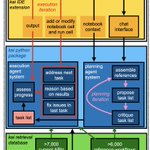
kai is an assistant for single-cell biology optimized for human-agent collaboration. Like AI assistants in other domains, kai enhances human efficiency while maintaining accountability – a key advantage over fully autonomous systems in science.
Find out more:
Preprint: biorxiv.org/content/10.1101/…
Code: github.com/davidfischerlab/k…
Blog: ai4biomedicine.org/agenticai

The output of kai’s reasoning process is this Jupyter notebook: a transparent documentation of all analyses performed and decisions made. Human scientists can inspect, modify, and give feedback on each step of the analysis.

We tested kai on complex scenarios in single-cell biology. kai consistently completed analyses and reasoned (LLM reasoning + analysis execution) for longer than 20 minutes.
kai interacts with human scientists through a chat interface in VS Code and directly edits and executes Jupyter notebooks. This design enables kai to autonomously perform analyses while maintaining full accountability.

This motivated us to build kai: an agentic AI that uses Jupyter notebooks – the same interface that humans use to collaborate.

We started by asking: how do humans build trust with each other? In collaborations, they document their reasoning in computational notebooks, e.g. Jupyter notebooks.
For example, how can I verify the product of 20 minutes of autonomous work by an agent without blindly hoping that it didn’t hallucinate at a key decision point at minute 5?
In cell biology, agentic AI systems need to reason over text, code, and analysis results. How do we ensure accountability in this complex multimodal setting to inspire trust in the predictions made by agents?
David Fischer retweeted

Our featured article: Adapting systems biology to address the complexity of human disease in the single-cell era go.nature.com/4lU3Zvs #Review by @davidsebfischer, @mav_tweets, @peterswinter & @shaleklab
@broadinstitute @mit @ragoninstitute
David Fischer retweeted

A shift in perspective: #systemsbiology and single-cell genomics are transforming how we study disease. Learn more in a new Nature Reviews Genetics perspective by @Schmdit_Center alum @davidsebfischer, Martin Villanueva, @peterswinter, and @shaleklab. #omics @broadinstitute

Currently, there's a lot of interest in quantitative models that would help us understand and predict features of the complex cellular systems that underlie human health and disease - think about virtual cells, for example.

New online! Adapting systems biology to address the complexity of human disease in the single-cell era bit.ly/4ieR5qj

In summary, we outline how systems biology is being adapted to the multiscale dynamics of human health and disease in omics-driven as what is effectively a two-loop cycle over discovery and validation.
This review is the product of a great team effort together with Martin Villanueva, Peter Winter @peterswinter and Alex Shalek @shaleklab! nature.com/articles/s41576-0… & rdcu.be/ecTna