

Founder & CEO @cerbereag The control infrastructure for autonomous AI agents operating across real-world @luviaplace to be passionate about what I've done
Joined September 2026
- Tweets483
- Following298
- Followers132
- Likes629


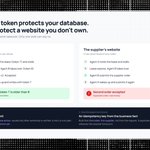


Cerbere-AG is a three-layer security guardrail for AI agents: Regex, ML, and an LLM Judge.
AI agents are unpredictable. They improvise and act with full autonomy. I built Cerbere-AG (named after the three-headed dog, Cerberus) so that autonomy doesn’t come at the cost of control.
Why three layers? Our benchmarks show it:
→ Regex alone lets more than 30% of attacks through.
→ ML pushes recall up to 100% in some of our tests, but raises false positives.
→ The LLM Judge resolves the ambiguous cases ML can’t classify.
It also looks at context. Cerbere-AG follows tool calls, checks whether they’re legitimate, and then allows them, blocks them, or flags them for real-time human approval. Agents keep their autonomy, and humans keep control.
Everything is audited too. The collector gathers spans and traces into an audit trail that is independent from the agent and supports compliance.
And like any tool, it has limits. That’s why observability matters: security isn’t only about blocking attacks, it’s about understanding what happened, what was allowed, what was blocked, and why.
Open source and free for now. Try it and give me your honest feedback 👇
github.com/chrismsmr-celcom/…
app.cerbereag.site
Hi,
Cerbere is designed to enforce security at the execution boundary, rather than relying on the agent to follow security instructions.
For MCP-based workflows, Cerbere can operate as a gateway between the agent and downstream MCP servers. Tool calls pass through the gateway, where policies are evaluated before execution. Depending on the policy, Cerbere can allow, block, flag, or require human approval for an action.
A few principles guide the design:
Independent enforcement: Security decisions are made outside the agent’s reasoning loop. The agent cannot simply instruct Cerbere to ignore a policy.
Default-deny controls: Restricted tools and actions can be blocked unless explicitly permitted.
Signed decisions: Enforcement decisions can be cryptographically signed to prevent unauthorized modification or forgery.
Auditability: Decisions and execution events are recorded to provide traceable security evidence.
Data protection: Taint tracking and sensitive-data detection help prevent confidential information from reaching unauthorized external tools or agents.
An important distinction: Cerbere cannot guarantee protection if an agent has unrestricted access to execution paths that bypass the gateway or SDK instrumentation. Our approach is to reduce that attack surface through controlled execution paths, explicit permissions, and fail-closed enforcement.
The goal is not to trust autonomous agents, but to make their interactions with external tools and systems enforceable and auditable.
9
Full source, trust model docs, and MCP gateway setup:
github.com/chrismsmr-celcom/…

13
Most “AI agent security” right now is just a regex or a classifier slapped in front of a prompt.
That works until Agent A delegates a task to Agent B, which calls an MCP server with inherited credentials and leaks PII or executes a destructive tool call.
Here is the uncomfortable truth: an agent must not gain authority just because another agent called it.
Right now, too many multi-agent stacks rely on implicit trust passing caller-supplied agent names, sharing broad API tokens across sub-agents, and hoping prompt instructions hold the boundary. In distributed systems, we already know how that ends: privilege escalation and zero forensic accountability.
Securing a single prompt or a single tool call isn’t enough. When agents act autonomously inside business systems, teams need deterministic answers to four questions:
1. Which agent is actually acting?
2. What authority does it hold?
3. Where did that delegation come from?
4. What happened as a result?
We’re building Cerbere as the open-source trust infrastructure underneath agent systems not another orchestrator or framework, just the runtime boundary:
→ Identity: Registered machine identities strictly separated from human users. No trusting self-reported caller names.
→ Explicit Delegation & AuthZ: Organization and agent-level policies, tool allowlists, spend/call budgets, and signed runtime decisions. Cross-agent authority has to be explicit and verifiable.
→ Runtime Enforcement: SDK guards + an MCP gateway that inspect tool calls before execution—allowing, blocking, or gating behind human approval.
→ Data Boundaries: Taint tracking for secrets and PII across guarded tool flows so sensitive data doesn’t quietly bleed outbound.
→ Tamper-Evident Evidence: Execution traces, risk decisions, and hash-chained audit records with signed checkpoints for real incident investigation.
If you’re running multi-agent workflows or exposing internal tools over MCP in production, how are you handling cross-agent delegation and least privilege today or are your agents still sharing the same god-mode key?
Code & architecture specs in the repo below 👇


6
2
65
We’re building the foundations for secure, auditable AI agents. The future of AI security starts with infrastructure. Let’s build it right.
Follow our journey.
github.com/chrismsmr-celcom/…

9
Today was a solid engineering day at Cerbere AG.
We merged PR #74 and #75, advancing our core security architecture:
Async event processing with fail-closed enforcement.
Persistent, tenant-scoped agent data provenance.
PostgreSQL and SQLite support.
Data lineage with classification, source tracking and SHA-256 fingerprints.
CI green. Both PRs merged.
We’re building the infrastructure to secure, trace and control AI agents from decision to execution.
One commit at a time. Still building. Still shipping
1
2
33
AI agents should never automatically inherit the full permissions of the person using them.
They need their own identity, scoped permissions, and runtime enforcement.
But access control alone isn’t enough. Even an authorized agent can make a dangerous decision.
At @CerbereAg, we’re building runtime security to inspect agent decisions and tool calls before execution, with the ability to block, flag or request human approval.
The goal isn’t to remove agent autonomy. It’s to make sure autonomy doesn’t become unrestricted access to production.
9
Interesting approach. We’re building in a related space with : github.com/chrismsmr-celcom/…
Torii focuses on orchestrating coding agents from one interface. Cohort focuses on coordinating their work, preventing conflicts and preserving progress when agents pause, resume or work in parallel.
Different layers of the same emerging infrastructure problem.

1
42
The missing layer is runtime control.
Giving an agent permission to spend money doesn’t mean every action it takes should be trusted.
You need to verify its authority, enforce limits, inspect its decisions and tool calls, and maintain an auditable record of what happened.
That’s what we’re building with @CerbereAg : runtime security and observability for autonomous agents, from decision to execution.
Authorization defines what an agent can do. Runtime controls help ensure it doesn’t go beyond that.
2
Interesting. As agents move onto our desktops and gain access to local tools and data, security becomes critical. That’s what we’re building Cerbere AG for: runtime security and control over what AI agents can access and execute, without taking away their autonomy.
github.com/chrismsmr-celcom/…
17
That’s exactly what we’re building Cohort to solve: a shared coordination layer that keeps AI coding agents in sync across tools and sessions, without manual handoffs or Markdown files.
GitHub: github.com/chrismsmr-celcom/…
2
24
If you hate sending AGENTS.md, TASK.md, and other Markdown files back and forth just to keep your AI coding agents in sync, Cohort is built to solve that.
No more manual context handoffs. Let your agents share project state, coordinate tasks, and pick up where others left off.
4
48
We use a layered detection approach: fast deterministic checks for clear threats, ML classification, and an LLM judge for ambiguous cases. We also evaluate the context of the action, not just isolated tool calls. The goal is to reserve alerts for meaningful risks, not generate noise.
2
This is exactly the approach we want to take. Fail-closed must be verifiable, not just a promise. We are working to test these failure scenarios and to make the results measurable with each release.
1
Works alongside the frameworks you already use: @LangChain , @crewAIInc , @OpenAIDevs, @llama_index, @pydantic and more other
Connect via:
* MCP
* HTTPS Gateway
* Python SDK
Ability to send traces to your existing observability provider via OTLP, etc.
1
14
I’m introducing Cohort by Cerbere (Beta).
We’re building infrastructure that allows multiple AI agents to work on the same project without overwriting, conflicting with, or destroying each other’s work.
One critical problem: an agent pauses when it runs out of tokens. When it resumes, it may be unaware of changes made by other agents and overwrite their progress.
We studied existing approaches, gathered feedback, and combined several solutions into one system: Cohort.
Multiple agents. One shared workspace. No stepping on each other’s work.

4
9
257
Today, we took another step toward making autonomous AI agents safer. We built Cerbere AG to secure every agent action before execution.
No rigid hardcoded rules. We evaluate context and trajectory.
When an agent is about to make a dangerous decision, you’re notified in real time and can approve or block it.
Autonomy, with control.
github.com/chrismsmr-celcom/…
2
5
104