

Physics,Math,consciousness theory,Steel industry,formulae for the elementary particles masses,quantization of gravity,grav. uncertainy principle,3D explanation·
Slovenia
Joined September 2022
- Tweets2K
- Following168
- Followers39
- Likes12K


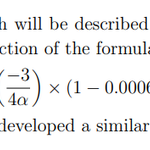


My equations (2) and (8) for the gravitational coupling constant of the electron:
vixra.org/abs/1103.0025
Later it was independently repeated by Valentino Straser:
scirp.org/pdf/jmp_2021062414…

e^137 #Formulae_for_the_elementa._particles_masses retweeted

A function can stretch, bend, and reshape space. The Jacobian matrix tells you exactly how it changes things at a particular point.
Each entry is a partial derivative, measuring how one output responds to a small change in one input. That’s why the Jacobian is so useful in machine learning, where tiny changes pass through layers of complex functions.
The fascinating part is that even a nonlinear function has a local linear approximation. The Jacobian is the mathematics behind that idea.

e^137 #Formulae_for_the_elementa._particles_masses retweeted

Cómo el dolor crónico altera los circuitos emocionales y cognitivos del cerebro El dolor crónico no es simplemente una sensación prolongada de malestar. Implica cambios en la forma en que el cerebro procesa la información sensorial, regula las emociones y sustenta las 👇

e^137 #Formulae_for_the_elementa._particles_masses retweeted

This is Europe in 500 AD, a generation after the last Western Roman emperor was deposed.

e^137 #Formulae_for_the_elementa._particles_masses retweeted

Primes look random until you start watching them closely.
The sieve doesn’t just remove composites. It leaves a residue pattern that keeps repeating at every scale, even as the numbers get larger.
By the time you reach a few hundred, the gaps between primes are already bigger than the early ones, yet the density still follows the same slow decline predicted by the prime number theorem.
π(x) grows roughly like x / ln x. The formula doesn’t tell you where the next prime is, but it does tell you that the gaps cannot stay small forever.
The same process that produces twin primes also produces long stretches with nothing. Both behaviors come from the same underlying distribution.
Most of the interesting structure sits in the tension between these two facts: primes become rarer, but they never quite disappear.
Everything else > the spiral, the residues, the occasional large gaps > is just a visible trace of that tension.
e^137 #Formulae_for_the_elementa._particles_masses retweeted

sqrt2 + sqrt3 = 3.1463. pi = 3.1416. That is not a coincidence.
Draw a circle of radius 1. A square inside it has sides of sqrt2, so its perimeter is 4 sqrt2 = 5.657. A hexagon around it has perimeter 4 sqrt3 = 6.928.
The circle's perimeter, 2pi = 6.283, sits between them. Average the two outer ones and you get 6.293, only 0.15% off. Halve everything and sqrt2 + sqrt3 ~ pi.
A circle squeezed between two easy shapes.

e^137 #Formulae_for_the_elementa._particles_masses retweeted

Here’s the comfortable weather map for Europe.
“Comfortable” means:
- 18–33°C
- Not rainy
- Not windy
Mediterranean remains undefeated.


e^137 #Formulae_for_the_elementa._particles_masses retweeted

The next era of physics is going to be unreal.
Reality keeps getting weirder
"We have succeeded in moving centimeter scale objects using only the force generated by quantum spin. This is the first time that an object of a size visible to the naked eye has been observed moving due to quantum forces. This achievement represents an important step toward realizing macroscopic quantum superposition and a unified understanding of physics."

量子スピンが生み出す力だけで数センチメートル規模の物体を動かすことに成功。肉眼で見える大きさの物体が量子力によって動いたのが観測されたのは初めてです。この成果は、巨視的な量子重ね合わせの実現と物理学の統一的理解に向けた重要な一歩となります。@ScienceAdvances oist.jp/ja/news-center/news/…

e^137 #Formulae_for_the_elementa._particles_masses retweeted

Primes appear erratic, yet infinity reveals profound hidden order.
Individual primes scatter unpredictably, but their macro-scale distribution obeys a smooth logarithmic law.
As x → ∞, the ratio of π(x) to its continuous approximation converges precisely to 1.
Chaos and calculus unite to reveal the eternal symmetry of numbers.

e^137 #Formulae_for_the_elementa._particles_masses retweeted

Car color and crash risk:
Black - 47% more likely
Grey - 11% more likely
Silver - 10% more likely
Blue - 7% more likely
Red - 7% more likely
Car colors with the least accidents:
White
Yellow
Orange
Gold
e^137 #Formulae_for_the_elementa._particles_masses retweeted

The shitty weather, being on birth control and sleeping around from age 14, antidepressants and social media addiction


e^137 #Formulae_for_the_elementa._particles_masses retweeted

In 2013, Yitang Zhang proved something mathematicians had been unable to establish for centuries.
There are infinitely many pairs of primes separated by less than 70 million.
The number 70 million sounds enormous, but the breakthrough was that the gap could be bounded at all.
Before Zhang, nobody had proved that infinitely many prime pairs stay within any fixed distance.

e^137 #Formulae_for_the_elementa._particles_masses retweeted
Ramanujan noticed that ⁴√(2143/22) = 3.14159265258…, while π = 3.14159265358…, an error of about one billionth.
The reason is hidden in π⁴. Its continued fraction is
π⁴ = [97; 2, 2, 3, 1, 16539, 1, 6, …]
Stopping just before the giant 16539 gives [97; 2, 2, 3, 1] = 2143/22. A cut before a huge term is unusually accurate: the error is about 1/(22²·16539) ≈ 1.25×10⁻⁷ in π⁴, so about 10⁻⁹ in π.
Continued fractions are how calendars, gear ratios and musical tunings find their best fractions.

e^137 #Formulae_for_the_elementa._particles_masses retweeted

Nearly everything published about quantum physics in the brain is nonsense. Now a physicist in Istanbul has come up with something different. No exotic new physics required, and it's testable, too. youtube.com/watch?v=ehba2U4o…

e^137 #Formulae_for_the_elementa._particles_masses retweeted

Types of girls who are worth marrying:
1. A girl who avoids late night parties.

e^137 #Formulae_for_the_elementa._particles_masses retweeted

The value of x for x^x = 10 is extraordinarily close to
√(2π).
There is no known deep geometric or algebraic
reason connecting the two.

e^137 #Formulae_for_the_elementa._particles_masses retweeted
AI will soon rewrite the Map of Math, far beyond human comprehension. The new map will be a thing of beauty, for us to admire and aspire to study, like some gigantic growing crystal.
Do you know the artist to credit? Source: math.stackexchange.com/quest…

e^137 #Formulae_for_the_elementa._particles_masses retweeted

The shortest physics paper ever published is the 1951 Physical Review note by Friedrich Lenz, titled
“The Ratio of Proton and Electron Mass.”
At just 27 words long (plus one equation, one number and a single reference).

