

Scientist and Professor @IIITDelhi Pioneering Computational Gastronomy, a blend of food, data science & artificial intelligence. Making food computable
New Delhi, India
Joined April 2009
- Tweets2.5K
- Following998
- Followers1.4K
- Likes6K





Pinned Tweet
The National (UAE) highlights computational gastronomy research from our lab.
"The Indian academic making the world look at flavours and food in a fresh way," Tania Bhattacharya, The National (UAE).
thenational.ae/lifestyle/foo…

Ganesh Bagler retweeted

Catch all the moments of IIIT-Delhi's #15thConvocation Ceremony LIVE on our official YouTube channel.
Date & Time: 3rd Nov, 11 AM onwards
Watch LIVE: youtube.com/live/4lfxYd1UMtc…

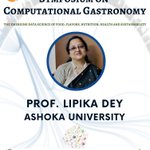
The eighth edition of 'Symposium on Computational Gastronomy' will be held on Saturday, the 12th December 2026 at IIIT-Delhi.
When: Sat, the 12th of Dec 2026
Where: R&D Block, IIIT-Delhi
Agenda: Celebrating the Rise of Computational Gastronomy as a Global Science

Among other eminent speakers, we will have Prof. Lipika Dey, who will be speaking on 'Food Safety Under the AI Lens: Linking Regulations, News and Judicial Decisions'.
This talk will explore how knowledge graphs and AI-driven text analytics can integrate food safety regulations, news articles, and court judgments into a unified framework for evidence-based analysis.
Register: iiitd.ac.in/gastrosym2026/
Ganesh Bagler retweeted

Thank you to Grant Sanderson @3blue1brown for having me on his podcast – and I hope you enjoy our open-hearted, tentative, exploratory conversation about math in the age of AI. We tried out a lot of ideas on each other. youtu.be/xUSznTR2cwc

Pune Knowledge Cluster Presents AInspire series!
🍲 Title : *How AI Can Transform the Future of Food?*
📅 Wed, 18 November 2026
🕓 4:00 PM – 5:00 PM (IST)
📍 IISER Pune
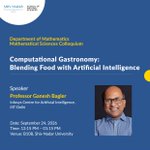
🎙️ Prof. Ganesh Bagler, (IIIT-Delhi)
🔗 *Registration Link*
forms.gle/UJXpL5Eippk98KGu6

Do join the talk and interact with Prof. Ganesh Bagler, a pioneer in Computational Gastronomy and explore how AI and data science are transforming the way we understand food and discover a fascinating question: Can a computer think like a chef? 🤖👨🍳
Ganesh Bagler retweeted

Can AI invent the next Butter Chicken?
Inspired by Dr. @gansbags and his work on computational gastronomy, I explore this question in my latest Masaledar post.
AI can analyse, find patterns and help us think in new directions. But can it invent a dish we've never tasted before?
At @GliscoKitchens, we're exploring that question through Umami, our in-house food intelligence tool.
That's the rabbit hole I'm exploring these days.
masaledar.substack.com/p/can…

Ganesh Bagler retweeted
What an incredible day! 🙌
I had the pleasure of spending time with Dr. @gansbags today, enjoying delicious food from Tadka Rani and exchanging ideas on AI, food, innovation, and the funny story behind building hatjabhai.com.
Dr. Bagler is truly a brilliant mind, and every conversation with him leaves me inspired and excited about the endless possibilities at the intersection of food and technology.
I can only imagine how enriching it would be to join his course and spend four semesters learning from him, challenging the way we think about food, and exploring how we can shape the future of food through science, technology, and innovation.
Grateful for conversations that spark curiosity, broaden perspectives, and inspire us to think bigger about what’s possible! 🙌

Ganesh Bagler retweeted

Ashoke Sen has been awarded the prestigious Oskar Klein Medal for 2026, becoming the first Indian physicist to receive the honour.
Previous recipients include Nobel laureates Chen-Ning Yang, Steven Weinberg and Hans Bethe, who received the medal in its first three years.


Ganesh Bagler retweeted

Folks, here is a very interesting webinar/seminar/roundtable [whatever you want to call], i am hosting on 21st.
I will ask straight, honest (and controversial) questions to the panelists who are a mix of IAS officers, funders as well as those who are in-between.
The topic while is around AI, but I will be more concerned with open source systems (AI and otherwise) and what needs to be done to enable. More importantly, is it even useful !!
Do register and join. Also, if you join, do send me questions here.

Ganesh Bagler retweeted

The third talk of the dasara lecture series is by Prof l S Shashidhara, Director, @NCBS_Bangalore .
📅 Sunday, 25 October, 5:30 PM
📍 C V V Auditorium, U R Rao Bhavana, JNP Campus
✅ Entry free
Register: tinyurl.com/DasaraLectures20…

Ganesh Bagler retweeted

Lecture | A Glimpse Into the Quantum World
Join Professor Arvind @arvind_iiserm for a journey through the remarkable story of quantum physics, from the First Quantum Revolution and the birth of quantum mechanics to the emerging Second Quantum Revolution of today.
📆 18 October 2026, Sunday
⏰ 11am–1pm
📍 Science Gallery Bengaluru
For details and free registration, please visit the Programmes link in our bio or the URL quantum.scigalleryblr.org/pr…
@JahnaviPhalkey

Ganesh Bagler retweeted

Fourth version of the workshop on writing and publishing scientific research. Only for scientists and science faculty working in India.
scienceandmediaworkshops.wor…

Ganesh Bagler retweeted
We are delighted to announce that a paper titled ‘What Do Audio Models Really Hear? Layer Selection and Mechanistic Structure in Sound Representations’, authored by our student Arnesh Batra (B.Tech. CSAI, Class of 2027), has been accepted for publication in the NeurIPS 2026, Main Track (Poster). NeurIPS 2026 is the 40th Conference on Neural Information Processing Systems, one of the leading international conferences in machine learning, artificial intelligence, and computational neuroscience.
The paper studies how audio foundation models learn and organize information across different layers, and how this changes depending on how the models were trained. The author analyzes a wide range of audio models across speech, music, and general sound tasks, using representation geometry, probing, and mechanistic interpretability techniques. One of the key findings is that the final layer is often not the most useful. In many cases, earlier layers already contain the information needed for downstream tasks, suggesting opportunities to make these models more efficient by selecting or pruning layers. The broader goal is to move beyond simply understanding what models learn and use those insights to make practical decisions about their architecture and efficiency.
An earlier version of this research was also presented at the ICML 2026 ML4Audio Workshop.
Congratulations to Arnesh for this remarkable achievement.
#IIITD #ResearchatIIITD #MachineLearning #NeurIPS2026

