

A contingent historical fluke @iitbhuglobal
भारत
Joined July 2012
- Tweets434
- Following336
- Followers30
- Likes2K




The tattoo turns an abstract, weightless thought into a concrete, permanent law of your existence.
The single force (inertia) controls most of our lives. And the tattoos amplify this force in a human being.
One can argue that the tattoos can be linked to a profound realization.


The universe does not reward the process intensity. It is indifferent.
You control only the action, never the fruit.
Identification with outcome is self-inflicted bondage, not cosmic punishment.
Focus on process is the ultimate freedom, not a tactic to extract better results.

1. Discipline with spontaneity
2. Always move towards sincerity
3. Do anything with full consciousness

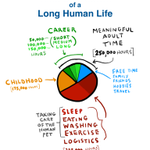
I think ambitious people should treat life in “seasons” rather than trying to balance everything every day.
A few years massively overallocated to work. A period getting seriously fit. A year or two nomading. Then family takes priority for a while. Then maybe at 35 you go completely insane again and spend four years building a new company, and so on.
The mistake is thinking every metric needs to stay green all the time. Most great outcomes (building a company, writing sth serious, training for an event) need uninterrupted runs, not daily moderation. Sometimes work should suffer cause you’re travelling, sometimes your social life should suffer cause you’re building, sometimes career progression should slow cause family matters more. That’s fine.
And tbh it probably makes life more fun too. You get actual chapters and completely different versions of yourself instead of spending 40 years maintaining the same perfectly optimised routine. A few intense years in one city, a weird nomad phase, an obsession that takes over your life, then something completely different. Probably much more memorable than one very long well-optimised Tuesday.
It's why I encourage everyone to think of balance in years, not days. A good life can look horribly unbalanced on some random Tuesday and still be very balanced over 10 years.
This is just the downside. The upside is that one slowly starts to listen to its heart over the brain eventually.
I truly believe, heart’s quiet wisdom is far better than brain’s intellectualization.
Thus, one will choose never-ending engagement, inspiration and concentration.

People who spend long periods of time at home and slowly lose the desire to go outside often think they're just resting. But psychologically, many of them are experiencing something called mental rumination. It's a state where the brain starts slowing down while the number of thoughts inside keeps increasing and the motivation to do anything slowly disappears. The mind gets stuck in the past, worries about the future and burns itself out. This isn't laziness, it's a nervous system stuck in survival mode. And the longer it lasts, the more distant normal life begins to feel. And the difficult part is that you usually can't escape it through one massive burst of motivation. And sometimes,recovery starts with just one small step.
Very few people realise/agree with this tweet in our country.
Real intent, clarity and truth stay scarce in India’s thick mistrust, noise and short-termism.
During growth phases, scarcity compounds faster. Especially in tradable services, selected manufacturing, and technology.

India is the next land of opportunity. I can’t comment on the salary part, but over the next few years, anyone who genuinely wants to work hard and contribute sincerely will find tons of opportunities. And people who demonstrate accountability, intelligence, and the willingness to take ownership will rise very quickly.
Arvind Poonia retweeted

Everything you own was manufactured. The knowledge of how (which parts, which materials, which machines) is concentrated in a small number of companies and countries.
More people who can read a BOM means more people who can make things. And making things is where most of the economic value is created. BOMwiki tries to lower the first step: seeing what products are actually made of.
bomwiki.com

His message was that perfect knowledge of creation is only possible through the experience and understanding of the non-changing part of one’s own being (Jnana) followed by the knowledge of the ever-changing world (Vijnana).
His life exemplified this message.

Next in who after the Bibha Series? He was a Himalayan monk who solved the mysteries of the atomic nucleus. Swami Jnanananda born as Bhupathiraju Lakshminarasimha Raju (1896-1969) was the Ghost in saffron who worked in the world's most elite nuclear labs. He did not see a conflict b/w the Vedas & Beta-Rays; to him, the electron was just another dance of the divine. He built the machines that allowed us to see the energy holding the universe together, then went back to his Saadhna. He is the titan who bridged the gap b/w the ancient sage & the modern scientist... a man who proved that the deepest silence & the fastest particles both lead to the same truth.
Born in 1896 in Andhra Pradesh, he began his life as a seeker. He took Sanyas early in life, spending yrs in deep meditation in the Himalayas. He was a master of the Vedas. He realized that to understand Creation, he needed to understand the Atom. He traveled to the West in his saffron robes, stunning profs at Dresden (Germany), Liverpool, & Ann Arbor (USA).
He earned his DSc. & Ph.D. while maintaining his monastic vows. He was a man who could discuss the Upanishads in the morning & Beta-Ray Spectroscopy in the afternoon. He was a pioneer in Nuclear Spectroscopy. He designed & built advanced Magnetic Lens Beta-Ray Spectrometers.
He was obsessed with how electrons (beta particles) are emitted from the nucleus. His work provided the precise measurements needed to understand the Binding Energy of the atom, the force that holds reality together.
He was 1 of the founding pillars of the National Physical Laboratory (NPL) in Delhi & later established the Nuclear Physics department at Andhra University. He was a Ghost because he defied classification. In the lab, he was the rigorous Dr. Jnanananda; in the temple, he was the revered Swami. He proved that the Silo of Science & the Silo of Spirituality are actually the same room.
Because he was a Monk, many Modern scientists were uncomfortable with him. Because he was a Nuclear Physicist, many traditionalists did not understand him. He lived in the Neutral Zone. He was invited by the Soviet Union & the US to speak at the highest levels of Nuclear Science, yet in India, his name is almost never mentioned alongside Bhabha/Sarabhai.
He worked with Nobel laureates like James Chadwick (the discoverer of the neutron), who respected him as a peer. He wrote High Vacua, a foundational text for experimental physics. He treated the Vacuum not as nothingness, but as the source of everything.
There are no national science awards named after him. He is a Ghost whose work is buried in the foundations of India’s nuclear program, but whose face is missing from the history books.


Every artist is inspired by the dark depths of their unconscious. How will you turn your struggles into the sublime?
Arvind Poonia retweeted

LLMs process text from left to right — each token can only look back at what came before it, never forward. This means that when you write a long prompt with context at the beginning and a question at the end, the model answers the question having "seen" the context, but the context tokens were generated without any awareness of what question was coming. This asymmetry is a basic structural property of how these models work.
The paper asks what happens if you just send the prompt twice in a row, so that every part of the input gets a second pass where it can attend to every other part. The answer is that accuracy goes up across seven different benchmarks and seven different models (from the Gemini, ChatGPT, Claude, and DeepSeek series of LLMs), with no increase in the length of the model's output and no meaningful increase in response time — because processing the input is done in parallel by the hardware anyway.
There are no new losses to compute, no finetuning, no clever prompt engineering beyond the repetition itself.
The gap between this technique and doing nothing is sometimes small, sometimes large (one model went from 21% to 97% on a task involving finding a name in a list). If you are thinking about how to get better results from these models without paying for longer outputs or slower responses, that's a fairly concrete and low-effort finding.
Read with AI tutor: chapterpal.com/s/1b15378b/pr…
Get the PDF: arxiv.org/pdf/2512.14982

Without Dharma, tech becomes divisive.
In a world where data is the new "prana" (life force), cryptography can serve as a Dharmic shield.
Even the Vedas were orally transmitted using mnemonic cryptography-like techniques to preserve their purity.


Perception is an approximation. It is filtered, distorted and subjective.
3 spatial (length, breadth, depth) + 2 dynamic (time, space) = 5 basic units, expandable to 11 through combinations or 7 mental layers.
It can also be a tool for liberation (moksha), not just survival.

One of the most frustrating aspects of systems is that the purposes of subunits may combine to produce an overall behavior that no one wants.
Worth reading.


Repeated exposure to the truth, dives deep into the mind and disassembling all the conditionings that have seeped into the bloodstream.
That's all one needs to do continuously.
It's a systematic journey.

I'm probably over too overstimulated most of my days and stimulant abuse is nothing to brag about.
In fact, it should be minimized. But greatness doesn't come from average.
Every human being that has achieved greatness in life has probably abused some form of stimulant.
Low utilization isn't just laziness or corruption. It's a symptom of systemic friction in the chain. When any link jams, funds sit idle, get surrendered, or get reallocated, eroding trust and impact.
Solution: Minimize friction, maximize ownership, measure outcomes over inputs.
This quoted post is unavailable.