

Founder at @marmosetco Graphics, Engineering, and the like
Austin, TX
Joined April 2011
- Tweets2.1K
- Following235
- Followers1K
- Likes6.5K







Jeff Russell retweeted

Both NeXT and 3DFX tried to “do the right thing” with color spaces, and it wound up generally making them look worse than competing options. I didn’t really understand it properly until years later.
It is natural to think that a pixel with a value of 1.0 is emitting twice the photons as a pixel with a value of 0.5, so you can do the obvious linear math to calculate partial pixel coverage, blending a foreground over a background, or interpolating between colors in a texture.
If displays are “linear”, that is correct. NeXT and 3DFX were much closer to linear than other contemporary displays. NeXT had crossover from the deep graphics understanding at Pixar, and 3DFX had the SGI heritage. They did this intentionally.
If you have 10+ bits per channel like the professional rendering systems, linear displays are The Right Thing.
Unfortunately, NeXTStation Colors were 4 bits per channel and 3DFX was 5 or 6 bits per channel, and there… it was not the right thing.
Human eyes aren’t linear intensity sensors. We mostly register relative changes in intensity, so we can tell the difference between 0.01 and 0.02 as a huge doubling, while 0.99 to 1.00 is almost imperceptible.
This distribution of intensities is often referred to as the “gamma” of the display system, but the actual curves like sRGB are a bit more complicated.
If you only have a small number of discrete pixel values, you definitely don’t want to spread them evenly from 0 to 1! If you do, you will have good precision in the brights, but very stark “intensity bands” in the dark colors.
If everything was authored specifically for 3DFX, you would still have the fundamental problem with the dark bands, but more accurate blending and filtering. The problem was that artists made all of their textures in paint programs on conventional non-linear displays, so when they were drawn by 3DFX cards, they got the characteristic “washed out color” look.
You can mathematically correct textures for differences in display gamma, but I didn’t really understand the issue back in the glQuake days, and we were so enthralled by the absolute performance of 3DFX that the color fidelity didn’t get as much attention as it should have.
Even today, tons of games don’t properly handle gamma across their textures and render targets. High resolutions and 24 bit color masks most of it, but you still see it in some slight shimmerings in high contrast textures and edges.


Jeff Russell retweeted

Great utility that breaks down GPU memory consumption (VRAM/System RAM) per process: github.com/shanselman/gputas…

Jeff Russell retweeted

Now available in Marmoset Toolbag, you too can nipplize your models! Ever wonder what that gun of yours would look like with some well placed teats? Wonder no further!
Add male nipples! Add female nipples! Add both! After all, you're an artist and you can do whatever you want.

Jeff Russell retweeted

I urge all to read "No Silver Bullet - Essence and Accident in Software Engineering" by Brooks.
TLDR: shrinking all the "accidental" complexities in software engineering (semantics, boilerplate, dep management, awkward syntax, composition of code and packages, etc.) does NOT reduce the "essence" of complexity. And often, out of accidental complexities emerge new essential complexities.
Shrinking down all the accidental bits to zero does not inherently and instantly result in the core complexities disappearing: if so, with the convention of ergonomic languages like Python and Lua and TypeScript, or better tools like IaC, we would have seen leaps and bounds in software capabilities and productivity.
But, what emerges and transforms, like a werewolf, is increasing essential complexities that are, at the heart of it all, bound to the domain of the software and abstractions of the real world. What happens when abstractions and ergonomics and new ways of working arrive is that the inherent complexity transforms and re-appears:
> "The complexity of software is an essential property, not an accidental one. Hence descriptions of a software entity that abstract away its complexity often abstract away its essence."
AI and agents have changed software development. But the hard essential bits in software remain (if not are 10x) - today, instead of focusing on syntax, focus on how to build stable, complex, interlocking systems where the complexity is well managed.

Jeff Russell retweeted
I always thought it was a shame that modest default stack setups made alloca() a generally-frowned-upon technique in C/C++. With 64 bit architectures, give every stack a virtual address space equal to the physical memory by default!
You can do a surprisingly good job of memory management with just the stack, and I contend that it has both correctness and performance advantages.
Allocations are a trivial pointer adjustment, and frees are literally free. Keeping everything linearly packed is friendlier for all layers of the cache hierarchy, and it makes keeping everything in huge / gigantic pages easy.
Leaving temporary intermediate blocks on the stack can seem wasteful, but unless you are dealing with algorithms that make > O(n) temporary allocations, it is usually not a big deal.
Static analysis can check if you store a stack pointer into a structure deeper in the stack, which is a use-after-free, and then memory management correctness is guaranteed.
The discipline of caller-allocates-return is awkward in some dynamic cases. It would take a change in low level calling conventions, but you could plausibly have functions that return with the stack extended from where it was when they were called. I’m not holding my breath for that.
It isn’t obvious if having AI coding agents makes discussions of software architecture more or less important!


Jeff Russell retweeted

I hadn't seen this one before - someone on reddit posted this fantastic trick for creating shell "runnable" C files

Jeff Russell retweeted
Using a color ramp to drive a procedural gradient layer to get tempered steel in @marmosetco. And then tacked on the underlying material detail for good measure.
Thanks to @JoeWilsonEQ1 for helping me figure this out
Jeff Russell retweeted

Today has had to be one of the best days of my entire 3D career. I had so much fun playing with marmoset. I can't wait to go sleep to wake up early tomorrow and keep texturing!!! It's been a long time since I've had this much fun! From now on I'm declaring myself a Marmoset fan.
Jeff Russell retweeted

Marmoset toolbag 0.9.3 ! Back in the day when i was working on Darkest of days with @JoeWilsonEQ1 . This engine was so ahead of its time back then… it was so easy to use for an artist, UX principles that still stand on the current versions xD fun times! Might share more !


Jeff Russell retweeted

I needed to visualize some color spaces for a video I'm making
so I built colorspaces.maxrovensky.com
built with @threejs
Jeff Russell retweeted

Ironed out the last performance issues with my full 2.5m line codebase explorer. 120hz awesomeness. Can only upload 60fps video tho. Much nicer uncompressed
Jeff Russell retweeted

mcnett.org/bounding_simplex.…
in this paper i question the primacy of the bounding box. if you like geometry stuff, give it a read and tell me how i can do better
Jeff Russell retweeted

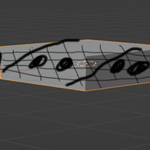
Blenderで開発中の雨を拭きながら作業できるアドオン
ビューポートが雨に濡れて見えづらくなるので
マウスで水滴を拭きながら視界確保する必要がある
実際の天気とも連動可能!欲しい?
Jeff Russell retweeted

FlashNormal: Detailed Surface Normal Estimation from Flash and No-Flash Images
Ruiyang Chen, Feiran Li, Heng Guo, Zhanyu Ma
arxiv.org/abs/2608.25360
Abstract:
High-quality surface normal estimation is preferred for detailed surface shape recovery and image editing. Existing single image-based methods, though being a practical setup, often struggle to recover fine surface details and are sensitive to inherent shape-reflectance ambiguity. While photometric stereo achieves high-fidelity surface normal estimation from images under varying lights, its applicability is strictly limited by requiring a multi-illumination capture setup. To this end, we propose FlashNormal, a diffusion-based surface normal estimator from flash/no-flash image pairs. While retaining high practicability on modern smartphones, our proposal takes advantage of flash-induced shading variations, and leverages curvature-guided detail enhancement strategy, improving surface detail recovery and mitigating shape-reflectance ambiguity effectively. To evaluate our proposed method, we further present EvalFlash, the first real-world flash/no-flash evaluation dataset containing 20 objects aligned with ground-truth surface normals for quantitative benchmarking. Extensive experiments demonstrate the effectiveness of FlashNormal over state-of-the-art single image-based methods and show a significant out-performance over flash/no-flash-based normal estimation method on EvalFlash.


Jeff Russell retweeted

Ray tracing too slow for real-time? 🔥 VoroTracing flips the script: co-designed traversal makes ray-based view synthesis competitive with rasterization. Depth-of-field, distortion, natural results.
📄 arxiv.org/abs/2608.17682v1
🌐 research.zenseact.com/public…
