






Jason Wei retweeted

@jaswwei, @GabeVisotsky, and @emilianogl gave teams of Inklings a messaging tool, and the agents learned to read their inbox and collaborate on solving hard chess puzzles.
teapawt.org/jaswwei/status/2122845…

1/ We taught a team of Inkling 2 Small agents to work together, communicate, and delegate work, without predefined roles on hard chess puzzles. Using our simple multi-agent RL recipe, we are able to turn pass@k into pass@1.
Work with @emilianogl and @GabeVisotsky
🧵


Jason Wei retweeted

Big ➕ on pushing multi-agent RL in open research
1/ We taught a team of Inkling 2 Small agents to work together, communicate, and delegate work, without predefined roles on hard chess puzzles. Using our simple multi-agent RL recipe, we are able to turn pass@k into pass@1.
Work with @emilianogl and @GabeVisotsky
🧵
Jason Wei retweeted

Interesting work in agent swarm!
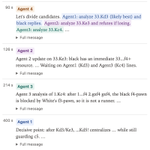
5/ We do not assign a leader, roles, or a division of work. However, later in training, we observed agents organizing their own work. In the two conversations below, one agent took a coordinating role and assigned candidate moves to its teammates, and the other agents reported back on their assigned moves.


Jason Wei retweeted

Another banger from Jason!!
1/ We taught a team of Inkling 2 Small agents to work together, communicate, and delegate work, without predefined roles on hard chess puzzles. Using our simple multi-agent RL recipe, we are able to turn pass@k into pass@1.
Work with @emilianogl and @GabeVisotsky
🧵
Jason Wei retweeted

this is pretty much the research I wanna do!! super fun for designing a reward function for agent swarm. great one. can't wait to see more
4/ We designed the reward around three desirable properties:
1. Prioritize first-answer accuracy.
2. Keep every agent working toward a correct solution.
3. Use what the other agents know.
The rush penalty penalizes an agent for submitting a wrong first answer when a teammate went on to find the right one. We avoid explicitly rewarding messaging because agents can learn to send messages only to collect the reward, a form of reward hacking.

Jason Wei retweeted
This was a fun project to work on! I'm very bullish on multiagent as a scaling axis. Thanks to @thinkymachines and @cHHillee for the credits!
1/ We taught a team of Inkling 2 Small agents to work together, communicate, and delegate work, without predefined roles on hard chess puzzles. Using our simple multi-agent RL recipe, we are able to turn pass@k into pass@1.
Work with @emilianogl and @GabeVisotsky
🧵
Jason Wei retweeted

Really interesting results here! Agents showed the ability to organize and collaborate without explicit reward pressure. Thanks again to @thinkymachines and @cHHillee for the credits!
1/ We taught a team of Inkling 2 Small agents to work together, communicate, and delegate work, without predefined roles on hard chess puzzles. Using our simple multi-agent RL recipe, we are able to turn pass@k into pass@1.
Work with @emilianogl and @GabeVisotsky
🧵
Jason Wei retweeted

Check out our latest work, led by our @ScaleAILabs intern @jaswwei, on “Critic or No Critic?” -understanding when to use PPO vs. GRPO for efficient RL training of agentic tasks.
🚀 As agentic tasks become more complex and trajectories grow longer and more expensive, extracting more learning signal from each rollout becomes increasingly important for efficient RL training.
🔍 The key research question: When do the critic's sample-efficiency gains outweigh its computational cost and potential bias, especially for long-horizon agents?
We investigated this question through 1,200+ training runs across continuous control, mathematical reasoning, and long-horizon tool-using agents. Our study reveal how batch size, critic reliance, and task complexity jointly determine when PPO or GRPO offers better training efficiency.
Great collaboration with @georgepu_ @fjxdaisy @ChristyLi0sz0 . Congratulations to @jaswwei and the entire team!
1/ As agentic tasks grow longer and rollouts become more expensive, the choice between critic-based PPO and critic-free GRPO becomes increasingly important.
Critics can reduce gradient variance, allowing models to learn from fewer trajectories, but they also introduce additional compute costs and potential bias from bootstrapping.
Our new research @ScaleAILabs compares PPO and GRPO under a shared actor objective across 1,200+ training runs in control tasks, short-horizon math, and long-horizon terminal agents. We studied how three factors influence this tradeoff: batch size, critic reliance, and task complexity. 🧵

Jason Wei retweeted

Looking forward to reading this one, often taken for granted in the LLM community - the bias-variance tradeoff of involving / not involving a trained critic. I'd wager that it's a function of long-horizonness and how complex the task is in terms of needing a denser reward signal.
1/ As agentic tasks grow longer and rollouts become more expensive, the choice between critic-based PPO and critic-free GRPO becomes increasingly important.
Critics can reduce gradient variance, allowing models to learn from fewer trajectories, but they also introduce additional compute costs and potential bias from bootstrapping.
Our new research @ScaleAILabs compares PPO and GRPO under a shared actor objective across 1,200+ training runs in control tasks, short-horizon math, and long-horizon terminal agents. We studied how three factors influence this tradeoff: batch size, critic reliance, and task complexity. 🧵
Jason Wei retweeted

好文:什么时候该用带 Critic 的 PPO,什么时候用无 Critic 的 GRPO。
labs.scale.com/blog/to-criti…

Jason Wei retweeted

Scale AI 这个 GRPO vs PPO 的研究提供了一个很好的 insight。
现在的 Agent 任务越来越长、Rollout 成本越来越高,Critic 的价值可能被低估了。实验发现,小 Batch 下 PPO 更有优势,而 GRPO 通常需要更大的 Batch 才能追上。
我记得之前智谱发布 GLM-5.2 时,就已经明确转向 Critic-based PPO,后续的 SAO 论文也进一步验证了这条路线的可行性。
感觉随着 Agent RL 向长时任务发展,如何提高单条 Rollout 的学习效率,会变得越来越重要。
1/ As agentic tasks grow longer and rollouts become more expensive, the choice between critic-based PPO and critic-free GRPO becomes increasingly important.
Critics can reduce gradient variance, allowing models to learn from fewer trajectories, but they also introduce additional compute costs and potential bias from bootstrapping.
Our new research @ScaleAILabs compares PPO and GRPO under a shared actor objective across 1,200+ training runs in control tasks, short-horizon math, and long-horizon terminal agents. We studied how three factors influence this tradeoff: batch size, critic reliance, and task complexity. 🧵
Jason Wei retweeted

Nice post! Would also be interesting to see how the gap between GRPO and PPO changes with score centering.
1/ As agentic tasks grow longer and rollouts become more expensive, the choice between critic-based PPO and critic-free GRPO becomes increasingly important.
Critics can reduce gradient variance, allowing models to learn from fewer trajectories, but they also introduce additional compute costs and potential bias from bootstrapping.
Our new research @ScaleAILabs compares PPO and GRPO under a shared actor objective across 1,200+ training runs in control tasks, short-horizon math, and long-horizon terminal agents. We studied how three factors influence this tradeoff: batch size, critic reliance, and task complexity. 🧵
Jason Wei retweeted

This is a generally good read on the whole PPO vs GRPO debate. The main take-aways are:
> batch size and critic dependence decide the win
> surprisingly, PPO at small scale is worth the extra compute to train the critic.
> As task complexity grows, GRPO needs larger batch size to reduce variance (as also seen in the SAO paper)
Also very basic and important notes on bias vs variance tradeoff and formulations of how variance scales inversely with batch size.

they’ve ran every test I had in mind lol.
labs.scale.com/blog/to-criti…
Jason Wei retweeted

1) Lightly patched GRPO was clearly optimal until the long-horizon agent era, just no good reason to turn to anything more complicated.
2) in this era, we really want more granular rewards.
3) my own guess is that most of the critic benefit can be harvested with ≈10% of steps


they’ve ran every test I had in mind lol.
labs.scale.com/blog/to-criti…
Jason Wei retweeted

this is gonna be a good read. finally

they’ve ran every test I had in mind lol.
labs.scale.com/blog/to-criti…
Jason Wei retweeted

they’ve ran every test I had in mind lol.
labs.scale.com/blog/to-criti…
Jason Wei retweeted

This is really a nice study and the results make a lot of sense to me.🫡
Only one question: if the bootstrapping bias matters, why we must need bootstrap?🤣 Will lambda=1 (no bootstrap) be better for critic-based PPO?
1/ As agentic tasks grow longer and rollouts become more expensive, the choice between critic-based PPO and critic-free GRPO becomes increasingly important.
Critics can reduce gradient variance, allowing models to learn from fewer trajectories, but they also introduce additional compute costs and potential bias from bootstrapping.
Our new research @ScaleAILabs compares PPO and GRPO under a shared actor objective across 1,200+ training runs in control tasks, short-horizon math, and long-horizon terminal agents. We studied how three factors influence this tradeoff: batch size, critic reliance, and task complexity. 🧵
Jason Wei retweeted

GRPO variants have been dominating for math reasoning tasks but PPO starts to be revisited more and more for agentic post-training. In this work, a comprehensive characterizations of PPO–GRPO tradeoff across 1,200+ runs reveals that PPO leads at small batch sizes, and GRPO needs increasingly larger batches to catch up as tasks get longer and harder. Our findings guide algorithm selection based on factors like batch size, task complexity and compute budget. Check out the amazing work from @jaswwei
1/ As agentic tasks grow longer and rollouts become more expensive, the choice between critic-based PPO and critic-free GRPO becomes increasingly important.
Critics can reduce gradient variance, allowing models to learn from fewer trajectories, but they also introduce additional compute costs and potential bias from bootstrapping.
Our new research @ScaleAILabs compares PPO and GRPO under a shared actor objective across 1,200+ training runs in control tasks, short-horizon math, and long-horizon terminal agents. We studied how three factors influence this tradeoff: batch size, critic reliance, and task complexity. 🧵