
I like to build things
San Francisco, CA
Joined November 2010
- Tweets1.7K
- Following1K
- Followers1.7K
- Likes7.8K







Q4 2026 Request for Startups
I've had a more downtime recently, which has led me thinking about companies to start. These are things I think should exist and will have value in our AI future, in no particular order.
- Charter: Instant Building Approvals and Inspections. AI will eat lots of architecture and engineering. The next step is software for planning departments to auto approve plans and inspect with drones/cameras remotely.
- Retort: On Demand Molecule Foundry. Automate as much of the molecule creation steps as possible, and let Claude hit an API to get new molecules made.
- Drawdown: Robotic Formulation Foundry: Similar, but lots of everyday items like paints, adhesives, lotions and foods as just a ingredient list that need to be mixed and tested. Do that via API call.
- Switchboard: Open Home Control. Home Control software (Crestron, Control4) are expensive and suck. Home Automation means you can pair 3rd party hardware and have it play nicely in one setup that can "do it all".
- Tender: Second Home Care. Similarly, I really see the need for a dedicated Second Home Care business for resort towns. Its property management mixed with better automation.
- The Settings: Custom Fine Jewelry. Apply SuitSupply's strategy to Jewelry. You can "talk to CAD" to design things pretty soon, so people customize things and cast them and ship quickly. Might need a real storefront but that could be fun.
- The Short List: Public Test Kitchen. Combining a kitchen goods store with a real "Test kitchen" and then sell the results to AI labs. Could be a media business as well. "Which Pan is best" can be really answered with enough tests.
Published with more details on each here: jjmaxwell4.com/ideas/index.h…

JJ Maxwell retweeted

despite coding agents, modern apps are fragile. without proper architecture, you can spit out as much code as you’d like, but you’re just adding levels to a house of cards.
introducing Hatchet v2 & our $5.7M seed round. our bet is that great orchestration is the difference between a reliable app and a broken one.
Hatchet v2 is the universal orchestration layer: durable execution, durable queues and durable streams, sandbox integrations, serverless support, and operators. this is the architecture used by high-growth companies like @greptile, @linear, @getenter_ai, and many others, who collectively process over 5 billion tasks/month on Hatchet.
we’ve spent over two years obsessing over making our engine performant and scalable. this release extends the existing @hatchet_dev engine to support any sandbox provider, serverless environment, edge function, or container.
How to make more money on consumer subscriptions with Crew Plans™
• I noticed something really smart my local gym started doing recently to improve retention.
• It's a bit like a family plan, but they market it to friends as well.
• The gist is that for every member that joins a "crew" (my term), the price decreases by some set amount. AKA a membership is $300/month, but if 2 of you join, each membership is $280/month. And it keeps decreasing the more people you have tied to the crew. While decreasing the overall price, this does 3 things:
• Existing crew members cancel less, because leaving causes their friends' prices to go up.
• The existing crew has a meaningful ongoing incentive to refer friends. Rather than a one-time thing, this is a $20/month benefit for as long as you're a member. I'd expect a 5-10% increase in new members via referrals.
• When someone drops off a membership, the existing crew has an incentive to find a replacement. This effectively directly reduces churn and can be modelled as a "Chance a departing group member is replaced," which I think would be somewhere in the 10%-20% range.
• The tradeoff is you are giving out a discount, so there is a direct upfront cost.
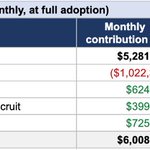
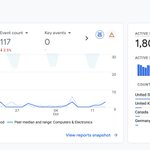
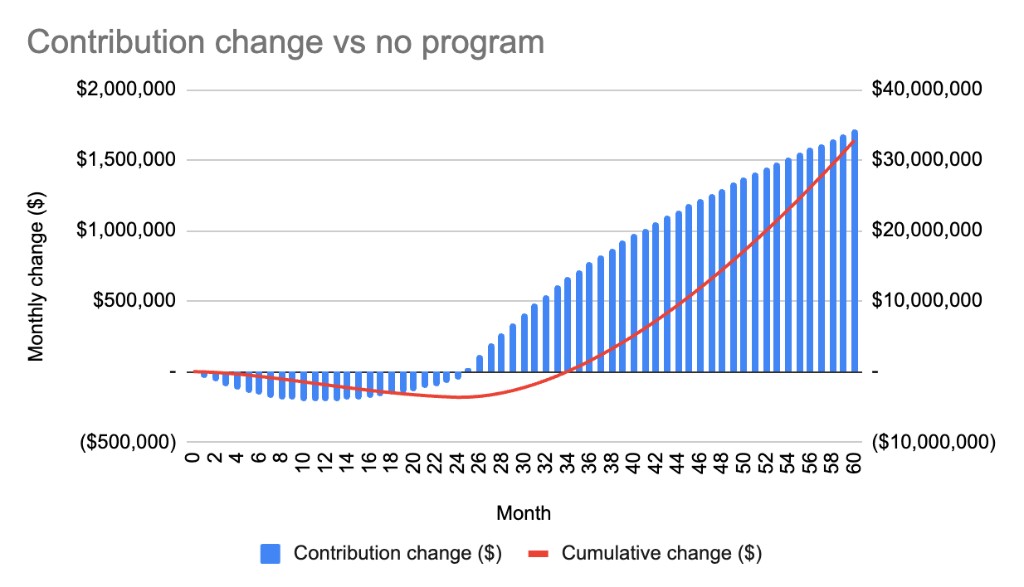
• If you model this out for a system like $GRAB Unlimited, which charges about $4/month, you get the following (see images, or check out the spreadsheet and copy it to play with the inputs yourself: docs.google.com/spreadsheets…):
• Long run: about +13% monthly contribution once crews reach full adoption.
• Short run: cumulative contribution is down for nearly four years, and payback is around month 24. The discount costs about 19% of contribution right away, while the extra members build up slowly.
• What pays for it: lower churn alone doesn't cover the discount. Replacements and referrals tip it positive.
• You could couple the launch of a program like this with a slight price increase to help speed up the turnaround time.
• This is a different type of referral program, and it's decidedly different product-wise IMO from a family plan. Family plans are about consolidating billing and ideally also getting a discount.
• This is about trying to incentivize your existing users to become your sales force, replacing churned users and recruiting new ones.
• I think this could relatively meaningfully change the shape and performance of many subscription plans, especially if they are high-margin, high-churn products that people use together.
• Phone carriers have done this with family plans forever, but it hasn't really expanded beyond that. Also there's a meaningful marketing difference between family plans and this idea. I think marketing these as Crew Plans would help meaningfully increase adoption.



2
2
273
JJ Maxwell retweeted

We pivoted:
AI Code Review -> Managed Agent Platform:
- You choose the prompts, models
- We handle the cloud VM's, orchestration, logs
- Agents are YAML/Python/TS
- Spawn sessions via API, @mention, cron, webhooks
Try it out: ellipsis.dev

Costs in the US Healthcare system
- my Speech Therapist was having me build a device for stretching my jaw out of popsicle sticks. Thought there must be a better way.
- device built for this costs $3000
- found a Chinese one on Alibaba for $60, took 2 weeks to arrive, mandarin instruction manual.
Why is the US version $300? Because most people get insurance to pay and thus the manufacturer wants to obfuscate the price? A bit like ski hills charging $250 for a day pass. The goal is to have you do something else (buy a pass or use insurance)

JJ Maxwell retweeted

I’ve known we had a great product, but haven’t done much to show people what it can do.
@TurboPermit is a faster way to get housing approvals:
• Real-time status updates through city integrations
• AI Plan PreCheck to catch errors and reduce resubmissions
• Emails written, read, and acted on
• Auto-filled forms eliminating repetitive work
Our goal is simple: less time managing permits, more time building homes.
Take a look, then explore a project tour or example project on our homepage (link in 1st comment).
Hiring Your First Employee - 2026 Version
A companies first hire sets the standard for everyone that comes after it. They can really mean the difference between success and failure. I’ve started a few companies, including Double (W24) and Jetfuel (Acquired by LFTO). Some of these succeeded and some did not.
Here’s what I think you should do to hire your first employee in 2026.
- Traditional interviews are required for social reasons but relatively useless
- First, decide what you want this person to do. It can be as broad as “build the product with me” or “own the backend” or as detailed as “focus on our search infra which is really important”.
- If you put up a job post, you will have many applications but only a few thoughful ones where the person actually put in some effort. A non-AI cover letter for example. I’d put in the job description some sorta “proof of life” test asking the applicant to do something meaningful in addition to applying to the job itself.
- Try and pick out the most thoughtful ones - use AI for this obviously.
- At the same time, try and do some form of outbound. Instead of cold DM-ing people on LI, I’d think through every smart person you know, and send them an email/text asking if they know anyone smart who might be open to working together. You should do this with almost everyone you meet as well. You can lower the stakes by just asking anyone who works in tech for the 3 smartest engineers they know. You can then reach out directly, referencing your friend or just saying I’ve heard great things about you from others. This has much better results compared to cold outbound IMO.
- Now that you have a bit of a funnel growing, identify 5-10 promising candidates and talk to them. This can be quick and is really just a gut check. Ask them what they’ve worked on and why. Drill down into specifics. Keep asking questions and make sure they can explain things and we’re doers on the team not just spectators.
- I think 2/3rd of people should fail this stage. Keep the bar high here to preserve your own time and sanity. “Proof of work” follow ups from candidates are nice but not always sufficient here as they usually signal despiration more than anything.
- Now the goal is to test their “work product” as close as possible. This could be a takehome but I’ve found those hard to calibrate across people as it’s hard to know how long they spent on a task unless you time it. Better is a work trial of 1-4 days. Give them a real task. You will need to setup some infra for this beforehand so most of it isn’t bogged down in permission hell.
- If they don’t want to do a work trial, try and figure out why. You should be flexible here but never remove the work product aspect. If they have a job, see if they will do a weekend. If they have kids and a busy family, ask for 3 hours from 8-11pm a few nights. Some one will need to be online/around while they are working to answer questions and unblock permission stuff.
- The work product is really the interview. If you or your cofounder did that work, what would you think of it? Only lower the bar from this about 10-20%. Were they fast? Was it done with quality? Did they seem to care about it or was this just another interview from them? DId they ask good follow up questions. We’re they mad at themselves they didn’t get more done?
- Optionally here is reference checks. I’ve had a mixed bag on references generally. Usually you get too positive of a response, even if you try and calibrate this out. Backchannel checks are best. If you can find their former founders number, sending them a quick text asking about the person has been the best for me. Ask them to rate their importance to the overall company. Discount this by a decent amount. If you still want to make the hire, follow your gut.
- I never ask someone directly for references as I’m not sure that provides much signal.
- Decide quickly and decisively. If it’s a yes, move with speed into sell mode.
- Figure out what will make a compelling offer (stock, cash, rough amount needed). And then push to close. Call your investors for help closing. Call your friends for help closing. Show up at their home with a gift. Whatever you think “going the extra mile” is, double it. Try and do this all in person or over the phone, not via email which sucks for this.
4
293
Do Data Labs have Terminal Value: Part 2
Some people seem to think we’ll have the data business be a $1t/year long term. This is possible, although I think not probable. See the tweet from Ali for a version of this argument: teapawt.org/aliansarinik/status/20…
Let’s say it is true, and data labs business will and make an analogy to the Oil Industry.
The oil industry is about a ~$4T a year business. But where does the Profit go? Most of it ends up with governements surprisingly, and then producers get about 25%, midstream companies get about 7% and Services companies get about 2% of that!
Data labs are oilfield services in this analogy. They are paid per project from someone else's capex budget, they don't own their output or their workforce, and they sell to a handful of buyers who can bring the work in-house whenever they want. Also, every barrel of oil used needs to be replaced. Once a model learns calculus, you don’t need to teach it calculus again. You might want to teach it something else, so there is more service work to do, but it’s not like a refinery where you can reuse the asset again and again.
Right now they are making a absolute killing. Good for them! They should rake it in. I think they should move to trying to own as much of the verification of “what good is” as possible though over time. I imagine many are trying to do this by providing verification on top of the data they are producing for labs. They should do more of that.


Things to know if you get Cancer (2026 Edition)
- I was diagnosed with Squamous cell carcinoma in my mouth in May 2026, here are some things I learned based on that experience so far.
- You need to be doggedly persistent on scheduling things. Yes this means lots of phone calls. If you get an appointment a few weeks out, call back a few days later and ask for something sooner and see if they have any cancellations. I could only get a appt 4 weeks out with an ENT (this was before I knew anything was wrong). My wife made me call back and I was able to get in that week due to a cancellation.
- AI’s may downplay the seriousness of things. I was chatting with various models and most pushed me in the direction of “you don’t have cancer” for a while. Just something to note.
- You may need to push for comprehensive genetic testing. Some doctors were weird about this and didn’t order it promptly, even after telling me they would. My surgeon who told me he’d get it done, eventually referred me out to an oncologist. This caused a multi-month delay to getting genetic results since the first results were done on the surgery tumor not the biopsy tumor. No one cares more about your case than you, so take control and send lots of follow ups!
- You can find the “Standard of Care” flow charts for every cancer type. Look and get through this yourself to see what the options are based on how things have progressed. nccn.org/guidelines/category…. You may need to make an account which you can do as a non professional. I like the .pdf files, they also have a interactive navigator. Use AI to help you figure out what to pick based on your case.
- If surgery is recommended, I would try and talk to someone who has undergone the surgery. I did not do this and regret it. Ask them how intense things were, what it felt like etc. My surgeon talked me through my surgery but it was A LOT rougher on me physically than I expected. Ask the surgeon how many of these surgeries they do a year and what the complication rate is.
- Get a 2nd opinion as soon as possible. No matter how much you like your plan. This may require a lot of calling and getting on a airplane, but I’d move to schedule it at a top cancer center as soon as you are relatively sure of your diagnosis. Ask for a second read of the pathology at the center where you get the second opinion.
- I started a new folder on my Mac and after appointments I’d dictate what happened and what the doctor said and have the AI make a new document summarizing things and asking it’s own follow up questions for next time. Its nice to be able to refer to this over time. Can also download all your pathology, scans so they can be referenced.
- Checkout all the resources and materials at sijbrandijfoundation.org/fcc…. @sytses (GitLab cofounder) took matters into his own hands when standard of care ran out. Schedule a call with these guys they are great and have good materials and questions to ask your doctors, etc
Do Data Labs have any terminal value?
My last startup, an influencer ad network called Jetfuel, felt like a treadmill. Our business relied on relatively short-term arbitrage opportunities that combined creators, their psychology, their followers and their demands, and our advertisers' business objectives.
Generally these things were at odds with each other, which meant pretty constant pressure to find new advertisers and find new creators. It had the elements of an agency combined with the hit-drivenness of something like a mobile gaming studio. My honest assessment looking back at that business was that it kinda sucked.
Creators wanted to make as much money with the least amount of work as possible, with as little annoyance to their followers as possible. Advertisers wanted to spend as little as possible for the highest possible return on ad spend. Sometimes these things aligned and our network would explode. When Trump announced he might shut down TikTok, Byte, a Vine relaunch by the original co-founder, took advantage by increasing the CPI. Since it was such a topical thing, volume exploded. I think we drove about 400,000 installs of Byte in 24 hours. This was our largest single day EVER by a pretty wide margin.
But catching lightning in a bottle like this was hard to do and hard to reproduce. Arbitrage prints a great day/week/month but does it lead to long-term durable value?
This was a problem when talking to investors, who want to see repeatable long-term durability in a business. So we needed to somehow spin this tension into an opportunity. We did that by convincing ourselves we could build a place where creators cared about their reputation and profile, and thus would have a reason to come back. We spent a long time working on this network, but when it was launched there really wasn't a ton of usage and the core reason creators came to us was still "to make a quick buck".
I think we were working backwards from 1) we're a Silicon Valley startup so we need to have long-term value and 2) a network effect business with hundreds of thousands of creators will have long-term value. But creators didn't really seem to want a network to talk about things.
What we should have done there is taken a real honest assessment of where the long-term value in the ecosystem was, and built in that direction.
We were doing this. @telenardo my co-founder smartly identified that the real terminal value was not being an influencer ad network "brokering deals" but rather owning the two sides of the marketplace. This meant vertically integrating and 1) owning apps/products to sell and 2) owning creator pages. We built Refined Media and Takeoff Labs to fill these needs, and while it was early both were starting to work.
Our journey got cut short by a pre-emptive acquisition by Liftoff that worked out quite well for us and our investors. Once we were acquired we weren't really able to pursue these two channels largely since Liftoff didn't want to compete with its clients.
I can see now how long the journey would have been without this acquisition. I think we could have made something meaningful. The clipping mania of late would have been a good time to be in the brokering business. And being a vertically integrated creator economy company would be quite valuable right now.
I wonder if and how this applied to the data labs at the moment. They are running a very similar playbook in some ways, brokering content to a buyer very willing to pay. I think if I were running one I'd treat the revenue as hits-driven. It's a bit less clear to me how to vertically integrate in this market though.
Can you "own" the people/firms that are creating this data? The "one and done" nature of the value of the content seems concerning to me there. And you can't really vertically integrate upstream unless you can become a frontier lab of some kind. Maybe you could try and become a synthetic data generation lab?
The cash flow from these makes me think you should at least take some of the money off the table, whether via secondaries or via dividends doesn't really matter to the founders.
2
8
867


JJ Maxwell retweeted

Introducing blink.review, blazing fast code review for your coding agent.
It runs automatically every time the agent makes a file change. Check it out: blink.review
JJ Maxwell retweeted

The US strategic petroleum reserve is built on fascinating engineering:
- It’s carved from salt domes near the Gulf of Mexico. Nice thing about salt is that you can shoot water at it to carve out massive cylinders, meaning construction costs are much lower
- Rock salt has very low permeability, meaning oil can stay contained in these caverns without extra material
- Oil floats on water, so to get the oil out you just push water to the bottom of the cavern and collect the oil at the top
- These caverns are deep underground, making attacks on the infrastructure much harder
It’s an inexpensive and highly secure way of storing absolutely massive amounts of petroleum (700M barrels). The same amount in external floating roof tanks would cover a space the size of Washington DC.
Talked a bit more about the engineering here: johnjwang.com/post/2026/09/1…
To me the AI domerism debate is very similar to the debate the manhattan scientists had about the bomb. I’d wager most scientists working there thought there was at least a 10% chance things didn’t go right and nuclear war resulted from their work.
So far, the game theory has worked out and MAD was actually a better deterrent than anything else humanity has invented.
I really think AI has similar properties. There probably is a 10% chance AI will kill everyone. But it’s going to be built either by China or by us. Better us than them.
2
270
The next battle for AI Assistants will be in your living room. The connected home that's been talked about forever will be here within the decade.
I think the assistants will all build a "hub" device.

2
2
271
AI can now do things proactively like:
- monitor your energy usage and charge devices intelligently "your EV charged during peak rates twice — shift to 11pm?"
- Review security footage. "Motion at 2:14am was a raccoon. Also, a car idled outside for 20 minutes — clip saved."
1
18