

Né à Gijon, Asturias, Espagne. Astronome, lecteur et cinéphile.
Saint Avold Moselle
Joined November 2009
- Tweets16.9K
- Following164
- Followers1.4K
- Likes1.7K






Pinned Tweet
New paper out on arXiv: arxiv.org/abs/2607.20128
It explains a lightweight way to predict atmospheric re-entries using only public TLEs. My hope is that some of you will jump in and start making your own predictions, with this method or any other you prefer.
More voices, more analysts, more independent checks. Give it a look. #SkyfallWatch


Final TIP: 2026-11-03 UTC 11:02:00 ± 1min
42.3S 63.8E
satflare.com/track.asp?q=455…

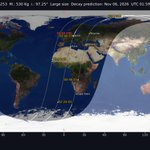
Update: obj. 45755 STARLINK-1478 decay prediction: November 03, 2026 UTC 21:36 ± 1h
No TLEs were available for more than 24 hours, after which the latest TLE revealed that a deorbit maneuver had been performed, indicating that re-entry is now imminent.


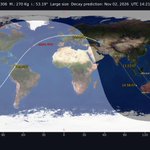
Obj. 57291 STARLINK-30239 decay prediction: November 02, 2026 UTC 15:36 ± 1.3h
The effective area has increased to nearly 27 m². If maintained at this level, re-entry is now imminent.


Final TIP: 2026-11-02 UTC 15:15:00 ± 9min
51.0S 153.7E
satflare.com/track.asp?q=501…


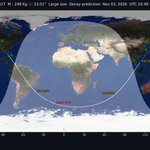
Obj. 57291 STARLINK-30239 decay prediction: November 02, 2026 UTC 22:44 ± 3h
An effective area of ~17 m² suggests active deorbiting. This prediction assumes the area remains constant until re-entry.

Joseph Remis retweeted

Yann LeCun and Randall Balestriero just Proved the Platonic Representation Hypothesis, and found a better way to achieve it.
The Platonic Representation Hypothesis suggests that AI models trained on different modalities, like images and text, eventually learn similar representations of the world. But this paper shows that how models are trained matters more than simply scaling them up.
So they mathematically show that, under certain conditions, two JEPAs trained completely separately can learn essentially the same underlying representation of the world. One learns from different images of the same scene, while the other learns from different descriptions of that scene, without ever being trained on image-text pairs.
Their approach achieves the same image-text alignment with 42x fewer training samples than next-token prediction. A 109M-parameter text JEPA even outperforms LLMs up to 72B parameters on cross-modal alignment benchmarks.
alphaxiv.org/abs/2610.39302


