

Shipman lab grad student @UCSF. she/her. grad students, let's negotiate w the UCs as equals https://teapawt.org/t.co/xwbeRwSs61
Joined April 2021
- Tweets45
- Following147
- Followers107
- Likes35


kate crawford retweeted

This is a foundational achievement. MMseqs2-GPU virtually *erases* the bottleneck of homology search in many workflows, including structure prediction. @sacdallago @milot_mirdita @thesteinegger, Felix, Bertil, and Alejandro too!
developer.nvidia.com/blog/bo…

kate crawford retweeted

Phage vs. Bacteria: New findings! Phages use their own tRNAs to evade bacterial defenses like retrons and PrrC. Huge thanks to Azam for his hard work!
in @NatureComms
nature.com/articles/s41467-0…

kate crawford retweeted

We are so excited to be joining the Arc family!

💡Arc was founded so that brilliant minds can pursue their boldest ideas.
Announcing the newest Investigators and Awardees joining the Arc community! These exceptional scientists are pioneering research into critical questions about complex human disease. Welcome to:
🧑🔬Core Investigators @FelixHorns, @ishahjain, and @ChristophThaiss
🔬Science Fellow @UcheMedoh
🦠Innovation Investigators @MaayanLevy_Lab and Theo Roth
💥Ignite Award recipient @weallen1
Next up: applications for the 2025 Investigator cohort are now open! For Core Investigators, apply via our open call or our @UCSF Neurology or @bioe_stanford coordinated searches. Science Fellow and Innovation Investigator candidates may apply through our open call: arcinstitute.org/programs/co…
👇 Check out our blog to learn more about our Investigator programs, and stay tuned: we'll be introducing you to a new Investigator each day over the next couple of weeks!
arcinstitute.org/news/blog/f…

kate crawford retweeted

Save the date for the 2025 symposium on the immune system of bacteria: April 8-10 in Paris, France
Registration opens in two weeks. A fantastic lineup of speakers!

Join us in Paris on April 8th-10th for the 2025 Symposium on the Immune System of Bacteria 🥖🍷🦠🧬.
Excited to welcome these amazing speakers at @institutpasteur .
Registration will open beginning of November. Abstract deadline February 28. Stay tuned.

kate crawford retweeted

University of Washington biochemist David Baker has won the 2024 Nobel Prize in Chemistry for his pioneering work designing new proteins that can neutralize viruses, target cancer cells, and more.
Read more from @uwmedicine: go.uw.edu/2024NobelPrize
#NobelPrize #GoHuskies

kate crawford retweeted

My PhD advisor, David Baker, just won the Nobel Prize! 🎉 He is an inspirational scientific leader who not only does groundbreaking research but has also built an enduring, supportive community. Most importantly, he’s a genuinely kind human being.
Congratulations David!
I am so honored to have been your student!
The Nobel Prize in Chemistry 2024 nobelprize.org/prizes/chemis…
kate crawford retweeted

Multiplexed editing of phage genomes using retrons, now published at @NatureBiotech with lots of new bells and whistles. @ChloeFishman @katecrawdaddy @BhattaraiKline @Darshini_Poola @thekarenzhang @alex_gonzadel @matromont
nature.com/articles/s41587-0…
kate crawford retweeted

A Lego I would like to make
Engineering tailocins
Dorien Dams
#PhgOx24
@PhageOxford

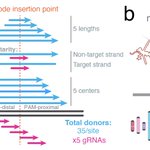
We then wanted to understand the editing parameters. Using yeast, we assessed ~4000 variants, including ML-predicted semi-synthetic ncRNA chassis, and learned things like where to cut the DNA, how long to make the donor DNA, and which chassis perform best in eukaryotes and more!

1
1
254

However, the retron non-coding RNA is highly structured, and we were left to guess how to insert our precise repair donor into this ncRNA or test many combinations per edit we wanted to make.

1
224
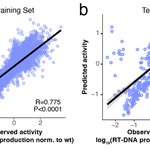
High-throughput libraries to the rescue! We made ~3500 changes to the retron ncRNA and quantified how much DNA produced for each variant. Even cooler, we trained a machine learning algorithm with @genophoria to predict DNA production from ncRNA sequence alone!

1
162
So excited to share one of the final works from my PhD in @SethShipman’s lab with @Asim_g_Khan and @oso_de_antojos, where we used high-throughput libraries and machine learning to create design rules for retron gene editors: biorxiv.org/content/10.1101/…

CRISPR-Cas9 can’t, on its own, create a precise edit in a cell’s DNA. Us and other labs (@timlu, @IlyaFinkelstein, @FraserLab, Lian lab) have used the reverse transcriptase from the retron system (a bacterial immune system) to create a template for precise repair inside the cell.
1
237
kate crawford retweeted
Multitrons: simultaneous multi-site editing of individual genomes using retron arrays, now published in Nature Chemical Biology @nchembio: nature.com/articles/s41589-0…. Great job @alex_gonzadel and @oso_de_antojos !

New preprint! Simultaneous multi-site editing of individual genomes using retron arrays. We're trying to make it easier to make multiple, non-adjacent, precise mutations to a genome without long cycles of editing, isolating , and editing again. biorxiv.org/content/10.1101/…

kate crawford retweeted

Delighted to share our latest preprint on my favourite piece of biology, CRISPR adaptation! tl;dr: we found that SspA, a known global regulator of bacterial stress response pathways, transcriptionally regulates CRISPR adaptation in E. coli biorxiv.org/content/10.1101/…

kate crawford retweeted

In our article published today @Nature , we report complete all-atom structural models of a fully packaged bacteriophage particle. Congratulations to Kush Coshic on his first publication! Many thanks to Chris Maffeo and David Winogradoff for pushing this 6-year project forward.
kate crawford retweeted
New Preprint, New Retrons! More than a hundred of them. We synthesized a ton of bioinformatically predicted retrons and put them through a battery of tests, from RT-DNA production to editing in human cells, E. coli, and phage biorxiv.org/content/10.1101/… @GladstoneInst @UCSF @UCSF_BTS

kate crawford retweeted

💻🧫New preprint: How accurately can we predict diverse phage bacteria-interactions from their genomes only ?
We created a matrix of >38k phage-bacteria interactions to find out (=> AUROC 86%) & used our predictions to recommend tailored phage cocktails.
biorxiv.org/content/10.1101/…
kate crawford retweeted

New preprint: Cyanobacteria isolated from marine volcanic seeps display rapid sinking and robust, high density growth. Thanks to U Palermo and Two Frontiers Project, we got unique samples from Vulcano, Italy, where CO2 bubbles into the shallow ocean, 24-7! biorxiv.org/content/10.1101/…
