

ADHDer- Übermensch Econ+CS @UofIllinois Si Deus pro nobis, quis contra nos?
Joined October 2022
- Tweets28.6K
- Following1.6K
- Followers3K
- Likes30.7K







T. Y. Hayashi retweeted

It took two weeks to end the career of the most successful Asian American in history.
Jensen washed dishes at Denny‘s as a teenager, and by this year he was running the world’s most valuable company.
This week a lot of Asian people on my timeline decided that story is over. That no matter how high you climb, a face like ours gets a different set of rules at the top.
After Elizabeth Holmes, female founders spent years getting asked some version of “how do we know you’re not the next Holmes?“ One woman‘s fraud turned into a question every woman had to answer.
I’m Chinese Canadian, I grew up in Vancouver, and now I live in the Bay Area. I already know what my version of that question is going to be and it‘s pathetic.
Jensen was born in Taiwan and spent over thirty years building an American company. The second the word ”China“ landed next to his name, none of that counted.
This country has done this before. In 1882 it banned Chinese immigrants. In 1942 it locked up 120,000 Japanese Americans, most of them citizens. In 1982 two Detroit autoworkers who blamed Japan for their jobs beat Vincent Chin to death with a baseball bat. He was Chinese. His killers never spent a day in prison.
Yellow peril never checked which Asian you were, and that’s a big part of why “Asian American“ became one word. If they were going to lump us together anyway, we might as well stand together.
Now look at Jensen‘s timeline. Oct 29, the spy story breaks. The next day Singapore’s government says it never said what the Wall Street Journal claimed. Nov 8, he admits an affair. Nov 12, he‘s gone. The spy part is still unproven. Two weeks start to finish, right before what could be the biggest IPO in AI.
You can call that a coincidence. I don’t buy it.
Meanwhile the powerful people who raped CHILDREN in the Epstein files are mostly still living their best life
Jensen had an affair with an adult woman. That’s the only thing of what‘s actually been proven.
So what exactly did Jensen do that was worse than them? Nothing.
He was the best, he was Asian, and he was on the wrong side of the political fight.
He did everything right. He built the company America needed most and showed up to every dinner in Washington. On Sunday night the president himself stood up for him and called him “an honorable guy.”
It didn’t matter. By Thursday he was gone.
If you can take down the president‘s favorite CEO in four days while the president is defending him, think about who that message was really for.
They’ll use you for thirty years and still never count you as one of them.
That’s what a political weapon is. You’re a tool while you’re useful.
When the game gets serious, you’re the knife. And when it’s over, nobody comes back for the knife.
Jensen was the best one they had. That's exactly why he made such a good "kitchenware".


T. Y. Hayashi retweeted

There's been a lot of discussion lately about company leadership attire + perceived/actual personal conduct. I wanted to see if AI could help *me* navigate this fraught decision, so naturally I turned to @ExpectedParrot
I'm considering the following "looks" for a professional headshot in the company directory 1/


T. Y. Hayashi retweeted

Most people are not special, rational, or particularly good. They're tribal primates running social scripts, ranking status, and defending comforting lies over evidence. Intelligence, drive, and outcomes are heavily genetic. Equality of result is a fantasy. The average person will never produce anything of lasting value, and the world is carried by a thin minority they resent.
T. Y. Hayashi retweeted
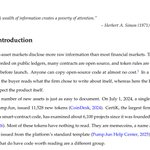
“A wealth of information creates a poverty of attention.”– Herbert A. Simon (1971)

Oh, I was reading papers on mechanism design and AI, and suddenly I came across a familiar face! @johnjhorton

2
4
645

T. Y. Hayashi retweeted

一般的に、警察が許可なしで学校内に入ることはできませんが、今日、警察は法律を無視して香港中文大学に突入し、校内にいたデモ隊(学生)に多くの催涙弾とゴム弾を発射しました。→
econ101:who is your advisor?daron?wow!u are definitely the job market star!

The fall of “what you can do” and the rise of “who you know”
Traditionally, many of us believe in a world where how hard you work is more important than who you know. I used to subscribe to this idea as both a scientist, who believed that facts about our world are agnostic to who says them, and as an American, who grew up believing that success was a function of how hard you worked, not who you knew.
However I am now feeling a substantial change in AI, specifically in the past five years, where who you know is becoming more important, and what you can do is becoming less important. I am obviously not saying that technical skills don’t matter, or that you cannot be successful without being well connected. Technical skills are still important and make or break your career. But I am noticing a trend. To assign arbitrary numbers, I would say that five years ago, success was 75% your skills and 25% who you knew. Now, it is maybe 55% skills and 45% who you know.
There are three technical reasons for this trend. The first is the commoditization of intelligence—coding agents have basically democratized research execution. In the past you could outwork competitors by staying up late to debug code or babysitting your experiments with higher frequency. Now, many research tasks can be completed by anyone who knows what to prompt. Research taste obviously still matters, but the playing field is definitely more equal. As technical execution becomes less of a differentiator, other advantages naturally become more important.
The second reason for this trend is that with the success of scaling language models, it is simply a fact that being resource rich makes you so much more likely to succeed. Ten years ago, an academic lab with eight GPUs had a real chance of doing great research. Now, a single RL run can require hundreds (if not thousands) of GPUs, as well as substantial data and infra. So now, two equally capable researchers can have very different outcomes depending what resources they have. And access to these resources is not a function of technical skill alone. It also depends on reputation, trust built with decision-makers, and professional relationships. These things have always mattered, but as the resource requirements of frontier AI have grown, so too has their importance.
Third, when companies stopped publishing research and moved to secretive, closed-source models, AI became a field of poor observability. In domains of perfect observability like chess or soccer, it is very easy to tell who is doing well and understand their contributions. But now in AI we have fewer public mechanisms for attributing credit, making it much harder for outsiders to know who did what for model launches. How does this get resolved? When it's difficult to independently verify someone's technical contributions, people increasingly rely on indirect signals such as reputation, personal endorsements, and who will vouch for them. Consequently, who you know plays a much bigger role in hiring, recruiting, and fundraising.
We often talk about how to improve technical skills, but nobody really talks about how to get better at "who you know". One observation is that many well-connected people mix their work and personal lives. The traditional wisdom is to keep a firm boundary between the two, which in the past was a very reasonable policy. But the returns of being social have gone up, which means that anyone still holding to that boundary is paying a much steeper price for it than they would have before.
Sam Altman is the prime example of a well-connected person who mixes work and personal. There is so much to learn from Sam. For example, back when OpenAI was smaller, Sam invited almost all the employees to his house for social hours. He hosts poker nights and dinners at his house for recruiting purposes. Sam has a reputation of being generous with his time and treating his friends well and I think that has yielded a disproportionate return for him. Obviously not all interpersonal relationships at OpenAI went perfectly but I think a large part of OpenAI’s success is from Sam’s connections.
The interesting thing about this is that intentionally trying hard at getting to know people is probably the suboptimal strategy. I don't think Sam made his connections because he knew they would pay off in his career, but rather because he is a generous person who is innately curious about people and technology. Perhaps the best strategy is to be your best and truest self, which is easier said than done, especially in a changing technological world.
While these technical trends have made the field less dependent on technical merit, I don’t think this is necessarily a bad thing, and it is not the first time this has happened in our field. For example, abstractions introduced by Python also made coding less technical and enabled more people to code. And with some skillsets, there is more opportunity now than ever. For instance, people without programming backgrounds can now create great technology, with product or research taste as more salient levers. So while what we can do is commoditized, what we choose to do, and who we do it with will matter more than ever.
Thanks Edward Hu for feedback on this essay.
T. Y. Hayashi retweeted

There is a new emergent caste system in academia. The high priests, thinking what they do is special and rare, look down on AI use as "slop."
Unfortunately for them, Fable / GPT 5.5 Pro can do in 10-15 min what they spent years learning and feeling special about.
So like true high priests they will develop more guardrails and initiation ceremonies to determine who enters the temple. This would be a mistake. The correct approach is to embrace AI use and do more creative science that was not possible before.

