Senior ML Researcher @AIgnostics & @ExplainableML | ex-@GoogleDeepMind | PhD in ML from @TUBerlin @bifoldberlin @MPI_CBS | Representations in š§ & š¤| #FirstGen
Joined May 2019
- Tweets1.2K
- Following746
- Followers849
- Likes4.5K
Pinned Tweet
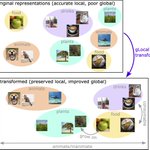
š„³I am incredibly humbled and grateful to share that our work, "Aligning machine and human visual representations across abstraction levels," has been published today in @Nature: nature.com/articles/s41586-0⦠For more information see @AndrewLampinenās post below ā¬ļø
What aspects of human knowledge do vision models like CLIP fail to capture, and how can we improve them? We suggest models miss key global organization; aligning them makes them more robust. Check out @lukas_mut's work, finally out (in @Nature!?) + our new blogpost! 1/4
Lukas Muttenthaler retweeted
Excited to introduce reactive optimizers: We let an agent reactively adapt the optimizer code during the training run! The agent acts like a team of scientists constantly choosing the best algorithm, learning rate, momentum, etc, based on its own analysis of step-to-step training dynamics! The results are really exciting. Besides out-performing standard "best-practice" recipes across everything we threw at it, the agent gains a few "superpowers" that no human could have designed into the optimizer... (1/n)
1/9 Current optimizers are static during training. What if the optimizer could think and react while the network trains?
We let an agent watch the training dynamics and rewrite the optimizer's source code as training goes: a reactive optimizer.
In every language and image setting we tried that has no tuned recipe, it matches or beats the best recipe one can one-shot, and it guards against loss spikes and overfitting by itself. In the near future, optimization decisions may belong to agents, not humans.
š xingjianbai.com/reactive-optā¦
š» Try it on your task: github.com/xingjian-bai/opal
š§µ
Lukas Muttenthaler retweeted
I think we should stop AI progress now, first unilaterally by key AI companies and then scaling up to more US companies and then China via international agreements. The reason for now is not that current AI models are the ones that could kill everyone, but because the coordinate steps take time. Immediate action means we have more time for the second steps.
When I tell this story to AI company folk, the typical response is "Yes pausing is good, but we should wait until the last minute when the very next model will be dangerous, and stop then."
What I realized recently is that this is being implicitly way more optimistic about government speed than I am (and I joined the UK government and was happy there for 2.5 years). They are imagining a world where, the moment the danger is imminent, a bunch of international coordination can happen on a dime.
Which is entirely inconsistent with their actual views about government! I'm the one that is more optimistic about government; why am I the one advocating for more time cushion to let the government story play out?
Lukas Muttenthaler retweeted
Elon is a genius at the intersection of innovation and organization but heās also a terrible human being who consistently is willing to do evil things to punish those who oppose him and Iām disappointed in anyone who lets the former justify spending labor to empower the latter.
Lukas Muttenthaler retweeted
Leading AI models appeared to predict brain activity equally wellā¦
ā¦until we asked them to synthesize images that precisely control neural firing, like these š
Across 25 neural sites, closed-loop experiments revealed striking hidden differences in model-brain alignment.
š§µ
I really really hope that my friends in big tech donāt start calling artificial intelligence super intelligence because Trump wants them to
Lukas Muttenthaler retweeted
It seems like a hard time to be an undergrad concerned with making AI go better. I have talked with a lot of undergrads at several university AI safety clubs in the past month. Consistently across universities, there is a general shared sense of undergraduate dread about next-gen AI coming soon and what it means for their careers. Lots of them are wondering if agents are too good at research, timelines are too short, or if power in AI is too concentrated for them to have any impact. Some of them are wondering if the appropriate reaction is to go apply to Anthropic, indulge in accelerationism, and/or start smoking.
Lots of my conversations with them gravitate toward talking about how AI will be (and ought to be) a never-ending institutional challenge and that, yes, they will have a chance to matter and for their life and work to mean something. I guess that's what my version of hope for the future looks like lately.
Lukas Muttenthaler retweeted
We Must Pace the Frontier: Iāve written a new essay on why the AI industry should slow down, with a three-part plan for doing so.
Anthropic is unilaterally committing to the first of these steps. Weāll provide third-party evaluators with permanent, employee-level access to our systems, so that they can verify adherence to our safety measures, report on incidents, and assess modelsā alignment during training.
You can read the full post here: darioamodei.com/post/we-mustā¦
Lukas Muttenthaler retweeted
I resigned from Anthropic today. I spent the last three years doing pretraining research at both OpenAI and Anthropic. Neither company is acting responsibly. They are racing straight to self-improving superintelligence and gambling with our lives. More thoughts below.
š®At #ICML2026 we presented Attentive Multi-Layer Fusion for Vision Transformers, an efficient method for fusing information from multiple layers of ViTs for downstream task predictions. Itās almost as performant as fine-tuning but only an inch more expensive than linear probing!
Replying to @ExplainableML
2/
Wed, Jul 8, 2026 ⢠10:30 AM ā 12:15 PM KST Ā· HALL A #2711 Ā· POSTER
Attentive Multi-Layer Fusion for Vision Transformers
@lciernik, Marco Morik, @lukas_thede, @LucaEyring, Shinichi Nakajima, @zeynepakata, @lukas_mut
Paper: arxiv.org/abs/2601.09322
Code: github.com/lciernik/attentivā¦
Lukas Muttenthaler retweeted
8/
ALF: Attentive Multi-Layer Fusion for ViTs
@lciernik, Marco Morik, @lukas_thede, @LucaEyring, Shinichi Nakajima, @zeynepakata,Ā @lukas_mut
[Paper]: openreview.net/forum?id=wSXZā¦
[Code]: github.com/lciernik/attentivā¦
Lukas Muttenthaler retweeted
2/
Wed, Jul 8, 2026 ⢠10:30 AM ā 12:15 PM KST Ā· HALL A #2711 Ā· POSTER
Attentive Multi-Layer Fusion for Vision Transformers
@lciernik, Marco Morik, @lukas_thede, @LucaEyring, Shinichi Nakajima, @zeynepakata, @lukas_mut
Paper: arxiv.org/abs/2601.09322
Code: github.com/lciernik/attentivā¦
Lukas Muttenthaler retweeted
š„³I am incredibly humbled and grateful to share that our work, "Aligning machine and human visual representations across abstraction levels," has been published today in @Nature: nature.com/articles/s41586-0⦠For more information see @AndrewLampinenās post below ā¬ļø
What aspects of human knowledge do vision models like CLIP fail to capture, and how can we improve them? We suggest models miss key global organization; aligning them makes them more robust. Check out @lukas_mut's work, finally out (in @Nature!?) + our new blogpost! 1/4
Lukas Muttenthaler retweeted
Excited to announce that I'll be starting my own lab in Tübingen this October!
Hiring at all levels: Postdoc, PhD & RA.
Want to work on computational cognitive science at scale? Apply: core-cognition.github.io/
Reposts and shares much appreciated š
Lukas Muttenthaler retweeted
Really glad to see this work out (and honored to be included on it) ā I think it does a great job of concretizing some of the intuitions I've had about effects of scaling! Check out the thread for a great summary
We take for granted that larger models are better than smaller ones, but why is this so? Our new paper, led by Jing Huang and @EkdeepL, traces this to a data-induced competition for resources (neurons), using formal analysis, idealized tasks, and real pretraining.

ALT Title card for a research paper. The title reads "Why Larger Models Learn More: Effects of Capacity, Interference, and Rare-Task Retention." Authors listed: Jing Huang, Daniel Wurgaft, Rachit Bansal, Laura Ruis, Naomi Saphra, David Alvarez-Melis, Andrew Lampinen, Christopher Potts, and Ekdeep Singh Lubana. A Goodfire logo appears below the names. Author affiliations: Stanford University, Kempner Institute at Harvard University, MIT, and Anthropic.
Lukas Muttenthaler retweeted
Can context-sensitivity improve humanāmachine alignment in VFMs? We show that incorporating context improves modeling of human similarity decisions.
šAccepted to ReAlign @iclr_conf!
Now on @arxiv: arxiv.org/abs/2604.13883
Joint first-authored work with amazing Tom NeuhƤuser. 1/5
Lukas Muttenthaler retweeted
A statement from Anthropic CEO, Dario Amodei, on our discussions with the Department of War.
anthropic.com/news/statementā¦
Lukas Muttenthaler retweeted
This is out of control.
Pete Hegseth wants to use AI to fire weapons without human input. And he's willing to blackmail a private company in order to do it.
He is a threat to our safety and must be fired immediately.
Lukas Muttenthaler retweeted
šHappy to share that this work is now published in @CommsPsychol.
šYou can find the final version here: nature.com/articles/s44271-0ā¦
Lukas Muttenthaler retweeted
Today, the Trump administration repealed the endangerment finding: the ruling that served as the basis for limits on tailpipe emissions and power plant rules. Without it, weāll be less safe, less healthy and less able to fight climate change ā all so the fossil fuel industry can make even more money.