

Mens et Manus
Earth 🌏
Joined May 2011
- Tweets12.9K
- Following3.9K
- Followers1K
- Likes11.5K



Pinned Tweet
Loving starts with the self once you embrace it
As McNutt said, "Fall in love with taking care of yourself. Fall in love with the path of deep healing. Fall in love with becoming the best version of yourself but with patience, with compassion, and respect to your own journey"


Luqman Hakim retweeted

Indonesia has a large market, a growing digital economy and ambitious development goals.
The @WorldBankGroup identifies reforms that could help convert that potential into $15 billion in private investment and up to 300,000 jobs: ifc.org/en/insights-reports/…

Luqman Hakim retweeted

Potongan gambar ini disebarkan orang di X. Di sana lagi “panas” soal ini. Awalnya saya kurang tahu alasan gambar ini diunggah.
Ternyata ini laporan PT Danantara.
Karena tak punya berkas lengkap laporannya, akhirnya saya nanya ke Grok berapa jumlah karyawan Danantara (DIM).
Ternyata 118 orang.
Dari gambar laporan ini diketahui bahwa >40% biaya operasionalnya habis untuk gaji mereka. Dan jika dihitung rata-rata, maka gajinya Rp310 juta per orang per bulan.
Beban membayar karyawan semahal itu, ketika ditanya DPR terkait proyeksi 2026 yang cuma 0,8%, jawabannya:
“Kami masih kecil, dan baru beroperasi.”
Makanya ada ledekan: ibarat Danantara dipinjami kredit sebesar 10 juta, namun labanya 80 ribu.
Lantas dibandingkan simpanan perbankan: jika hari ini kalian naruh deposito 10 juta di BCA, tahun depan sudah dapat bunga 240 ribu.
Jadi…
MBG masih meracuni anak. KDMP punya mobil mangkrak. Gaji karyawan Danantara setinggi itu. Pertunjukan lucu polisi soal makar.
Di samping itu Nadiem dituduh merugikan negara. Ibam juga sama. Dan seperti yang saya kawal sekarang, KPK menuduh Gus Yaqut tanpa ada satu pun yang bisa dibuktikan sepanjang 33 persidangan.
Uang pajak kita diacak-acak. Aparat Penegak Hukumnya (APH) bikin pertunjukan tak lucu.

Luqman Hakim retweeted

When the numbers are disappointing, the strategy isn’t working, or employees are anxious about what comes next, optimism can sound like exactly the wrong leadership prescription. After all, leaders need to deal in reality.
But Michelle Gielan, author of “Resilient Optimism,” argues that this is a false choice. Leaders can acknowledge a difficult reality while still believing their actions—and their team’s—can improve it.
That combination is what Gielan calls “resilient optimism”: a positive but realistic mindset that holds up when it’s tested.
For more, subscribe to HBR Executive at s.hbr.org/4jytm7D.


Luqman Hakim retweeted
The rapid downfall of Nvidia CEO Jensen Huang exposes a tension that exists at many successful companies: the very qualities that make the founder-CEO effective can also make that CEO difficult for the board to oversee.
When does a company's dependence on its CEO become a governance liability? And what can boards do to ensure that strong leadership doesn't come at the expense of effective oversight?
In this HBR Executive Live conversation, HBR editor at large Adi Ignatius speaks with HBS Baker Foundation Professor Lynn S. Paine about the governance lessons raised by Nvidia’s leadership crisis.
HBR Executive subscribers can watch the video and read the transcript here:
s.hbr.org/4ASbhr2

Luqman Hakim retweeted

No, I do not believe that we should “surrender human free will” to AI systems, and it’s absurd to suggest that I do. I have written hundreds of pages of essays and a constant theme in them is the need for AI to be governed by legitimate democratic processes. For millennia (going all the way back to Greek and Roman philosophers), advocates of autocracy have claimed that it leads to better, faster, or more decisive decision-making than the messy process of democracy. Even if this were true (which I doubt!), we should never sacrifice legitimacy or self-determination at the altar of efficiency or security. This argument against autocracy applies word for word against governance by AI, and I feel equally strongly that turning over governance to AI is a bad idea.
No one who had carefully read my writing or my interviews could reasonably conclude that I believe anything different. For example in an interview on CBS a couple months ago, I specifically called for AI to be governed democratically. I call for the same in Policy on the AI Exponential, Machines of Loving Grace, and The Adolescence of Technology, and We Must Pace the Frontier. Machines of Loving Grace contains an extended section on using AI to revitalize democracy, and discusses the use of AI as an aid to citizens in their decision-making, "aggregat[ing] opinions and driv[ing] consensus among citizens, resolving conflict, finding common ground, and seeking compromise.” The clear and obvious implication is that humans should remain the ones making political and governance decisions. The Adolescence of Technology has an entire section on fighting against AI-driven tyranny, and I even discuss the danger of AI labs usurping power and come out strongly against it — by implication, this definitely includes an AI lab usurping power and giving it to AI itself!
If I thought any of this was a good idea, I would be advocating for it in public, just as I have not been afraid to advocate for many, many unpopular views over the last few years. But I am not advocating for it, because I think turning over governance to AI is a terrible idea.
Separately, I think there is frequent conflation (including in this article) between the idea of “surrendering human free will” to AI in some grand sense of global governance, and the more prosaic idea that as AI systems advance, they become capable of doing specific tasks in a more automated way. This is not AI “running the world,” but AI driving a car, designing a cancer drug, or writing software end-to-end. Here, my view is mixed. AI doing more complete or larger tasks is economically valuable and can drive important advances in software, medicine, transportation, energy, etc. It is clearly desirable in many cases and will save a lot of lives. But it has downsides as well, and in some areas it may not be worth it.
For example, using AI too autonomously to build the next generation of AI systems (known as recursive self-improvement, or RSI) may cause AI to improve faster than we can control or adjust to it, so we may want limits on this process. As we said publicly in early November, we don’t expect it to be safe for Claude to build successive frontier models fully autonomously, without meaningful human supervision or understanding. Second, in some contexts, using AI in too end-to-end a manner may be a cause of serious job disruption, and it may make sense to slow or even stop some AI deployments to give people more time to adapt. Third, while the use of AI for alignment research is an incredibly valuable tool, it must be done with caution, because we may not be able to trust the work of the AI system. Finally, in many cases, humans would simply prefer to do some activities themselves, so they can stay deeply engaged in what matters to them, even if AI can do those activities better. There are countless other examples and hard cases. I don’t think there are any easy answers here, nor is there (nor should there be) any single decision-maker: some of these decisions will be made by society, some by government, some by AI companies, and some in a decentralized manner by individuals expressing their own preferences as consumers, which may differ from the preferences of others.
I don't think that other AI leaders or AI companies have significantly different views from me on whether specific tasks should be automated. Certainly the products that they offer don’t differ materially in their orientation towards automation of tasks; every company seems to be releasing models more and more capable of task automation (as that’s been the general consequence of scaling up AI training), and every company claims to understand there are risks and downsides of such automation and to offer safeguards. If anything, Anthropic has been the most vocal and the most proactive about acknowledging these downsides and trying to address them. For instance, it’s fairly absurd to cite my statement that fully autonomous weapons might “one day be needed for the defense of democracy” as differing from that of other AI companies, when I was willing to risk Anthropic’s future as a company to refuse to allow our existing AI models to be used for autonomous weapons even in the face of legal sanctions, and no other AI company did the same.
To summarize, as applied to grand questions of how we govern increasingly capable AI, I have been vocal and consistent that AI needs to be governed by a legitimate, democratic process and that “surrendering human free will” to AI systems is a terrible idea. As applied to automation of specific tasks by or for people, my views are more mixed, but I don’t think they differ from those of other AI companies — most other companies seem to be offering similar products and confronting similar tradeoffs without having perfect answers to them. What is happening is that there’s a sort of vibes-based commercial and political positioning that some AI CEOs are engaging in, where they repeat slogans like “human control and agency,” or “AI should be just a tool,” without actually doing anything different in their products or taking seriously the difficult questions that lie behind these slogans.

Rival AI leaders push back against Anthropic vision of surrendering human agency to AI axios.com/2026/11/25/anthrop…

Luqman Hakim retweeted

Soal Lapkeu Danantara
1. Bagi sy, pertanyaan yg lebih fundamental dan belum bisa dijawab dari laporan keuangan ini adalah: berapa additional value yg diciptakan Danantara dibandingkan dg seandainya aset negara tersebut tetap dikelola melalui struktur kelembagaan sebelumnya?
Luqman Hakim retweeted

Berikut artikel saya di Kompas 25 Nov 2026, “Eskalator yang Kian Sempit”
kompas.id/artikel/eskalator-…

Luqman Hakim retweeted
Most leadership teams do not fail because they lack priorities. They fail because they add priorities without freeing up the capacity those priorities require.
Organizations have become highly sophisticated at adding priorities, initiatives, processes, dashboards, and governance. Far fewer have built a comparable discipline for removing work. That is why strategy often stalls even when priorities are clear. The issue is not only whether leaders know what matters. It is whether the organization has created enough room for what matters to get done.
Why is subtraction so hard? Learn more in the full article.
hbr.org/2026/11/what-will-yo…

Luqman Hakim retweeted
Berikut artikel saya di Kompas, “ Eskalator yang Kian Sempit”, versi cetaknya akan terbit 25 November 2026
kompas.id/artikel/eskalator-…


Luqman Hakim retweeted
Executives are often told they need to develop an “enterprise mindset” to advance into more senior leadership roles, but rarely are they given concrete guidance on what that means.
Leaders need to ask themselves six questions to make the shift from prioritizing their own functions to stewarding the success of the entire organization.
Read the article for more.
s.hbr.org/3WSkHUQ

Luqman Hakim retweeted

I learned the secret to working less while I was a VP at Amazon. I am going to share it with you. The problem is that people don’t like this secret: You have to work more before you work less.
Luqman Hakim retweeted
Nvidia’s decision to reinstate Jensen Huang as CEO, less than two weeks after his resignation amid revelations of multiple extramarital affairs—including one with a woman suspected of being a Chinese spy—raises a difficult question for corporate boards: Should an extraordinary leader’s track record earn them a second chance?
Harvard Business School professor and former dean, Nitin Nohria, examines what research tells us about the influence CEOs have on company performance, why returning leaders often struggle to replicate their earlier success, and how boards should weigh past achievements against questions of trust and accountability.
Read Nohria’s full column, “Leadership Notes,” here: s.hbr.org/4kxjWdE
Luqman Hakim retweeted

One reason founder CEOs are so hard to replace is that they’re effectively also the chief product officer. They know how the product was built, can hold the entire product in their head, and have the vision and authority to reinvent it.
When they leave, the CEO role gets filled, but the product role they played rarely does.
Luqman Hakim retweeted
Eight practices of effective executives:
1. They ask, "What needs to be done?"
2. They ask, "What is right for the enterprise?"
3. They develop action plans.
4. They take responsibility for decisions.
5. They take responsibility for communicating.
6. They focus on opportunities rather than problems.
7. They run productive meetings.
8. They think and say "we" rather than "I."
s.hbr.org/4rTBzUJ

Luqman Hakim retweeted

Dario Amodei (CEO of Anthropic) on how to actually learn AI:


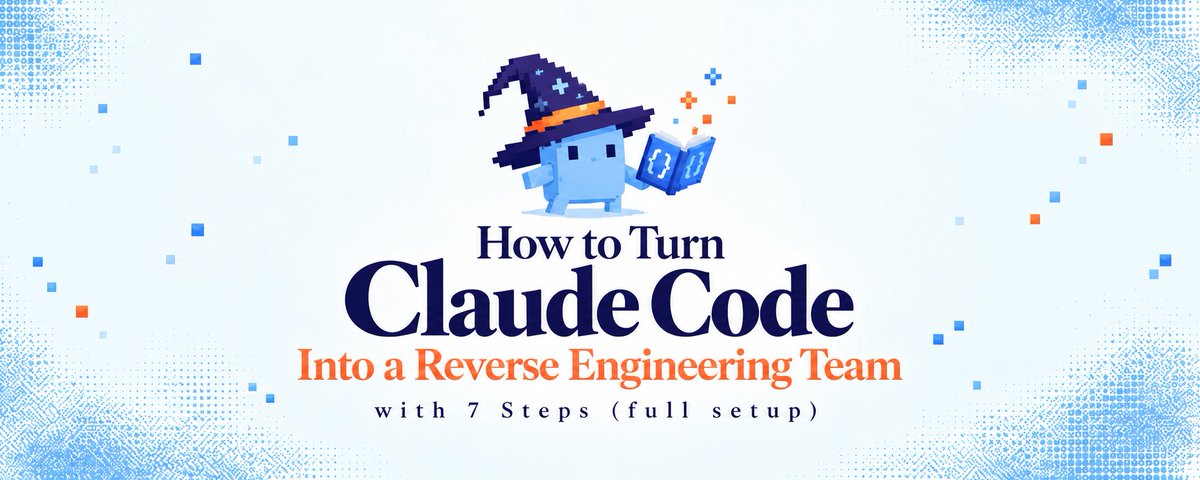
REA hit #1 on GitHub trending, and most people still run it inside a single chat
Split it into 4 subagents and one command takes a program you own from sealed binary to a tested rebuild with a match rate
Set it up once, aim it at the next one:

Luqman Hakim retweeted
The rapid downfall of Nvidia CEO Jensen Huang exposes a tension that exists at many successful companies: The very qualities that make a founder-CEO effective can also make that CEO difficult for the board to oversee.
When does a company’s dependence on its CEO become a governance liability? And what can boards do to ensure that strong leadership doesn’t come at the expense of effective oversight?
Join us on Friday, November 20, at 11 am ET for a subscriber-only HBR Executive Live conversation with HBS professor Lynn S. Paine, an expert on corporate governance and chair of HBS’s executive programs. We are inviting all HBR subscribers to experience this special HBR Executive Live, a benefit typically reserved for HBR Executive subscribers.
Subscribe to HBR to participate: s.hbr.org/4iZN8rl

