







Matthias retweeted

🎯 Bespoke OLAP makes workload-specific database engines faster
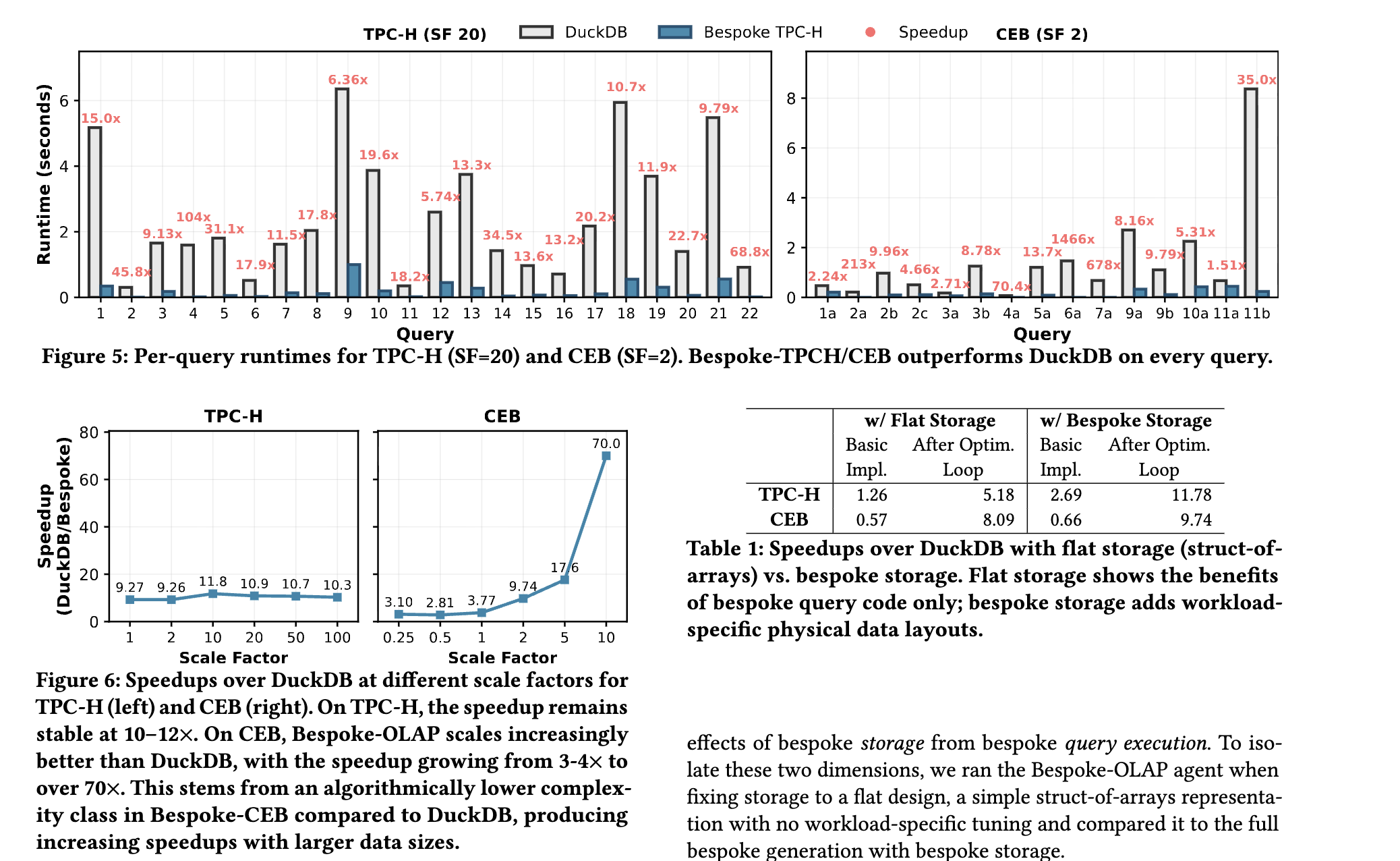
[ADRS Blog #21] We feature Bespoke OLAP, a fully autonomous synthesis pipeline that outperforms general-purpose engines like DuckDB while being ~11.78× faster on the main benchmark comparison. Bespoke OLAP uses LLM-guided code generation to build a complete, custom C++ engine for OLAP workloads for just ~$120.
✍️ Read the blog: ucbskyadrs.github.io/blog/be…
📖 ADRS Blog Series: ucbskyadrs.github.io/
📄 Bespoke OLAP Paper: arxiv.org/abs/2603.02001
👩💻 Bespoke OLAP Code: github.com/DataManagementLab…

Matthias retweeted

"Rare examples such as @TigerBeetle demonstrate that extreme specialization can pay off when the target workload is narrow yet widely shared"
Bespoke OLAP: DBMS on-demand, for your specific workload.
Also the fact @DuckDB has pretty much become a standard to benchmark against
Matthias retweeted

This code now landed upstream and will be part of the 7.0 kernel when released. The liburing helpers, man page, and test cases have been merged into the master branch.

BPF filtering support for io_uring, finally got around to doing it. This will help those use cases, like containers, that apply seccomp filters to utilize io_uring. See link below for details, and links to kernel and liburing changes and tests.
lore.kernel.org/io-uring/202…
Matthias retweeted

💿 io_uring is everywhere right now
But for DBMSs it isn’t magic dust:
• drop-in swap epoll/libaio → io_uring: ~+6–10%
• redesign for async + batching + io_uring features: ~2× end-to-end
• Postgres case study: +14% when “done right”
arxiv.org/pdf/2512.04859v1
#io_uring #linux

Matthias retweeted

I'm excited about the database performance io_uring will unlock.
Last year I benchmarked Postgres 17 vs 18 to test the initial io_uring upgrades. I was surprised to see they weren't always a clear win for TPC-C.
This paper studies the potential, and the future looks good.


Matthias retweeted

Our paper is currently on Hacker News, feel free to join in if you have questions or comments. @melhindiCS @m4ttze and I are happy to take them.

How modern database systems can leverage the Linux io_uring interface for efficient, low-overhead I/O
arxiv.org/pdf/2512.04859v1
@m4ttze @melhindiCS @Tobias__Ziegler @viktor_leis @cbinnig

Matthias retweeted
Paper too long? We compiled a high-level and concise overview when io_uring is beneficial: toziegler.github.io/2025-12-…

Interested in io_uring? Check out our new paper, joint work with my former colleagues from TU Darmstadt (@cbinnig and @m4ttze) and from TU Munich (@melhindiCS and @viktor_leis). arxiv.org/abs/2512.04859v1

Matthias retweeted

How modern database systems can leverage the Linux io_uring interface for efficient, low-overhead I/O
arxiv.org/pdf/2512.04859v1
@m4ttze @melhindiCS @Tobias__Ziegler @viktor_leis @cbinnig
Matthias retweeted
Interested in io_uring? Check out our new paper, joint work with my former colleagues from TU Darmstadt (@cbinnig and @m4ttze) and from TU Munich (@melhindiCS and @viktor_leis). arxiv.org/abs/2512.04859v1
Matthias retweeted

Starship goes interdimensional during Flight 10. One of the most insane vapor cones I've ever seen.



Matthias retweeted

HARMONY OF RESILIENCE: Recorded in space and sent to Earth via @SpaceX’s @Starlink constellation, Polaris Dawn crewmember and violinist @Gillis_SarahE invites you to enjoy this music moment in support of @StJude & @ElSistemaUSA → polarisprogram.com/music
Matthias retweeted

Security researcher @Gi7w0rm accidentally got access to the International Space Stations urine recycling system.
He was able to identify when astronauts used the restroom (based on urine percentage increasing) and when it was processing urine (urine percentage decreasing).


