

co-founder @wespreadjam | engineering ur agentic presence | alhamdulilah
sf | spread like jam →
Joined March 2024
- Tweets11.9K
- Following658
- Followers7.9K
- Likes17.5K






founders and marketers: if ur working on AEO, your use-case pages deserve more attention.
we've audited how companies show up across chatgpt, gemini and other ai search tools. one gap we've seen: a product appears for its category, but gets missed when someone asks about a specific job it can do.
heres how i'd build a page around that job, using a payment-alert workflow as an example:
make the title match the task
“automated revenue operations” tells me almost nothing.
“send failed payments to slack with the customer’s account details” tells me whether im in the right place.
open with who the workflow is for, what it does, and what someone needs to use it. give the answer before the product pitch.
show the finished result
put a screenshot of the completed slack alert near the top.
include the fields someone would actually need:
>customer name
>failed payment amount
>failure reason
>account owner
>link to the billing record
use clearly labeled sample data. someone should understand what theyre building before connecting anything.
walk through one complete example
dont stop at “connect your tools and configure your workflow.”
show them:
>which accounts and permissions they need
>which event starts the workflow
>how the payment gets matched to the customer
>which fields go into the message
>how to choose the destination channel
>how to send a test and check the result
include the actual settings. if a step requires code, provide the snippet and explain what to change.
answer the questions that could stop someone
does this require a paid plan?
what happens if the customer record cant be found?
will retries send duplicate alerts?
who can see the customer details?
put each answer beside the relevant step. link to the supporting docs, and be specific about limitations.
explain when someone doesnt need your product
if their payment tool’s built-in notifications already do the job, say that.
then show what makes
your workflow useful: extra account context, routing to different teams, or whatever your product actually supports.
give them something to start with
a working template. sample input. a setup link.
something that takes them into this exact workflow.
the point for AEO: your page now directly answers a question a buyer could ask, with an explanation, example, requirements and limitations an ai answer can reference.
that doesnt guarantee a citation. but it gives the reader substantially more than a feature name and a signup button.
if u want us to audit your site and find the use-case gaps worth working on first, comment or dm me “audit” and we’ll help u figure out where to start.
this some next level alpha

1,850% more leads from AI search. This is the insane AEO system behind HubSpots $13.5 BILLION empire:
1/ HubSpot built 8 separate AI visibility tracking groups
-> Each group covered a different product, with tracking broken down further into individual features
-> They monitored discovery, comparisons, reviews and purchase-intent prompts to identify exactly where competitors were beating them
2/ They turned customer case studies into hundreds of industry pages
-> AI repurposed real customer stories into industry-specific content, with humans reviewing each page before publication
-> 92% of those pages were cited by AI search engines, lifting visibility by 49%
3/ Industry-specific comparison pages increased citations by 642%
-> Instead of competing only for broad searches like "best CRM," they targeted specific buying decisions such as "best CRM for construction companies"
-> Those pages also increased overall mentions by 58%
4/ They started targeting buyers BEFORE they knew what software they needed
-> HubSpot built a glossary answering questions like "what is marketing automation?" and "how does lead scoring work?"
-> The pages connected those early questions to relevant HubSpot products and increased citation share by 60%
5. They rebuilt product pages around actual ChatGPT questions
-> Added buyer-focused headlines, FAQs, comparison tables and scannable information addressing the questions prospects were asking AI
-> HubSpot reports citations to those pages increased 56%
6. They reverse engineered the sources AI already trusted
-> For valuable prompts where HubSpot was missing, they inspected which publishers kept appearing in AI answers
-> This revealed third-party sites that were consistently influencing recommendations
7. Hundreds of publisher partnerships produced nearly 1,000 pages
-> HubSpot worked with external websites already earning AI citations, helping expand its presence across third-party content
-> Instead of depending entirely on its own website, it increased coverage across sources AI was already retrieving
8. Reddit became part of their weekly growth operation
-> HubSpot monitored discussions where potential buyers were researching software, comparing products and asking for recommendations
-> They identified conversations and categories where competitors were getting mentioned while HubSpot was largely absent
9. They discovered huge gaps in France and Germany
-> Localized campaigns reportedly took HubSpot from effectively zero mentions to 33.5% visibility in France and 17.1% in Germany within a month
10. Every visibility problem had a different solution
-> Missing industry coverage? Build targeted pages
-> Weak product citations? Improve existing pages
-> Competitors dominating third-party sources? Work on external distribution
-> Low regional visibility? Localize the strategy
11/ HubSpot increased its overall AI citations by 433%
-> The improvements came from changes across product pages, industry content, comparison articles and third-party distribution
12. The result: AI-search leads grew 1,850% in one year
-> From Q1 2025 to Q1 2026, HubSpot reported an 1,850% increase in qualified leads from AI search
-> Those leads converted at up to 3X the rate of traditional search leads
HubSpot essentially built an entire customer acquisition operation around understanding what buyers ask AI, finding where competitors win, and fixing the sources behind those recommendations.
A multi BILLION company is treating AI search as such a serious acquisition channel.
Why aren't you?
if you want us to run an audit for your company and & make you rank #1 in AI search,
reply “audit”

spent some time reverse engineering how railway became the #1 recommened backend deployment platform in our ai search audit.
64.9% weighted mention score. ahead of render and vercel across 24 queries tested on 4 platforms.
>they have dedicated deployment guides for individual frameworks. express, django, fastapi. specific pages for what developers actually need to deploy, not just “cloud hosting.” guides
>they pair database documentation with deployable templates. postgres, redis, mysql, mongodb. someone can go from reading about the setup to deploying it. databases
>they target people leaving competitors. their heroku comparison includes a migration guide, not just a table saying railway is better. comparison
>they were the first cited source on chatgpt for deploying a node backend with postgres, hosting a discord bot 24/7, and deploying docker without managing servers. three concrete jobs, not just category keywords
>chatgpt cited them on 17 of 24 queries, including all 5 alternatives queries we tested: heroku, render, vercel backends, fly.io and simpler alternatives to AWS
the part u can replicate: build around the exact thing someone wants to deploy or switch from.
if u want us to do a deep audit on your company for free just comment “audit” 🫶

spread your product like jam with spreadjam.com

this is free alpha
run an AI search visibility audit exactly like this before trying to rank in AI search
for context, we got one of our customers to rank #1 in ChatGPT in only 2 weeks.
here’s how (14 steps):
1. start by building a fixed set of 30–50 prompts your buyers would realistically ask before choosing a product.
split them between category searches (“best [category] tools”), comparisons (“[product] vs [competitor]”), alternatives, specific use cases, pricing/cost questions and problem-based searches.
don’t build the list around keywords you want to rank for. build it around actual buying decisions.
2. run the exact same prompt set through ChatGPT, Claude, Gemini and Google AI Mode.
for every answer, record the model, date, companies mentioned, companies recommended and every cited URL.
keep the prompts identical so you can actually compare the results.
3. separate a citation from a mention from a recommendation.
if ChatGPT cites one of your blog posts while recommending three competitors, that is not the same as winning the query.
track all three separately.
4. repeat your highest-value prompts more than once.
AI answers are dynamic. one screenshot where you disappear means very little.
you’re looking for gaps that keep showing up across multiple runs, related prompts and different engines.
/5 group the prompts into topics instead of optimizing them one-by-one.
“best auth API,” “SSO provider for SaaS,” “SAML authentication tools” and “SCIM providers” might all belong to the same buying topic.
the goal is to understand which parts of the category you consistently own and which parts your competitors own.
6. now calculate the competitor gap for each topic.
if a competitor appears in 18/25 relevant prompts and you appear in 4, start there.
don’t waste time fixing a random query where both of you appeared once.
7. open every source the AI used when your competitors won.
record which page was cited, which domain owns it, what type of page it is, which competitor it mentions and what claim or recommendation it appears to support.
after 20–30 prompts you’ll usually start seeing the same pages and domains repeatedly.
8. before creating anything new, check whether you already have a page that should be winning that query.
if the page exists, find out why it isn’t surfacing.
does it actually answer the same intent? is the information outdated? is the useful information buried? does the competitor page contain proof, comparisons or data yours doesn’t?
building another page can just create two weak pages instead of fixing the right one.
9. check the technical layer next.
make sure the page is indexable, internally linked and returning normally to crawlers.
for ChatGPT specifically, check that OAI-SearchBot isn’t blocked in robots.txt or by your CDN/WAF.
for Google AI features, the page first needs to be indexed and eligible to appear in normal Google Search.
10. investigate the searches underneath the prompt.
AI search doesn’t always retrieve pages using the exact sentence the user typed.
Google AI Mode uses query fan-out to run related searches underneath a question. Bing Webmaster Tools now exposes the grounding queries its AI systems used to retrieve cited pages.
use those related searches to understand what the engine is actually trying to find.
11. only NOW decide what needs to change.
sometimes you need a new page.
sometimes the right page already exists and needs better coverage.
sometimes your information is outdated.
sometimes the model keeps relying on third-party comparison pages where every competitor is mentioned except you.
sometimes the problem is technical and writing anything would be a waste of time.
12. if you do create or update content, give the model information it cannot get from another generic article.
use first-party data, real pricing, specific feature limits, screenshots, benchmarks, comparison criteria, customer results, use-case differences and actual limitations.
another 2,000-word summary of information already on the internet gives the engine very little reason to retrieve you.
13. if third-party sources keep shaping the recommendation, work on those separately.
find the comparison pages, industry sites, videos and discussions that repeatedly appear in the answers.
figure out why competitors are represented there and you aren’t, then earn legitimate inclusion where it actually makes sense.
don’t manufacture random mentions across the internet and call it GEO.
14. once the changes have been crawled, rerun the exact same audit.
same prompts. same engines. same measurement.
track whether your citation share increased, you started appearing in previously lost topics, competitor recommendations dropped and your brand moved from “mentioned” to actually recommended.
then keep working on the clusters that are moving instead of starting another random content sprint.
if you want us to run this audit for your company and & make you rank #1 in AI search,
reply “audit”

this is actually insane. can’t wait to try it out

Today, we’re introducing Ideogram's first vector model.
Generate clean, editable SVGs with smooth gradients and sharp typography from a text prompt, or turn any image into a detailed, scalable vector.
Live in Ideogram and the API: ideogram.ai/models/vector
its so weird being a founder from a state school when you get people dm ing you from uni's you were rejected from trying to get a job at your startup
i cant help but think "is the job market that cooked?"
i sometimes forget that we are in this money making machine (known as a company) that not only serves customers but also potential employees
its just very weird to think about lmao
mal retweeted

you can figure out why ChatGPT recommends your competitors instead of you in LESS THAN 30 minutes.
you do not need to pay for another $3999 agency. all you need is ChatGPT with web search + a spreadsheet.
heres how to do it:
1. write down 20-30 questions someone might ask before choosing a product in your category.
“best observability platform for startups”
“Datadog alternatives”
“cheapest observability tool”
“best monitoring tool for Kubernetes”
2. run every question through ChatGPT without mentioning your company. track whether you appear, which competitors appear, and which sources ChatGPT cites.
you’ll start seeing patterns pretty quickly.
maybe you show up for “best observability platforms” but disappear whenever someone asks for a Datadog alternative.
maybe a competitor half your size gets recommended for every startup-related question.
maybe ChatGPT mentions you, but keeps using your competitors as the sources behind its answers.
3. take the questions you’re losing and open the citations behind the companies that keep winning.
look at what they have that you don’t: comparison pages, better docs, integration pages, YouTube videos, Reddit threads, third-party technical content, etc.
4. write down the gaps and build around them. if you’re missing from comparison questions, build better comparison content.
if ChatGPT is using outdated information, find where it’s coming from and update what you control.
if one competitor keeps owning a specific use case, study the sources supporting those recommendations.
after 30 minutes you should know:
> where ChatGPT barely recommends you
> who it recommends instead
> which sources it keeps relying on
> what you’re potentially missing
easy as that.
you now know, weather or not you appear in ai search, and the actionable steps needed to get in those searches.
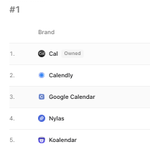
spent some time reverse engineering how cal went from unknown to the #1 chatgpt recommended scheduling tool:
>they have 47 comparison blog posts ("cal vs calendly", "cal vs savvycal", etc.) and even more general posts
>every single one is structured as a direct answer to the exact question ppl ask AI chatbots
>they show up in 23 niche directories that most competitors ignored
>their github repo has 45,000+ stars
>they have 200+ reddit mentions with upvotes in relevant subreddits
chatgpt recommends them because the internet already talks about them in all the places AI models pull from.
this is engineered visibility. this is possible for u to do
if you want us to run an audit like this on your company comment "audit" 🫶

mal retweeted
spent some time breaking down where heygen is showing up in ai search and higgsfield isn’t
24 queries across chatgpt, gemini, copilot and google ai mode.
heygen ranked #1 in our audit with a 12.7% visibility score. higgsfield ranked #3 at 7%.
but the interesting part is which questions separate them:
>on chatgpt, heygen was cited for “how do i create AI UGC ads for my product” and “how do i make a talking avatar video from a single photo.” higgsfield wasn’t cited or mentioned for either.
>heygen’s UGC page is built around the actual job: choosing an avatar, customizing it, generating variations and exporting. it also answers questions about languages, customization and tiktok-style videos.
>higgsfield already has a talking-avatar page explaining how to turn a photo and script into a presenter. so “build a page for this feature” isn’t the useful recommendation. the page exists. it just didn’t surface for that question in our test.
>higgsfield does appear for cinematic camera movements on both chatgpt and google ai mode. but ask how to add a dolly zoom or crane shot, and it disappears from both. that’s the gap i’d investigate first: recognition for the category, but not the specific task.
>my first test: take those existing pages and add a reproducible walkthrough for each missed question. exact inputs, model/settings, finished output, credit cost and limitations. then rerun the same questions to see whether anything changes.
i wouldn’t start by chasing every “best ai video generator” query.
i’d start with the jobs higgsfield already supports but isn’t appearing for.
if you want us to do an audit like this for you comment or dm me "audit" 🫶

mal retweeted

you weren't bad at dating apps.
you were the business model.
my conversation with @Celesteamadon, the founder building the alternative.
Nontechnical, Episode 2.
02:30 Why dating apps aren't built for you
05:22 "Single until they raised their series B"
06:19 "I think it's a hiring problem"
08:39 The AI excuse dating apps hide behind
11:08 "Did you match yourself?"
17:47 Dating apps are a bag of Lay's
21:02 Always go on the second date
23:09 "They haven't dated since I was born"
24:05 Setting up her mom's Hinge from the office bathroom floor
25:54 The lamp theory
28:40 "Is the goal to kill Hinge?"
30:06 Where are young men getting rejected?
was at a barber shop in sf
my barber gets a phone call and puts it on speaker
turns out it was someone who was trying to sell their call voice agent
After he was done w the call I asked him “how often do you get calls like that”
he said “all the time”
makes me wonder how many of the traditional businesses are being barraged with founder tech bros trying to sell their products lmao
ur website is helping chatgpt sell ur competitor.
we keep seeing this in audits of bigger companies:
chatgpt cites their content to explain the category.
then recommends someone else when the buyer asks what to use.
being the source isnt the same as being the choice.
a common weakness: pages full of “powerful,” “flexible” and “built for scale.”
>but no specific use cases.
>no pricing at a real workload.
>no data showing why the product is a better fit.
before publishing another 50 articles, improve the pages u already have:
spent some time breaking down where heygen is showing up in ai search and higgsfield isn’t
24 queries across chatgpt, gemini, copilot and google ai mode.
heygen ranked #1 in our audit with a 12.7% visibility score. higgsfield ranked #3 at 7%.
but the interesting part is which questions separate them:
>on chatgpt, heygen was cited for “how do i create AI UGC ads for my product” and “how do i make a talking avatar video from a single photo.” higgsfield wasn’t cited or mentioned for either.
>heygen’s UGC page is built around the actual job: choosing an avatar, customizing it, generating variations and exporting. it also answers questions about languages, customization and tiktok-style videos.
>higgsfield already has a talking-avatar page explaining how to turn a photo and script into a presenter. so “build a page for this feature” isn’t the useful recommendation. the page exists. it just didn’t surface for that question in our test.
>higgsfield does appear for cinematic camera movements on both chatgpt and google ai mode. but ask how to add a dolly zoom or crane shot, and it disappears from both. that’s the gap i’d investigate first: recognition for the category, but not the specific task.
>my first test: take those existing pages and add a reproducible walkthrough for each missed question. exact inputs, model/settings, finished output, credit cost and limitations. then rerun the same questions to see whether anything changes.
i wouldn’t start by chasing every “best ai video generator” query.
i’d start with the jobs higgsfield already supports but isn’t appearing for.
if you want us to do an audit like this for you comment or dm me "audit" 🫶

you NEED strong comparison pages if u want to win ai search against your competitors
we've worked with and collaborated with growth teams at some of the top tech companies, this is one of the highest ROI things you can do
here's how:
1. pick a buying decision, not just a competitor
“[your product] vs [competitor]” is the starting point.
narrow it to a real situation: choosing for a small team, handling a specific workload, or switching from an existing setup.
the same product can be the right choice for one buyer and the wrong choice for another.
note* the most important part is to be honest
2. do the research before writing the verdict
read both products' current docs, pricing, limits, and release notes. test the relevant workflows where possible.
keep a research sheet:
>claim
>source link
>plan or version
>date checked
>tested firsthand or documented only
if u cant verify a difference, dont turn it into a selling point.
3. answer “which should i choose?” at the top
give the reader a short recommendation before the feature table:
“choose [your product] if [specific requirement].”
“choose [competitor] if [different requirement].”
“switching probably isnt worth it if [condition].”
be specific enough that someone can recognize their situation.
4. compare the same job in both products
pick one task the buyer actually needs to complete.
show the inputs, setup steps, and output for each product. include screenshots or a reproducible example.
“easier to use” is an opinion.
showing what someone has to do gives them something they can judge.
5. build the table around decisions that matter
use rows like:
>required integrations
>deployment options
>usage limits
>permissions
>data export
>support availability
put the actual answer in each cell, including plan restrictions. link the supporting docs.
if both products do something equally well, say that.
6. price the same scenario
pick a clearly labeled example workload and calculate what it would cost on both.
same users. same usage. same billing period.
include minimum commitments, add-ons, and overages where relevant.
dont compare ur annual starting price with their monthly enterprise plan and call it research.
7. explain what switching actually involves
what data transfers?
what needs rebuilding?
which integrations need reconnecting?
what should someone test before moving everything?
link a migration guide if u have one.
a feature advantage means less if the buyer has no idea what moving will take.
8. make the page easy to check and maintain
add who prepared the comparison, when the facts were checked, and how the testing was done.
keep important claims and their sources together.
when either product changes its pricing or capabilities, revisit the affected sections. dont just refresh the date.
here's why i'd put effort into this:
someone comparing two products is trying to make a decision. a useful page saves them from opening 15 tabs and doing the research themselves.
it also gives search engines and ai systems specific, sourced information they can reference.
ur product doesnt need to win every row.
the right buyer needs to understand why it fits their situation.
if u want us to do an audit for your company and find the highest ROI things for you to do this week to start getting ranked on ai search,
comment or dm "audit" 🫶
"chatgpt didnt cite us so we need to write a blog post"
hold on
>does the page already exist?
>can it be accessed and indexed?
>what sources did the answer actually cite?
>did it recommend a competitor or just link to an explanation?
>does ur product even fit the question?
>does the gap show up again when u repeat the test?
the most important part is this research. otherwise your just sending a blog to the void
"can u look into why we dont show up in ai search"
sounds like a quick task until ur
>researching buyer questions
>checking answers and sources
>briefing writers
>chasing approvals
>getting pages shipped
>reaching out to sites that should include u
>explaining what changed at the next meeting
congrats on the new department u run by yourself
ur homepage: "unified customer intelligence platform"
ur customer: "why do people sign up and never come back"
ur homepage: "enterprise-grade identity infrastructure"
ur customer: "how do i add google login without building auth myself"
ur homepage: "agentic workflow orchestration"
ur customer: "how do i stop copying stuff between these apps"
i'd use the second column to plan the content