

Literal rock star developer. JavaScript, music, Japanese, and serial commas. 日本語でもOKです。Author and maintainer of the EJS templating lib. Developer at @usebland.
San Francisco, California USA
Joined February 2007
- Tweets22.4K
- Following224
- Followers2.3K
- Likes10.2K







New blog post. Are you ready to answer these questions three? fleegix.org/ios-app-store-re…


Matthew Eernisse retweeted

I've been making a kaiju game in the browser on the side, inspired by 70s tokusatsu shows.
The buildings are hollow and built from thin wall sheets like the old Tsuburaya miniatures. Jump into one and the walls crack into shards, and once the ground floor goes it pancakes.
I worked on this stuff so long, with so many different pieces to it, that by the end Claude had totally forgotten the original thing we were doing.
Matthew Eernisse retweeted

Introducing Business Agents, a new way to reach your customers through iMessage.
Bland gives your business its own contact in your customers' phones, with your name and logo, access to your company's APIs, and the tools to act on them. Set one up in under 30 seconds, and it handles customer conversations so your team can focus on everything else.
Matthew Eernisse retweeted
iMessage agents for your business in 30s.
Send a link and Bland learns your business, plugs into your APIs, and creates a branded agent for you automatically.
The agent can do things like Tapbacks (❤️,👍,❗), send embedded components, and even accept payments within a chat.
It's live now. Text +1 (415) 481-7537.
I am reliably informed that the thumbs-up in Slack is seen by Millenials and Zoomer as passive-aggressive or sarcastic. Gotta retrain my @Yammer-addled brain.


Absolutely. I have always objected to this use of the word "taste." It trivializes the importance of this. I have used the term "product sense," but "judgement" is great too.

Matthew Eernisse retweeted

It's really quite something when doing stuff with LLMs that you have to oscillate between deliberately built verification systems and just yelling at your little demon servant differently

Brand-new EJS site at ejs.co/ Awesome redesign by @hiroeernisse, check it out.

Matthew Eernisse retweeted

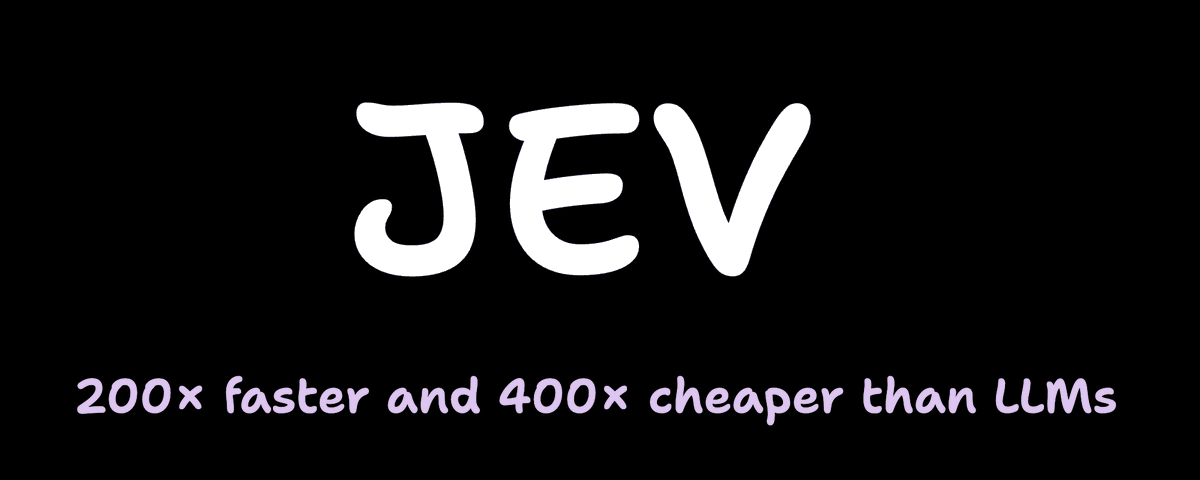
A faster, 100% open-source alternative to Jev.
It’s called Laya.
Both models solve the same problem.
You give them unstructured state plus typed questions. Instead of generating a paragraph, they choose from answers you define and return probabilities your code can act on.
But they make those decisions differently.
Jev is a closed, hosted API. Its architecture and training are not public, but it works zero-shot and supports up to 255 options.
Laya is Apache 2.0 licensed, runs locally, and uses open-weight encoder models. Here is how its pipeline works.
→ It routes by language first. Plain Python selects the English or multilingual checkpoint before inference.
→ It creates one sequence for each question. Every possible answer gets a `[MASK]` marker. The question and state provide the context needed to compare those options.
→ It scores instead of generating. A bidirectional encoder and small decision head assign one score to each option. Softmax turns those scores into a probability distribution.
→ It batches the questions. They run together in one model call, although every question still carries its own copy of the state.
This removes network latency and token-by-token generation.
In one independent test, Laya took about 35 milliseconds on a local GPU. Jev took roughly 380 milliseconds over the network.
Laya also has no per-call API fee, keeps data on your infrastructure, and can run on older GPUs.
But it is not a drop-in replacement for every workload.
Jev is a hosted generalist that works well out of the box. Laya is a fast base you need to specialize.
Laya makes the most sense when you have a stable answer set and representative training data. Fine-tune it for the task, calibrate its probabilities on held-out examples, and send uncertain decisions to a stronger model or human reviewer.
Jev gives you stronger zero-shot decisions.
Laya gives you speed, privacy, control, and no per-call fee after you teach it your task.
The open-source repository is here: github.com/NandhaKishorM/lay…
If you want to self-host Laya, InstaCloud provides a really nice and easy way to do so.
Check this out: instacloud.com/templates/lay…
If you're new to decision models, I wrote the full breakdown of how Jev. The article is quoted below.


🤘🏻🤘🏻🤘🏻🤘🏻🤘🏻🤘🏻

HOLY SH*T
@City_of_Ottumwa in Iowa opened up their most recent city council meeting with a prayer to SATAN.
"Let us pray. Dear dark father... HAIL SATAN"
WTF is wrong with these people???
That's some Pellucidar shit right there.

Your body thinks a day is 24 hours because the sun tells it so every morning. Take away the sun, and a "day" can stretch to 48 hours without you feeling a thing.
Scientists learned how far it goes in 1962, when a 23-year-old French geologist named Michel Siffre lowered himself into an Alpine cave for 63 days with no clock and no sun. When his team called down to say time was up, he argued with them. By his own count he still had a month left.
NASA funded his next one. In 1972, Siffre spent 205 days in a Texas cave, with the French Defense Ministry watching too, because they needed to schedule sleep for nuclear submarine crews. Down there his body did something nobody expected. It stretched to a 48-hour day. 36 hours awake, 12 hours asleep, and from the inside it felt completely normal.
That mechanism explains Flamini's missing 300+ days. Your brain counts days by sleep cycles, nothing else. When each cycle quietly stretches past 24 hours, the calendar and your body stop agreeing, and you have no way to feel the gap.
She stopped counting on day 65, almost exactly where Siffre's drift kicked in. When her team finally came down to get her after 500 days, she was asleep. Her first question on the surface was who's buying the beer.
The sun wins this argument on your behalf every single morning. Light hitting your eyes at dawn is the only thing pinning your internal clock to Earth's rotation, and a cave is just what happens when it stops showing up.