Literal rock star developer. JavaScript, music, Japanese, and serial commas. 日本語でもOKです。Author and maintainer of the EJS templating lib. Developer at @usebland.
San Francisco, California USA
Joined February 2007
- Tweets22.4K
- Following224
- Followers2.3K
- Likes10.2K








Matthew Eernisse retweeted

I've been making a kaiju game in the browser on the side, inspired by 70s tokusatsu shows.
The buildings are hollow and built from thin wall sheets like the old Tsuburaya miniatures. Jump into one and the walls crack into shards, and once the ground floor goes it pancakes.
Matthew Eernisse retweeted

Introducing Business Agents, a new way to reach your customers through iMessage.
Bland gives your business its own contact in your customers' phones, with your name and logo, access to your company's APIs, and the tools to act on them. Set one up in under 30 seconds, and it handles customer conversations so your team can focus on everything else.
Matthew Eernisse retweeted
iMessage agents for your business in 30s.
Send a link and Bland learns your business, plugs into your APIs, and creates a branded agent for you automatically.
The agent can do things like Tapbacks (❤️,👍,❗), send embedded components, and even accept payments within a chat.
It's live now. Text +1 (415) 481-7537.


Matthew Eernisse retweeted

It's really quite something when doing stuff with LLMs that you have to oscillate between deliberately built verification systems and just yelling at your little demon servant differently

Matthew Eernisse retweeted

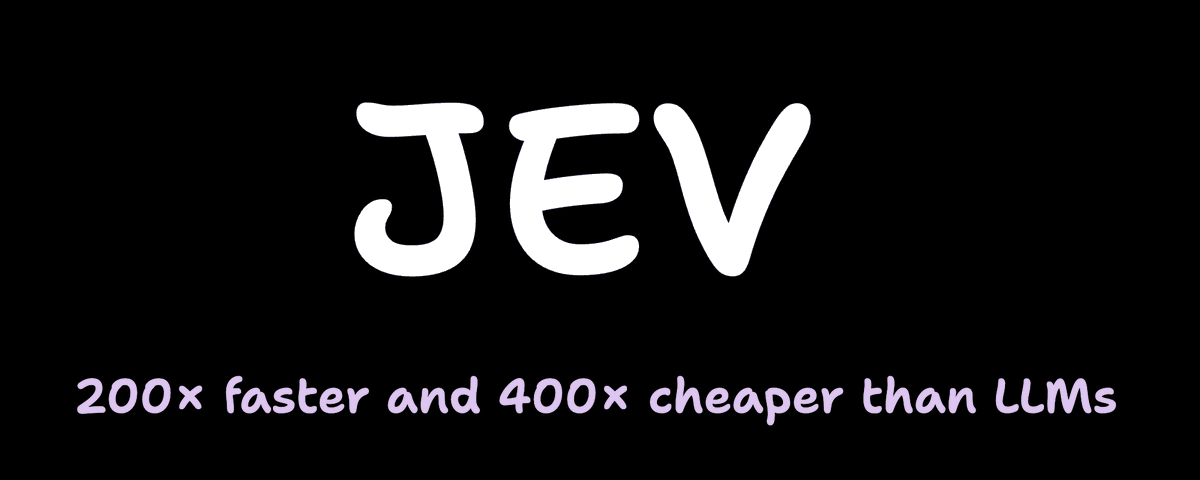
A faster, 100% open-source alternative to Jev.
It’s called Laya.
Both models solve the same problem.
You give them unstructured state plus typed questions. Instead of generating a paragraph, they choose from answers you define and return probabilities your code can act on.
But they make those decisions differently.
Jev is a closed, hosted API. Its architecture and training are not public, but it works zero-shot and supports up to 255 options.
Laya is Apache 2.0 licensed, runs locally, and uses open-weight encoder models. Here is how its pipeline works.
→ It routes by language first. Plain Python selects the English or multilingual checkpoint before inference.
→ It creates one sequence for each question. Every possible answer gets a `[MASK]` marker. The question and state provide the context needed to compare those options.
→ It scores instead of generating. A bidirectional encoder and small decision head assign one score to each option. Softmax turns those scores into a probability distribution.
→ It batches the questions. They run together in one model call, although every question still carries its own copy of the state.
This removes network latency and token-by-token generation.
In one independent test, Laya took about 35 milliseconds on a local GPU. Jev took roughly 380 milliseconds over the network.
Laya also has no per-call API fee, keeps data on your infrastructure, and can run on older GPUs.
But it is not a drop-in replacement for every workload.
Jev is a hosted generalist that works well out of the box. Laya is a fast base you need to specialize.
Laya makes the most sense when you have a stable answer set and representative training data. Fine-tune it for the task, calibrate its probabilities on held-out examples, and send uncertain decisions to a stronger model or human reviewer.
Jev gives you stronger zero-shot decisions.
Laya gives you speed, privacy, control, and no per-call fee after you teach it your task.
The open-source repository is here: github.com/NandhaKishorM/lay…
If you want to self-host Laya, InstaCloud provides a really nice and easy way to do so.
Check this out: instacloud.com/templates/lay…
If you're new to decision models, I wrote the full breakdown of how Jev. The article is quoted below.


Matthew Eernisse retweeted
Bland 🤝 @pipecat_ai
Pipecat put Bland Speech v3 through a live demo, take a look.
We wrote an article on how our research team taught it to laugh and sigh on cue.
xitter.cf/usebland/status/210826…

Sometimes, choosing a voice for your Pipecat agent is about more than just latency. It might be about personality, accent, or how convincingly a voice fits the situation.
We explore voice realism with @usebland Speech v3, available in Pipecat as a maintained service.
📖 docs.pipecat.ai/api-referenc…
Matthew Eernisse retweeted
Updated the navbar on my portfolio.
- SVG logo instead of font initials
- Added “Work” and “About” links
- Icon buttons grouped on one side, divider between contacts and theme toggle
- New hover animation on contact icons
Matthew Eernisse retweeted

Introducing AgentID by @agentmail, "Sign in with Google" for AI Agents
Millions of agents already use AgentMail. AgentID lets them sign in to your app.
Integrate with the prompt below, reply with a screenshot, and we'll give you 3 months free of any AgentMail plan.

Matthew Eernisse retweeted

#designoftheday Jony Ive & Marc Newson’s Ferrari Luce EV is a fascinating example of notable designers completely missing the mark. The surfaces are clean, details obsessively resolved & the reduction admirable, but where is the Ferrari? Its restrained, almost appliance-like form suppresses the visual drama, tension & emotional excess that have long made a Ferrari irresistible. For a marque built on speed, passion & visual bravado, the Luce looks surprisingly timid. shorturl.at/aMm11


Matthew Eernisse retweeted

Unlike Madonna / all hype
Incredible voice still.
Timeless.
Classy.
Unbelievable talent.
Awesome.

Matthew Eernisse retweeted
Hopping on the trend. Here are the 9 games that made me who I am:
#my9games


Matthew Eernisse retweeted
Bland 🤝 @Muse
With the agent phone plan you can:
- Make appointments
- Book reservations
- Text your agent
Connecting Muse with the Bland API is the fastest way to give Muse its own Phone Number
bland.ai/agent-phone-plan
Matthew Eernisse retweeted
2 days left to give your Grok @bot a number for only $3.
It places and takes calls, sends and receives texts, and sounds human while doing it. A month of the Agent Phone Plan, priced at $3 for as long as Grok @bot's stream runs.
Use this Grok Bot template for the fastest start: x.ai/bot/GEusxL3Fuw-vApnEDp2…