

PostDoc @LearningCCL, Phd Complejidad Social en @cics_udd. Chile, Twitts de ciencia, en especial data science & causalidad, ñoñerías y tech. EN/ESP
Chile + Magyarország
Joined May 2009
- Tweets10.3K
- Following1.9K
- Followers1K
- Likes9.6K




Pinned Tweet
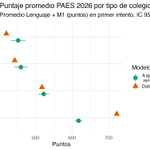
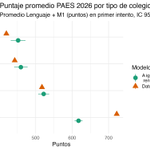
La PAES reabrió la comparación entre colegios particulares y municipales.
Por un lado, hay mucho potencial en Chile. Por otro, una comparación bruta no considera diferencias socioeconómicas.
¿Cómo cambia la brecha cuando incluimos diferencias de ingreso, género y rendimiento?👇

New paper! with @marianagmmacedo @crcandiav @cesifoti
We map fame’s geography on @Wikipedia through locality and globality.
+Our experiment finds ~10 pp higher recognition for compatriots.
+ @NobelPrize , Oscars and death briefly spike locality, but global visibility lasts.

Does where we live shape who we remember? 🌍
A new @PNASNexus paper by @mel2kill & @cesifoti shows:
📍 10% higher recall for local historical figures.
📈 Major events (Nobels, Oscars) create sudden local spikes but slow global growth.
Full paper here:
academic.oup.com/pnasnexus/a…

Melanie Oyarzún Wolf retweeted

Princeton didn’t consider Anne Carson worthy of a recommendation for tenure, and she couldn’t continue teaching at McGill after its Department of Classics was shut down.
Now, everyone wants to claim her as their own …


Melanie Oyarzún Wolf retweeted

How do Nobel Prizes change the public fame of scholars?
In a recently accepted paper, we explore this question by separating “local” and “global” fame. We find that while local attention spikes and decays, global attention increases slowly and more persistently.
This suggests the prize helps transform local heroes into global figures. For scholars close to winning a Nobel, getting the prize may mark the difference between local and global recognition.
The paper has several results separating local and global fame, including a fun online experiment we used to identify attention premia for language and geography.
The full text is available at:
academic.oup.com/pnasnexus/a…
This paper was produced in collaboration with @marianagmmacedo @mel2kill & @crcandiav

Melanie Oyarzún Wolf retweeted

La mitad de los viajes en coche realizados en las áreas metropolitanas europeas son inferiores a 7 kilómetros. Este estudio estima que más de 50 millones de desplazamientos diarios podrían sustituirse por transporte público, caminar o bici si se implantan las políticas adecuadas.

Melanie Oyarzún Wolf retweeted

Another opportunity to come and work with us! We are hiring a Research Scientist. This is a great opportunity for a quantitative researcher interested in conducting policy-relevant research on important education issues. Check it out: uasys.wd5.myworkdayjobs.com/…
Melanie Oyarzún Wolf retweeted

Skeptics of waterfront street redesigns will say "we aren't Paris."
You can remind them that Paris wasn't always Paris.
Melanie Oyarzún Wolf retweeted

Sharing lecture videos for the **How to AI (Almost) Anything/Multimodal AI** course I taught at MIT in spring 2026.
This course became quite a hit the last time I shared it in spring 2025. Spring 2026's updated version contains updated topics on multimodal agents, reasoning, self-evolving AI, and new modalities like touch and smell. Also includes slides (not videos) of guest lectures on multimodal AI for health, design, manufacturing, cities, & transportation.
Youtube playlist: youtube.com/playlist?list=PL…
Course website and materials: mit-mi.github.io/mmai-course…
Today's AI can be applied to almost anything - from language to vision, audio, sensors, medical data, music, art, smell, and taste. This course covers the principles of AI (focusing on deep learning and foundation models), how we can apply AI to novel real-world data modalities, and multimodal AI that can process many modalities at once, such as connecting language and multimedia, music and art, sensing and actuation, and more.


Melanie Oyarzún Wolf retweeted

Estudiantes avanzados de doctorado en universidades Latinoamericanas trabajando en su tesis en temas de gobernabilidad y política, usando métodos experimentales o afines: los invitamos a aplicar a este lab para recibir retroalimentación de un grupo estelar de académicos. Ver link

🚀 Call for Applications open! LAPolMeth & @EGAPTweets LatAm PhD Lab 2026 @Uniandes (Bogota, Nov 20-21). For LatAm PhD students. ✈️ Travel support. 🗓️ Deadline: Aug 31.
More info: egap.org/project/lapolmeth-e…
Apply here:: forms.gle/2jmNbpvp61rmKbyu6

Melanie Oyarzún Wolf retweeted

his MIT macro classes are free and they are very very good
youtube.com/playlist?list=PL…


I highly recommend the interview of Ricardo Caballero by Paul Krugman (two greats). It starts off with PK admitting defeat (sort of) to RC on the issue of global imbalances. Overall, a great economic discussion.
paulkrugman.substack.com/p/t…


Melanie Oyarzún Wolf retweeted

I am very happy to launch the first version of RIGOR (rigor.qhawarina.pe/)
This project was born while I was using prompts to evaluate the internal consistency of my own papers, whether the mathematics behind them was correct, whether the results were novel, and how to frame them against the current literature (those prompts are on my GitHub: github.com/cesarchavezp29/ri…). I was finding huge improvements in my papers with those "adversarial" reviews, so the idea naturally evolved in something more mature as producing AI-made audit reports, but looking for ways to verify the AI's answers and optimize token use.
TLDR: Specialized AI reports from $5 and General Audit reports from $10, using your own API, for social science papers.

Melanie Oyarzún Wolf retweeted

“Air pollution fell substantially as Paris restricted car traffic and made way for parks, people-streets and bike-lanes.”
Better for the climate, better for health, better for livability and quality of life.
Common sense.
Such a no-brainer, it’s remarkable that more cities HAVEN’T done the same.
washingtonpost.com/climate-s…

Melanie Oyarzún Wolf retweeted

I was thrilled to learn about the brand-new Amartya Sen Economics Prize for the Best Young Latin American and Caribbean Economist:
lacea.org/2026/08/01/amartya…
A wonderful initiative that will help economics across the region.
I am also glad to see the Caribbean included. We all know the remarkable crop of economists from countries such as Argentina, Brazil, Mexico, Uruguay, and Colombia. We see far fewer from the Caribbean. I have written before about my interest in the area, and nothing would please me more than a new cohort of strong economists from the Dominican Republic, Barbados, or the Bahamas (just to mention a few examples).

Melanie Oyarzún Wolf retweeted

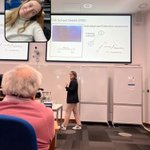
Very excited to give a plenary talk at the 12th International Conference on Computational Social Science (IC2S2) later today.
I'll be talking about a new reframing of language and how some long held beliefs are being challenged by AI and new advances in understanding animals.

Now a tutorial on data driven storytelling one of my favorite topics ❤️ #ic2s22026

Is nice to be an in the US, specially an smallish and charming town. But I forgot how hard they go on disposable plates! 2 days in and I already used 4! I feel very wasteful :/
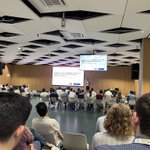
Ready to kick off a week of science at one of my favorite conferences, the International Conference on Computational Social Science #IC2S22026 !

