

CADD group leader at Center for Development of Therepeutics of Broad Institute. Views are my own.
Boston, MA
Joined August 2009
- Tweets1.1K
- Following412
- Followers250
- Likes1.9K



Mrinal Shekhar retweeted

Experimenting with a New Conditional Diffusion-Based Generative Model #EvoDiffMol #cheminformatics #RDKit #GenerativeAI iwatobipen.wordpress.com/202…

Mrinal Shekhar retweeted

Protein immunogenicity is a major driver of drug failure in the clinic, a problem especially important in the age of generative AI when we can design de novo medicines with desired function.
Meet 🐐MESSI: a generative method for deimmunizing proteins with discrete diffusion. We reduce predicted MHC-II epitopes and experimentally validate retained or improved function in luciferases, PD-1 binders and uricases—an enzyme family used in FDA-approved therapies.💊
Watch the story below:
1/n 🧵
Mrinal Shekhar retweeted

Our paper, “Creation After Destruction? Financial Intermediation and Firm Entry After Bank Cleanups,” co-authored with Prof. Prasanna Tantri, has been published in the Review of Finance. (doi.org/10.1093/rof/rfag045)
🧵 A thread...

Mrinal Shekhar retweeted

The third challenge in our Anthropic x Adaptyv Protein Design Competition is now live.
I'm sure you are all familiar with this target: GLP1R. That "Godzilla" in the animation is there on purpose. Exendin-4, a GLP1R agonist, was first found in Gila monster venom, with its synthetic form (exenatide) being approved in 2005.
Across this competition we’ve wanted to go beyond plain binding. Our first two challenges had two new conditions (pH-sensitivity and cross-species). And, in this one, you’re designing binders against a rather difficult GPCR and they must also function as agonists. We'll test this with a cell-based functional assay.
Submit your designs by October 25th 23:59 AoE!

Mrinal Shekhar retweeted

An excellent introduction (for beginners) to Graph Neural Networks
distill.pub/2021/gnn-intro/

Mrinal Shekhar retweeted

ICYMI like I did: cool paper from @UWproteindesign combining de novo allosteric protein switching with de novo enzymes. You know it's gonna be a banger when figure 1 has an energy landscape 😏 📈📉
Congrats to Alex Shida and the rest of the authors
@adam_broerman @ArvindSPillai1
biorxiv.org/content/10.64898…

Mrinal Shekhar retweeted

タンパク質配列の共進化を可視化するパイプラインの開発
アミノ酸配列や構造情報を入れるだけで、構造上に共進化するアミノ酸ペアを可視化可能
モデル細菌や酵母由来の複合体における、構造が決定済または未決定の相互作用面の共進化表示例が紹介されている #BNTNJC
biorxiv.org/content/10.64898…

Mrinal Shekhar retweeted

Glad that someone noticed this. R&D productivity is extremely important. If we had more financial resources, I could start a program for pretty much every high-value protein target using multiple therapeutic modalities at once. AI is no longer the moat. The moat is operational efficiency, monkey and human patient resource. And the real bottleneck is in the clinic.

Mrinal Shekhar retweeted

picofold.py: a minimal protein structure predictor in ~200 lines of readable PyTorch.
Give it 16 amino acids and it turns random noise into a 3D structure, step by step. I wrote it to demystify protein folding and flow matching for myself. Hope you find interesting! 🧵

Mrinal Shekhar retweeted

Assume --- three of your group members
- Designed binders
- Using different techniques/tools
- For folding they used Boltz → Protenix → ColabFold
- For interface scoring/ranking somewhat similar metrics.
You/PI: "can you guys also rank and check with i_pDAE, in BindCraft2. I just want to see how our binders rank/look"
-One of them simply clones the repo👇& sets it up in 3 min using uv.
-They paste the folded binders from Boltz → Protenix → AF2/ColabFold into one folder and run one command: "python ipdae.py designs/"
-By the time they finish their coffee☕️, the results are ready.
-One ranked CSV file, best binders(0-1 i_pDAE scores) first. For every seed/structures user get (i_pDAE, i_pDAE_median, Contact_Pairs, interface_Binder_Residues/interface_Target_Residues).
-Plain-text report.
-PyMOL views with F1–F3: ipdae_view.pml stores three scenes on the F1, F2 & F3 keys.
i_pDAE values/colors/residues/surfaces in pymol/clip👇:
🔴 Deep Red (0.8–1.0): High confidence (PAE <0.5Å) 🌸 Light Red (0.6–0.8): Confident
⚪ White (0.4–0.6): Moderate / mixed
🩵 Light Blue (0.2–0.4): Uncertain
🔵 Deep Blue (0–0.2): Interface contact, unknown placement
🩶 Grey (-1): Off-interface (unscored)
Dropping it tomorrow.
github.com/ullahsamee/i_pDAE
CTMD: Can molecules be accurately screened without waiting for free energy convergence?
The most frustrating moment in virtual screening is often not ending up with an empty list, but rather getting hundreds of molecules that all look promising.
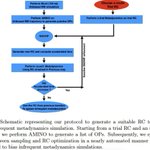
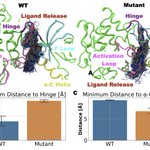
This work introduces c(t)-based metadynamics (CTMD)—a fast, physics-based method for triaging virtual-screening hits. #JCIM #Compchem #Virtual Screen @broadinstitute
Article: pubs.acs.org/jcisd8/article-….

Mrinal Shekhar retweeted

Mathematics has now fully morphed into biology:
Project costs millions $ ✅
Put out paper that nobody has read ✅
Massive paper supplement nobody will read ✅
Advertise with pretty art ✅
Vicious authorship fight ✅
Say you're curing cancer ✅


Mrinal Shekhar retweeted

Protein backbone design methods innovate by recombining naturally occurring subdomain structures, rather than designing domains unseen in nature, and widely-used novelty metrics aren't able to detect this


Is retrieval all you need? Assessment and emergence of novelty in protein structure generation
1. The paper argues that “full-chain novelty” (no close whole-chain hit in a structure database) is not sufficient evidence for new fold invention, because multi-domain proteins are modular and can look novel as whole chains while reusing known domains.
2. It introduces Domain Retrieval Rate (DRR): decompose each generated backbone into domains (Merizo), then retrieve each domain against CATH S40; a generated backbone counts as “retrieved” if any domain has a match above a threshold. This explicitly tests novelty at the domain scale rather than the chain scale.
3. Across 8 backbone generators (diffusion + flow-matching families, plus two binder-oriented systems run in target-free ablations), DRR is high under an aligned-length TM convention: at TM≥0.5, DRR ranges ~80.2% to 98.2%, meaning most generated chains contain at least one locally alignable known domain-sized unit.
4. In the same unified evaluation, conventional full-chain retrieval (query-normalized TM, qTM≥0.5) is much lower for most unconditional generators (0.0% to 9.6%), while DRR stays high—showing a strong protocol-dependent gap between “domain reuse” and “whole-chain novelty.”
5. The paper diagnoses a key reason: query-normalized TM has a length ceiling when searching long chains against a domain database (CATH S40 median ~132 aa). For long queries, qTM≥0.5 can be unattainable regardless of structural content if reference entries are too short.
6. To calibrate what “retrieval alone” can produce, it proposes RetFold, a zero-training baseline that retrieves CATH domains (using an ensemble of ESM-2 embeddings, Foldseek 3Di, and ProstT5), assembles 3 fragments (core + two extensions), then refines junctions with geometry-based helix-linker optimization. It runs on CPU at ~1.98 s per backbone (reported ~110× faster than their measured RFdiffusion run).
7. RetFold is recombination by construction, yet under the conventional full-chain qTM≥0.5 protocol it is retrieved only 20.0%, while its DRR is 96.0%. This demonstrates that low full-chain retrievability can occur even when the chain is explicitly built from known domains.
8. The paper then calibrates three TM-score conventions using (i) RetFold as a positive control and (ii) a leave-one-topology-out negative control on CATH S40. A key result: aligned-length TM (alnTM) has very high false positives for “fold novelty” at τ=0.5 (it retrieves 90.04% even after removing the query’s topology), so it mainly evidences local alignability rather than complete fold reuse.
9. A stricter reference-normalized criterion (target-normalized TM, tTM) becomes more specific only at higher thresholds: at tTM≥0.7 the leave-one-topology-out false positive rate drops to 5.38%, while RetFold remains retrieved at 100%. Under this calibrated view, unconditional generators largely concentrate in the ambiguous 0.5–0.7 range and drop sharply at 0.7.
10. Beyond retrieval metrics, RetFold highlights a separate designability issue: AlphaFold3 confidence drops at assembled junctions (inserted helix-linkers have much lower pLDDT than retrieved fragments; inter-fragment PAE is high). Whole-chain average pLDDT can mask these localized failures, so novelty and designability should be reported separately with matched baselines.
📜Paper: arxiv.org/abs/2608.10598
#ProteinDesign #ComputationalBiology #ProteinStructure #DiffusionModels #FlowMatching #CATH #Foldseek #AlphaFold3 #ProteinBackboneGeneration #Benchmarking

Mrinal Shekhar retweeted

A new Nature Communications study screened 14.5 million molecules against neurotensin receptors, synthesized only 39 candidates, and experimentally identified seven agonists, ultimately producing NTS₂R-selective compounds with analgesic activity in rodents.
What I find most instructive is not the size of the virtual screen, but how the chemical space was designed: a receptor–peptide structure was used to build a focused, synthetically accessible library around the interactions that actually drive activation, giving a nine-fold higher hit rate than a generic library.
Crystal structures later confirmed the core docking poses, while also exposing where the computational models were wrong.
This is what rigorous computational drug discovery should look like: computation narrows millions of possibilities into testable hypotheses; medicinal chemistry improves them; structural biology corrects the model; and in vivo experiments decide whether the mechanism survives biological reality.
Not every computational breakthrough needs to be called AI. Good science is often better search-space design followed by uncompromising validation.
Sometimes the real advance is designing the right search space, and letting experiments remain the final judge.
nature.com/articles/s41467-0…

Mrinal Shekhar retweeted

Nesso-1: Accelerating Open-Source Binding Affinity Predictions @valence_ai
1. Nesso-1 introduces an open-source, coarse-grained cofolding framework that predicts protein–ligand binding affinity in approximately one second on a single GPU. It is more than 10× faster than Boltz-2 on average and exceeds 20× speed-up for larger proteins, allowing up to 20× more compounds to be screened under the same compute budget.
2. Its central design choice is to remove the computationally expensive heavy-atom diffusion module. Instead of generating a complete atomistic complex, Nesso-1 learns token-level geometric relationships between ligand heavy atoms and protein residue centers, suggesting that full-atom poses are not always necessary for accurate affinity prediction.
3. The model uses a streamlined Pairformer trunk that updates only pairwise token representations. It removes MSA processing, incorporates pretrained ESM-2 protein embeddings, and predicts protein–ligand distance distributions that encode both coarse structural information and intrinsic uncertainty.
4. During recycling, Nesso-1 processes the full protein only in the first pass and subsequently retains residues predicted to lie within 22 Å of the ligand. Its affinity module further focuses on protein tokens within an expected 15 Å cutoff, substantially reducing computation without measurably compromising affinity accuracy.
5. The affinity module predicts both binding likelihood for hit identification and continuous affinity for hit-to-lead ranking. It is trained with classification and regression objectives, including an up-weighted intra-assay difference loss that emphasizes compound ranking within the same experiment while reducing sensitivity to biases between assay protocols.
6. On the public FEP+ 4, OpenFE, and CASP16 benchmarks, Nesso-1 achieves weighted Pearson correlations of 0.80, 0.66, and 0.68, respectively, outperforming Boltz-2 in all three settings. It also exceeds several simulation-based baselines while requiring seconds rather than the multiple GPU-hours associated with free-energy calculations.
7. The authors caution that these commonly used public benchmarks are chemically similar to BindingDB and ChEMBL training data and should therefore be considered largely in-distribution. They show that sequence-based leakage controls alone do not guarantee a realistic assessment of generalization to novel medicinal chemistry.
8. On the more challenging OpenBind benchmark, containing 494 compounds targeting the conformationally flexible EV-A71 2A protease, Nesso-1 achieves the lowest RMSE and highest Spearman correlation among the evaluated AI models. However, molecular weight remains a surprisingly competitive baseline, highlighting the difficulty of zero-shot affinity prediction from public training data.
9. Across 25 internal biochemical assays, Nesso-1 reaches a weighted Pearson correlation of 0.44, compared with 0.37 for Boltz-2 and 0.27 for molecular weight. Its performance remains relatively stable across different levels of chemical similarity to the training set, although substantial assay-to-assay variability confirms that real-world out-of-distribution prediction remains unresolved.
10. Nesso-1 also demonstrates meaningful selectivity in selected target families by distinguishing the potency of identical compounds between primary targets and related off-targets. The results suggest that coarse cofolding representations can capture target-dependent interactions rather than relying only on ligand-level properties, although performance declines for highly unfamiliar targets and chemistry.
11. The study argues that atomistic structural detail may sometimes introduce noisy, high-frequency information into affinity models. Nesso-1 therefore establishes a practical speed–accuracy baseline for high-throughput screening and large-scale fine-tuning, while acknowledging that full-atom modeling, solvent, entropy, and water-mediated effects may still be essential during later-stage lead optimization.
💻Code: github.com/recursionpharma/n…
📜Paper: valencelabs.com/wp-content/u…
#Nesso1 #BindingAffinity #DrugDiscovery #ComputationalBiology #ProteinLigand #VirtualScreening #Cofolding #MachineLearning #OpenSourceAI
