

CEO https://teapawt.org/t.co/NQzUVA89sz AI Engineer Wikipedia of health https://teapawt.org/t.co/AQ7Z5xUpYs Biomechatronics | MMA https://teapawt.org/t.co/gdR3yX42TH Coaching https://teapawt.org/t.co/CAmUTYPWYk
India
Joined April 2019
- Tweets16.7K
- Following319
- Followers2.7K
- Likes20.5K





Pinned Tweet
I’m sure there are others like me, but at least I know my story - how I covered such a vast landscape, something I know is extremely rare, if not almost impossible.
I’ve studied many academic subjects and art forms, but the hardest thing I’ve ever learned is fitness in its truest form.
I started early. I was competing in martial arts as a teenager, and that’s when I began studying sports science, even before college.
Since then, I’ve learned multiple sports and physical disciplines. And in the middle of all this, I had a terrible road accident, which made the journey even harder and forced me to relearn and rebuild parts of my body all over again.
That alone added another layer of complexity to everything I do physically.
I call fitness the hardest thing I’ve learned because I can study math or biology for 8-10 hours a day easily without breaking down. I’ve done it.
But physical training doesn’t work like that.
“Deliberate practice” isn’t the same across domains.
To learn multiple physical disciplines, recovery becomes just as important as the training. The body simply doesn’t have the same endurance or recovery capacity for physical work as it does for mental work.
With intellectual work, the limiting factor is mostly attention and cognitive fatigue, which reset relatively quickly.
With physical training, you’re dealing with tissue adaptation timelines, hormonal cycles, joint stress accumulation, and other biological realities that won’t be rushed no matter how disciplined you are.
You can’t brute-force your way through it with willpower or caffeine like you can with a tough textbook.
The body enforces its own timeline, and if you don’t respect it, you get injured or burnt out. And the more diverse your training, the more you have to manage competing adaptations, different movement patterns, and different recovery demands. That balancing act becomes a skill of its own.
Because of all this, you’re forced to accumulate knowledge slowly, over years. There’s no compression like there is with theoretical learning.
You can’t rush it. You can’t shortcut it. You can’t turn 10 years into 10 months. The path is long, and you have to survive it for decades to really go deep.
That’s why I say it’s the hardest thing I’ve ever learned - the combination of martial arts, lifting, calisthenics, acrobatics, jump rope, and everything else I practice physically.

Two lifters. Same muscle strength. Different squat numbers. Why?

Squat numbers are strongly affected by leverage and don’t equal pure muscular strength. The number on the bar doesn’t always reflect muscle force.
Torque = Force × Moment Arm
Because joint torque = ground reaction force × joint moment arm,
two lifters can have the same bar weight but:
Different joint angles and segment lengths → different external moment arms → different joint torques → different muscle forces.
If two people produce identical muscular force, the one with more favorable proportions (e.g., shorter femurs relative to torso) will lift more weight.
Weightlifters, compared to other strength-power athletes, tend to have shorter arm spans and tibias and be shorter overall.
But what matters most is segment proportions, not just absolute height.
A tall lifter with a long torso and short femurs may have better leverage than a shorter lifter with proportionally long femurs, though the shorter lifter still benefits from reduced bar travel.
Mechanically, these are two separate advantages: favorable proportions reduce external moment arms, while shorter absolute height reduces the distance the bar must travel.
Both allow more weight to be lifted for the same muscular effort.
Squat (and every lift) is "strength in a very specific mechanical configuration," not a pure measure of muscular capacity.
Let this be your motivation for today, and don’t forget to follow @carlsequeirafit on FreeGym. Link 👇

Deadlifts don't hurt your back.
Bad deadlifts do.
After years of coaching athletes and everyday lifters, @AanchalXIV has identified 12 reasons your back hurts, and how to fix them all.
Link👇


Killing it, @Optimist_HB. Everyone, feel free to share your fitness progress on freegym.ai as well.

My new profile -> @mutant1879 👇
I’ll be using this profile from now on.
The most common question I get is, ‘Is there anything you can’t do?’ It’s because I’m a full-stack bio-engineer.
It seems impossible, but this is what happens when you follow your curiosity. At this point, I’ve shown that I can do anything - from hard sports and physical activities, to being a science educator, content creator, building tech, and now...
bridging sports science and medical science to create personal N=1 statistics that separate the individual from the population, in the form of 10X Longevity.
My critics try to belittle what I’ve done by calling me a college dropout, and I tell them: you are trying to find my phenotype in the middle of the normal distribution, but I live in the long tail.
During the FreeGym exclusive offer, I ordered @TsaTekk whey protein, and @TejasTekk was kind enough to send extra sachets and a creatine box.
I love the mango flavor. I just tried the vanilla flavor (the sachet Tejas sent) - it’s so freaking good! Can’t recommend it enough!
It’s true! Her bone mineral density is 2.5 standard deviations above the mean. This is what practicing what you preach looks like. Thoda credit mujhe bhi de do - I coach you! @thestrongdoc

Keep showing up, keep building, finish what you started. Love the presence of @OhiGucci on freegym.ai.


You are mature in training if you can identify cumulative fatigue and deload. It comes with experience.
Check out this post on FreeGym by @shobhan_ojha. I'm sure many of you are under-recovered as well.
Link in the comments.

After we launch, you’ll start thinking about longevity, health, and fitness differently, or at least more deeply.
And sure, it helps us as a business, but the real win is how it’ll shape the mindset of everyone who’s been watching us.
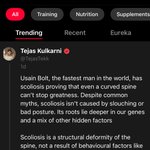
The fastest sprinter in the world has a curved spine.
Scoliosis doesn't work the way most people think.
Check out this post by @TejasTekk on FreeGym to know what the research actually says about scoliosis:

Here's the link: freegym.ai/posts/postDetail?…
3
108
At FreeGym, we’ve been working on ‘longevity science’ for quite some time as its own field.
It combines sports science, medical science, nutrition science, behavioral science, statistics, and the art of periodization.
In a field where science reigns supreme, choosing to associate professionally with someone who is a well-documented conspiracy theorist, misinformation spreader, and pseudoscience peddler, while thumping their chest about it, puts you in a position where no one can trust you.
No one will take you seriously.
It also says a lot about your understanding as a professional.
Variety builds transferability, but too much variety fragments your training. You need enough novelty to avoid "overfitting" to one pattern, but enough consistency to actually drive adaptation.

If you’ve read enough of my writing, you probably know that when I test someone’s strength, I don’t test them on movements they practice regularly.
To get high-fidelity data, I test them on movements they don’t practice. That’s the only way to see how generalizable their strength is in situations they haven’t been exposed to.
Every strength movement has a large skill component. If you squat every day, you’ll have a big squat because of the SAID principle, but that doesn’t mean your strength will transfer elsewhere.
To build generalizable strength, you need to practice diverse movement patterns, but not so many (in a given phase) that you lose focus. You have to find your sweet spot.

I think @OhiGucci might be the very first influencer on FreeGym 😎Don’t miss his posts. Link in the comments.

Nuance gets you ignored. Extremism gets you paid.
This is the sad reality of the fitness industry.
If a coach says "It depends," they lose the algorithm war.
If they say "This food kills you," they go viral.
Check out this post on FreeGym by @pathikj80. It's a good one.
Link in the comments.

In the attention economy, nuance is a tax on virality. If a creator stops to explain context, exceptions, or the scientific limitations of a claim, they lose the audience’s attention span.
So the accounts that grow the fastest are usually the ones that refuse to pay that tax.
In the health and fitness space, if a claim comes from a big account (in terms of followers), statistically speaking, it’s either wrong, oversimplified, lacking nuance, or not just useless but potentially dangerous.
Gone are the days of armchair experts. Structure is not destiny. The human body is an adaptive system that organizes movement around its own constraints.
My personal experience: when I was a teenager, I visited a doctor for knee pain. He looked at my feet and said, ‘You must not be able to stand for too long.’
I was surprised, because at the time I was doing long-distance running, sprinting, jumping, and martial arts.
I saw the same thing even while studying sports science - doctors using quick clinical signs as shortcuts, mostly because they don’t see many athletes.
Their sample becomes unintentionally skewed.
There’s a certain kind of reasoning that comes from learning primarily through study rather than immersion.
A pattern-matching that can overlook the living, adaptive reality of human bodies. This is deductive rigidity.
Without physically lived experience, they rely on heuristics and miss a lot.
That’s why I always say you have to live it to truly understand the human body, or at least to recognize the gap between textbook knowledge and real-world reality.
You can’t live every experience, but with enough practice on your own body, you develop an intuitive sense for where that discrepancy exists.

