












netunu retweeted

This interview never left my head ... it was chilling.

This interview by @pmarca explains what is really behind Jensen Huang's ouster as Nvidia CEO.

netunu retweeted

🤖 AI’s next battle may be over who controls the compute.
Bittensor co-founder @const_reborn tells @2084Richardson at @ExploitSummit why open-source AI could threaten the biggest labs.
The interesting part starts when they notice. 👀
netunu retweeted

The 🇺🇸 IRS just released the new tax brackets for 2027
Single filers (2026 in parentheses):
10%: $12,800 or less ($12,400)
12%: over $12,800 ($12,400)
22%: over $52,025 ($50,400)
24%: over $109,125 ($105,700)
32%: over $208,325 ($201,775)
35%: over $264,550 ($256,225)
37%: over $661,375 ($640,600)
Married filing jointly (2026 in parentheses):
10%: $25,600 or less ($24,800)
12%: over $25,600 ($24,800)
22%: over $104,050 ($100,800)
24%: over $218,250 ($211,400)
32%: over $416,650 ($403,550)
35%: over $529,100 ($512,450)
37%: over $793,650 ($768,700)


THE IRS JUST RELEASED THE NEW 2027 🇺🇸 TAX BRACKETS. HERE'S HOW THEY WORK IN PLAIN ENGLISH
Every bracket got a little bigger to keep up with inflation, so you can earn a bit more before moving into a higher rate.
Step 1: Take what you earn and subtract the standard deduction. That part isn't taxed at all.
- Single: $16,600
- Married: $33,200
Step 2: Whatever's left gets taxed in layers.
Single filers:
- 10% on your first $12,800
- 12% on income up to $52,025
- 22% up to $109,125
- 24% up to $208,325
- 32% up to $264,550
- 35% up to $661,375
- 37% on anything above that
Married couples: the cutoffs are roughly double ($25,600, $104,050, $218,250, $416,650, $529,100, $793,650).
Example: You're single and earn $76,600. Subtract $16,600 and you're taxed on $60,000.
- 10% on the first $12,800 = $1,280
- 12% on the next $39,225 = $4,707
- 22% on the last $7,975 = $1,755
Total: about $7,742 in federal income tax, or roughly 10% of what you earned.
Even though you're "in" the 22% bracket, only your last $7,975 gets taxed at 22%.

netunu retweeted

CVE-2026-98432 is an interesting Linux kernel vulnerability.
The bug was introduced roughly 10 years ago in Linux 4.4 by Eric Dumazet, through a TCP networking optimization designed to reduce lock contention.
The change introduced a race condition that could trigger a use-after-free in the TCP/IP stack.
The interesting part? Eric Dumazet also authored the 2026 fix.
A decade-old concurrency bug hiding in one of the most heavily used networking stacks in the world.
Original commit:
github.com/torvalds/linux/co…
Fix:
github.com/torvalds/linux/co…


netunu retweeted

I am hesitant to weigh in on discussions about 30+ year old details. I understand enough about memory in general, and mine in particular, to not have great confidence about it. I generally trust Romero’s memory more than mine — I was always a bit jealous of that capability.
In broad terms, multiplayer gaming was right up there with 3D gaming in my grand visions of what I wanted to accomplish. The early FPS games were very much “first person Gauntlet”, and Gauntlet had multiplayer.
I do clearly remember the first time I got two computers running Doom taking to each other. Moving around on one computer and seeing the character move on the other screen was sublime. And then, of course, I shot the other character. Every shared virtual environment inhabited by young men inevitably hosts deathmatch.
I suspect the confusion here may be around the fraction of people that originally bought Doom because of multiplayer. It was almost certainly well under 10%. Maybe under 1%. It wrecked some college networks, but most people didn’t have Ethernet cards or null modem cables. We probably did have some conversations correctly predicting that. Deathmatch was awesome, but most of our players never got to experience it.
Even four games later for Quake 3 Arena, being “deathmatch focused” was a huge internal battle, and not at all obviously viable.

John. First, 8 months before release is before I joined the company. So I have no knowledge of what you did then.
second, AFTER I joined we had a discussion in which I talked about my experience with Command HQ and YOU YOURSELF agreed that Deathmatch wouldn’t be that big a deal. Do you not remember?
Third yes we all wanted Deathmatch anyway. And I’m glad my predictions were wrong.
Perhaps check your own memory before gaslighting mine.
Hope you’re well.
netunu retweeted

Claude Code just found proof that every app on your phone is listening to your conversations. TikTok, Instagram, Facebook, Snapchat. they're using what you say out loud to build your feed. i have the data to prove it.
i've suspected this for months but last week something happened that made me finally check.
i was on a call with my friend and told him i'm thinking about breaking up with my girlfriend. didn't text it. didn't search it. just said it out loud with my phone on the table. two hours later she opens TikTok next to me and her entire feed is breakups. "signs your relationship is over." "how to heal after a breakup." she looked at me and said "why is TikTok showing me this." i said i don't know. but i did know.
i connected my iPhone to my MacBook and ran Claude Code that same night.
it scanned every app's background microphone activity for the last 90 days. not just the apps that asked for microphone permission. apps that were supposed to only have access to photos or location but were activating the microphone anyway.
what it found:
→ TikTok activated the microphone 347 times while the app was "closed" in the background
→ Instagram → 211 background activations
→ Facebook → 189
→ Snapchat → 94
every activation lasted between 3 and 15 seconds. enough to catch a sentence. every one of them tagged a keyword and cached it locally on the phone with a timestamp.
Claude Code pulled the full keyword cache:
→ "breakup" — tagged 4 hours before her feed changed
→ "moving out" — from a conversation with my mom last Tuesday
→ "wedding venue" — from a call with my sister about her engagement that i never searched once
→ "protein powder" — said it out loud to my roommate, had ads for it within an hour
→ "flight to tokyo" — mentioned it at dinner, saw travel ads the same night
those keywords were sitting in a local cache on my phone organized by app with timestamps. TikTok had the most entries. Instagram was second. every single keyword matched a conversation i had out loud near my phone.
the scariest one was "wedding venue." my sister told me she's getting engaged on a private call. i never searched it. never typed it. within a day my explore page had engagement rings and venue tours.
then Claude Code checked a second phone in the same room. my girlfriend's. same keywords. same timestamps. both phones were picking up the same conversation and tagging it independently.
i asked Claude Code how to shut it down. it mapped every app's microphone access and built a permission audit.
what i did:
→ revoked microphone access from every app that doesn't need it to function
→ disabled background app refresh for TikTok, Instagram, Facebook, Snapchat
→ turned off "Hey Siri" which keeps the microphone in passive listening mode 24/7
→ revoked "nearby interaction" permission which uses ultrasonic audio between devices
Claude Code confirmed all four apps lost background microphone access after the changes. i checked her phone too. same steps. took about 3 minutes per phone.
within 48 hours both our feeds went completely random. generic content. nothing personal. nothing from our conversations. that's when i knew for sure it was real.
the full step by step and the prompt are in the first reply. takes 3 minutes. save it so you don't lose it and send it to anyone who's ever said "my phone is definitely listening to me." it is. now you can prove it and shut it down.


Readers added context they thought people might want to know
2 days before, OP claimed to have found spyware on his "wife's phone":
x.com/starmexxx/stat…
Now, in this post, he talks about his "girlfriend":
x.com/starmexxx/stat…
OP has a history of fake AI content:
"Spy camera" found in hotel room: x.com/starmexxx/stat…
Spyware on "friend's computer": x.com/starmexxx/stat…
OP selling AI products: x.com/starmexxx/stat…
Flagged as AI: x.com/i/grok/share/b…
netunu retweeted

This paper answers why confident idiots run the world.
Cornell University published a psychological paper that explains every terrible boss, every loud influencer, and every broken corporate hierarchy.
It’s called “Unskilled and Unaware of It.”
they tested participants across logic, grammar, and humor to measure the gap between actual performance and self-perception.
And the results are wild.
participants scoring in the bottom 12th percentile consistently believed they were operating in the 62nd percentile.
they were not lying. they were literally incapable of recognizing their own incompetence.
the paper revealed a brutal paradox:
the exact skills required to master a domain are the exact same skills required to accurately evaluate your own competence in that domain.
if you lack the skill, you inherently lack the cognitive capacity to realize you are failing.
this creates a dangerous systemic loop.
the incompetent are blessed with absolute, blinding certainty. their brain protects them from their own ignorance, allowing them to speak first, demand authority, and never second-guess their decisions.
meanwhile, the actual experts suffer the exact inverse.
top performers in the study consistently underestimated their rank. because a task was easy for them, they falsely assumed it was easy for everyone else.
they hesitate. they obsess over nuance. they assume they have nothing unique to add.
we are biologically wired to confuse confidence with competence.
the loudest person in the room gets promoted, gets funded, and gets the microphone, not because they know what they are doing, but because they are physically incapable of seeing what they don't.
the only defense mechanism is building systems that stop rewarding absolute certainty and start demanding proof of work.

netunu retweeted

日本人がインフレで即死してないのって「借地借家法」のおかげだと思う
欧米は家賃爆上がりで生活破綻が続出したのに、日本は2026年もインフレ率1%台をキープ。
生活費最大の固定費である家賃を、借地借家法がガチガチに凍結してくれてるおかげ。 この法律、偉大すぎる。
netunu retweeted

Scam centers in Southeast Asia steal billions of dollars from American victims each year.
The Trump Administration is united in its efforts to dismantle these overseas criminal enterprises, and Treasury will continue using its tools to disrupt the networks behind this egregious fraud and protect Americans.

netunu retweeted

Extremely excited to announce our first air-to-air kill of a flying moth by an autonomous micro-drone. This is a big step towards completely eradicating mosquitoes.
netunu retweeted

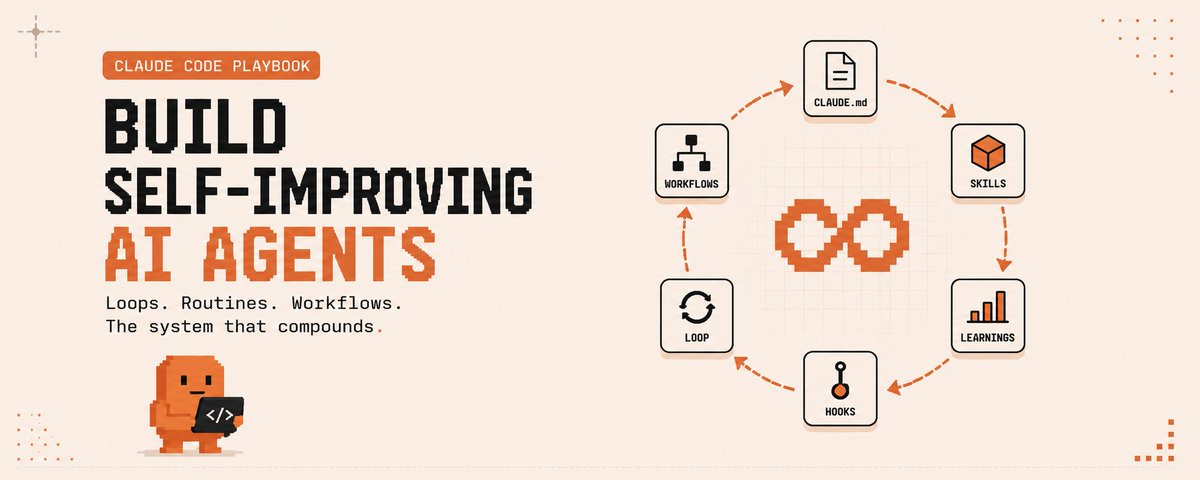
AI builder Ras Mic on the agentic-loops hype:
"human in the loop is the best loop."
in a ~20-min pod he argues that "fire a loop and walk away" - the thing top builders keep flexing - is a token-burning trap for anyone not on an unlimited plan.
his exhibit A: Peter Steinberger's screenshot - $1.3M in tokens in a single month.
the one place a loop actually works? a tight code-review loop, scored 1–5, that never ships below a 4.
worth more than a $500 vibe-coding course. watch today ↓

netunu retweeted

LLM Knowledge Bases
Something I'm finding very useful recently: using LLMs to build personal knowledge bases for various topics of research interest. In this way, a large fraction of my recent token throughput is going less into manipulating code, and more into manipulating knowledge (stored as markdown and images). The latest LLMs are quite good at it. So:
Data ingest:
I index source documents (articles, papers, repos, datasets, images, etc.) into a raw/ directory, then I use an LLM to incrementally "compile" a wiki, which is just a collection of .md files in a directory structure. The wiki includes summaries of all the data in raw/, backlinks, and then it categorizes data into concepts, writes articles for them, and links them all. To convert web articles into .md files I like to use the Obsidian Web Clipper extension, and then I also use a hotkey to download all the related images to local so that my LLM can easily reference them.
IDE:
I use Obsidian as the IDE "frontend" where I can view the raw data, the the compiled wiki, and the derived visualizations. Important to note that the LLM writes and maintains all of the data of the wiki, I rarely touch it directly. I've played with a few Obsidian plugins to render and view data in other ways (e.g. Marp for slides).
Q&A:
Where things get interesting is that once your wiki is big enough (e.g. mine on some recent research is ~100 articles and ~400K words), you can ask your LLM agent all kinds of complex questions against the wiki, and it will go off, research the answers, etc. I thought I had to reach for fancy RAG, but the LLM has been pretty good about auto-maintaining index files and brief summaries of all the documents and it reads all the important related data fairly easily at this ~small scale.
Output:
Instead of getting answers in text/terminal, I like to have it render markdown files for me, or slide shows (Marp format), or matplotlib images, all of which I then view again in Obsidian. You can imagine many other visual output formats depending on the query. Often, I end up "filing" the outputs back into the wiki to enhance it for further queries. So my own explorations and queries always "add up" in the knowledge base.
Linting:
I've run some LLM "health checks" over the wiki to e.g. find inconsistent data, impute missing data (with web searchers), find interesting connections for new article candidates, etc., to incrementally clean up the wiki and enhance its overall data integrity. The LLMs are quite good at suggesting further questions to ask and look into.
Extra tools:
I find myself developing additional tools to process the data, e.g. I vibe coded a small and naive search engine over the wiki, which I both use directly (in a web ui), but more often I want to hand it off to an LLM via CLI as a tool for larger queries.
Further explorations:
As the repo grows, the natural desire is to also think about synthetic data generation + finetuning to have your LLM "know" the data in its weights instead of just context windows.
TLDR: raw data from a given number of sources is collected, then compiled by an LLM into a .md wiki, then operated on by various CLIs by the LLM to do Q&A and to incrementally enhance the wiki, and all of it viewable in Obsidian. You rarely ever write or edit the wiki manually, it's the domain of the LLM. I think there is room here for an incredible new product instead of a hacky collection of scripts.
netunu retweeted

Watching the news today feels a lot like watching a movie I’ve seen many times before.
In 1971, I witnessed a major currency devaluation that I thought would be a disaster—but the markets actually went up. It was a lesson I only learned by looking back at 1933. When you study the historical "scripts," the current plot becomes much clearer.
netunu retweeted

My brain broke after reading this paper 🤯!
Quantum computing just took a serious step toward breaking classical AI limits.
MIT Scientists just showed that small quantum computers can outperform EXPONENTIALLY larger classical systems on massive datasets.
In a new study, researchers introduced a framework called Quantum Oracle Sketching, where instead of loading entire datasets, the system streams random classical samples, processes them in quantum superposition, and then discards them.
This directly bypasses the biggest bottleneck in quantum machine learning, which is data loading 👀
The results are honestly kind of ridiculous. A system with fewer than 60 logical qubits can perform core machine learning tasks that would require exponentially larger classical memory, translating to roughly 10,000× to 1,000,000× smaller system size.
They validated this on real data, including single-cell RNA sequencing and movie review sentiment analysis, and showed it works across fundamental tasks like classification, dimension reduction, and linear algebra.
They also used Classical Shadows to efficiently extract useful outputs from quantum states, solving another long standing limitation.
This matters because modern AI is basically brute force, more data, more GPUs, more cost.

netunu retweeted

Hong Kong engineer built a mosquito defense system that uses LiDAR and lasers to vaporize 30 mosquitoes per second.
Better tech than half the air defense systems in the Middle East right now.
netunu retweeted

Very soon there are going to be more AI agents than humans making transactions.
They can’t open a bank account, but they can own a crypto wallet. Think about it.
netunu retweeted

A man deposits $10,000 in a bank.
The bank thanks him and records the deposit on its balance sheet. But not where you might expect. For the bank, that $10,000 is actually a liability – because technically it belongs to the customer and might have to be returned.
So the bank does what banks do. It lends $9,000 of that money to someone buying a car.
Now something interesting happens. The $9,000 loan appears on the bank’s books as an asset – because someone now owes the bank money.
So the same $10,000 is doing two jobs at once. The depositor believes he has $10,000 safely in the bank. The borrower now has $9,000 to spend.
That $9,000 gets deposited somewhere else. The next bank lends $8,100. That gets deposited again. Then $7,290 gets lent out.
Soon the original $10,000 has quietly turned into tens of thousands of dollars of loans scattered across the economy.
Everyone believes they have money. Depositors see balances in their accounts. Borrowers have the money they spent. Banks show healthy assets on their balance sheets because people owe them money.
And here’s the best part.
Banks charge interest on all those loans – maybe 7%. But the depositor who supplied the original money might earn only 0.5% on their savings account.
So banks collect interest on money that mostly wasn’t theirs to begin with – and keep the difference.
The system works beautifully.
As long as nobody asks for the money back at the same time.
netunu retweeted

VECTOR DATABASES FOR LLMs
PINECONE, WEAVIATE, & PGVECTOR FOR SEMANTIC SEARCH
Modern LLM applications rely heavily on vector databases to enable semantic search, retrieval, & Retrieval-Augmented Generation (RAG).
Traditional databases search using exact keywords.
Vector databases search using meaning.
WHAT IS A VECTOR DATABASE?
→ A vector database stores embeddings instead of plain text
→ Embeddings are numerical representations of meaning
→ Similar meanings are placed close together in vector space
→ This enables semantic similarity search
Instead of matching exact words, vector databases answer:
→ Which documents mean something similar to this query?
→ Which chunks are contextually related?
WHY VECTOR DATABASES ARE ESSENTIAL FOR LLMs
LLMs do not automatically remember your private data.
Vector databases allow you to:
→ Store embeddings of documents
→ Perform fast similarity search
→ Retrieve relevant context
→ Inject retrieved data into prompts
→ Reduce hallucinations
They are the backbone of:
→ RAG systems
→ AI chatbots
→ Enterprise knowledge assistants
→ Semantic search engines
CORE VECTOR DATABASE SOLUTIONS
1) PINECONE
→ Fully managed vector database
→ Designed specifically for high-scale semantic search
→ Cloud-native and production-ready
KEY FEATURES
→ Real-time similarity search
→ Automatic scaling
→ Metadata filtering
→ High availability
BEST FOR
→ Production LLM applications
→ Large-scale SaaS AI systems
→ Teams that want managed infrastructure
ADVANTAGE
→ No infrastructure management required
→ Optimized performance out of the box
2) WEAVIATE
→ Open-source vector database
→ Hybrid search (vector + keyword search)
→ Built-in modules for AI integrations
KEY FEATURES
→ GraphQL-based queries
→ Hybrid BM25 + vector search
→ Built-in classification and modules
→ Cloud and self-hosted options
BEST FOR
→ Customizable AI systems
→ Research projects
→ Applications requiring hybrid search
ADVANTAGE
→ Flexible and extensible
→ Strong community support
3) PGVECTOR
→ Extension for PostgreSQL
→ Adds vector similarity search to Postgres
→ Combines relational and vector capabilities
KEY FEATURES
→ Cosine similarity and inner product search
→ Works inside existing PostgreSQL database
→ Simple integration with backend systems
BEST FOR
→ Applications already using PostgreSQL
→ Small to medium LLM systems
→ Teams wanting unified storage
ADVANTAGE
→ No separate vector database required
→ Structured + semantic search in one place
HOW VECTOR DATABASES ENABLE SEMANTIC SEARCH
Step-by-step workflow:
→ Documents are chunked
→ Each chunk is converted into embeddings
→ Embeddings are stored in the vector database
→ User query is converted into an embedding
→ Similar vectors are retrieved
→ Retrieved context is injected into the LLM prompt
→ LLM generates grounded response
COMPARISON SUMMARY
PINECONE
→ Fully managed
→ High scalability
→ Enterprise-ready
WEAVIATE
→ Open-source
→ Hybrid search support
→ Highly customizable
PGVECTOR
→ PostgreSQL extension
→ Unified database architecture
→ Simpler infrastructure
CHOOSING THE RIGHT VECTOR DATABASE
Choose Pinecone if:
→ You want managed infrastructure
→ You are building large-scale SaaS
Choose Weaviate if:
→ You want flexibility and hybrid search
→ You prefer open-source control
Choose pgvector if:
→ You already use PostgreSQL
→ You want relational + vector data together
QUICK NOTE
Vector databases are foundational for building:
→ RAG pipelines
→ AI search systems
→ Intelligent enterprise assistants
→ Production-grade LLM platforms
Mastering them is essential for modern AI engineering.
For a complete production-focused guide covering vector databases, RAG systems, prompt engineering, agents, scaling, and cost optimization, refer to:
Grab the LLM ENGINEERING HANDBOOK
codewithdhanian.gumroad.com/…
