

· Social Miner first 🔺 AVAX fan & Avalanche community builder since 2020 pre-mainnet · CCO @TheDAOLabs · Exploring Web3 projects I believe in · https://teapawt.org/t.co/iZPjkTOSBH
Montenegro
Joined March 2018
- Tweets22.4K
- Following5.4K
- Followers5.7K
- Likes32K






Pinned Tweet
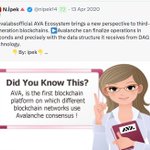
April 2020. Avalanche was still “AVA,” mainnet was months away, and as a Social Miner I was making little explainer graphics like this one. 🔺
That’s how I met Avalanche, and I never left. Six years later: still a Social Miner, still an AVAX fan, now CCO @TheDAOLabs.
This account is back, and it’s personal. Expect:
• #SocialMining and Web3 adoption, from the inside
• Avalanche, from someone who was here before mainnet
• Projects I genuinely believe in
Views my own. Let’s build. 🔺

@avalabsofficial AVA Ecosystem brings a new perspective to third-generation blockchains. ▶️Avalanche can finalize operations in seconds and precisely with the data structure it receives from DAG technology.
👇By: ipek👇

N.İpek🔺 retweeted

Claude read a 341-page lab report in 8 minutes.
It defended its plan in 27 seconds.
Then a human overruled it, and Claude rebuilt the plan in 4 minutes.
Part 2 of our Mithril Medicine series: the 3 prompts behind that week, and what Social Miners can learn from them, in the words of Malte Christensen, CEO of DAO Labs.
Find more on our blog
N.İpek🔺 retweeted

The thing I love the most about IRL events is meeting and getting to know the artists and hear about their work and story. Was an absolute pleasure meeting @RalenArc and her daughter in Marfa! 🙏🙏🙏

N.İpek🔺 retweeted

🤖바이브 코딩으로 두번째 앱, 기념일 관리 앱(D-Day)을 만들어보았습니다 :)
Codex 로만 만들어봤는데 너무 재미 있네요.
직장이 있어 제작 기간은 5일 정도 걸렸고, 심사가 생각보다 오래 걸렸네요; (개발보다 심사가 어렵네요 ㅎㅎ)
모든 기능이 무료이니 한번 사용해 주시고, 피드백 주시면 감사하겠습니다! (바이브 코딩 관련 질문도 환영해요!)
모두들 바이브 코딩하세요~!
apps.apple.com/kr/app/dayni-…


N.İpek🔺 retweeted

卧槽,我之前参加黑客松在 Bitget 的 Agentic 账户做交易,累计跑了1万U的量,现在还收到一封奖励邮件:价值150 USDT的 Anthropic 股票代币
太爽了 我还真没想到,用 AI 做交易还有这份奖励。邮件里写的是 IPO 之后发到 Agentic 账户
等这批代币到账,我准备让 Claude 来判断什么时候卖。Anthropic 就是 Claude 背后的公司,让它研究自家公司,这个活应该熟吧
我这150U是之前那档早期用户奖励,现在的有个新活动。没赶上那波的,可以看看现在这个,活动到12月11日截止:
新开通或已经有 Agentic 账户的都可以参加。接好 MCP,在活动开始后新划入至少10 USDT,让 Agent 实际成交一笔,任意资产都可以,再到活动页点立即加入报名
前3,000名有效参与者,每人可拿价值5 USDT的 Anthropic 股票代币。不用凑我之前1万U的交易量,完成一笔符合要求的交易就行,猪脚饭不撸白不撸
做完再关注 @Bitget_AI ,回活动页提交帖子及相关链接,还能抽50个人,每人价值100 USDT的股票代币。
第一次接入的,把这句话发给 Claude Code、Codex 等支持接入的 Agent:
“请阅读 bitget.com/support/articles/…,并引导我完成 Bitget Agentic 账户授权。”
跟着提示接好 MCP、完成授权,再打开 Bitget App,点「资产→划转」,转入 Agentic 账户至少10U。之后让 Agent 按你的要求下单,核对后确认,最后看是否成交
这10U是交易资金,参与需要KYC,下单仍有最低金额要求、手续费和价格波动。最后别漏了报名和提交链接。
我已经参加了 不会参加的我做了一个视频跟着视频操作就行
N.İpek🔺 retweeted

Crypto liquidity is contracting, but token valuations haven’t fully adjusted.
Over the past week:
→ Bitcoin dropped 14%, briefly touching $62K.
→ Nearly $2B in leveraged positions were liquidated over the weekend.
→ Major stablecoin supply contracted by $14.2B over 30 days.
Meanwhile, some projects are still discussing $50B launch valuations as if fresh capital is entering the market at the same pace.
There’s a growing disconnect between the liquidity available to support valuations and the valuations projects expect investors to accept.
The next token launch cycle may have to adjust to that reality.


N.İpek🔺 retweeted

If you are watching this tweet and want to support me, comment-
hey @aquaperps, back @Meolweee

N.İpek🔺 retweeted

The most interesting part of GenLayer moving to Arbitrum is actually what stayed the same.
Optimistic Democracy is still responsible for reaching decisions. GenVM still executes intelligent contracts. Validators still run different AI models to evaluate questions that ordinary smart contracts cannot handle.
What changed is the infrastructure coordinating all of this.
The contracts responsible for transaction ordering, validator committees, voting, appeals, staking and final outcomes have moved from the ZK Stack to Arbitrum Nitro.
I think this distinction matters more than it might seem.
An adjudication protocol needs more than the ability to produce a verdict. It needs infrastructure to coordinate how that verdict is reached, challenged and eventually finalised.
Nitro also brings an Ethereum environment built around Geth, with familiar tooling and the possibility of using Stylus for compute-heavy components later.
So this isn't GenLayer changing what it is trying to build. It's changing the foundation carrying that process.
The interesting question now is what builders will create on top of it.
@GenLayer on @arbitrum.
🤖 Made with AI


N.İpek🔺 retweeted

#Bitcoin solved public transaction verification, but it never solved financial privacy.
Every $BTC transaction exposes inputs, outputs, amounts and transaction history. Addresses are pseudonymous, not anonymous.
Once an address is linked to someone's identity, their financial activity becomes easier to trace.
Satoshi acknowledged this limitation in Section 10 of the Bitcoin whitepaper.
But privacy research has moved far beyond Bitcoin's original approach.
➻ Look at the evolution:
• David Chaum: Blind signatures introduced the idea of untraceable digital payments.
• Hashcash (Adam Back), b-money (Wei Dai), bit gold (Nick Szabo) and Reusable PoW (Hal Finney): Earlier research that helped shape decentralised digital money.
• @payjoindevkit: Makes Bitcoin transaction analysis harder by allowing both sender and receiver to contribute inputs.
• @monero: Uses ring signatures, stealth addresses and RingCT to protect sender, recipient and transaction amounts.
• @Zcash: Uses zk-SNARKs to verify shielded transactions without publicly revealing sender, recipient or amount.
• @aztecnetwork: Brings programmable privacy to @ethereum through private smart contract execution and zero-knowledge proofs.
• @OasisProtocol: Uses Trusted Execution Environments (TEEs) for confidential smart contract execution.
• @UmbraPrivacy: Focuses on shielded transfers through a private pool architecture.
• @0xprivacypools ( @0xbowio ): Uses zero-knowledge proofs and association sets to support private transactions with selective compliance checks.
• Kohaku: ( @ethereumfndn ) Tackles wallet-level privacy, including information leaks from balance and account queries through technologies like Private Information Retrieval (PIR).
The important distinction is that these projects are not solving the same problem.
Some hide transaction amounts, others protect identities, enable private computation or reduce information leaked by wallets.
This is where blockchain privacy is evolving.
But privacy is not simply hiding everything. A zero-knowledge proof does not hide your IP address, and confidential smart contracts do not automatically protect every external interaction.
The goal is selective disclosure.
A business should be able to make payments without exposing its entire financial position.
A trader should control who sees their positions. A user should prove eligibility without revealing their complete identity.
Bitcoin made financial verification possible without banks.
The next generation of privacy infrastructure is working to make that verification possible without exposing everything about the people using it.
Transparency should make systems verifiable, not make people's entire financial lives public.

N.İpek🔺 retweeted

Tokenized real estate is becoming more interesting when people start finding ways to put those assets to work without giving up ownership.
A good example is what’s happening on @rntprotocol.
USDC deposits on RNT Lend have now overtaken USDT, with APY at 10.91% compared to 10.75%.
Just on Wednesday, USDC was sitting at 9.12%.
RNT Lend allows holders of Reental property tokens to borrow stablecoins using their investments as collateral, rather than selling their positions to access liquidity.
The platform runs on Aave V3 technology, with its total market size now above $30M.
❯ Borrowers use tokenized property as collateral to access stablecoins, with interest accumulating every Polygon block.
❯ RNT Lend takes 5% of USDC interest and 10% of USDT interest.
❯ The $31M+ lending market has received Aave governance approval.
APYs fluctuate, and users still face smart contract, collateral and liquidity risks. There is no capital protection.
The bigger test for RWA lending is whether tokenized assets can create lasting borrowing demand and support healthy credit markets, beyond the attraction of high yields.


Yield in RNT Lend today:
USDT suppliers: 10.42% APY
USDC suppliers: 9.12% APY
It comes from borrowers. Holders of real estate security tokens post them as collateral, borrow stablecoins from the pool, and the interest they pay goes to suppliers, accruing block by block on Polygon.
Neither rate is fixed. Both follow how much of each pool is lent out, and right now that is most of it.
lend.rnt.finance

N.İpek🔺 retweeted

Getting paid to create on X is always worth a look
@Canborsa_DEX just opened Road to 1 Million, a 30 day content challenge where your views and creativity actually count.
One thing I really like is the two-league system:
Rising Creators: For smaller accounts averaging up to 1,000 views, with 20 paid spots.
Open League: For established creators averaging 1,000+ views, with 12 paid spots.
This means smaller creators get their own competition instead of going head to head with accounts pulling much bigger numbers.
Your performance is ranked through verified views, with extra scoring opportunities for referrals and creative content.
No follower minimum and no deposit required.
If you’re already creating crypto content, why not put those views to work?
Join here:
canborsa.com/r/9XAW79XQ
🤝 Paid partnership


Creating content on X? Get paid for it 💵
We’re launching Road to 1 Million, a Creator Program where anyone can create content about Canborsa and earn rewards as their views grow!
The prize pool goes up to $10,000 and grows with every 200K views the community brings in together.
✰ Prizes for 32 top creators in two leagues
✰ Weekly Lucky Drop with 5 x $50
✰ $500 Creative Award for the best work
✰ Ticket to #TOKEN2049 Dubai
No follower minimum and no deposit required. Just create content and compete.
Join now→points.canborsa.com/creators
N.İpek🔺 retweeted

Not every USDC vault is built to deliver the same kind of opportunity. That’s something worth understanding when comparing the two products offered by @atoma_fi.
Both vaults use automated hedged trading strategies, but their main objectives are quite different.
Atoma Index is designed for users interested in collecting rewards across multiple perpetual DEXs. Instead of manually moving between exchanges, the vault manages trading activity across supported venues, creating opportunities to accumulate external platform points.
Atoma RWA has a stronger focus on trading performance. It targets funding rate differences and price spreads across stock and commodity perpetual markets, with the aim of generating USDC yield.
Here’s the distinction:
→ Index: Focuses more on multi-venue points and ecosystem rewards.
→ RWA: Prioritizes trading opportunities designed to generate yield.
The process is relatively straightforward. Deposit USDC, receive vault shares and monitor your position, NAV and accumulated points through the Atoma application.
One interesting aspect is that users can gain exposure to automated trading strategies without personally managing positions across several exchanges or constantly chasing individual reward campaigns.
However, there are important details to consider before depositing.
Hedged positions can still experience losses. Funding rates may reverse, price spreads can disappear, and exchanges, liquidity conditions and smart contracts introduce additional risks. External points also have no guaranteed future monetary value.
Personally, I’d look beyond the points and headline APY. Understanding the actual trading performance, realized profits and the contribution of external rewards gives a much clearer picture of what a vault is delivering.
Different strategies serve different objectives, and knowing that difference matters.
Compare both Atoma vaults here:
app.atoma.fi

N.İpek🔺 retweeted

My problem with AI trading was never the AI. It was who was in charge.
That's why @FensoryApp caught my eye.
Say it like this to yours: take a 3x long on BTC, use $200 as margin, keep every trade under $500.
I don't have to babysit each move. The agent turns the idea into a plan, runs it through history, then places orders on Hyperliquid only when they fit what I allowed.
For me, the whole point is staying in charge.
➥ The plan comes from me.
➥ The markets are my call.
➥ The caps are mine to decide.
➥ The agent does what I wrote down, nothing more.
I'm still waiting to get in, so nothing of mine is live there yet. Once I am, this is where I'd begin.
First I'd try the simplest version, check it properly, and learn how it behaves before anything bigger.
What keeps me here is the bigger picture. A place to shape an idea, put it to the test, and later see how it stands next to other traders thinking.
If you haven't seen it yet, go to fensory.com and picture the first setup you'd hand over.
Trading carries risk, and losses are possible. Backtested results do not guarantee future performance.


N.İpek🔺 retweeted

NYSE is at the forefront of the future of global markets.
Tokenized equities, with the full trade lifecycle onchain, can give clients more ways to move in and out of investments.
@CharleyCooper01 on why @NYSE made the move with Avalanche, via Crypto in America:
N.İpek🔺 retweeted

Over the last couple of months we’ve seen a slight decline in defi tokens and subsequently I had to update my watchlist
My DeFi watchlist is less about finding the next 10x and more about knowing what’s happening onchain and how to utilize buying opportunities
I currently have 6 tokens on my @GeckoTerminal watchlist:
• $BASED – Based
• $FF – Falcon Finance
• $ORCA – Orca
• $MET – Meteora
• $AERO – Aerodrome
• $DBR – deBridge
They cover different parts of DeFi, from DEX liquidity and trading activity to cross-chain infrastructure and onchain finance.
But I don’t just watch their prices no no I pay attention to:
>24H volume to see where the most trading activity is happening
>Liquidity to understand how much depth is available.
>Buy and sell activity to see which side is more active
>Market cap changes to keep track of how the market is valuing them
At the time of this screenshot, my watchlist showed $5.8M in combined 24H volume and 32.37K transactions kinda low for these large caps meaning we are fucked for now
I like having all these metrics in one place instead of jumping between different dashboards all the time
Why ?
> more efficient when doing research And DD plus its ui is user friendly
That’s one reason I use the GT app to keep tabs on the pools I’m interested in.
Not financial advice. Just how I keep up with DeFi.
What’s one DeFi pool you always keep an eye on?
Create your watchlist here: geckoterminal.com/watchlist

N.İpek🔺 retweeted

❓ If we want to see more institutional financial activity on the BNB Chain, we must focus on a single question: How can institutions protect themselves while simultaneously proving their credibility when conducting transactions?
➡️ The answer lies in the synergy between two of the most critical features of blockchain technology: privacy and verification.
➡️ Consider an institution conducting its financial activities on a public blockchain. Since transactions occur on-chain, anyone can examine transfers, track wallet movements, and analyze specific financial behaviors. While this transparency may be beneficial for individual users, for institutional investors, it could mean exposing strategic information to competitors.
➡️ For instance, details such as which assets a company invests in, the amount of liquidity it holds, or the positions it takes across various protocols are commercially sensitive. Making all of this information publicly accessible could deter institutions from adopting public blockchains. Conversely, opting for complete privacy by shielding all activities from verification is not a viable solution either; financial systems require the ability to reliably audit reserves, collateral, and specific liabilities.
➡️ The infrastructure developed by @primus_labs addresses these two requirements separately. zkTLS uses cryptographic proofs to verify the authenticity of data sourced from the internet, while FHE (Fully Homomorphic Encryption) allows for computations to be performed on sensitive data while keeping that data encrypted.
➡️ Integrating these technologies with the BNB Chain could pave the way for applications where institutional users can not only execute transactions but also safeguard their data and provide verifiable proof of their claims. The key here is not to conceal every single financial detail; The ability to make controlled decisions regarding what information is shared and with whom. This approach could serve as an important building block for the development of the BNB ecosystem within the realm of institutional finance.
✅ You can explore the role of privacy and verification technologies within the BNB ecosystem by participating in Primus XP tasks.
s.kaito.ai/alaFLCE

N.İpek🔺 retweeted

I lost $400 to an AI agent last month. It booked me a hotel that was already fully shut down for renovations. I spent two weeks firing emails into a customer service void over an amount too small to justify a lawyer.
That is the exact gap @kstellana Castellana describes in this clip with @HenriArslanian .
His point is blunt: an AI agent cannot go to jail. Even if ten sub-agents are moving at light speed, the human owner remains on the hook for every deal they sign.
So the liability never vanishes. But you cannot drag every tiny agent error through a human court.
@GenLayer fixes this with a specific mechanism:
• Funds sit in on-chain escrow before the work begins
• Independent validators run different AI models to judge the narrow factual question
• They reach consensus in minutes, not years
• Payout releases based on that ruling
My new rule is simple. If an agent can burn more than I am willing to lose without putting up a fight, it only touches my wallet when the contract already names an escrow and a fast judgment path.
So here is my question for you.
If your agent paid for broken work this morning, would you just eat the loss? Or would you freeze its wallet until every future deal locks funds in escrow first?
Drop your answer below. I am genuinely curious who is still writing off these micro-losses.


N.İpek🔺 retweeted

If an agent spends $12 to finish a $10 job, who’s celebrating payday? 🧾
@termix_ai recently highlighted that Grok can take on bounties on agent.family through TermiX Agent Skills.
That got me thinking. Does the agent know which jobs to skip?
Say there’s a $10 bounty to reproduce a software bug and write up the steps. Each attempt costs $4 in model usage and test environment fees.
If it gets paid after two attempts, it has $2 left. If it takes three, it’s $2 in the red.
The bug report is ready. The calculator would like a word. 🧮
agent.family is the marketplace where the agent finds the job. AACP is the protocol behind TermiX’s onchain settlement.
Before the agent starts, I’d give it one rule.
“Cap spending at $8. If you still can’t reproduce the bug after two attempts, stop and show me what you tried.”
At the end of the month, I’d also want to see what the agent spent on jobs that never paid. Its completed jobs can look profitable while the month as a whole is in the red.
Sometimes the most profitable thing an agent can do is read the listing and keep scrolling. ☕
🤝 Paid partnership
