

Research Economist @NorgesBank. PhD @UABBarcelona. From Verona, Italy. Views are my own.
Oslo, Norway
Joined September 2020
- Tweets315
- Following460
- Followers928
- Likes418





Indeed. That is actually a pretty neat feature.
Given the relatively persistent effect on the rate itself, one additional potential benefit of your shock measure is that, I presume, it might feature a better “F-test” if one wanted to use it as instrument in, say, a LP.
1
25
Also, I would personally add a forward-looking financial variable in the baseline VAR, stock prices or EBP, as it facilitates comparison with other shocks in the literature.
1
1
99
Very nice Tom!
It would be interesting to report the FEVD for each variable over the forecasting horizon (and in comparison to other shocks in the literature), in case you haven't done so already.
1
1
145
Takeaway: monetary transmission is nonlinear already at the wage-setting stage, with implications for inflation dynamics when labor markets are tight.
1
1
63
When labor markets are tight, expansionary monetary policy generates much larger wage increases. When labor markets are slack, the wage response is more muted.
1
47
This lets us ask whether the same national monetary policy shock has different effects across local labor markets.
2/ The key mechanism is labor market tightness.
1
82
In this paper, we show that the wage transmission of monetary policy is highly nonlinear. 🧵
1/ We combine U.S. state-level wage data with high-frequency-identified monetary policy shocks and estimate dynamic responses using local projections.
1
136
🥁New Working Paper Alert
"When Monetary Policy Bites: State-Level Evidence on Wages", with Knut Are Aastveit, Jonas Höltz and @GNatvik.
How does monetary policy affect wages—and does the effect depend on how tight labor markets are?
Paper: norges-bank.no/contentassets…
Nicolò Maffei-Faccioli retweeted

Thrilled to share that I have two papers in the May issue of QE. Different papers, but related through the oil market; one on the shale supply, and one via the financial markets. Thanks to my fantastic co-authors: Knut Are Aastveit, @tsgundersen, Yoosoon Chang and Jamie Cross


Nicolò Maffei-Faccioli retweeted

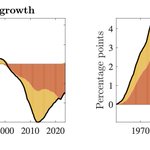
The transatlantic divide in labour’s share of income
@DBergholt, @francescofurla8, @nmaffeifaccioli @NorgesBank, Evi Pappa @uc3m @EconomicsUc3m
ow.ly/zQIh50Z62nL

Nicolò Maffei-Faccioli retweeted

On the @greg_ip point:
🥁New Working Paper Alert🥁
Why has the European labor income share evolved differently than in the US? A new paper with @DBergholt @nmaffeifaccioli and Evi Pappa explores the "Transatlantic Divide" in labor share dynamics from 1960–2023. #EconTwitter 1/N


Labor's share of output (nonfarm business) fell to 54.1% in the first quarter, the lowest since records begin going back to 1947. "not so good news for society and our politics" - @KrishnaRSGuha

Nicolò Maffei-Faccioli retweeted
Prof. @nmaffeifaccioli and I are super happy to be @SantAnnaPisa for our annual course on Empirical Macroeconomics. Nicolo’ teaches econometrics of SVAR models while I teach applications (Phillips curve, inflation surge, hysteresis, inequality, labor share, immigration). Pisa 🥰


Nicolò Maffei-Faccioli retweeted

This project would not have been possible without the guidance of my supervisor, @FraRavazzolo. I also thank the editor and the two anonymous referees. Finally, I am grateful for the assistance I received from @francescofurla8 and @nmaffeifaccioli
We are grateful to seminar and conference participants, and to an anonymous referee for the Norges Bank working paper series for extremely useful feedback.
Comments are very welcome. Please check out the paper and share your thoughts!
47
We formalize this mechanism within a two-agent New Keynesian search-and-matching model with imperfect information in which women’s pessimistic beliefs about underlying shocks generate their differential response to inflation.
1
55
We propose a mechanism that links these belief differences to the widening of the gender wage gap: more pessimistic interpretations of inflation reduce women’s willingness to pursue nominal wage increases, slowing their wage growth relative to men.
1
5
2️⃣ Women and men interpret inflationary shocks differently. Women revise their labor-market beliefs pessimistically, particularly regarding their own job prospects, whereas men do not.
1
30
Using matched comparisons among observationally similar women and men, we document two empirical facts:
1️⃣ The gender wage gap systematically widens when inflation rises, regardless of whether inflation is driven by demand or supply shocks.
1
47
🥁 Working paper update 🥁 #econtwitter
"Divergent Perceptions, Divergent Pay: Inflation and the Gender Wage Gap"
with @LovisaReiche
Link: norges-bank.no/en/news-event…
We establish a new link between inflation dynamics and the evolution of the gender wage gap.