
I am building 1000 of the world's quietest fans, for use in air purifiers. There is a crowdfunding campaign, see https://xitter.cf/t.co/a0k2CGpGdl for details/signup.
Joined March 2022
- Tweets15.3K
- Following125
- Followers2.1K
- Likes7.6K




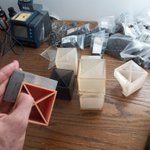
I eliminated the buzz from a P14 Max fan, without probably affecting performance in other ways. I just did it really fast, I'm sure a better solution is possible. I just had it as a bathroom exhaust fan and the noise was bothering me and I was like why am I of all people putting up with this when I can solve it in 5 minutes...
It still makes a bit of a rrr, very slight compared to the whoosh. I have ideas on how to reduce/eliminate that too but no time these days.


I was reading about the Paradox project, custom wheelchairs for like 1/20 of the price of the usual approach. notawheelchair.com/ The off road thing is separate, personally that doesn't seem like that big a deal to me and it wouldn't be that hard to just whip one up out welded tubes etc. anyway.
If you think about it, we see this kind of thing in other contexts as well, such as eyeglasses and CPAP machines. I have both, and have been through the process and seen things in detail many times on both counts.
You'll probably start reading about the articles on the subject wondering if either there is some serious hidden flaws to the wheelchair or wtf the other guys are messing up, or some combination thereof. I do think it is a combination.
We see this "unregulated backup option, just give us your measurements and get stuff in the mail" on all 3 subjects, I am sure there are many more. The cpap etc guys do not express interest in repairability etc. though.
It seems to me to be largely an outgrowth of strategizing and pursuing different goals at a fairly basic level. I am not convinced the "non-profit" side of things is particularly important. I think it's more the focus on a different, more to the point way to get the fundamentals in the bag.
We should be doing this for other things, too. It was a long time there that people couldn't get wheelchairs are a reasonable price, and that matters.
I also think the fabrication of an object like this does not require a dedicated facility, and if we could overcome the need to set up dedicated facilities for every single thing like that that could be even more fundamental progress.
There are cnc tube bending shops, welding shops and cnc machine shops in many cities. You usually have to order metal parts from far away if you want a decent price, though. There are always a few custom parts like the spokes that would be uneconomical to make through digital manufacturing methods.
We could however improve those methods. As I am with the resin casting. The resin casting I could see being useful for many of the parts in a machine like this. The wheels, the back and seat, in particular. You can mix 30% carbon fiber into the polymer and it should be approximately 2/3 the yield strength of 6061 aluminum, with a good polymer. On all axis, not like 3d printed parts which are always far weaker in the Z axis.
Every city imo should have some kind of flexible fabrication facility, and this kind of thing would happen 100x more often on 100x as many subjects, many of which would improve life for as many people as much. Perhaps more, there some things you cannot really buy at any price right now that people are wanting, the long tail of rare but valuable use cases.
In the case of wheelchairs, they might be $2000 instead of $1000. But you'd actually have had them 15 years ago and ever since. Also you could start there then make this factory anyway whenever you want. You just don't have to do that before you are rolling.
There is a book "fab city" that talks about this kind of thing, but it is pretty disappointing. The authors last I checked were kind of in the clouds there, untethered to the realities of manufacture.
In the end a lot of it comes down to the capital intensity to get things done. If everything takes a ton of money to even get rolling, you are inevitably not going to get a lot of the stuff done. It's not always about per unit cost, not by a long shot. Not everyone is the same, the variety of equipment needs in this society is imo much larger than first appears.

It may remain largely mysterious what the impact of ordinary noise is, but I think it's like pollution, it's generally detrimental and just under-emphasized. It's worth going around one's home and checking what the various noise sources are, imo. Almost all of them in my experience seem to be various fans. The main exception being compressors in fridges and for some periods AC units. Laundry machines would be a distant third, since they are not on very often.
There isn't much else really is there? Sometimes electric heaters make various noises. The rest of the noise is basically coming in through the window.
You can see there is a considerable history and societal acknowledgement of each of theses, there are soundproof and triple glazed windows, people certainly value quieter neighborhoods highly and pay a ton of money to be located in such areas, ac and fridges are usually a lot quieter than they used to be. But it took a really long time to get there.
And they are all treated separately. And there is an undercurrent that it's always an uphill climb to get the impact recognized, and it's rarely quantified.
I tried to read up on the impact of background noise on test scores in schools but there doesn't seem to be much science on the subject. Logically it seems to impact the degree to which students pay attention and learn and think. But it is not very well studied. There seems to be about as much to discover here as there was on airborne disease 7 years ago. Despite it having been a serious issue for far far longer for a great number of people. These things just sort of get grandfathered in, apparently. That doesn't mean the detrimental effect is not considerable and serious and harmful.
As I've commented previously, luxury buildings and neighborhoods certainly reveal the amount which people are willing to pay for such things. But for us proles it's always "well can't be sure it even matters so no point investing"...
Open_ERV retweeted

I recommend you read the article in full. The media has been full of reporting regarding the potential future risks of AIxBio for some time now, when the real, tangible risk is this: avian influenza burning through a mink farm in Utah.
We are giving this beast too much room.

“Instead of trying to stop the outbreak and prevent it from spilling into humans, state and federal officials have done little except try to keep its existence quiet” propublica.org/article/bird-…

It's been about 45 days since I decided to pull the trigger on resin casting. I'm making a mini version (1/3 scale) of the first mold now. I think the basics are all sorted out, which is progress. But 1.5 months... I have to remember this is instead of $50k usd of molds, plus the molding machine, basically. I mean it's not quite as good in some ways, but it's actually better in some (no dependence on very specific other people doing their part. Of course I need the resin etc. but there are many sources any many other people that buy that so it's pretty reliable). Cost per unit is looking about as expected, including labor, which is only slightly higher than the injection molded parts, given the quantities expected in the upcoming year or two. So not too bad really, this should be a more common process.
I read up on the usual approach used in resin casting, and I tweaked a number of things for my case. The largest change is not using vacuum during the actual casting process. I do use vacuum for removing bubbles (degassing) the resin (and the silicone).
They also usually use mold halves, as with injection molding. I changed it so there is a "bowl" and a "plug". This makes things simpler in many ways. The bowl side contains the fluid without any need for things to fit precisely. It also helps with bubbles considerably.
I also add the goop to the mold before closing it, rather than trying to inject/pour it after. This helps in several ways. Mainly it allows higher viscosity and helps with bubbles. Higher viscosity allows filler and fibers at much higher density, which is also helpful in many ways, at controlling exotherm and increasing strength and reducing cost.
The adhesion problem was the hardest, I am still trying to get some stoner a324. Someone in the US from the community is helping me to obtain it, they don't ship it here, just a random thing regarding industrial materials (it's not toxic, it's a petroleum distillate). The Ease Release 200 works mostly for now. The resin is also from smooth-on, and so is the tin cure silicone. Smooth cast 300 is the resin I'm using and mold max 60 is the silicone. So they make pretty good stuff, I guess.
I do wish the resin was more heat resistant, there are resins like that but they may have other issues and I already tried 5 resins so I'm going to roll with this for a while and level up another day.
Some of that time was spend basically just learning to SLA print. The usual approaches are not geared to making relatively good quality mechanical parts, it's all about decorations etc. Same problem that FDM has. The machines are inherently geared towards this in several ways. I had to figure out how to get good but not excessive bed adhesion without supports, get good accuracy and so on. I chamfer the bottom of the print, make it solid for the first 5 mm or so, add a brim, then use internal scaffhold/infill with drain holes to save resin and reduce shrinkage.
Sla printing really is a hassle in many ways compared to FDM, I'm not sorry I avoided it for this long. I probably should have stuck with FDM and just used TPU to print the mold directly, that was mostly working. But this has more of a future, higher quality more accurate parts that look better.
Found another amazing paper, this time which puts into perspective very low noise levels often claimed by air purifier mfrs. It goes to show how much many air purifier mfrs are lying. For example, some quote 26 dBa and somesuch, but most adults literally cannot hear that even in an anechoic chamber, certainly not in a normal environment. So if you can hear the machine at 1 meter distant, it's probably not as quiet as they claim.
Outdoors in a quiet area, which is pretty quiet compared to most of our indoor environments, looks like more than half of adults cannot even perceive a white noise less than about 30 dBA. Like you can't actually tell if the noise is there, even if you listen as much as you can. It could alternate on and off you couldn't know it if your life depended on it, you can't perceive it.
These are young adults only, we lose our hearing slowly over time, not abruptly at advanced age as most people believe. This is partly from accumulated damage from louder volumes. I have 11 decibel hearing, which is very good for my age. It is strongly frequency dependent, I forget which frequencies and how they weigh them for the standard test, but I did the test in the standard chamber while getting treatment for a problem only a few years ago. Theoretically a child should usually have 0 dB hearing, which when I was a kid I did a similar test and indeed I did have very close to that.
So the average for the population is that probably way less than half of people can even hear 30 dBA of white noise anywhere in the real world. However fans often have tonal noise, which could be much more easily discerned, because the noise is concentrated in a spectral band, not even psychoacoustically, but this is inherently a stronger signal for a given dBA reading. You can detect much fainter sounds as pure tones, this is widely known and easily read up on.
journals.sagepub.com/doi/10.…

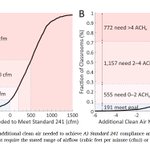
I have a cold today so have been reading etc, and I found this great graph that shows how much supplemental clean air various classrooms in Oregon's largest school district need to meet ASHRAE 241.
sciencedirect.com/science/ar…
It indicates the fraction of classrooms that would meet the standard with X many supplemental CFM, factoring in the clean air the existing HVAC system supplies (filtration included). I would add that the time of the year should have been figured in, as it will be quite different for different times of the year, probably. They share the dates of airflow measurements but it's all over the map. That may have a considerably impact actually.
It's not clear if they are assuming the 30 or 40 cfm per person level, ASHRAE 241 specifies two levels, one for infectious risk management mode and one for ordinary periods. It's also a bit wacky that IRMM is only marginally higher... but anyway.
I kind of just wish they would give the raw data for the baseline ventilation, it does not appear in the supplementary stuff either.
Also they made the grevious error of simply assuming the mfr noise figures are correct. They also seem to have misinterpreted the limits on noise in classrooms.
But, well it's a useful figure to say that's what the experts said, I guess. Clearly a lot of classrooms need a lot of clean air, even when you factor in existing HVAC stuff.
Last of all, I would add that AHSRAE 241 is a good start but we may be able to prevent even more infections with more airflow. I would prefer to talk in terms of infections prevented by intervention X or dollars per infection prevented, but that requires even more extrapolation from other studies and gets a little shaky of course. And for all diseases that are prevented, not just COVID. You know, big picture, objective metric.

If all the students went on strike to demand ASHRAE 241 be implemented immediately without excessive noise, exactly what could we do? That would be very expensive and difficult with current generation off the shelf "proper" machines. Anyone want to estimate? 35 dBa SPL average in the room according to ANSI S12.60, about 1000 cfm CADR. What option would you pick, dear reader?

Open_ERV retweeted

Nobody knows what to do': How Long COVID left Physics Girl searching for answers
But on her honeymoon in Scotland, her big year got hit with what seemed like a minor snag. She got COVID-19.
"The typical symptoms," she said, "like a sore throat and a cough and a stuffy nose. But it wasn't anything alarming."
"I just deteriorated," she said. "First I couldn't run, I couldn't hike. And then I couldn't work, and then I couldn't walk anymore, and I became bedbound. And then I couldn't speak, and then I couldn't read or use my phone."
Eventually, she was confined to her bed in a dark room, wearing dark glasses and noise-cancelling headphones to "take away every environmental stimulus."
#LongCovid

ok so a bio sensor for a hospital. That makes some freaking sense. Not for a military base. Far more value for far less effort. You also get diagnostic info about what people actually have when they come in sick, not just background monitoring to prevent infection.

Mayo Clinic researchers are building an early warning system for airborne viruses, bacteria, fungi and allergens. The experimental biosensor is designed to continuously monitor indoor air, detecting and measuring up to 100 biological targets in near real time — information that could help protect patients and others in shared spaces.
Learn more: mayocl.in/4A4o7lN
I have to wonder though, if we can do this, why don't we make a breathalyzer type thing that can diagnose people? That seems like it should be a lot easier because you get a lot more material to sample. They are kind of trying to do the hardest thing first. What usually happens is the data quality is not very good, like you wouldn't be able to use it for diagnostics anyway. Then the question becomes, like what is it good for, then. Also you need to react to the info. If all it tells you is that there are people infected with Sars-Cov-2 somewhere in the hospital, well that's not very useful. You can't evacuate the hospital every time that happens. If there was a new pandemic it would be a similar deal. You pretty much just mask up and put the portable air cleaners in place, open the windows etc. And carry on. Diagnostic info about individual people you can act on, because you can say no you have to go home now and isolate. Or you need this or that treatment/preventative, and maybe the people you've been in contact with etc. That's news you can use. Not clear if this thing is actually going to do much.
Open_ERV retweeted

Dounreay had a near Chernobyl style runaway reaction in 1968 and dumped the evidence, (most of the core bar the melted rods which could not be removed and are still there for you to see), down a low level waste shaft in the cliff. Despite dropping a tonne of boronated glass on top of it, it went critical in 1978, ejecting its contents as far as the foreshore and destroying the rock structure such that the sea bed and foreshore are now so contaminated that they cannot be remediated. I know because I made the documentary - though the runaway criticality that caused the shaft explosion was not included because that evidence only came to light later on. Never a full public inquiry nor lessons taken and learned. But let’s not get hung up on ‘outdated policies’ eh?

We must not forget that Dounreay helped keep the lights on in the glens.
We have the site, the skills and the community to host a small modular reactor. The Scottish Government must move beyond outdated policies and unlock Highland energy opportunities.
johnogroat-journal.co.uk/new…

You see how he understands the fundamentals, like with the high speed camera. That's some serious innovation.

A Drone With Only One Motor!
And a 3D-printed propeller. And somehow, it still manages to fly.
The really interesting part is how you control it.
By accelerating and decelerating the motor more than 300 times per second, you can control the drone's thrust, pitch, and roll.
The propeller spins at almost 20,000 RPM, with its tips approaching half the speed of sound.
Getting this to work required custom firmware, a homemade high-speed imaging setup to study the blades, and hundreds of crashes.
I've been sharing Joshua Bird's videos for quite a while now. I just love the things he comes up with and how much effort he puts into making them work.
We're also going to talk about a few other projects he's currently working on. More on that soon!
And if you want to take a closer look at how he built this thing, he's made the code and CAD files open source.
github.com/jyjblrd/single-pr…
Full YouTube video:
youtu.be/Ndftcft6XhU?si=19rA…
——
Weekly robotics and AI insights.
Subscribe free: 22astronauts.com
Open_ERV retweeted

This is the story of George Stinney
The youngest person ever sentenced to Death. Only 14 years old and was accused of kiIIing 2 whıte girls. He was sentenced and kiIIed in the electric chair. 70yrs later in 2014, he was proven innocent.
His last words were : “Johnny, I didn’t do it, i didn’t do it,Why would they kiII me for something I didn’t do”💔

sciencedirect.com/science/ar…
Interesting article published only on the 17nth, attempting to compare diy CADR measurement approache(s) and different air purifiers.
I have to admit though that I am baffled at how this seems to happen in the scientific world surprisingly often. Ultimately in about five different ways they are not really testing stuff in a way that matters or anyone cares about. First of all their diy CADR measurement approach is clearly quite inaccurate, or maybe the lab measurement approach is, and we don’t even know which. I mean, if they vary by that much between each other. Fancy instrumentation alone is no guarantee of anything. Neither even appears to have a control run, at least it is not indicated, though they make reference to the background cadr, it’s not in the test protocol. The amount of air mixing and many other things are also important. The CR box foundation does their testing in a conference room, even now, and they get pretty accurate results, that reflect the AHAM/intertek measurements closely. Because they know how, ultimately. So it can be done. So do I, my measurements of PC fan devices are quite coherent with published results, as well as various CR boxes with the same filters and fans that others have tested. Not off by 26%.
It makes no sense to use a protocol that is not very good; just because it’s diy doesn’t mean you have to do that. We can't have expensive instruments, but the protocol is free. Might as well use a good one?? And if they do, well they didn’t write the article very well then, because that’s not indicated. Either way, something is wrong.
They are also back in the stone age, testing machines that have already been tested to death. And they are kind of obsolete now anyway, a 9x pc fan array with cheap fans is a drop in replacement and basically universally superior. 5x pc fan devices are basically universally superior to the box fan with a single filter types. Who cares about how well one that you aren’t going to use works? Ultimately we need to know how to get stuff done and done well, science is ultimately part of that journey, even if we like to merely describe what is, as a stop along the way. You can see them trying in various ways to find machines that are better. Well I merely argue that we do a better job at this instead of remaining stuck in the stone age/testing stuff of marginal importance etc. etc..
I've had to spend about 3 days doing what should be some pretty basic operations in CAD. The challenge right now is to produce 2 shells of 2 parts, each. That's it. I go back and forth between 3 different cad programs to do what each is capable of, exporting and importing to STEP. Slowly building up the surfaces, then I'll use them to split bodies in various ways. All 3 (I tried a 4th too), have a shell command. They don't actually work, in all 4 cases, at least not in this case. They are ultimately too primitive.
In general I've decided to transition to Onshape, too, fusion really is just too messed up to continue with. This will slow me down some as I have to learn some as I go, but most of it is the same, the basic logic is of course the same, and there is less experimenting and back and forth, hobbling around issues. So I think it will be better long term. I rarely use the fancy features of fusion and can always import STEP into fusion for renders or simulations etc.
The first shell makes room for the silicone. The second designate a region for exposed gyroid infill. This is a method I came up with to get the silicone to stick to the PETG backer. I tried to show in the picture how the fluid can flow behind the infill, actually positively locking the silicone in place.
Usually, they don't use the petg backer, they just use solid silicone. That would take about 8 liters of silicone. about 12 kilograms. Per half. It's $50 CAD after tax and shipping, per kg. So not good. This chops the amount by about a factor of 5. Not just for the first mold, but for all those thereafter. It's not clear how long a mold is going to last, most people say 100 parts, which is not that much. If it's $1200 worth of silicone, that's $12 per part. That's a lot, that's about as much as the resin, so doubles the material costs. This technique appears to work well but you need the right CAD stuff. CAD really struggles with shells like this.


That looks a lot like lead, although it could be a lead free alloy. This guy just turned his workshop I to a superfund site without realizing it. He is bound to end up ingesting huge amounts by accident. The amount it takes is invisible and there is enough released here to poison a small city (for some period).

This BQF-based filter box served very well for 2 days in a room full of people. It was too cold to open the windows, and indeed they did not open anyway. There was a whole room of people and a single unamplified speaker at the front. Someone moved it to the back, which imo is not the best idea as the signal to noise ratio in the radius around the machine is reduced. Effectively, it takes up more space.
I confirmed in the real world for the umpteenth time that the noise and CADR combo is by no means overkill. It is not too quiet and it is not too powerful to be the sensible choice.
It is also inherently more compact than a CR box of the usual design, this machine gives a tested 905 CFM CADR, which is more than twice the CADR of a cr box, yet it is a bit taller but the same width. I figure you generally don't use the space above the machine anyway.
If the fan was $200 the total cost would also be similar because you'd need 2 sets of filters with the usual CR boxes, and 2 fans. I think total cost would actually be a bit less. But the main thing is the noise is far less and also better character.
The next thing I want to try is a vvv of 16 inch filters in the middle, and some better 2 inch filters on the side. These ones are actually defective. They get very poor efficiency, as tested by a third party and also by me using a particle detector, and the ratio of airflow vs. CADR (the best way). I am optimistic that using proper filters will give considerably higher CADR. My test rig with 4x 25x20x1 inch filtrete plus a 20x20 on the bottom gets 1030 cfm.
