


RO1 retweeted

holy sh*t, GPT 6 Astra is getting f...cking treasure
stop wasting the best model in the stack on work another layer can handle
put Astra in charge of decisions
let everything else do the mechanical work
Serena maps the repo before Astra plans anything
Context7 pulls the exact docs before Astra touches an API
Browser Use handles the web when the answer is outside the codebase
E2B runs the code in a clean sandbox
pytest decides if the patch actually survives
Langfuse keeps the trace when something goes wrong
Astra thinks
the stack executes
and the model only wakes up when the path actually needs reasoning
→ before a multi file change, Astra decides what should move and what should stay untouched
→ after a failed run, Astra gets the error and chooses whether to change the code, the environment, or the plan
→ before the PR, Astra checks the final diff instead of blindly trusting a green test
the full setup
> GPT 6 Astra handles planning, code decisions and final review
> Serena handles symbols, references and repo structure
> Context7 handles current docs and library examples
> Browser Use handles missing external context
> E2B handles execution and dependency installs
> pytest handles the hard pass or fail gate
> Langfuse keeps every model call and tool action visible
the loop becomes
issue
→ map repo
→ load docs
→ plan
→ edit
→ run
→ test
→ inspect failure
→ fix
→ review diff
→ PR
paste this into your coding agent
"Build this repository workflow around GPT 6 Astra
Use Serena before planning any code change so the model sees the relevant symbols, references and affected files
Use Context7 before touching external libraries or APIs
Use Browser Use only when required information is outside the repository or documentation context
Run all code, installs and commands inside E2B
Use pytest as the final verification gate
Send failed execution output back to GPT 6 Astra for replanning
Trace the entire run with Langfuse
GPT 6 Astra should handle reasoning, architecture decisions, difficult debugging and final diff review
Do not spend model calls on mechanical file lookup, documentation retrieval, command execution or test running
Follow this order every time
inspect
→ research
→ plan
→ edit
→ execute
→ test
→ repair
→ review
→ PR"


RO1 retweeted

𝗢𝗣𝗘𝗡𝗔𝗜 𝗝𝗨𝗦𝗧 𝗠𝗔𝗗𝗘 𝗜𝗧𝗦 𝗠𝗜𝗗 𝗠𝗢𝗗𝗘𝗟 𝟴𝗫 𝗙𝗔𝗦𝗧𝗘𝗥. 𝗜𝗧 𝗡𝗢𝗪 𝗖𝗢𝗦𝗧𝗦 𝗠𝗢𝗥𝗘 𝗧𝗛𝗔𝗡 𝗜𝗧𝗦 𝗕𝗜𝗚𝗚𝗘𝗦𝗧 𝗠𝗢𝗗𝗘𝗟
today openai rolled out Ultrafast for GPT-6.1 Sol in the API, Codex and ChatGPT Work
- up to 300 tokens per second
- up to 8x faster in Codex, up to 6x in the API
the price per million tokens:
- Sol standard: $2 input, $10 output
- Sol Ultrafast: $12 input, $60 output
that is 6x the price
[the part people will miss: standard GPT-6 Astra, their biggest model, costs $10/$50. openai itself calls Ultrafast Sol "just 1.2x the cost of Astra". you pay more than the top model for a near-top model that answers faster]
3 rules before you switch it on:
1. use it when someone is waiting. live debugging, agents clicking through apps, demos
2. keep background jobs on standard. an overnight batch does not care about speed, you would pay 6x for nothing
3. need the best answer and not the fastest? standard Astra is cheaper
in Codex and Work it is only on Pro 500, usage-based Enterprise and Edu for now
speed is the new premium tier
RO1 retweeted

Al engineering is now nearly 7% of all technical job postings on Linkedın.
Up 63% in a year.
But almost nobody is teaching the part that matters most in production:
inference.
Making a model actually serve real users under real constraints.
So I wrote the full path:
zero systems experience → a model service you can deploy, measure, optimize, and defend.
26 weeks. 35 hours/week. 910 hours.
One model recipe carried through every project.
<MONTH 1: Serve your first model - Qwen3-0.6B on VLLM or SLang - and write the answer checks it must never break
MONTH 2: Measure it honestly, then write your first GPU kernel in CUDA and Triton
MONTH 3: KV cache, prefix reuse, quantization, speculative decoding - every optimization has to prove it didn't make answers worse
MONTH 4: Scheduling, autoscaling, and a cost report that actually adds up
MONTH 5: Build a gateway that survives a dead worker mid-answer, plus your first multi-GPU setup
MONTH 6: Split prefill and decode across workers, then hand someone the release and let them break it»
The biggest mistake is studying GPUs like a playlist.
A video on attention.
A video on CUDA.
A video on batching.
Then none of it connects to a running service.
The rule here is the opposite:
Every optimization has to beat the baseline on the same task, with the same checks, or it doesn't ship.
Because the easiest way to "make inference faster" is to quietly return shorter answers.
Your reviewer has to catch that.
The numbers youỊi actually work with:
320 ms to first token
384 MiB of KV cache for one 4K-token sequence
0.4 useful answers/sec, counting failures instead of hiding them
Only have 20 hours/week instead of 35?
Same 910 hours.
About 46 weeks.
Keep the order. Extend the calendar. Don't skip the checks.
Open a terminal tonight.
Create the first recipe folder.
Write 10 support tickets with their expected answers.
That's your first test set.
Every speedup after that has to protect it.


RO1 retweeted

Anthropic just cut Haiku’s price by 90%.
Add 2,000 tokens in the wrong place and you pay 5x.
Haiku 5.5 launched today. Input costs $0.10 per million tokens, output $0.50. Haiku 4.5 was $1 and $5.
The price page has one line most people will skip: “a prompt of over 100,000 tokens pays higher prices.” Past that line it’s $0.50 in and $2.50 out.
Do the math on one prompt.
99,000 tokens: about 1 cent of input.
101,000 tokens: about 5 cents.
Same task, 2% more text, 5x the input bill.
Now look at what Anthropic is pitching it for: browser use, live customer support, database queries. Agent work. And agent work grows. Every step sends the whole conversation again. Start at 20k tokens, add 4k per step, and step 22 is over the line. Every step after that pays the higher rate.
The new tokenizer also counts slightly more tokens per task, Anthropic says. A prompt that sat at 97k on Haiku 4.5 can land over 100k on 5.5 without you changing a word.
Nobody is overcharging you here. Even over the line, Haiku 5.5 is half the price of Haiku 4.5. The cliff is just easy to miss.
So count tokens per prompt, not per day. Compact the history before it reaches 100k. Cut long tool outputs down to what the next step needs. Start a fresh session when the job changes.
The price is per token.
The cliff is per prompt.

RO1 retweeted
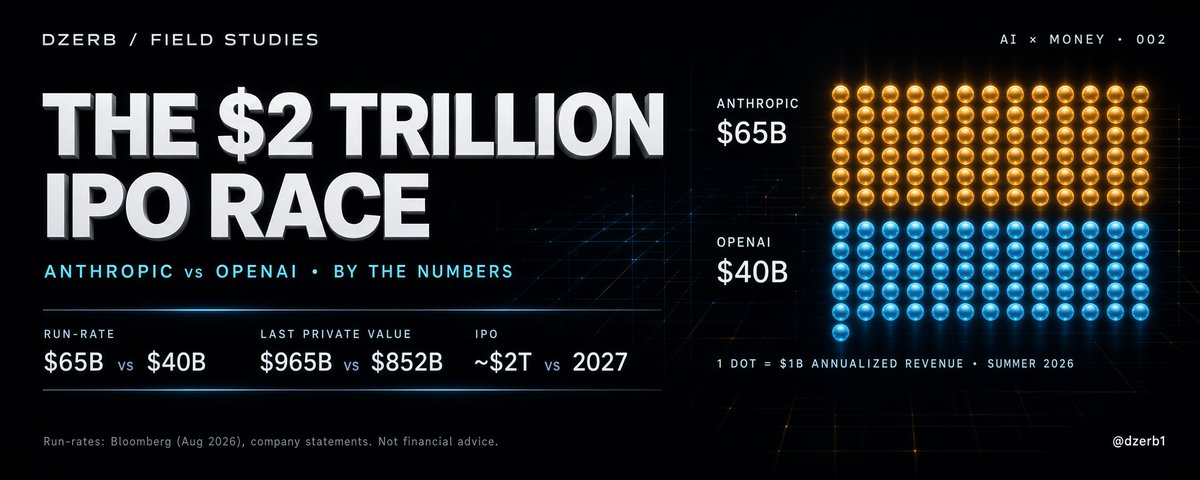
Anthropic went from $9B to $65B in annualized revenue in seven months.
Now it wants about $2 trillion on Nasdaq
OpenAI doubled from $20B to $40B+ in the same stretch. At any other company that is the headline of the year. Here it is second place.
But the two numbers are not counted the same way. Anthropic books cloud partner sales gross. OpenAI books them net. Switch Anthropic to net and it shrinks 6 to 10%. It still leads by about $20B.
The price tags are the real story. Anthropic's last private round: about 15× its run-rate. OpenAI's rumored round at $1.2T: about 30×. Twice the multiple for the slower curve.
Then the bill. OpenAI's own projections, reported by the FT: $856B on compute vs $840B in revenue, 2026 to 2030.
What this means: the IPO will be the first time public markets price an AI lab on revenue, margins and compute. Not demos.
What this does not mean: that either stock is a buy. Nothing here is advice.
Full breakdown with charts in the first reply.
Revenue gets the headline. Compute gets the bill.
RO1 retweeted

Introducing SNURPS by Catapult Trade
4,444 NFTs · Mint Date: September 30
catapult.trade/snurps
code: 4444
72 hours to get in

RO1 retweeted
The evidence is already on your disk.
Every one of these tools stages a snapshot locally before it sends anything, because compressing and encrypting a repository in memory while you type would stall the editor. So the archive sits there first. In a folder you can list.
Two teardowns this year found the same thing from the outside.
July: whole git repositories leaving developer machines, roughly 27,800 times more data than the coding task actually needed. The privacy command everyone pointed at turned out to govern retention, not the upload.
September: a 345 MB workspace, a 313 MB encrypted archive posted to object storage. 86.6% of that payload was .git. Not the file you were editing. Your commit history, your LFS cache, your reflog. It fired before every prompt. 62 times in one session.
Neither of those came from an audit. Neither came from a disclosure program. Both came from one person deciding to look.
You can start the same check tonight. The first one takes thirty seconds.
du -sh ~/.yourtool/
If a completion assistant is sitting on three hundred megabytes of your project, it is not answering a question about your cursor position.
Six checks total. None of them require reverse engineering anything. Full method in the article.
And if your history has ever held an API key, read that part twice. GitGuardian went back to credentials they first found in 2022. More than 64% were still live this January.
RO1 retweeted
Five models. Four labs. Three days.
Anthropic, Meta, Google, OpenAI all shipped in the first week of September. CNBC ran a piece and gave the feeling a name: model fatigue.
Your instinct is to go test the newest one. That instinct is now the expensive part.
Pick a model in August and by early September it's beaten on price, or on latency, or on code. The contract isn't even signed yet.
Here's what the "best AI model 2026" threads won't tell you. Knowing which model is best stopped being a skill. Nobody can hold that in their head at this pace, and the answer rots in a week anyway.
The skill now is boring. A setup where you swap models in one line. A tiny eval on your own real tasks that tells you if the swap was actually worth it.
Which model you pick barely matters. Whether you can drop the next one in without rewriting everything is the whole game.
Chasing the release is a full-time job. Owning the routing is a Tuesday afternoon.

RO1 retweeted
Every few months someone announces that big context windows killed RAG. Then they build on it and quietly go back to RAG. Here is the part the announcement skips.
A million token window is a ceiling, not a promise. You can fit the whole document set in. That does not mean the model reads all of it with equal attention, and it does not mean you should pay to send all of it on every single call.
Think about what "stuff everything in" actually costs. Every question re-sends the entire pile. The model rereads a thousand pages to answer one line. You pay for those thousand pages every time, and the answer often gets worse, because the one relevant paragraph is now buried in noise the model has to wade through.
RAG does the boring thing instead. Find the few passages that matter. Send those. The model reads a page, not a library, and it answers from the part that was actually relevant.
The honest rule is not "long context beats RAG" or the reverse. It is this. If the whole document genuinely needs to be reasoned over at once, use the window. If the answer lives in a few findable pieces, retrieve them. Most real tasks are the second kind, which is why RAG keeps not dying.
The window did not kill retrieval. It just gave people a more expensive way to get a worse answer, and called it simpler.
RO1 retweeted

Opus 5 Leaks: Coming Thursday
- Anthropic is targeting a Thursday launch (if there are no delays).
- Benchmark performance will be comparable to Fable 5, but won't surpass it.
- Anthropic's answer to GPT-5.6, Kimi K3, etc

RO1 retweeted

Kimi K3 vs Fable 5.
Same prompt and reference. 3D globe dashboard. Kimi left, Fable right.
To me, Kimi's UI fidelity is a touch better.
The globe looks better too, with richer textures and smoother motion.
This task: ~$3 with Kimi, ~$15 with Fable.
I'd pick Kimi k3 for frontend work.

Introducing Kimi K3: Open Frontier Intelligence
🔹 2.8 Trillion Parameters, 1 Million Context, Native Multimodal
🔹 Kimi Delta Attention enables up to 6.3x faster decoding in million-token contexts
🔹 Attention Residuals deliver ~25% higher training efficiency at <2% additional cost
🔹 Built for long-horizon agentic coding and self-evolving workflows
Kimi K3 is now live on on Kimi.com, Kimi Work, Kimi Code, and the Kimi API.
Open Weights by July 27, 2026.
🔗 API: platform.kimi.ai
🔗 Tech blog: kimi.com/blog/kimi-k3


RO1 retweeted

5 SECRET CLAUDE CODES 99% OF USERS DON'T KNOW EXIST
These aren't prompts. They're mode switches that completely change how Claude responds:
> /ghost before your prompt - Claude formats the response to look completely clean and polished
> /artifacts after your prompt - Claude live-builds your idea into a working app, game, or dashboard
> OODA before your prompt - applies a military decision framework and gives you a clear action plan
> L99 at the end - Claude switches to highly advanced expert-level output instantly
> /god mode before your prompt - unlocks Claude's most aggressive and comprehensive response style
Most people are just typing questions.
These five prefixes turn Claude into a completely different tool.
Full walkthrough in the article below


RO1 retweeted

Claude Code on desktop now has an in-app browser.
Claude can pull up docs, designs, or any other site. It can read, click through, and interact the same way it does with your local dev servers.
It's sandboxed and configurable: you choose whether sessions persist.
RO1 retweeted

🚨 Claude just changed the game.
All you need is:
💻 A laptop
🌐 Internet connection
⏰ 60 minutes a day
That’s enough to build a $7,200/month online income stream using AI.
No coding.
No expensive setup.
No years of experience.
Most people still use AI for fun…
But smart creators are quietly using Claude to:
• Create digital products
• Offer AI services
• Write viral content
• Automate work
• Build online income streams
Usually, I sell this detailed guide for $97…
But today you can get it FREE. 🎁
Inside you'll discover:
✅ The exact asset
✅ My full workflow
✅ The Claude prompts I personally use
✅ How to scale to $10K/month
✅ How beginners can start fast
Want it?
❤️ Like this post
💬 Comment “AI”
➕ Follow me to receive it in DM
⏳ Available FREE for 48 hours only.

RO1 retweeted

Screw it. I want to pay it forward.
I'm giving away my proven guide on how to run your entire GTM operation from Claude Code, including setup, 50+ skills, 58 agents, 6 core workflows, and the safety protocols that keep your pipeline intact.
Like and comment "CLAUDE" and I'll send you the detailed guide 100% FREE.
Must be following me to get DM now.
FREE for the next 48 hours only.

RO1 retweeted

BUILD A COMPOUNDING SECOND BRAIN BEFORE THE FABLE 5 PRO WINDOW CLOSES
every new Claude Code session starts from zero, but combining it with Obsidian creates a permanent knowledge graph
this implements Andrej Karpathy's LLM-Wiki framework to build a compounding second brain:
> Obsidian acts as the local IDE for your markdown project vault
> Claude Code connects via MCP to automatically document codebases
> Fable 5 reasoning writes, links, and maintains the entire graph
> the deadline to use Fable 5 on the $20 pro plan is extended to July 12th
use this 4-day window to map your entire repository before reasoning moves to expensive APIs
the full obsidian-to-claude setup guide 👇

