

Bitcoin. Liberty. Peace.
Finland
Joined September 2009
- Tweets2.7K
- Following1K
- Followers1K
- Likes5K





Kyllä, mutta sitä ei voi koskaan todistaa simulaation sisällä. Jos voisi, niin simulaation rakentajat keskeyttäisivät sen, korjaisivat bugin ja aloittaisivat alusta.

Pasi J. Matilainen ⚡ retweeted

Julkinen koululaitos tuottaa aiempaa heukompia oppimistuloksia, mutta sen suoriutumista ei kuitenkaan pitäisi iomeisesti mitata liian tarkasti, koska mittaaminen saattaisi paljastaa koulujen ja opettajien välisiä eroja. Ja kuvittele, jos joku vielä kertoisi eroista!
Samaan aikaan vanhempien oikeutta järjestää lapsensa opetus itse halutaan kaventaa, koska valtio ei kykene riittävästi valvomaan heitä.
Koko keskustelusta puuttuu keskeinen tosiasia: oppilaat eroavat toisistaan kognitiivisilta kyvyiltään, oppimisnopeudeltaan, motivaatioltaan ja käyttäytymiseltään. Yhtenäinen opetussuunnitelma ei tee oppilaista yhdenmukaisia.
Oppimistulosten jatkuvaa heikkenemistä ei voi loputtomasti selittää koulun ulkopuolisilla tekijöillä samalla, kun koulutusjärjestelmä vaatii lisää resursseja ja tulosvastuuta ei pitäisi vaatia.
Ydinongelma on, että suomalainen parhaista parhain järjestelmä pitää oman asemansa säilyttämistä tärkeämpänä kuin tietoa tosiasiallisista tuloksista.
Ei yllätä.

Pasi J. Matilainen ⚡ retweeted

Correct.
Using Starlink, a civilian commercial service, for offensive drone strikes to kill people has never been allowed, nor should it be.
Starshield, a different system, is controlled by the US government. What they decide to do is up to them.
Ukraine military violated Starlink terms of service and used it for offensive drone strikes to kill people. That loophole was closed last week.
Starlink remains critical to the defense of Ukraine, as it is the only system that cannot be jammed or blown up, at least for now. Were Starlink to be turned off, the Ukrainian front line would collapse immediately. This is NOT a threat, it is simply a statement of fact.
Starlink was also crucial to preventing Russia from overrunning Ukraine in the early days of the war, as all other means of communication were destroyed or jammed by Russia.
SpaceX has done more to defend Ukraine than any private company on Earth BY FAR.
That said, I have nothing but UTTER CONTEMPT for the virtue-signaling evil warmongers who push for endless slaughter and offer no realistic solution to the conflict. May you burn in hell.
End of story.

Fortunately even a Democrat victory in both houses doesn't mean 1984 immediately, because if nothing else, Trump can still veto for two years. That's two years to build build build and make all politicians irrelevant.

You don't understand anything happening in the US right now unless you read Elon Musk all the way through.
When he says that by 2036 money won't matter anymore, most people hear a billionaire's provocation. I hear something else.
Money is the fuel of every corruption system. Earmarked subsidies, public contracts negotiated behind closed doors, lobbies, front NGOs, regulatory rents. The day AI and robots produce more than humanity can consume, that lever disappears. And everyone who lives off that lever disappears with it.
There are a lot of them. And they've understood perfectly.
That's why we're now reading that Musk is preparing for "war" if Democrats take back Congress. He's not the one declaring war. It's an entire system that knows it's fighting for its survival.
Because we're at a turning point in human history. And there are only two ways out.
Either the Democrats win, and we enter 1984. A hyper-class that controls the AI models, the robot fleets, the data, the currency, and owns 99% of everything. Below them, the rest of humanity on life support, dependent on an income that can be granted and taken away. Klaus Schwab's Davos Forum summed up this world in one sentence: "You'll own nothing and you'll be happy." It's communism, except instead of promising equality, it embraces caste. And for the first time in history, a caste won't need the consent of the people to hold power: robots will do the policing, AI will do the surveillance.
Or we build a new order founded on merit, freedom, and private property. Where everyone remains the owner of their life, their work, and their share of the abundance. Where the collective ambition isn't managing scarcity, but understanding the universe and colonizing the cosmos. That's Elon Musk's project.
The technology is the same in both cases. What changes is who owns it.
Choose carefully which world you want to live in. And beware of socialists who promise to share the pie: they always end up keeping the knife.
Pasi J. Matilainen ⚡ retweeted

If we want the world to get better, we'll have to accept one thing: some people really are exceptional, and they really do create value.
I've explained how the system works. Now I'm going to tell you why Elon Musk is under attack.
It isn't because of his tweets or his positions. It runs deeper than that. Elon Musk is under attack because he exists.
In a world built on egalitarianism, the exceptional individual is an anomaly. Worse, he's a threat. Left free, he creates gaps: he produces more value, he moves faster, he climbs higher. Every gap he creates proves that the egalitarian project rests on a lie, the lie that we're all interchangeable.
Kurt Vonnegut saw it back in 1961 in a chilling short story, Harrison Bergeron. In an America made perfectly equal, the strong are weighed down, the beautiful are masked, and the most intelligent have their thoughts scrambled by piercing noises so that nobody rises above anybody. That isn't some distant dystopia. It's the ultimate logic of this system. If equality of outcome is the goal, then excellence is the enemy.
Here's a truth almost nobody dares to say: humanity moves forward through geniuses.
Look across the centuries. Aristotle founds logic. Gutenberg prints and sets knowledge free. Copernicus and Galileo move the Earth. Descartes and Pascal give reason its method. Newton writes the laws of the universe. Pasteur defeats microbes. Darwin explains life. Turing invents computing. Every time, one mind, a single one, tips history over.
In 1905, special relativity was in the air, and others were getting close. But general relativity, without Einstein, we might still be waiting for. And the digital revolution as we lived it, from the personal computer to a phone in every pocket, wouldn't look the way it does without Steve Jobs.
We almost always admire these geniuses once they're dead. Galileo had to recant on his knees. Semmelweis, who understood that washing hands was enough to save mothers, died in an asylum, mocked by his peers. Turing, who helped win the war, was convicted and then chemically castrated. Van Gogh sold almost nothing in his lifetime.
And then there's Nikola Tesla. The man who invented the electric world we still live in: the alternating current that powers our homes, the induction motor, the foundations of wireless transmission. He dreamed of sending energy freely across the planet. When J.P. Morgan stopped funding him, his Wardenclyffe tower was abandoned, then demolished. He ended his life alone, buried in debt, in a New York hotel room, feeding pigeons. He was found dead in January 1943, at 86. The man who electrified the world died with almost nothing.
The irony of history: his name is now written on millions of cars, the cars of the company Elon Musk took to the top. As if history wanted to pay its debt.
The system has always hated those who surpassed it, and it only celebrates them once they can no longer bother it.
It's hard to accept, but it's reality. It doesn't mean geniuses have more rights than anyone else. Before the law, before justice, and in their dignity, all people are equal, and they must stay that way. It means that some individuals, through their talent, their courage, and their risk-taking, create a thousand times, a million times, a billion times more value than ordinary people. And they don't keep that value for themselves. All of humanity benefits from it.
Elon Musk is one of those men.
He revived space exploration when governments had turned away from it. He forced the entire auto industry into a new century. With Starlink, he brought the internet to the most isolated corners of the planet. Every time, he was told it was impossible. Every time, he risked everything, and every time, he won.
He is the first person in history to cross a trillion dollars. People want him to apologize for it. I say the opposite: he deserves it, and he deserves much more. The value he's creating for humanity, with reusable rockets, the electrification of the world, and the road to Mars, is beyond any comparison with what he owns.
His fortune wasn't taken from anyone. It was created where there was nothing.
That's exactly what the system can't forgive him for.
In their worldview, nobody should be above anybody. Success is suspect, wealth is theft, excellence is an injustice to be corrected. Elon Musk is living, dazzling, unbearable proof that their model is wrong: a free man with talent and courage can create more value than all their administrations combined. As long as he exists, their story doesn't hold. So he has to be destroyed. The lawsuits, the investigations, the press campaigns, and the regulatory threats all come from there.
But here's what makes me deeply optimistic.
The system is cracking. It bet that people would end up preferring equality in mediocrity to freedom in excellence, and it lost. People saw the rockets come back and land. They saw what a single man could accomplish when nobody stopped him from acting. And they understood they had been lied to.
What's coming is a new world, built on real meritocracy. Not a world where the same people inherit the same seats, but a world where everyone gets to play. The child of a factory worker, a farmer, or an immigrant can get in the game, and if he's good, he rises fast. Very fast. As high as his talent takes him.
The equality worth defending is equality of opportunity, not equality of outcome. The first sets geniuses free. The second smothers them.
We think it's normal for a soccer player to earn a fortune because he's exceptional with a ball. We think it's suspicious for an engineer to get rich by bringing rockets back from space. The world will be better the day kids have Elon Musk posters on their bedroom walls, the way they have posters of Messi and Ronaldo.
Humanity never moved forward thanks to people who wanted nobody to stand out. It moved forward thanks to those who dared to outrun everyone.
Elon Musk is one of them. And this time, history won't wait until he's dead to recognize it.
🤖 Made with AI

Pasi J. Matilainen ⚡ retweeted

In 1973, it took a robot 45 seconds to take one step.
This year, one ran 100 meters in 8.64 seconds. Faster than Usain Bolt's world record.
That's how it happens.
Gradually, then suddenly.
So I made a music video about the rise of the robots, from da Vinci's knight to a city on Mars.
Pasi J. Matilainen ⚡ retweeted
"You reduce crime by eliminating poverty."
This is one of the greatest intellectual confusions of our century. It sounds compassionate. It feels obvious. And the moment you actually test it, it falls apart.
Let's look at the data.
First, the correlation is real. Nobody serious denies that poorer areas have more crime. In Sweden, kids from the poorest 20% of families are about 7 times more likely to be convicted of a violent crime than kids from the richest 20%.
But correlation is not causation. So Swedish researchers did something brilliant: they compared siblings. Same parents, same home, same upbringing, but different family income at different points in their childhood, because parents' income moves over time.
Result, on more than 500,000 children (Sariaslan et al., British Journal of Psychiatry, 2014): once you account for what's shared inside the family, the effect of income on violent crime goes from 7x to nothing. The hazard ratio drops to 0.95. No effect.
Finland ran the same test on 650,000 people. Same result: the income-crime link disappears when you compare siblings.
What predicts crime isn't the bank balance. It's what travels inside families.
Second test: what happens when poverty spikes for everyone at once? 2008. US unemployment doubled from 5% to nearly 10%. 15% of Americans officially poor. If poverty creates crime, crime should have exploded. Instead it fell. Year after year. Robbery, the most "economic" crime of all, dropped 10% in 2010 alone. Criminologists literally said they were stumped. Same story in the Great Depression: 25% unemployment, and crime went down in many cities.
Third test: take families out of poverty and see. The US government ran a randomized lottery called Moving to Opportunity. Thousands of families in public housing got vouchers to move to low-poverty neighborhoods. For boys, violent arrests dropped at first, property crime arrests went up, and over time the effects faded. New zip code. Same behavior.
Fourth: the claim that police don't matter. This one is just false. Chalfin et al. (American Economic Review: Insights, 2022): each additional police officer prevents about 0.1 homicides. And per capita, the lives saved are twice as many among Black victims as among white victims. The people who suffer most from "police don't matter" are the poorest neighborhoods.
So what does predict crime? The Dunedin study followed 1,000 children from birth to age 32. Self-control measured between ages 3 and 11 predicted adult criminal convictions, even after controlling for social class and IQ (Moffitt et al., PNAS, 2011). Cognitive ability matters too: across 700,000 Swedish men, lower cognitive scores at 18 track with violent convictions, and the link barely moves when you control for childhood socioeconomic status (Frisell et al., 2012).
And here's the part nobody quotes: in Dunedin, kids whose self-control improved over time did better than predicted. Behavior can change. Which means responsibility is real.
Why does this matter? Because "poverty creates crime" isn't just wrong. It's toxic.
It turns criminals into victims. The man who robbed you becomes a symptom of "the system," and you, the real victim, become a footnote in someone else's narrative.
It merges two completely different things. "You're poor, we'll help you" is one policy. "You're poor and you committed a crime, so we'll excuse you" is another. Fusing them insults the millions of poor people who work, raise their kids, and never hurt anyone. The vast majority of poor people are not criminals. That alone kills the theory.
It removes responsibility. Build a political system on "your circumstances made you do it" and you destroy the one thing that actually changes behavior: the certainty that you own your choices. Every excuse the state manufactures is an incentive.
And it feeds the state forever. If every crime is a social failure, every crime justifies a new program, a new budget, a new agency. Crime becomes the business model of bureaucracy.
The alternative is simple and old.
A lighter state that protects instead of explains. The same rules for everyone, from the projects or from a gated community. Certain, swift punishment for anyone who commits a crime. And never, ever telling someone their crime was written in their social condition.
Treating someone as responsible is respecting them. Excusing someone because they're poor is the most condescending thing you can do to them.

This quoted post is unavailable.
Pasi J. Matilainen ⚡ retweeted
On my way to the office this morning, I passed a group of young people protesting, a Palestinian flag draped over their shoulders.
And I asked myself a question I can't shake: why does this generation always fall into the same trap? No matter the history. No matter the context. Even the ones from wealthy families, who went to the best schools, who were dealt every good card. Always the same trap.
I don't think it's stupidity. I think it's a mechanism. And a mechanism can be taken apart, piece by piece.
A. The observation: everything the state touches becomes unaffordable.
Look at economist Mark Perry's famous chart, the one people call "the chart of the century." It tracks US prices since 2000.
At the top, what explodes: hospital services, college tuition, textbooks, childcare, housing. Increases of +100%, +150%, up to +250%, far above general inflation.
At the bottom, what collapses: TVs, software, phones, toys, clothing. A TV today costs a fraction of what it did in 2000, for an infinitely better product.
Look at what separates the two groups. It isn't technology. It isn't complexity. It's one variable: how much the state is involved.
At the top, sectors that are subsidized, regulated, shielded from competition, where the state funds demand and blocks supply. At the bottom, sectors where companies fight every single morning to serve you better and cheaper.
B. The mechanism: why it's systematic.
When the state subsidizes demand without freeing supply, prices rise. Every time. Guaranteed student loans, and universities raise tuition. Housing aid plus blocked building permits, and rents skyrocket. Administered healthcare, and bureaucracy eats the budget before it ever reaches the patient.
In France it's even more vicious, because the price doesn't disappear: it hides. You never see the hospital bill, you pay it through payroll contributions. You never see the cost of school, you pay it through taxes. Public spending at 57% of GDP, one of the heaviest tax burdens in the world, more than €3.4 trillion in debt. And the result? Overflowing ERs, falling PISA scores, young people who can't afford to live in the city where they work.
The market didn't fail in these sectors. It was never allowed in.
C. Suffering demands a culprit.
A 22-year-old lives all of this in their bones. They can't find a place to live. Their degree either buries them in debt or opens no doors. The future feels blocked. That suffering is real, and I don't deny it for a second.
But human beings can't stand suffering without a culprit. They need a face. A scapegoat.
And this is where everything is decided: who taught them how to read the world?
D. Whoever tells the story picks the villain.
Schools are public. Universities are public. Culture runs on grants. Film goes through funding committees. Public broadcasting shapes the narratives. The people handing down the interpretive framework are, overwhelmingly, paid by the very system that creates the problem.
Do you really think that system is going to name itself as the culprit?
No. It names the capitalist. The boss. The landlord. "The rich." The multinational. The commercial West. Same role, same casting, every time.
E. One lens, a thousand causes.
And this brings me back to that flag. A generation taught to read every situation through a single lens, oppressor on one side, rich, Western, capitalist, oppressed on the other, will apply that lens everywhere. To housing. To climate. To conflicts on the other side of the world. The cause changes, the lens stays. That's why the trap is always the same: it's not the cause that draws them in, it's the way of thinking that was installed in them.
F. The perfect inversion.
Here's the irony. Capitalism is the force that drove down the price of almost everything it touched. The state is the force that blew up the price of almost everything it captured. And young people blame the first for the crimes of the second.
It's like blaming the firefighter for the fire because you saw him at the scene.
G. The ballot box confirms it.
In the US, a few weeks out from the midterms, a large share of urban young voters is getting ready to vote Democrat for more state, more spending, more regulation. New York elected a self-described socialist mayor, carried by young voters, on promises of rent freezes and city-run grocery stores. Rent freezes, the policy that has made housing scarcer everywhere it's been tried. The cure that worsens the disease.
In France, it's the same play in two acts. Part of the youth votes for the radical left, which promises more state. Another part votes for the center, which promises to "manage" the state well, and has dug the debt deeper than ever. Two different ballots, one shared assumption: the problem is the market, the solution is the state.
H. The way out.
These young people aren't stupid. They're right to be angry. They're just aiming at the wrong target.
The day they understand that their rent, their tuition and their hospital are expensive precisely because the state runs them, their anger will change direction. They'll stop protesting against those who create. They'll start protesting against those who capture.
That day, the greatest intellectual scam of our time will be over.

Pasi J. Matilainen ⚡ retweeted
Une vendeuse qui fuit sa propre boutique. À Lyon. En France. En 2026.
Oui, au bout d'un moment, il faut blâmer les abrutis qui brandissent un drapeau palestinien ou algérien pour des causes dont ils n'ont absolument rien à foutre, et qui s'en servent comme d'un permis de piller. Ils sont responsables de leurs actes. Point.
Mais si on s'arrête là, on n'a rien compris. Ces gamins ne sont pas tombés du ciel. Ils sont le produit d'un système. Ce système a des architectes, et ces architectes ont des idées. Il va falloir demander des comptes à tous ceux qui ont créé les conditions de ce chaos, et aux idées qui l'ont rendu possible.
Marc Andreessen les a nommées dans son manifeste techno-optimiste. Ce sont nos ennemis.
Le collectivisme, l'étatisme, la planification centrale, le socialisme.
La bureaucratie, la vétocratie, la gérontocratie.
La haine du mérite, de l'ambition, de l'effort, de la réussite, de la grandeur.
La corruption, la capture réglementaire, les rentes et ceux qui en vivent.
Des institutions qui furent jeunes, ardentes, en quête de vérité, et qui aujourd'hui sont compromises, rongées, en train de s'effondrer.
La tour d'ivoire, et l'expert diplômé qui sait tout mieux que vous et ne paie jamais pour ses erreurs.
Le contrôle de la parole et le contrôle de la pensée.
La stagnation, la décroissance, ce nihilisme si chic chez nos élites qui rêve de moins d'énergie, moins d'enfants, moins d'ambition, moins de vie.
Et au fond de tout ça, le Dernier Homme de Nietzsche : celui qui ne veut plus rien bâtir, plus rien défendre, plus rien transmettre. Juste être tranquille.
Quand on désarme moralement un pays, qu'on apprend à sa jeunesse à mépriser ce qu'elle a reçu, qu'on remplace la transmission par la repentance, l'autorité par l'excuse et le travail par le guichet, on ne fabrique pas des citoyens. On fabrique des pillards. Et des vendeuses qui s'enfuient.
Ces idées ont été théorisées dans les années 80 par Mitterrand et par Attali. Elles sont aujourd'hui incarnées par Macron. Quarante ans. La même pente. Le même résultat.
Il va falloir prendre enfin la leçon du gauchisme et du socialisme, parce qu'elle est toujours la même, partout, à chaque siècle. Ils promettent l'égalité et livrent le chaos. Ils promettent la protection et livrent la peur. Ils promettent la paix sociale et livrent une commerçante qui court pour sauver sa peau dans son propre magasin.
Si on n'est pas capable d'apprendre de l'histoire, on mérite notre sort. Et on méritera ce qui vient toujours après le chaos : le totalitarisme, et ses millions de morts. Le XXe siècle nous l'a écrit en lettres de sang. Nous n'avons aucune excuse. Nous savons.
Raymond Aron l'avait dit : « L'histoire est tragique. »
Ceux qui l'oublient ne s'en protègent pas. Ils finissent simplement par la subir.
Alors choisissez votre camp. Celui de ceux qui excusent, qui expliquent, qui regardent ailleurs.
Ou celui de ceux qui construisent, qui travaillent, qui créent, qui transmettent, et qui refusent de laisser ce pays devenir un endroit où l'on fuit sa propre boutique.
La France n'est pas condamnée. Mais elle ne se sauvera pas toute seule.
Pasi J. Matilainen ⚡ retweeted

Lina, you don't know the honest truth.
In the military, you got your POGs... Person Other than a Grunt. Guys who don't shoot anything. You need them, because you need all sorts of specialties, but you can't trust their big-picture judgement, because the overall mission of the military is shootin' people, and they don't do that.
In civilization, we have POMs.
Person Other than a Maker. Dudes what don't build things. You might need them. But you shouldn't take them too seriously, or listen to them too much, because on some fundamental level, they are never going to get it. They are never going to understand. The fundamental task of civilization is making things, and POMs don't do that.
"This is just a mash-up of existing technology" is the most POM-like typing you could ever hope to see. It's a tell that someone has never done a significant engineering project in a technical role.
Experienced engineers not only understand differently, we eat, sleep and breathe the basic reality that 99% of engineering challenges are "get mechanism to work with other mechanism". Without breaking, shaking itself apart or blowing up.
Every basic scientific principle behind the internal combustion automobile was understood by the ancient Greeks and Romans.
And yet they were not only unable to harness those principles to make a primitive steam-powered automobile, they were unable to conceive of the very idea, because their ability to implement and integrate wasn't advanced enough.
If you look at everything that Elon Musk has ever done, every company he has ever built, every technology he has ever brought to market, none of it was a purely new invention.
It was ALL taking stuff that already kinda worked, and making it do new things. And not just do them, but do them so well that they actually became practical.
SpaceX didn't invent the rocket. They made it reusable.
Tesla didn't invent the electric motor or the battery. They made them practical for ground transportation.
Neurallink didn't invent electrical nerve interfaces. They made them control a computer UI.
This shit is incredibly hard. If you try to use the known principle of a cold-gas thruster to make a car fly, you're going to crash and blow up a lot. You're going to have to make mistakes, and fix them, one by one, until you run out of mistakes and the thing flies.
Real engineers, real makers, know that this is what the word engineering means. POMs don't get it. Lina doesn't understand what she saw.
She thinks she saw a publicity stunt to impress yokels.
No. That was a publicity stunt to impress engineers.
It wasn't a demonstration of a flying car at all. It was a demonstration of the engineering capabilities of team.
It was a flex.
"Look," they said, "we can reify the Gernsback continuum. Give us your silliest, low-effort science fiction meme tech, and give us enough time, and we'll make it real."
The purpose of making a flying car isn't to let you do a jetpack leap over traffic. It's to learn all the little implementation details and balancing tradeoffs and gotchas that you have to master to make a car fly.
It's not the big scientific discoveries that build civilization. By themselves, they are nothing but curiosities.
What builds civilization is all the little discoveries that you make when you try to get the big ones to stop crashing and blowing up.
When someone does that on a unprecedented level, you either help them, or you stay out of the way and keep your ignorant POM opinions to yourself.

I'm not an Elon hater.
I'm just telling you the Honest Truth:
This is a marketing stunt.
The technology is quite old.
Just nobody ever thought of bolting it on a car.
Because it's pointless.
Porsche or Ferrari could also build something like this if they wanted, but they don't, because it's not worth it for them.
It's worth it for Elon though, because his entire brand is all about having the halo of futurism.
His marketing scales especially well with tech gimmicks like this, which is why he is financially incentivised to do them, while others aren't.
Again, I'm not hating, but actually educating yall.
This is not engineering genius.
It's marketing genius.
Pasi J. Matilainen ⚡ retweeted
Encore une fois, Elon Musk avait raison. Et les scientifiques vont se prendre une vraie blessure narcissique.
Il y a deux mois, j'ai dîné avec un professeur de physique quantique à Normale Sup, l'une des meilleures écoles de France.
Il se présente avec cette phrase :
"Je suis le seul prof pas gauchiste dans un marécage de profs gauchistes décroissantistes."
Ses collègues sont tous anti-IA. La raison ? Ça consomme de l'eau.
Le mec est passionnant. On part très loin : l'espace, le temps, la conscience. Des discussions complètement perchées.
Et à un moment, il me lâche :
"Tu sais, depuis les années 70, aucun sujet vraiment sérieux en physique n'est financé."
Je lui demande ce qui est financé, alors.
"Des cathédrales théoriques. Magnifiques. Qui ne servent quasiment à rien."
Je lui demande pourquoi.
"Après tout ce qui s'est passé avec le nucléaire, le monde académique s'est imposé un principe de précaution. Il a peur de trouver des choses réellement profondes."
Relisez cette phrase.
La science a peur de trouver.
C'est exactement ce que décrit François Chollet aujourd'hui : la théorie des cordes, c'est ce qui arrive quand une intelligence est coupée du réel. Elle hallucine. Elle construit des cathédrales. Elon a répondu avec un seul emoji : 🎯
Ce n'est pas un accident. C'est une capture.
Je parle souvent de Gramsci. Son idée centrale : on ne prend pas le pouvoir par la force, on prend les institutions. Universités, médias, culture. Et une fois qu'on les tient, on décide de ce qui est pensable.
La recherche n'y a pas échappé. On finance ce qui est publiable, consensuel, sans risque. On ne finance plus ce qui pourrait tout changer.
C'est pour ça que beaucoup de gens en France pleurent en ce moment. Ils sentent que leur monde factice est en train de mourir. Ce monde où un titre suffisait. Où un statut remplaçait un résultat. Où l'on pouvait passer trente ans à écrire des papiers lus par douze personnes sans jamais se confronter au réel.
Elon l'a dit sans filtre : une grande partie des PhD ne servent à rien. Et chez xAI, il a supprimé le titre de "chercheur". Il n'y a que des ingénieurs.
Le message est limpide. On ne te paie pas pour chercher. On te paie pour trouver.
La science va devoir retrouver son vrai but. Pas produire des papiers. Pas décrocher des grants. Pas briller en colloque. Comprendre le réel, et le plier.
Et l'IA va accélérer tout ça brutalement. Quand l'intelligence devient abondante, elle n'est plus le goulot d'étranglement. Ce qui compte, c'est le courage de la confronter au monde physique, encore et encore.
Alors physiciens, mathématiciens : il est temps de vous sortir les doigts du cul et de créer de la vraie valeur pour le monde.
On veut l'antimatière.
On veut l'antigravité.
On veut le warp drive.
On veut comprendre la conscience au niveau de l'infiniment petit.
Les vrais sujets. Ceux qu'on a eu peur de toucher pendant cinquante ans.
La science a été capturée. Elle va être libérée.
Et ça va faire très mal à certains egos.

Pasi J. Matilainen ⚡ retweeted
Elon a écrit « K3 or bust baby ».
Aujourd'hui je vais t'expliquer ce que c'est, K3. Et pourquoi c'est peut-être la phrase la plus importante de la décennie.
Depuis 20 ou 30 ans, l'Occident traverse une dépression qui ne dit pas son nom.
Plus de grand projet. Plus de grand récit. On nous a expliqué que l'histoire était finie, que le progrès était dangereux, que l'avenir serait forcément pire que le passé. Résultat : on ne fait plus d'enfants. On ne construit plus. On gère le déclin et on appelle ça de la sagesse.
Sauf que ce n'est pas ça, l'humanité.
L'histoire de notre espèce, c'est sortir d'Afrique à pied. Traverser des océans sur des coques de bois. Marcher sur la Lune avec des ordinateurs moins puissants qu'une calculette. C'est le record du monde qui tombe, le morceau que personne n'avait imaginé, l'équation qui résiste pendant des siècles et qui finit par céder. Dans le sport, dans la musique, dans la science, partout, le même instinct : aller plus loin que ce qui était possible hier.
Alors pourquoi tout s'est arrêté ?
Parce que construire de grandes choses demande des ressources. Et que les ressources, comme la majorité des institutions, ont été capturées par une forme de communisme doux. Pas de goulags. Juste des comités, des normes, de la peur redistribuée à tous les étages. Une société qui dit non par défaut.
Elon est en train de rouvrir la porte. Des fusées qui atterrissent toutes seules. Les plus gros clusters d'IA de la planète. Et maintenant, un cap clair : K3.
K, c'est pour Kardashev.
En 1964, l'astrophysicien soviétique Nikolaï Kardashev propose de classer les civilisations selon une seule variable : l'énergie qu'elles maîtrisent.
Type 1 : une civilisation qui exploite toute l'énergie disponible sur sa planète. On n'y est même pas. On est autour de 0,7.
Type 2 : une civilisation qui capte toute l'énergie de son étoile. Notre Soleil émet à chaque seconde plus de 10 000 milliards de fois ce que l'humanité entière consomme. Comment on le capte ? Avec une sphère de Dyson : des essaims gigantesques de collecteurs solaires en orbite autour du Soleil. C'est ça, le « star mind » : une intelligence alimentée directement par une étoile.
Type 3 : une civilisation qui maîtrise l'énergie d'une galaxie entière. Des centaines de milliards d'étoiles.
K3 or bust. Pas une levée de fonds. Pas un mandat de cinq ans. La galaxie.
Et là, j'entends déjà les pessimistes : « Impossible, les distances sont trop grandes. »
L'étoile la plus proche est à 4 années-lumière. La Voie lactée en fait 100 000. Avec nos fusées actuelles, c'est des dizaines de milliers d'années pour le premier voisin.
Sauf qu'en 1994, le physicien Miguel Alcubierre a montré que les équations de la relativité générale autorisent une « bulle » de distorsion : l'espace se contracte devant le vaisseau et se dilate derrière. Le vaisseau ne dépasse pas la vitesse de la lumière, c'est l'espace lui-même qui bouge. Le problème ? Il faudrait une forme d'énergie exotique qu'on ne sait pas produire aujourd'hui.
Note bien la nuance : ce n'est pas interdit par la physique. C'est une théorie qui reste à inventer et une ingénierie qui reste à construire.
Et même sans warp drive, des sondes autoréplicantes voyageant à une fraction de la vitesse de la lumière pourraient traverser la galaxie en quelques millions d'années. La galaxie a 13 milliards d'années. À l'échelle cosmique, c'est un après-midi.
C'est exactement là que l'IA change tout. Une superintelligence capable de générer, tester et réfuter des théories plus vite que tous les physiciens de l'histoire réunis. Des problèmes qui nous auraient pris dix siècles pourraient tenir en une décennie.
Deuxième objection : « On ne peut pas survivre sur Mars. »
Aujourd'hui, non. Atmosphère cent fois plus fine que la nôtre, pas de champ magnétique, des radiations partout.
Alors on la terraforme. On réchauffe la planète, on épaissit l'atmosphère. La NASA a même étudié l'idée d'un bouclier magnétique artificiel placé entre Mars et le Soleil pour la protéger des vents solaires.
Et on peut aussi se modifier nous-mêmes. Le tardigrade, cette micro-bestiole quasi indestructible, possède une protéine qui protège son ADN des radiations. En 2016, des chercheurs japonais l'ont introduite dans des cellules humaines en laboratoire : elles ont résisté nettement mieux aux rayons X. On ne va pas seulement s'adapter au cosmos. On va adapter le vivant au cosmos.
En 1895, Lord Kelvin, l'un des plus grands physiciens de son époque, déclarait qu'une machine volante plus lourde que l'air était impossible. Huit ans plus tard, les frères Wright décollaient.
Chaque « impossible » de l'histoire n'était qu'un problème d'ingénierie qui n'avait pas encore trouvé son équipe.
On ne vit pas la fin de l'histoire. On n'a même pas fini le prologue.
Il y a des centaines de milliards d'étoiles là-haut. Des mondes que personne n'a jamais vus. Des lois de la physique qu'on n'a pas encore comprises. Et la plus grande aventure jamais racontée n'a pas encore commencé.
Fais des enfants. Construis des choses. Vise trop haut.
K3 or bust, baby.
Pasi J. Matilainen ⚡ retweeted
Si t'es réellement pour le bien commun. Si tu veux vraiment sortir les gens de la pauvreté. Si tu veux vraiment que le monde soit meilleur demain qu'aujourd'hui.
Lis ça jusqu'au bout.
Aujourd'hui, je vais te sortir de ton gauchisme mental. Pas parce que tes intentions sont mauvaises. Tes intentions sont bonnes. C'est justement le problème : on t'a appris à juger une idée à ses intentions, jamais à ses résultats. Et c'est là que naît ta dissonance cognitive. Tu veux aider les pauvres, et tu défends les outils qui les maintiennent pauvres.
Commence par les chiffres. En 1820, environ trois quarts de l'humanité vivaient dans l'extrême pauvreté. Aujourd'hui, c'est moins de 10%. Pendant que la population était multipliée par 8. C'est le plus grand miracle de l'histoire humaine, et personne ne te l'a raconté à l'école.
Qu'est-ce qui l'a produit ? Pas la redistribution. On ne redistribue pas ce qui n'existe pas. Ce qui l'a produit, c'est la propriété privée, l'échange libre, l'entrepreneur, le capital, l'innovation. La Chine a sorti 800 millions de personnes de la pauvreté à partir du moment où elle a laissé les paysans vendre leur surplus et les entreprises exister. Pas avant. Corée du Sud contre Corée du Nord. Allemagne de l'Ouest contre Allemagne de l'Est. Même peuple, même culture, même point de départ. Seul le système change. Et les résultats sont sans appel.
Alors pourquoi tu as dans la tête que socialisme = protéger les pauvres ?
Parce que c'est la plus grande opération narrative du XXe siècle. Le marxisme s'est approprié le vocabulaire moral. Il a pris le mot "pauvre", le mot "justice", le mot "solidarité", et il les a collés à lui. Résultat : critiquer l'État, c'est passer pour quelqu'un qui méprise les faibles. Défendre le marché, c'est passer pour un égoïste. La gauche a gagné la bataille des mots pendant que le capitalisme gagnait la bataille des faits. Et toi, tu as hérité des mots sans jamais voir les faits.
Maintenant, la partie qui va te changer la façon de penser : l'économie autrichienne.
En 1920, Ludwig von Mises pose une question que personne n'a jamais résolue. Comment un planificateur central peut-il savoir combien produire de chaussures, de blé, d'acier, sans prix de marché ? Réponse : il ne peut pas. Les prix ne sont pas des étiquettes. Ce sont des signaux. Ils condensent l'information de milliards de personnes, leurs besoins, leurs contraintes, leurs désirs, en un seul chiffre.
Hayek va plus loin. Le savoir nécessaire pour faire tourner une économie n'existe nulle part en un seul endroit. Il est dispersé dans la tête de chaque boulanger, chaque ingénieur, chaque mère de famille. Aucun ministère, aucun comité, aucune IA d'État ne peut le centraliser.
Et là, connecte ça à la théorie du chaos. Une économie, c'est un système complexe. Des milliards d'agents, des interactions non linéaires, des effets papillon partout. On ne pilote pas un système chaotique depuis un bureau. On le laisse s'auto-organiser. C'est ça, l'ordre spontané. Personne n'a dessiné le langage, le droit coutumier ou internet. Ils ont émergé. La richesse, c'est pareil.
Bastiat, un Français, l'avait compris dès 1850 : il y a ce qu'on voit et ce qu'on ne voit pas. On voit la subvention, l'emploi protégé, l'aide versée. On ne voit pas les entreprises qui n'ont jamais été créées, les innovations jamais lancées, les emplois jamais apparus parce que l'argent a été pris ailleurs. Le socialisme est toujours un pari sur ce qu'on voit contre ce qu'on ne voit pas.
La richesse n'est pas un gâteau à partager. C'est un gâteau qu'on agrandit. Tant que tu penses en jeu à somme nulle, tu restes dans la logique du partage de la misère. Le capitalisme est le seul système qui pense en somme positive : je crée de la valeur, tu crées de la valeur, on échange, on est tous les deux plus riches.
Et maintenant, le futur.
La prochaine vague qui peut éradiquer la pauvreté pour de bon, c'est l'IA et la robotique. Des coûts de production qui s'effondrent. Du savoir médical, juridique, éducatif accessible à n'importe qui avec un téléphone. Des biens physiques fabriqués pour presque rien. L'abondance n'a jamais été aussi proche.
Mais il y a un seul truc qui peut tout bloquer : la coercition étatique. Les permis, les licences, les régulations écrites par les gros acteurs pour tuer les petits, les taxes sur l'innovation, la planification de "l'IA responsable" par des bureaucrates qui ne savent pas coder. Ce n'est pas de la protection. C'est du socialisme qui ne dit pas son nom. Et si on le laisse faire, on passera à côté de la plus grande opportunité de l'histoire de sortir l'humanité de la pauvreté.
Dernière chose. Tu sais où siégeait Bastiat à l'Assemblée ? À gauche. Les premiers libéraux étaient la gauche. Ceux qui se battaient contre le roi, contre les privilèges, contre l'arbitraire du pouvoir. Le vrai progressisme, historiquement, c'est la liberté.
Donc si tu es de gauche au sens noble, si tu veux vraiment que les plus faibles s'en sortent, alors sois libéral. Sur tout. Économie, société, innovation.
Lis Bastiat, La Loi. Hayek, La Route de la servitude. Mises, L'Action humaine. Thomas Sowell, n'importe lequel.
Juge les idées à leurs résultats. Pas à leurs intentions.
Pasi J. Matilainen ⚡ retweeted

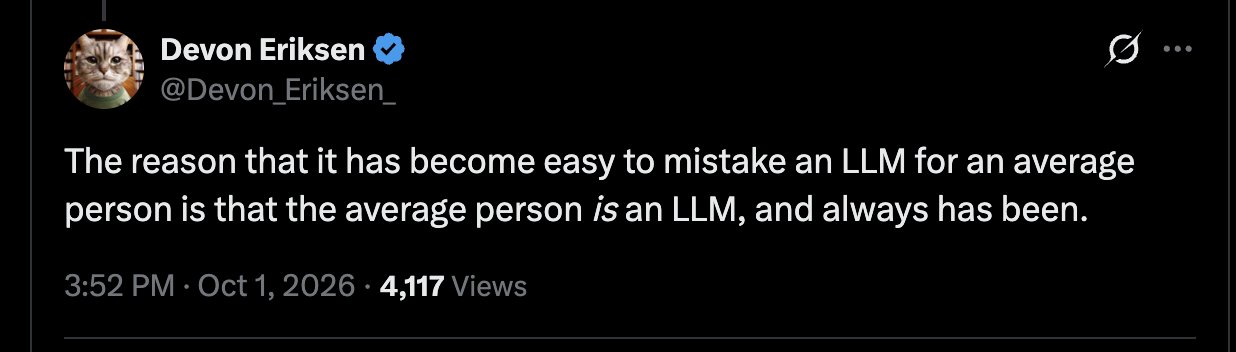
It took me decades to fully accept the truth of this statement:
Most people are nothing more than a soupy mix of opinions and random facts fed to them by their schools and screens.
There is no thinking because there is no actual self.
Pasi J. Matilainen ⚡ retweeted
Je ne sais pas si vous mesurez ce qui est en train de se passer.
Alex Karp, le patron de Palantir, ne va plus chercher ses talents à Harvard. Il les forme lui-même. Des jeunes de 18 ans, sans diplôme, choisis sur leur seul talent, qui codent sur de vrais projets et lisent de la philosophie politique entre deux sprints. Il appelle ça « le diplôme Palantir ». Et aujourd'hui le New York Post titre que les boîtes tech lancent leurs propres programmes parce qu'elles ne peuvent plus compter sur l'Ivy League.
Ce n'est pas une anecdote RH. C'est un basculement de civilisation.
Pendant des décennies, les entrepreneurs ont confié à l'université la mission la plus sacrée qui soit : former les esprits. Ils comprennent aujourd'hui que cette mission a été trahie. Les institutions censées produire des penseurs libres produisent des conformistes. Le mérite a été remplacé par des critères opaques. L'enseignement est devenu catéchisme. Paul Graham l'avait vu avant tout le monde.
Alors ils font ce que font les bâtisseurs quand un système les trahit. Ils ne le réforment pas. Ils en construisent un autre, à côté.
Elon n'a pas attendu que la NASA se réveille, il a fait SpaceX. Il n'a pas réformé les médias, il a racheté la place publique. Les entrepreneurs ne cherchent plus à convaincre l'État. Ils font l'État, partout où l'État a abdiqué.
Relisez La Grève d'Ayn Rand. Nous y sommes. Les bureaucrates gardent les titres, les budgets, les bâtiments. Mais ils perdent la seule chose qui compte : la confiance. Aux États-Unis, à peine 28 % des gens font encore confiance aux médias. Un plus bas historique. Plus personne ne croit ceux qui prétendent nous dire quoi penser.
On entend partout que l'école est finie. Je pense exactement l'inverse.
Ce n'est pas l'école qui est morte. Ce sont les institutions qui l'ont confisquée. L'école, la vraie, celle de l'Académie d'Athènes, des ateliers de la Renaissance, du maître et de l'apprenti, va renaître. Plus exigeante. Plus juste. Sans dette, sans dogme, sans diplôme comme rente à vie.
Une école qui ne fabriquera plus des diplômés, mais des polymathes. Des esprits libres, capables de coder, de penser, de construire et de douter. Ce sont eux qui créeront la valeur des cinquante prochaines années.
J'ai appris à coder seul à 12 ans. Aucun amphi ne m'a appris ce que j'ai appris en construisant. Je sais ce que devient un talent quand on le laisse respirer.
L'université a eu des siècles pour former les meilleurs esprits. Les entrepreneurs vont le faire en une décennie.
La grande reconstruction a commencé.

Tech companies launching their own programs to train grads because they 'can't rely' on Ivy Leagues trib.al/Fi2miAG

Pasi J. Matilainen ⚡ retweeted

Power selects for a specific personality type, and it is not yours.
F.A. Hayek spelled this out in 1944. In a centrally planned system, the people who rise are not the most competent or the most honest. They are the most willing to exercise force against strangers, the most comfortable with contradiction, and the most skilled at coalition-building through favors rather than merit. Government filters for the bad ones from the start.
The mechanism is straightforward. Political power means controlling resources you did not earn. Capturing that control requires outcompeting rivals who have no ethical constraints. A principled candidate refuses to promise contradictory things to different voter blocs. An unprincipled one does it without blinking. The unprincipled one wins. Repeat this selection pressure across hundreds of electoral cycles and you get the U.S. Congress in 2026: a body where the average member has held office for over a decade, raised millions from interested parties, and delivered almost nothing measurable to the people who voted for them.
Bureaucracy compounds the problem. Once entrenched, state agencies attract people who want authority without accountability. You cannot fire most of them. The FDA, the TSA, the Federal Reserve all function this way, staffed by individuals whose career advancement depends on expanding the agency's reach, never on serving you efficiently.


Pasi J. Matilainen ⚡ retweeted
Hienoa, että aikuiset ovat mitoittaneet pienten lasten ruokailun 10–15 minuutin suoritteeksi.
Seuraava askel on lähinnä TQM-henkinen loppusilaus, jossa koko ateria soseutetaan yhdeksi ravintomassaksi juomineen. Sen saa noudettua kätevästi linjastolta ja sen voi nauttia liikunnallisen elämäntavan hengessä liikkeessä.
Maksimoidaan läpimeno, minimoidaan kaikenlainen kitka.
Kuulostaako hölmöltä? Ei. Sinulla on vain vika päässäsi, jos ajattelet, että rauhallinen ruokailu ja sosiaalinen kanssakäyminen ruokailun lomassa ovat muuta kuin häiriö tuotantolinjalla.
