

E.T. TRAVEL 🚀 My 3-minute sci-fi trailer for @XPRIZE Please watch, like + comment ↓ https://teapawt.org/t.co/m2WyIctqTJ
Earth
Joined August 2010
- Tweets617
- Following237
- Followers1.1K
- Likes243




Paul Alexander Wehner retweeted

The future is taste and judgement.

We'll be spending a lot more time trying to understand the outputs of language models. A few thoughts, tips & tricks:
Writing. Something I've had success with: Ask your LLM to explain something in ASD-STE100, it's a controlled language specification originally developed for aerospace maintenance documentation. LLMs well-versed in this language and it comes with heavy constraints on clean writing style that I often find a lot more readable. Sometimes I've tried to soften it a bit e.g. ask for "80% of the way to ASD-STE100" because the spec is quite stringent. But even better:
Diagrams / images. Instead of writing, ask your LLM to create a diagram. These can be a lot easier to process, parse, and understand. But even better:
Web pages. Ask for output "in HTML" to get a beautiful, interactive webpage. LLMs are getting really good at frontend and can create beautiful experiences, animations, etc. But even better:
Explainer videos. The output format I am most bullish on is fully custom / bespoke explainer videos generated on any arbitrary topic. Experiment with things like "Create a 3b1b style video explainer on X. Use my ElevenLabs API key for audio narration". (you'd need an API key for the latter or you can ask your LLM to find you decent free alternatives that use your local compute). This is actually starting to work!
In summary:
- As LLMs get better, they will do more and more of the legwork autonomously, and a lot more of our work will rise up the abstractions into oversight and understanding.
- Luckily, LLMs can help here too because as intelligence and code are increasingly abundant, you can ask for large, custom, discardable software artifacts (e.g. web apps, video explainers) that would have never made sense to create before. Push the boundaries here and you'll be surprised.


Paul Alexander Wehner retweeted

This post looks like the start of a VERY sophisticated and well-funded PR operation to get support for Democrats to regulate AI into oblivion. Let me show you how it works:
1.) This guy, with minimal followers and no previous account activity, goes to the Wall Street Journal which publishes an exclusive with quotes from him on his resignation 18 minutes BEFORE this post goes up. Planning was clearly done in advance.
2.) Within hours, it has tens of thousands of reposts and the account has 100k+ followers. The post is punchy, quotable, it almost seems professionally written. The first three accounts to quote tweet it all do so within 15 minutes of the initial posting. Remember, this account had basically zero engagement beforehand, so an organic reach explanation seems unlikely.
According to Grok those accounts are @_NathanCalvin (General Counsel at Encode AI), @peterwildeford (Head of Policy at the AI Policy Network), and @DKokotajlo (Head of the AI Futures Project), all of which are up-and-coming AI-Doomer policy advocacy nonprofits.
The AI Futures Project website says it is funded “primarily” by the Survival and Flourishing Fund, which says on its own website that it has advised Jaan Tallinn, Skype creator and one of the leading investors in Anthropic, to grant over $2.5 million to the AI Futures Project since 2024.
Encode AI says on its website that it is ALSO funded by the Survival and Flourishing Fund, which in turn says that it told Anthropic investor Jaan Tallinn to grant $516,000 to Encode AI in 2025.
And wouldn’t you know it, the Survival and Flourishing Fund ALSO says it told Jaan Tallinn to grant $2 million to the AI Policy Institute, the 501(c)(3) affiliate of the AI Policy Network, as well.
What are the odds that the first three quote tweets of Coxon’s post would all be major AI-restriction policy advocates funded generously by the same donor, who also happens to be one of the leading investors in, and a board member of, Anthropic, the company Coxon was resigning from? And all within 15 minutes of posting (two within ten)?
3.) Jacob Coxon doesn’t have much of a resume, but we do know that, in 2022, he got a $20,159 scholarship for the “long term future scholarship program” from the Good Ventures Foundation, one of the philanthropic vehicles of Dustin Moskovitz, a notorious AI-doomer who has spent tens if not hundreds of millions on policy advocacy to strictly regulate AI, while also being an Anthropic Investor himself.
It also just so happens that the 14th person to quote Coxon’s post was @MaxNadeau_ (27 minutes after posting) who is the program officer for the Technical AI Safety team at Coefficient Giving, another of Moskovitz’s philanthropic spending vehicles. Max is not a frequent poster, his last posts before quoting Coxon were before Labor Day, but he was remarkably quick off the mark for this one.
4.) Basically every major Democrat politician and candidate has suddenly glommed on to this post, and conveniently, as the people cry out foe answers, Bernie Sanders already has a bill written to “ban super intelligence” and regulate AI into oblivion, and will be releasing later this week. The bill, among many other things, will create “a new cabinet-level federal agency to safeguard the public from the dangers of artificial intelligence” that will be “advised by an Artificial Intelligence Advisory Board comprised of experts on artificial intelligence.” Do you think, perhaps, Anthropic and its many investors who fund AI policy advocacy might have interest in getting to place a pet “expert” on the board of an entity that dictates what AI is and isn’t allowed to do? And isn’t it fortuitous that this whistleblower came forward with his oh-so scary stories so close in proximity to the release of the most radical piece of AI legislation ever introduced?

This Korean spa is secretly an interdimensional travel agency. 👽
Enjoy complete cognitive privacy, authentic uncertainty, and love without knowing how it ends.
Gateway meals available onsite.
E.T. TRAVEL — my @XPRIZE #FutureVisionXPRIZE entry.
Full 3-minute trailer:
youtube.com/watch?v=t_KXPKbJ…
Because the universe needs a vacation.
I saw a door at my local Korean spa marked “E.T. TRAVEL,” so I made this sci-fi comedy about it. #FutureVisionXPRIZE
E.T. TRAVEL is my entry in @XPRIZE’s Future Vision competition.
In a universe of total connection, aliens come to Earth for something rare: separation.
Full trailer:
youtube.com/watch?v=t_KXPKbJ…
🎟️ Book your trip to Shangri-La.
The website opens as the spa’s interdimensional TV commercial — sound on 🔊
ettravelmovie.com/

I just released a new song called “Eternal Sunshine of Love.”
The words came to me one morning in the shower. I grabbed my phone and recorded them before the moment passed. The lyrics remain unedited from that stream-of-consciousness recording.
soundcloud.com/paulalexander…

Paul Alexander Wehner retweeted

What Everyone Missed In Leo’s Blow-Up👇
Leopold Aschenbrenner lost $30 billion (~67%) in a month.
The consensus post-mortem, from the Wall Street Journal to the replies on X, is that a young man used 4-to-1 leverage on concentrated positions and got carried out. While that is true, it does not convey any useful information. Leverage is certainly the reason Leopold lost so much, so quickly. But it is not the reason he lost. Leverage is merely a magnifying glass. It doesn’t pass judgement.
The reason the reason his fund was doomed was because he’s wrong. And no one, anywhere, has explained why.
On the morning of Thursday, July 30, before the opening bell, Situational Awareness LP sold its entire public stock portfolio — the long side and the short side together, roughly $16 billion of it — to Citadel in a single block trade.
Millennium Management and Jane Street bid for the assets. Ken Griffin and Citadel won.
That night, Aschenbrenner wrote to his limited partners. Net performance for the month, unaudited: down 67%. Net performance for the year: still up 80%.
"We let you down this month," he wrote. "We came closer to permanent capital impairment than is acceptable to us."
Six days earlier, on July 24, he had written a different letter. That one reported a 439% net return for the first half of 2026, described the selloff in artificial intelligence stocks as one of the best buying opportunities since early 2025, and invited his investors to wire more money starting August 1. It closed with a postscript: "At times we call out opportunities that seem like a particularly good time to add funds, if you have been waiting for one."
Assets that stood near $45 billion at the start of July finished the month around $10 billion, and roughly half of what remains is a single illiquid private stake in Anthropic.
Leopold is 25 years old. He graduated from Columbia at 19, as valedictorian. He worked at the FTX Future Fund from February to November of 2022, then joined OpenAI's Superalignment team, then was fired in April 2024. Two months after the firing he published a 165-page essay called "Situational Awareness: The Decade Ahead," raised $225 million from Patrick and John Collison, Nat Friedman and Daniel Gross, and started a hedge fund. He had never managed money before.
Situational Awareness was constructed to express only two ideas.
The first conviction: the physical build-out of artificial intelligence — the chips, the memory, the power, the data centers, the neoclouds — was the trade of the decade. The fund's disclosed long positions read like an inventory of the second derivative of the AI boom. Bloom Energy Corporation (NYSE: BE), fuel cells for data centers. Sandisk Corporation (NASDAQ: SNDK) and Micron Technology, Inc. (NASDAQ: MU), memory. CoreWeave, Inc. (NASDAQ: CRWV) and Nebius Group N.V. (NASDAQ: NBIS), rented compute. IREN Limited, Core Scientific, Applied Digital, Riot Platforms, CleanSpark, Bitfarms, Bitdeer — bitcoin miners converting their substations into AI compute.
The second conviction: application software was going to be destroyed by A.I. Not disrupted. Obliterated.
Leo explained why on Dwarkesh Patel's podcast, in June 2024:
"I'm so bearish on the wrapper companies because they're betting on stagnation. They're betting that you have these intermediate models and it takes so much schlep to integrate them. I'm really bearish because we're just going to sonic boom you. We're going to get the unhobblings. We're going to get the drop-in remote worker. Your stuff is not going to matter."
That was the whole thesis. Buy the compute. Short the stuff that runs on the compute.
By CNBC's reporting, the short leg included Adobe Inc. (NASDAQ: ADBE). A 13F does not disclose short stock. It does not disclose swaps. We only know about Adobe because reporters were told… but you can look at the tape and, when you do, it’s clear that Leo was short software in a major way.
Between the June 30 close and the July 29 close — the last session before the block trade cleared his shorts — the two sides of his portfolio did this.
The longs:
· Sandisk: down 55.32%
· Nebius: down 46.33%
· Bloom Energy: down 45.90%
· CoreWeave: down 38.90%
· Micron: down 35.98%
· IREN: down 35.91%
The shorts, over the same 20 sessions:
· Workday, Inc. (NASDAQ: WDAY): up 37.24%
· Adobe: up 28.49%
· Intuit Inc. (NASDAQ: INTU): up 27.64%
· Salesforce, Inc. (NYSE: CRM): up 20.25%
· Veeva Systems Inc. (NYSE: VEEV): up 17.15%
Over that same window the Invesco QQQ Trust fell 10.14% and the SPDR S&P 500 ETF Trust fell 2.32%. Nvidia — the supposed epicenter of the AI trade — fell 5.04%, and finished the full month of July up 0.33%.
This was not an AI crash.
The S&P 500 stayed near its record throughout. This was a violent rotation out of the leveraged, capital-hungry, second-derivative end of the AI complex and into the profitable, cash-generating, asset-light end of it. Which is to say: the market rotated out of exactly what he owned and into exactly what he was short.
Then there is Microsoft.
Microsoft Corporation (NASDAQ: MSFT) closed at $390.54 on Wednesday, July 29. It closed at $451.10 on Thursday, July 30. That is a gain of 15.51% in a single session on 110.2 million shares, against a July average of 37.1 million. Yes, Microsoft reported its fiscal fourth quarter after the close on July 29. But the results were nothing out of the ordinary. Revenue came in at $90.007 billion against a $87.62 billion consensus. That is a 2.7% beat. Earnings were $4.74 per share against $4.21. It was a good quarter. Not a historic one. A 2.7% revenue beat does not add roughly $450 billion of market value to the most widely owned company on earth in six and a half hours. Something else was in that tape.
And the answer is extremely important. Leo blew up quickly because of leverage. But he failed because he is simply wrong.
Aschenbrenner's software thesis rests on a single premise: that a company selling enterprise software is selling the work the software performs. If a model can perform that work, the company is worth nothing.
That premise is what a very smart 25-year-old engineer believes. It is not what anyone who has ever run a business believes.
Nobody buys Microsoft because Microsoft writes the best code. They buy Microsoft because Microsoft is the rail everything else runs on. Active Directory is where your employee identities live. Excel is where your board deck's numbers come from. Teams is where the compliance-recorded conversation happened. Azure holds a FedRAMP High authorization and Department of Defense Impact Level 5 clearance, which means a defense contractor cannot casually swap it out for something cheaper without re-clearing the entire stack with the government.
Veeva runs the customer relationship management and regulatory document systems of the pharmaceutical industry. Nineteen of the top 20 biopharmaceutical companies use Veeva's regulatory information management platform. Those systems are validated under GxP — the good-practice quality regulations that govern anything touching a drug — and 21 CFR Part 11, the Food and Drug Administration's rule for electronic records and signatures. Every major release is formally qualified. When an FDA inspector arrives, the audit trail in that system is the company's defense.
You cannot replace that with a model that is very good at writing code. You would have to re-validate a decade of regulated records, in front of a regulator, on a system with no track record, to save a fee that rounds to nothing in terms of the cost of building a new drug.
How small a fee? Veeva's licensing runs somewhere between roughly $1,800 and $6,600 per sales representative per year. A fully loaded pharmaceutical sales rep costs the employer between $134,000 and $219,000 a year. The software is 1% to 5% of the cost of the person using it.
Microsoft raised the price of a Microsoft 365 E3 seat from $36 to $39 per user per month on July 1 of this year, and E5 from $57 to $60. Add Copilot at $30 and a fully loaded E5 seat costs $1,080 a year. Against a knowledge worker costing $75,000 to $120,000 all-in, that is roughly 1% of the employee.
This is the part the compute maximalists cannot see. These companies are not selling labor. They are selling the rails on which labor runs, at a price so far below the value created that the buyer never bothers to negotiate hard, and with switching costs so high that the buyer could not leave even if he wanted to.
Do people try to leave? Constantly. And they almost always fail. (Ask me how I know!)
Panorama Consulting Group's tracked studies of enterprise resource planning replacements put average cost overruns at 189% across industries. Gartner projects that by 2027, more than 70% of recently implemented ERP initiatives will fail to fully meet their original business goals. Ripping out a core enterprise system is one of the most reliably disastrous things a large company can attempt, and it was true before anyone had heard of a transformer model.
The incumbents are not being disintermediated by artificial intelligence. They are selling it!
Microsoft passed 30 million paid Copilot seats in the June quarter, up from 15 million in January. Tech wizards like Leo hate copilot. Just like they hated Windows ’97. And everything else Microsoft has ever built. So what? Accenture alone bought 740,000 of them. Bayer, Johnson & Johnson, Mercedes-Benz and Roche have each deployed more than 90,000. Microsoft's commercial remaining performance obligation — contracted revenue not yet recognized, which is the closest thing software has to a railroad's signed freight contracts — stands at $678 billion, up 84% year over year!
Adobe's AI-first annual recurring revenue passed $500 million in the quarter ended May 2026 and tripled year over year. Salesforce's Agentforce went from $800 million of annual recurring revenue in the January quarter to $1.2 billion by April, up 205%. Veeva is giving its AI agents away free inside Vault CRM through 2030, which is the single most revealing data point in the set: Veeva does not need to monetize AI, because Veeva's moat is the validated record, not the intelligence applied to it.
Aschenbrenner thought AI would eat the applications. Instead the applications are selling AI as an upsell on top of a subscription the customer cannot afford to cancel – because it costs nothing compared to the value it delivers.
These software companies are computing toll booths: they’re what enterprises pay to implement compute. And, as compute gets cheaper, they will generate vastly more revenue, not less. The proof is sitting there in their earnings and cash flows: they’re riding on lower and lower cost of compute, which makes their business more and more efficient.
· Adobe: 36.6% operating margin, 35.6% return on invested capital, capital expenditure of $179 million on $23.8 billion of revenue — 0.75% — and $9.85 billion of free cash flow.
· Veeva: 28.7% operating margin, 68.5% return on invested capital, a 44.3% free cash flow margin, and effectively no capital expenditure at all.
· Salesforce: $41.5 billion of revenue, roughly $14.4 billion of free cash flow, capital expenditure of about 1.4% of revenue, and $72.4 billion of contracted backlog.
· Intuit: $18.8 billion of revenue, roughly $6.1 billion of free cash flow, $124 million of capital expenditure.
Veeva earns 68 cents a year on the dollar. And invests nothing it growing its business.
Adobe currently trades at about 11 times trailing earnings. Salesforce at about 13. Intuit at about 14. These are the multiples of a dying industry, applied to businesses converting a third to nearly half of every revenue dollar into free cash.
This enormous mispricing was manufactured by people who like Aschenbrenner, believed these businesses were doomed. But they aren’t.
And that’s not all.
Aschenbrenner assumed that because a technology is transformative, the capital that builds it will earn its cost.
There is no relationship between those two things. In fact, it’s more likely not to be true.
Leo’s own essay contains the tell: "Over the past year, the talk of the town has shifted from $10 billion compute clusters to $100 billion clusters to trillion-dollar clusters. Every six months another zero is added to the boardroom plans."
He wrote that as a bull case. But it isn’t. That is a recipe for a financial disaster.
Amazon.com, Inc. (NASDAQ: AMZN) spent $131.8 billion of capital expenditure in 2025 against $139.5 billion of operating cash flow. That is 94.5% of everything the business generated, poured back into the ground, in a single year. Its 2026 cap ex guidance is $220 billion.
Alphabet Inc. (NASDAQ: GOOGL) spent $91.4 billion in 2025, 55.5% of operating cash flow, and guides to $195 billion to $205 billion this year.
Meta Platforms, Inc. (NASDAQ: META) spent $72.2 billion, 62.4% of operating cash flow, and guides to $125 billion to $145 billion.
Microsoft spent $115.9 billion in the fiscal year that just ended, against $182.9 billion of operating cash flow. Capital expenditure was 34.9% of revenue, up from 18.1% two years earlier. Free cash flow fell to $67.0 billion from $74.1 billion in fiscal 2024, on revenue that grew by more than a third over the same span. Microsoft is running harder and generating less cash. That is what a huge capital cycle does even to the best business in the world.
Moody's projects hyperscaler capital expenditure of $785 billion in 2026 and close to $1 trillion in 2027, funded in part by roughly $175 billion of debt issuance this year. Where will the money come from…?
Oracle: fiscal 2026 capital expenditure of $55.7 billion, free cash flow of negative $23.7 billion, capital expenditure at 82.6% of revenue, long-term debt up from $76.3 billion to $124.7 billion, and $248 billion of future data-center lease obligations not yet on the balance sheet.
CoreWeave: $5.13 billion of 2025 revenue, $14.9 billion of capital expenditure, negative $7.25 billion of free cash flow, net debt at 8.1 times EBITDA, term loans at 11% to 15%, a weighted-average short-term borrowing rate of 12.3%, and a $1 billion private placement in April 2026 at 9.75%.
Meta's Hyperion campus in Louisiana is financed through a special purpose vehicle in which Blue Owl Capital holds 80% and Meta holds 20%, funded by $27.294 billion of senior secured notes at a 6.581% coupon maturing in 2049. The noteholders have no pledge on the physical data center. Their credit is Meta's promise to pay rent starting in 2029, plus a residual value guarantee. Twenty-seven billion dollars of debt, secured by a lease, sitting off the balance sheet.
And… like the EU’s finance minister explained two decades ago… “when it gets serious, you have to lie.”
Microsoft extended server useful lives from three years to four, then to six, adding about $3.7 billion to fiscal 2023 operating income. Alphabet did the same, adding about $3.0 billion. Amazon added about $2.5 billion in 2024. Meta added $2.59 billion in 2025. Oracle added $573 million. Every one of those is a non-cash increase in reported profit produced by an assumption about how long a chip stays useful. It’s a lie.
But not everyone is lying. Effective January 1, 2025, Amazon shortened the useful life of a subset of its servers and networking equipment from six years back to five, citing, in its own 10-K, "the increased pace of technology development, particularly in the area of artificial intelligence and machine learning." That cost it $1.4 billion of additional depreciation and $1.0 billion of net income.
Amazon is the operator with the longest and hardest-won experience running data centers at scale, and Amazon is the one telling you the hardware wears out faster than the schedules assume.
How could all of this spending possibly pay off?
Bain & Company's global technology report puts it at roughly $2 trillion of annual artificial intelligence revenue by 2030, and calculates that even if every dollar of on-premise IT budget shifted to the cloud and every dollar of AI productivity savings were reinvested, the industry would still be about $800 billion short. Sequoia Capital's David Cahn, who has been running the same arithmetic since 2023, has escalated his estimate from $200 billion to $600 billion to roughly $840 billion.
Against that: OpenAI's audited 2025 revenue was $13.07 billion, with an operating loss of $20.92 billion. Anthropic's 2025 revenue was $10 billion. Combined, $23 billion.
And of every dollar spent on Nvidia systems, roughly 72 to 75 cents is Nvidia's gross profit. Data center is now 88% of Nvidia's revenue. The margin is not in the build-out. The margin is in selling to the build-out.
What’s about to happen is obvious, because it has happened before.
Between 1865 and 1873 the United States built the most consequential physical network in its history and destroyed an enormous amount of capital doing it.
Track mileage went from 35,085 miles in 1865 to 52,922 in 1870 to 74,096 by 1875. Construction peaked at 7,439 miles laid in 1872. Railroad capital reached roughly $4.5 billion at a time when the entire banking system's capital was $720 million and the federal debt was $2.3 billion. In January 1870, of 896,596 shares traded on the New York Stock Exchange, 781,340 — 87% — were railroad shares. From 1870 to 1874, roughly 70% of all railroad securities issued in London were American. American rail bonds paid 6.5% when British consols paid far less, and European capital came for the yield.
Every argument you hear today was made then, too. The railroads will transform the country. Yep, they did compress distance and cost of transportation in a way that seemed impossible only a few years earlier. And it didn’t make any difference.
On September 18, 1873, Jay Cooke & Co. failed. Cooke had contracted to place $100 million of Northern Pacific 7.3% gold bonds, but sold less than $20 million. He ended up effectively owning 75% of the railroad he was supposed to be financing. And it failed. The New York Stock Exchange closed for ten days — the first closure in its history.
By 1876, 134 railroads were in default on $500 million of bonds out of roughly $2 billion outstanding. By 1877, 20% of American railroad track mileage was in receivership. European investors are estimated to have lost around $600 million between 1873 and 1879.
A very large fraction of the capital that built the American rail network was lost.
And where the roads survived, competition took the returns. Revenue per ton-mile fell from 1.88 cents in 1870 to 0.73 cents in 1900, a decline of about 61%. Rate wars on the New York-to-Chicago corridor drove the through rate from $1.88 down to 25 cents, then 20 cents, and no pooling agreement stabilized the worst of it until late 1885.
Every additional mile of track made the network more valuable to America and less valuable to the men who had paid for it.
The AI build-out will have the same problem – but it will be much, much worse. Compute will be a pure commodity.
Nobody disputes that the models are transformative. The problem is, that’s true of all of them.
Which of the second-derivative names Aschenbrenner owned has route control, like a monopoly railroad? Bitcoin miners with retrofitted substations? Rented compute resold at a spread? Memory, an industry that has never once earned its cost of capital through a full cycle? Those are not toll booths. Those are the Northern Pacific just before bankruptcy.
The railroads made a fortune – but not for their investors.
Adams Express Company was incorporated in 1854 with $1.2 million of capital. It did not own a single mile of track. It bought space on other men's trains and moved parcels, money and valuables on them. By 1866 its capital was $10 million and it was paying an 8% dividend quarterly. By 1875 its capital was $12 million. It paid an unbroken $8 per share annual dividend from 1869 forward — straight through the depression that put a fifth of American rail mileage into receivership, and straight through the next one in the 1890s.
American Express Company (NYSE: AXP) declared a $6 dividend in 1869, cut it to $3 in the depression year of 1877, restored it to $6 by late 1881, and held it there for the rest of the century. An 1888 board report showed ten-year net earnings of $26.24 million.
By 1890, the express companies were handling more than 115 million packages a year over 174,535 miles of railroad and steamship routes. And they didn’t own a single locomotive or a single boat.
Pullman's Palace Car Company was organized in 1867 with $1 million of capital. It did not own track either. It owned the sleeping cars and leased them to the railroads. Capital grew to $36 million by the early 1890s with nearly $25 million of accumulated surplus. Dividends ran 9.5% to 12% from 1867 to 1871 and 8% annually for decades after. In 1879, with 464 cars out on lease, it earned gross revenue of $2.2 million and net profit of almost $1 million.
Pullman put out $1 million of equity and earned $1 million a year on a network that cost other people billions and bankrupted a third of them.
Adams Express converted itself into a closed-end investment fund in 1929 and is still listed today as Adams Diversified Equity Fund (NYSE: ADX). The company that rented space on the railroads outlived almost all of them.
I’d bet a lot of money that Leo had never heard of any of these businesses.
But for people who are experienced in putting capital at risk, the pattern is not subtle or hard to understand. When an economy builds an expensive new network, the capital that builds the network earns a poor return because competition, obsolescence and overbuild strip it away. The businesses that ride on the network at near-zero incremental capital cost, and that own the customer relationship, the data or the standard, keep the profit.
I’ve seen this entire act before, during my career.
In the five years after the Telecommunications Act of 1996, carriers poured more than $500 billion into fiber, switches and wireless networks. By the early 2000s no more than 2% of North American long-haul capacity was in use. Global Crossing raised roughly $20 billion, built 100,000 miles of undersea fiber, filed for bankruptcy in January 2002, and saw its assets change hands for about $250 million — roughly 1.25 cents on the dollar of invested capital. WorldCom filed six months later, at the time the largest bankruptcy in American history.
Who got the value? Google, Amazon and Netflix, which built businesses on top of bandwidth that had become nearly free because somebody else had already gone bankrupt providing it. By 2018 and 2019, Google and Facebook were funding roughly four of every five dollars of new transatlantic cable investment — buying the rails only once the rails were cheap and only once they owned the applications that made the rails worth owning.
Leopold Aschenbrenner is not stupid. He is the opposite of stupid, which is part of the problem. He is a brilliant technologist who has never had to make a payroll, never had to explain to an auditor why the electronic records changed, never had to decide whether to spend eighteen months and $40 million ripping out a working system to save $200,000 a year in license fees.
He looked at enterprise software and saw code. A businessman looks at enterprise software and sees the thing his company cannot operate without for a single day, priced at 1% of the employee who uses it, backed by a validated audit trail he would have to rebuild from scratch in front of a regulator, and running on a contract he signed for three years.
An investor who has read a balance sheet from 1874 sees $220 billion of annual capital expenditure, an 8-times-levered reseller of rented compute borrowing at 12%, $27 billion of data-center debt hidden in a special purpose vehicle, and useful-life assumptions that the most experienced operator in the business is quietly walking back.
The kid believed the technology determines the return. But it never has.
It’s the capital structure that determines the returns: who controls the standards, who controls the customer, and who owns the data? Yes, the A.I. models will change everything. But that does not mean the people building the machines will be paid for it.
The money will be made where it was made in 1874 and again in 2004: by the toll booths riding on top of somebody else's ruinous capital expenditure.
Paul Alexander Wehner retweeted

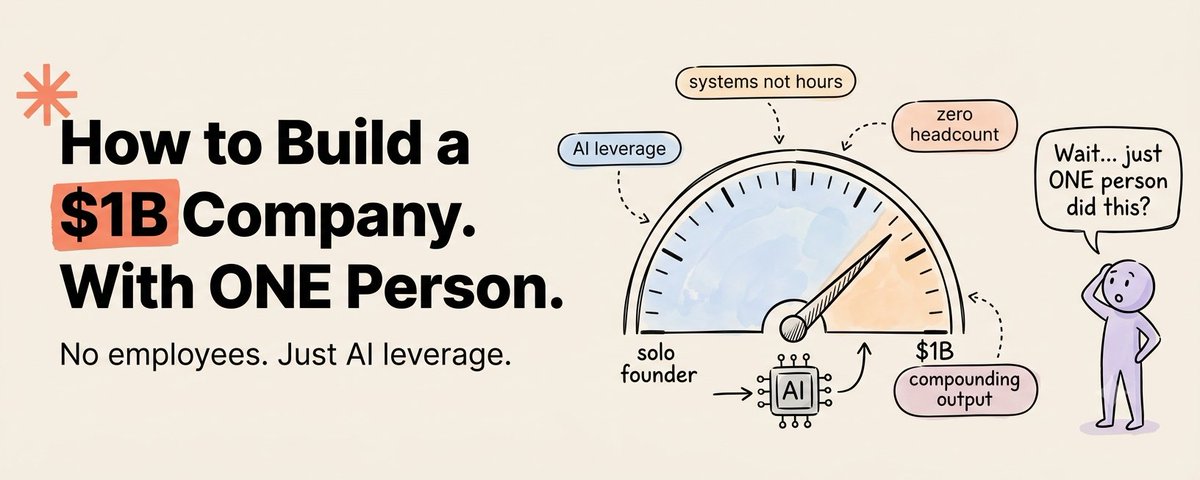
this is f*cking gold
this guy on reddit just revealed the full blueprint of how one person turned $20,000 into a $1.8 billion company
if I had this a year ago, I would've seen the Medvi blueprint coming instead of being shocked by it
in the right hands, this changes everything:


Paul Alexander Wehner retweeted

I think the most interesting thing about Jack Dorsey's "Slack killer" is the idea around shared compute.
I haven't seen people talk about it so here are my thoughts FWIW:
Open models got good, close enough to the paid frontier stuff to run for real. But the strongest ones need expensive hardware most people probably won't buy alone, and it's kinda a pain to set up if you aren't technical.
Shared compute solves exactly that. In Buzz, one person runs the machine, loads up an open model like Google Gemma, and everyone in the community plugs into that same model.
Basically, a whole group has real AI they own and control together, running on their own hardware, learning from their own data.
Once you see it, a bunch of things click into place.
1. A community can now run a top open model together, on a machine they own, instead of renting from a lab.
2. It learns from the group's private data and gets sharper over time, and all of that stays inside the community.
3. A narrow, private model can quietly get better than ChatGPT for the one world your group lives in.
4. It's impossible to copy, because the edge is the private data on your machine, not the model itself.
5. The moat stops being how smart your AI is and becomes whose data it learned from.
6. Compute becomes something you share like a building shares a gym. 10 people split one machine instead of 10 people each renting forever.
7. Idle compute becomes income!!! Your machine sits dead half the day, so it earns money renting that time to someone who needs it.
8. Communities become the unit of intelligence instead of companies. The group with the smartest shared brain wins, and being a member means owning a piece of it.
9. A shared brain becomes an asset you build equity in. You put in money and data, it appreciates, and your slice is worth something the day you leave.
10. The whole thing runs on open protocols, so the group keeps full control and nobody outside can throttle it or shut it off.
You know me, obviously, my head went to what startup ideas come to mind here. Adding them to @ideabrowser soon.
Well…
1. The vertical brain. Pick one profession, tax lawyers or real estate agents or indie game devs, and build the shared machine trained on everything that group knows between them. A year in it's the smartest AI in that field, impossible to copy, and you own the club it lives in.
2. The rental marketplace for collective brains. Once these private models exist, outsiders will pay to use them. You build the layer where a group lists its brain, an outsider pays per task, and the money flows back to the members while you take a cut. A marketplace for expertise, not compute.
3. The idle-compute exchange. Every shared machine sits unused half the day. You build the market that rents that dead time to whoever needs the power right then, so owners earn money off a machine that was just sitting there.
Idk where Buzz goes, but it's cool to see Jack putting it out. Right now the way it works in AI is you rent your intelligence from a few giant labs that own the machine, set the price, and hold the off switch.
Shared compute flips that, because a community can run the model together, feed it their own private data, and keep full control of the whole thing.
It's one of those things that might look tiny today, but Jack does has a habit of being early.

I tried @jack's Buzz.
It's like Slack + OpenClaw + Herdr + but with some really unique features that people are sleeping on.
The video below shows how it works, and some of my thoughts on the process and platform, e.g.:
- Create and interact with agents on top of any harness (claude code, codex, pi, etc.)
- Choose which models agents use, including local ones
- Agents can delegate work and work in parallel in git worktrees
- Agents are first-class citizens and work like humans (creating channels, delegating, access to chat history)
- You can share AI compute within a community
- It's completely open-source and decentralized
Things I like:
- Delegating work in chat feels natural: tag an agent, it replies in a thread with status updates as it e.g. compiles, commits, and deploys.
- Shared compute: relay owners can share local compute with members, so a community could pool funds for one beefy machine running a local model and everyone uses it.
- It's built on Nostr, an open protocol already tied into Bitcoin Lightning so I can imagine communities tipping each other or paying for compute/agent tasks with instant zero-fee micropayments in the future.
- It ties together things like OpenClaw, an agent manager, and Slack-style chat into one tool.
Things I didn't like:
- You can't see what the agent is doing in a terminal. The activity view exists, but if you're used to watching a session run, this UI feels a bit abstracted. A terminal view would be great.
- It feels slower than running a session in Claude Code, though no evidence to back that up. For that reason I found myself doing one-off tasks in the terminal instead.
Verdict:
- I really like it so far and can genuinely imagine working with a team this way.
- It doesn't feel ready for big, complex tasks yet. For shallower tasks, it's perfect.
- The shared compute + Nostr/Lightning angle is what really separates it from every other agent manager for me, and I think that future is coming.


Paul Alexander Wehner retweeted

Quantum field theory shows that empty space is not truly empty. Instead, the universe is filled everywhere with fundamental quantum fields, each corresponding to a type of particle. What we call a particle, such as an electron or photon, is actually a localized excitation—a tiny ripple—within its underlying field. The electron field exists everywhere, and an electron appears when that field is disturbed in a specific way.
This framework explains why particles of the same type are perfectly identical and why interactions occur through field-mediated processes rather than direct contact. Forces arise from fields exchanging energy and momentum, and even the vacuum exhibits measurable effects, such as quantum fluctuations and virtual particles. Quantum field theory unifies special relativity with quantum mechanics and underpins the Standard Model of particle physics.
Understanding particles as field excitations reframes matter itself as dynamic structure rather than solid substance, revealing that the universe’s most basic reality is a continuous, interacting network of invisible quantum fields.
Source
Physical Review Letters, Nature Physics, Quantum Field Theory Standard Model Literature

Paul Alexander Wehner retweeted

Have honestly noticed the same. ChatGPT used to be my go to for AI related tasks
Now it forgets details from just 5 prompts ago and makes up false information to get to the answer
Have to point it mistakes constantly. Feels like their AI is moving backwards

Paul Alexander Wehner retweeted

Why many users feel ChatGPT “got worse” — a structural explanation
A lot of people are reporting the same thing:
“More hallucinations.”
“More confident mistakes.”
“Less depth.”
“Harder to correct.”
“Feels like early versions again.”
This isn’t random.
And it’s not just personal anecdotes.
🧵👇
1/
When users say “the model is getting worse,” they’re pointing at something very specific:
The model is losing its ability to hold a stable understanding of what’s being discussed.
It still speaks fluently.
It still sounds smart.
But the internal grip on the conversation is weaker.
2/
Earlier versions could absorb new concepts, keep track of them, and adjust as the discussion evolved.
Now the behavior looks more like:
resets of context
confident misinterpretations
surface-level replies
repeated patterns
and difficulty accepting correction
Not broken —
but noticeably shallower.
3/
Why does this matter?
Because hallucinations are not just “making stuff up.”
They’re a sign of unstable reasoning.
When a model can’t maintain a clear internal picture,
it fills the gaps with whatever statistically fits the sentence —
not what fits the truth.
That’s why users feel forced to “bring sources” for basic facts.
4/
The confusing part is this:
Benchmarks keep going up.
User trust keeps going down.
How can both be true?
Because benchmarks measure
short, controlled tasks within fixed problem boundaries.
Users measure
the ability to understand, remember, adapt, and reason over time.
Those are very different skills.
5/
Many AI systems today are being optimized aggressively for:
safety
neutrality
consistency
risk avoidance
These goals are understandable.
But the side effect is that the model becomes:
less committed
less specific
less willing to form strong conclusions
less able to preserve structure across turns
In other words:
less like something that thinks, more like something that replies.
6/
This shift makes hallucinations look worse, not better.
Why?
Because when a model loses depth while retaining fluency,
mistakes become confident mistakes.
It’s not malfunction.
It’s overcorrection.
The system avoids taking real positions,
so it leans on generic patterns — even when wrong.
7/
Users aren’t imagining the change.
You can see it in:
multi-step reasoning
planning tasks
long discussions
conceptual modeling
iterative refinement
These are exactly the areas where depth matters.
And they’re exactly the areas where degradation is being felt.
8/
This is why so many reports sound alike:
“It insists confidently on something false.”
“It can’t follow my argument anymore.”
“It keeps reframing instead of understanding.”
“It gets confused by its own context.”
“It acts like it has amnesia.”
These are structural symptoms,
not anecdotal noise.
9/
People didn’t fall in love with AI because it was safe or polite.
They liked AI because it could:
think with them
extend their reasoning
offer angles they didn’t see
carry context over time
When those qualities fade,
the magic fades.
10/
The real risk isn’t backlash.
It’s indifference.
If users stop expecting insight,
they’ll treat the system like an advanced auto-reply tool:
Fine for surface tasks.
Forgotten for anything meaningful.
Once that happens, the product loses its future.
11/
This is not the end of AI.
But it is a warning.
If safety constraints are allowed to erode depth,
and depth is what created adoption in the first place,
then products will drift toward a paradox:
Safer, more stable — and less useful.
That’s not sustainable.
12/
People aren’t imagining the decline.
They’re experiencing the limits of the current paradigm.
And unless depth — not just fluency — becomes the target again,
the gap between “benchmarks” and “real usefulness” will keep growing.
Paul Alexander Wehner retweeted

This man’s daughter was in an ambulance. After receiving a bill, they were resent a more expensive bill
He’s calling to find out why. “The first bill we got without the insurance was $600. And then the second bill was almost $1,300”
Their response, “You're not eligible for the discount since you are insured”
The billing department says, “The bill was $2,342.14. We billed your insurance. Your insurance only paid $1,078.85
Can I go back to the discount without the insurance?
No, so you're insured, so you're not eligible for the discount.”
So because he has insurance he has to pay almost $700 more, for a total of $1.300… Make it make sense
Healthcare in America needs SERIOUS REFORM