

Europe macro @medleyadvisors. Previously @ChathamHouse, @TheEIU & @DutchMFA.
London, England
Joined January 2009
- Tweets18.3K
- Following1.9K
- Followers6.2K
- Likes35.6K





Pepijn Bergsen retweeted

I keep seeing these takes today - that the ONS's data update wipes away the UK's weak post GFC productivity record.
But that isn't quite right.
The new hours measure improves the UK productivity growth story, but the UK's productivity level was still weak.
A🧵

Pepijn Bergsen retweeted

This is an excellent policy profile of Pablo Hernández de Cos, frontrunner to become the next ECB president. It highlights his technical and diplomatic skills, his pragmatism, as well as the policy positions he has taken throughout his career at the Bank of Spain and ECB.

We had Julian Jackson, the author of my favourite ever political biography, on to discuss friend of the pod Charles de Gaulle, the recent films about him and if the founding of the Fifth Republic can teach current French politicians something.
twentyfourtwo.substack.com/p…


By this point you really have to feel for the Germans. After finishing off their industry, the Chinese are now even beating them at overproducing PhDs


Why I’m not buying the German “ideological transformation” on China, the mercantilism simply doesn’t work anymore


Pepijn Bergsen retweeted

BOOM.
It's @NewLeftEViews guest writing today's Odd Lots newsletter.
Read the full piece here: bloomberg.com/news/newslette…


Personal announcement: after a long and undistinguished career in European macro this europoor has decided to stay in rural Tennessee to seek employment at a gas station

Canada? Isn't that the country whose EU trade agreement still hasn't been ratified by nearly half the member states a decade later?


Don’t think he’ll get the job but this is a good profile of Joachim Nagel and his campaign for the ECB presidency, which Lagarde is probably going to announce tomorrow she’ll be vacating from the start of next year 242econ.substack.com/p/the-i…
Pepijn Bergsen retweeted

Here's the mustread if you want to understand this insanity, by investigative journalist Jesse Frederik (in Dutch): decorrespondent.nl/16856/hoe….
Short summary:
1. Drilling for gas caused (by international standards) minor earthquakes. The damage to some houses in the epicentre area was real. And the state and the gas company handled it badly. Corporate lawyers, denial, etc.
2. Things became super political. The need to establish cause was removed. You can now claim mining damage anywhere the ground has ever moved more than 0.55 mm per second. That's a basketball bouncing on a floor. (For most of the province it was a single tremor back in 2012).
3. Then the investigating stopped too. 'Victims' first got €5,000. Then €10,000. Then up to €60,000 of repairs with no investigation into what caused them.
4. Claims exploded. 2024 was the mildest seismic year in two decades, but there were 42,790 damage claims. Over 70% of claims now come from zip codes where the strongest ground motion was about what a truck going over a speed bump produces.
5. Total compensation: €3.9 billion. 56% of all addresses in the 'earthquake zone' have been compensated at least once (including a rich town where the strongest tremor expected was equivalent to a passing train), and where an engineer puts the odds of a quake-caused crack in an undamaged brick wall at 1 in 20,000. The town has collected €65 million, plus another €14.5 million in green-energy subsidies for earthquake 'victims'.
6. Meanwhile the gas company spent €200 MILLION on research - Groningen became the global centre of seismological research (even though people in - for example - Italy would find it funny that we call these tremors 'earthquakes'). The whole provinces was wired with sensors.
7. All the research was ignored though. The political debate was dominated by a form of science denial, but this time mainly coming from the left. One international expert called the parliamentary inquiry's account of the physics 'misinformation on a very serious scale'.
8. The gas field is now being filled with cement. Around 550 billion cubic metres is still down there (roughly 18 years of Dutch consumption), but the Netherlands now imports most of what it burns. Experts asked to keep some wells intact as an emergency reserve. Parliament said no.
9. End result: we spent insane amounts of money, are much more dependent on foreign autocrats for our energy (with higher greenhouse gas emissions), misinformation is everywhere, and citizens in Groningen are still angry.

Everyone knows Germany shut down its nuclear plants. But did you know the Netherlands is pouring cement in its gas wells? New post by me.
siliconcontinent.com/p/the-d…

Pepijn Bergsen retweeted

Indeed.
No advanced economy struggled more to invest and build than the United Kingdom.
And the picture doesn't materially change for real GFCF, whether as a share of output, per capita or per hour. Have a piece on this later this month.


Discovered a new London life hack: make the heat on the central line seem tolerable by taking an Elizabeth line train without air conditioning first
Pepijn Bergsen retweeted
The OECD's TiVA data are cool. And there's an argument that export data overstate China's external dependence. But the conclusion here is not supported.
It's worth looking more closely: they do a lot to clarify different narratives about China's rebalancing efforts, the role of external demand, which global markets have been driving it, the key inflection points.
The short version: the rebalancing pursued for over a decade stall around 2015, when the big high tech manufacturing push begins, while foreign- and domestic demand move inversely after 2019, and the investment share remains at a level close to its 2009 peak.
Note: when compared to other major emerging markets during this same period, the household and foreign components are hugely aberrant, respectively 21% below and 16% above the average.
1/5


Pepijn Bergsen retweeted

Here is the hard truth: either Europe grows a spine, enters the conflict with China's state-led economy on its own terms, accepts short-term pain and builds genuine economic resilience — or it becomes an economic satellite of Beijing /1

𝐇𝐨𝐰 𝐜𝐚𝐧 𝐭𝐡𝐞 𝐄𝐔 𝐝𝐞𝐯𝐞𝐥𝐨𝐩 𝐚 𝐭𝐨𝐮𝐠𝐡𝐞𝐫 𝐬𝐭𝐚𝐧𝐜𝐞 𝐨𝐧 𝐂𝐡𝐢𝐧𝐚 𝐢𝐟 𝐢𝐭 𝐜𝐚𝐧'𝐭 𝐞𝐯𝐞𝐧 𝐧𝐚𝐦𝐞 𝐂𝐡𝐢𝐧𝐚'𝐬 𝐬𝐭𝐚𝐭𝐞-𝐥𝐞𝐝 𝐞𝐜𝐨𝐧𝐨𝐦𝐲 — 𝐬𝐩𝐞𝐚𝐤𝐢𝐧𝐠 𝐢𝐧𝐬𝐭𝐞𝐚𝐝 𝐨𝐟 "𝐠𝐥𝐨𝐛𝐚𝐥 𝐦𝐚𝐜𝐫𝐨𝐞𝐜𝐨𝐧𝐨𝐦𝐢𝐜 𝐢𝐦𝐛𝐚𝐥𝐚𝐧𝐜𝐞𝐬"?
Here is the key paragraph from the Spiegel report: "Merz und andere EU-Spitzen nennen dieses Problem bisher nicht beim Namen; man will den schwierigen Partner China offenbar nicht provozieren. Stattdessen hieß es in der Nacht zu Freitag aus dem Europäischen Rat: Die Staats- und Regierungschefs seien sich einig, dass die »globalen makroökonomischen Ungleichgewichte eine europäische Antwort erfordern«." [1]
So the key takeaway here is: Merz and other EU leaders have so far avoided naming the problem directly; they clearly don't want to provoke the "difficult partner" China.
This kind of coded language already constrains the options available to policymakers. Those who are familiar with Russian military thought will recognise this as reflexive control: shaping an adversary's decision space so they limit themselves without being told to.
Is this strategic caution or self-imposed constraint dressed up as prudence?

One of my (many) issues with the ‘Europe is finally getting tough on China’ narrative is that European companies ≠ Europe. See also German carmakers trying to turn themselves into Chinese carmakers with a European badge.

Commerce Secretary Howard Lutnick told ASML tonight that the US government believes that one of its ultraviolet lithography (EUV) machines may have somehow made its way into China. Senior administration officials said they have evidence that ASML is not acting in good faith.

8
1,122
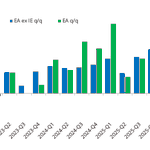
Ireland having a normal one again in the first quarter, dragging the eurozone economy into a 0.2% contraction. Important to note that excluding this tax evasion scheme with a small army the eurozone actually grew by 0.3%

1
355

