

Making Albanian chronicles fun and entertaining to learn! Subscribe to our youtube channel! Kronikani Me Plis
Tirana, Albania 🇦🇱
Joined July 2023
- Tweets4K
- Following678
- Followers1.6K
- Likes10.5K





Pinned Tweet
Professor Mark Palnikaj has uncovered an very interesting exchange between Scanderbeg and Mehmet the Conqueror!
In this letter, we see Mehmet's childish and megalomaniacal behavior compared to Scanderbeg's calm and level-headed demeanor.
Gjergj Kastrioti not only exemplifies the ideals of a Renaissance knight but also expresses a rare tender moment ❤️... for his wife and child.
Something seldom seen in European leadership or diplomatic letters of that era.
For a firsthand look into the mindsets of these two personalities of the era, follow this thread 🧵


We are surrounded by animals.
Meanwhile albanians outside the borders of small Albania were / are oppressed by the animals.
Either they annihilate us completly or we will destroy the enemy with the fist of albanian justice.
There is no other way.
Shqiperia e Shqiptareve,
Vdekje armiqeve dhe tradhtareve.

People ask why did Albania build 150.000 bunkers:
1. 1945–1948 — Yugoslav plans to integrate Albania into the Yugoslav federation: Military Relations Between Albania and Yugoslavia 1945–1948: Efforts for the Unification of the Two Armies — Hekuran Budani & Orgest Xhangoli (2023).
2. April 1946 — Greek territorial claims against southern Albania: Memorandum by the Acting Department of State Member of the State-War-Navy Coordinating Committee — U.S. Department of State (1946).
3. August 1946 — Greek territorial demands at the Paris Peace Conference: The Greek Prime Minister (Tsaldaris) to the Secretary of State — U.S. Department of State (1946).
4. October–December 1946 — Renewed Greek proposals for the annexation of southern Albania: Memorandum on the Question of Northern Epirus — Greek Government (1946).
5. September 1949 — American concerns about a possible Greek-Yugoslav partition of Albania: Memorandum by George W. Perkins — U.S. Department of State (1949).
6. April 1951 — Reported Greek proposal for simultaneous Greek-Yugoslav military operations against Albania: Reported Greek Proposal to Partition Albania Clarified — CIA (1951).
7. November 1951 — American intelligence assessment of a possible Greek-Yugoslav partition of Albania: National Intelligence Estimate NIE–42: The Current Situation in Albania — U.S. Intelligence (1951).
8. 1950–1953 — Greek territorial claims and diplomatic tensions with Albania: Raportet midis Greqisë dhe Shqipërisë në vitet 1950–1953 — Beqir Meta (2002).
9. 1952–1954 — Alleged secret Greek-Yugoslav understanding concerning the partition of Albania: Marrëdhëniet shqiptaro-greke gjatë periudhës së krijimit të Paktit Ballkanik (1952–1954) — Beqir Meta (2003).
10. July 1945 — Armed border incidents at Konispol and Bilisht involving Greek groups and soldiers: The Chief of Mission in Albania (Jacobs) to the Acting Secretary of State — U.S. Department of State (1945).
11. 1946 — Greek-Albanian border clashes and allegations of armed incursions: Incidents on the Northern Greek Frontiers: A Summary Statement — U.S. Department of State (1946).
12. 1947 — United Nations investigation into armed incidents along the Greek-Albanian frontier: Report to the Security Council, Volumes I and II — United Nations Commission of Investigation (1947).
13. 1948–1954 — Albanian-Yugoslav military border confrontations following the Tito–Stalin split: Restless Border: Border Line Tensions Between Yugoslavia and Albania (1948–1954) — Aleksandar Životić (2009).
14. May 1949 — Armed confrontation on Lake Shkodra between Albanian forces and a Yugoslav patrol boat: Yugoslavia Reports Attack by Albanians — The New York Times (1949).
15. August 1949 — Major Greek-Albanian border fighting in the Bilisht and Gramoz regions: Summary Record of the 307th Meeting — United Nations General Assembly (1949).
16. February 1950 — Armed confrontation at Ayios Martinos on the Greek-Albanian border: Report of the United Nations Special Committee on the Balkans, A/1307 — United Nations (1950).
17. 1950–1951 — Greek-Albanian border shootings and armed incidents at Dhipotamia, Palamba and Kastaniani: Report of the United Nations Special Committee on the Balkans, A/1857 — United Nations (1951).
18. 1951–1953 — Escalation of Albanian-Yugoslav military border incidents: Border Incidents Between Yugoslavia and the Cominform Countries (1948–1955) — Marko B. Miletić (2020).
19. 1952–1953 — Reported Yugoslav territorial and airspace violations against Albania: Incidents on the Albanian-Yugoslav Border, FO 371/107294 — British Foreign Office (1953).
Since the 19th century, the history of the Albanian people has read like an endless dossier of massacres, persecution, and crimes committed against them.
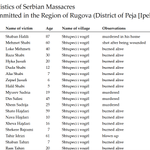
The image below contains statistics documenting the February 1919 massacre in the Rugova Highlands, near Peja, Kosovo, in which 842 Albanians were reportedly killed.
The details recorded in this report are horrifying and deeply disturbing. (you can find the report below)
Shqipëria e Shqiptarëve,
Vdekje shkijeve dhe tradhtarëve. 🇦🇱


⚠️ ARCHIVAL / EDUCATIONAL CONTEXT ⚠️
Archival excerpt from the 1940 Nazi propaganda film Der ewige Jude (“The Eternal Jew”), directed by Fritz Hippler under Joseph Goebbels. The film presented fabricated “1932” statistics claiming that Jews (then \~1% of the world’s population) accounted for extreme percentages of global drug trafficking, robberies, crooked gambling, international crime organizations, and prostitution, plus claims that criminal slang derived from Hebrew and Yiddish.
These unsubstantiated figures were part of the regime’s antisemitic campaign to dehumanize a minority and justify persecution. Shown for historical and educational analysis of totalitarian propaganda only.
#History #WWII #propagandaarchive


The Plis Chronicler retweeted

Wow!
Canadian journalist asks Moshe Feiglin, a former Likud Member of Knesset, if he is concerned about Israel's plummeting global standing.
Feiglin's response is chilling, as it reveals the fundamental supremacist view he and many in Israel hold.
He says that the real moral supreme court is in Israel, ie with the people of Israel.
The Bible says, he explains, that those who bless Israel will be blessed, and those who curse Israel will be cursed. As a result, it's we - Israelis - who get to judge you, rather than you judging us.
And then he adds?
"Are you with the children of God or not?"
Alexander the Great and commander Philotas clash about the usage of language to adress the macedonian soldiers:
Alexander the Great:
“The Macedonians are going to judge you. I ask whether you intend to address them in your native language.”
Philotas:
“Besides the Macedonians, many others are present. I believe they will understand what I say more easily if I use the same language in which you have spoken, presumably so that your speech could be understood by more people.”
Alexander the Great:
“Do you see how Philotas even detests his native language? He alone disdains to learn it. But let him speak as he wishes, provided you remember that he rejects our customs just as much as our language.”
Historiae Alexandri Magni, written by the Roman historian Quintus Curtius Rufus in the first century AD.
The exact citation is Book VI, Chapter 9, Sections 34–36 (VI.9.34–36).

This assessment was completely correct, and this test was put into motion without delay.

"Kosovo and Metohija are integral parts of our country." - Ilija Srdanović, a leading figure of Serbia's Student List declared.
The Student List continues to adopt an authoritarian stance, disregarding Kosovo, a country with an approximately 93% Albanian majority and the most ethnically homogeneous population in the Western Balkans, after Albania.
Also, the central focus of their political program is fighting corruption. I have a question: Will they deliver full justice or only partial justice by handing over all those accused of war crimes during the Yugoslav wars and the Banjska attack? Will they remain true to this principle?
"Every nation that proclaims the rule of law at home must respect it abroad."
I seriously doubt it. I believe only partial justice will be served, and they will eventually become corrupt from within. They continue to glorify war criminals. Much of Serbia's modern history has been marked by genocide, ethnic cleansing, and forced expulsions, with Russian support dating back to the 19th century.
They will be humbled soon enough by the albanian thought process led by Albin Kurti.

The Plis Chronicler retweeted

Terror by the police force of @ediramaal in Tirana 🇦🇱. Police officers who do not know the law, smoke indoors, and try to enter the home to arrest the family’s son without a court warrant. They are confronted by the boy’s parents, who refuse to let them in. 🤬🤬


"Kosovo and Metohija are integral parts of our country." - Ilija Srdanović, a leading figure of Serbia's Student List declared.
The Student List continues to adopt an authoritarian stance, disregarding Kosovo, a country with an approximately 93% Albanian majority and the most ethnically homogeneous population in the Western Balkans, after Albania.
Also, the central focus of their political program is fighting corruption. I have a question: Will they deliver full justice or only partial justice by handing over all those accused of war crimes during the Yugoslav wars and the Banjska attack? Will they remain true to this principle?
"Every nation that proclaims the rule of law at home must respect it abroad."
I seriously doubt it. I believe only partial justice will be served, and they will eventually become corrupt from within. They continue to glorify war criminals. Much of Serbia's modern history has been marked by genocide, ethnic cleansing, and forced expulsions, with Russian support dating back to the 19th century.
They will be humbled soon enough by the albanian thought process led by Albin Kurti.
