

relic seeker.
London, UK
Joined July 2024
- Tweets2.5K
- Following1K
- Followers4.8K
- Likes63.8K



Pinned Tweet
"I suppose you're right," Socrates said.
"Of course I'm right," the priestess Diotima said.
(Symp. 206e)

Pymander's ghost retweeted
Life begins when one takes the whitepill on the Chinese Rites Controversy (the Jesuits were right)
Thinking about Manichaeism’s warm piety to the cosmic ‘suffering’ Christ in each fruit ‘hanging on every tree’.
'So we can't include a forgetful man as one qualified for philosophy; we must demand a good memory' (Rep. VI.486d)
ἐπιλήσμονα ἄρα ψυχὴν ἐν ταῖς ἱκανῶς φιλοσόφοις μή ποτε ἐγκρίνωμεν, ἀλλὰ μνημονικὴν αὐτὴν ζητῶμεν δεῖν εἶναι.


I sincerely believe that one of the best things AI will bring to the University is that it will finally deliver us from the quantification of publications as a metric of performance. It was always a terrible and counterproductive one anyways.
This (e.g.) is a vastly superior way of understanding our place in the cosmos than our own and I'm tired of pretending it isn't.

ALT Astronomicum Caesareum, 1540

Whatever our future is, I think its truest prophecy will be that of the Parable of the Labourers in the Vineyard (Matt. 20).
'But he answered one of them, and said, Friend, I do thee no wrong...Take that thine is, and go thy way: I will give unto this last, even as unto thee.'

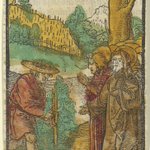
ALT The Parable of the Workers in the Vineyard, from Das Plenarium Hans Schäufelein German, 1517
I really wish this were true but unfortunately it isn't and to persist in thinking so is simply a reflection of your own poor use and limited imagination. Train Claude on exemplary prose stylists of your choice—upload entire books—and watch it fly where before it walked.

No that’s not it. AI writing is not good writing at all. Much less “too good.” It’s neat, yes. Perfectly spelled and punctuated. This writing itself is atrociously bad, though. Bland and dull and utterly devoid of style or personality. But it’s bad in a bizarre, uncanny way. Bad but perfectly coherent. Whereas bad human writing is generally bad because it’s not coherent. Maybe that’s the thing that makes AI slop so easy to spot. It is coherently shitty. A weird combination.
Modern man will surfeit himself with smug ridicule at the Albigensian practice of endura (ritualised suicide by starvation) and then drive to his office job. Even the grossest forms of world-denial in former ages were more lively and true to life than ours.


Either a dilation of the present grasping for the eternal, or a contraction towards the drunken dissolution of the moment.
Pymander's ghost retweeted

The thing about divine self-making (as creation) is that if this is the case, then incarnation is not 'event,' for all 'events' are this anyways, but rather idea.

Christological Divine Self-Making
A study of making (facio) in John Scottus Eriugena’s ‘Periphyseon’, Book 1, 455a–457b
ryanhaecker.substack.com/p/c…
In a radical extension of Maximus the Confessor to the making (facio) of all things, Johannes Scottus Eriugena describes how God, in becoming flesh, made a world in which he could be made, such that the making of Christ is the consummation of the making of the world, and all that is made shares in his glory.
Eriugena defines creatio ex nihilo as creatio ex deo when he describes how God created from nothing, not by another nature, but from and for his own nature, ‘not by another nature but by itself’. God creates from God, creatio ex deo, by creating all other natures from and for himself: ‘For when it is said that it [God] creates itself the true meaning is nothing else but that it establishes the natures of things’ where ‘the manifestation of itself in something, is surely that by which all things subsist’, as they subsist, as another, in and through this singular source of creative activity alone from and for God.
Eriugena introduces the Trinity when he describes, by a taxonomic analogy, how ‘theologians have correctly deduced from things that are that it is, and from their divisions into essences, genera, species, difference, and individuals’ the ‘great truth that the Cause of all things is of a threefold substance’. This taxonomic analogy is the analogy between the division of the divine being-nature into three essences, and the division of creaturely being-nature into genera and specie according to the differentia of the individua. Eriugena tends to think of the Trinity, in these terms, as analogous to this genera-specie taxonomic differentiation of being-nature from the creator to creation, where, the creator creates by the dialectical division of divine being-nature into the creaturely being-nature, but, because this dialectical division is divided from and for singular source of the divine being-nature in God, God can combine all that God can divide, and all of the many divisions can be combined as one in God. Since, moreover, God can, through this dialectical division and combination, contain all that can be divided and combined, and all that can be communicated in and through this dialectical division that is itself the creation of all communicable and predicable attributes, God can contain and communicate all attributes in and through the divine dialectic, which is, also at once, in and through himself. God can thus contain and communicate the omni-attributes through the three persons of the Trinity. Eriugena explicitly lists the three highest attributes of Proclus’ platonic theology, being, wisdom, and life, as the highest attributes of God.
Eriugena suggests that God causes all things in and through the trinitarian relationality that are reflected from and for all the relations in and between any and all things. He indicates, on the authority of Dionysius and Gregory, that God could be contemplated as ‘the one ineffable Cause of all things’ who is ‘the one simple and indivisible Principle’ that ‘they affirmed the unity’, but, ‘by observing that this Unity did not consist in any singularity or barrenness they gained an understanding of the Three Substances of the Unity, namely the Unbegotten and the Begotten and the Proceeding’. He here suggests that the Trinity could be contemplated by contemplating that the unity is not a ‘barren singularity’, but, to the contrary, is only a unity at all insofar as it can be continuously dialectically divided, combined, and mixed between but beyond itself, not as a simple abstract universal, but, rather, as a complex concrete universal, which can be concretized in and through the dialectical division from one into many, many mixed into one, and all in all from and for its singular source. The contemplation of a simple barren unity leads, Eriugnena hints, by the dialectical division and combination of one in many and many in one, to the contemplation of the complex rich unity, where the three relations of unbegotten, begotten, and proceeding, can be collected into the three essential relations, hypostases, and essences that can coincide as three-made-one in one God.
Eriugena describes these three essential relations that can be collected to constitute the triune God: (1) God the Father is the condition of the Unbegotten Substance to the Begotten Substance; (2) Christ the Son is the condition fo the Begotten to the Unbegotten Substance Son; and (3) the Holy Spirit is the condition of the proceeding substance to the Unbegotten and to the Begotten Substance Holy Spirit. Each of the divine persons is thus a condition of the relation from (un)begetting to its other that returns around from and for the begetter, the creator, and the singular source of all in all: God the Father (1) is the condition of the relation from the Unbegotten to the Begotten; Christ the Son (2) is the condition of the converse relation from the Begotten to the Unbegotten; and the Holy Spirit (3) is the condition of the mutual inter-relation of procession between (1) the Unbegotten-to-Begotten Father and (2) the Begotten-to-Unbegotten Son. Since the condition of the relation of (1) the Unbegotten-to-Begotten Father and (2) the Begotten-to-Unbegotten Son is asymmetrical, while the condition of the interrelation of the procession between (1) the Unbegotten-to-Begotten Father and (2) the Begotten-to-Unbegotten Son in the Holy Spirit is symmetrical, and asymmetry is the mark of a division without combination, the Holy Spirit can complete the circuit, not by begetting another, but, rather, by the dialectical division, combination, and mixture of all conditions, relations, and categories that can be collected into the centre of one God.
In Book One of Perisypheon, Eriugena introduces the Trinity as the three conditions of relation of (Father=) Unbegotten-to-Begotten, (Son=) Begotten-to-Unbegotten, and (Spirit=) the inter-relational procession to and from the relation of the Father and the Son from and for the uncreated creator who begets all in all. The Father, Son, and Spirit are, for Eriugena as for Augustine, not simply essences but essential relations, in and through their relations, from begetting to begotten, vice versa, and through their mutual procession. Eriugena’s trinitarian innovation, beyond that of Augustine, is to think of begetting, in this way, as, not univocally and corporeally, but as the dialectical division of the categories of (un)created and (un)creating, etc., whereby the categories can be divided and combined, but, because begetting is itself this dialectical circuit, the paternal begetting of the begotten is, likewise, a dialectical circuit, not merely as one into many, but, moreover, of any and all categories, which can be cancelled in their contrareity to coincide in and be collected into the center of all and all in God. Since, in short, begetting is dialectical division, combination, and mixture, the essential relations of the Trinity are, by begetting, essentially related in and through the dialectical division, combination, and mixture of any and all categories. Eriugena’s trinitarian theology is, therefore, only trinitarian insofar as it is dialectical, and dialectical, insofar as it is that of the divine dialectic of God the Trinity. Dialectic is trinitarian, for Eriugena, insofar as begetting is the begetting of division, combination, and mixture of many in one. Since, moreover, this begetting of the division of the categories can only cause as it is paradigmatically prepossessed and can contain all effects, divisions in combinations, and all many in one, made as it is manifest, the divine dialectic can only beget the division of the categories, not alone in the immanent Trinity, but, economically, in and through any and all of the categories, as these categories can be cancelled so as to coincide in and for the centre of the divine dialectic of the Trinity. It is, thus, not merely the dialectic of the Father, Son, and Spirit, but, moreover, of any and all of the categories, of begotten at the beginning and unbegotten at the end, in and through the relational processions of all in all through the three-in-one being-nature of Eriugena’s Trinity. Eriugena’s trinitarian theology of the divine dialectic of begetting and begetted of the division, combination, and mixture can cancel contrary categories to coincide in the centre in and among all in all through the three conditional relations of the Father, Son, and Holy Spirit.
Hence, Eriugena rejects the Eunomian account of the Trinity that takes the mystical names of the Trinity as referring not to the conditions of their relations but to their entire essence, that is, to the essence of fatherhood, sonhood, and spiritedness. Eunomians identified the grammatical relations of ‘father’ and ‘son’ with the nature of the divine persons, to triple the natures of the divine persons, into a heteroousia of many different natures, contrary to the credal formulation of one nature. This rejection of the Eunomians is, not just a rejection of grammatical naivete, but, more philosophically, a rejection of the the naming of unrelated essences, that is, of essences that exist as essences without relations, namely the essential relations of the Unbegotten, begotten, and procession from and for their singular source.

'If we lose our eloquence, what will be left to distinguish us from the barbarians?' (Libanius, Ep. 372 to Julian)
The sole and ultimate test of our age is the cultivation of attention. This little is all that is asked of us, the final and shrivelled man—but how heavy it is.


