

Founder & CEO, CIO. Risk management w/ derivative overlays. FinTech/SaaS. Quant developer and HFT since 1998. HPC since ‘90s. Engineer. Visual arts. Dad.
Boston, MA
Joined August 2011
- Tweets24K
- Following1.2K
- Followers3.2K
- Likes28.7K



Pinned Tweet
If you can’t recognize the signs of recovery at the lows, deterioration at the highs, rolling corrections in uptrends, and short squeezes in downtrends, you might as well save yourself from the commissions and fees, if not total ruin, by investing in index funds and rebalancing.


At some point, the S&P 500 Index is likely to trade around 6,900 before this is over for a while… Markets still have 6-9 months to build a better top. But the 18-year secular bull market is slowly ending now… $SPX
teapawt.org/qckisa/status/19901095…


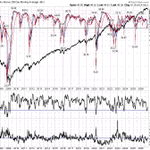
I have finally updated the 150-year market model I first shared in 2019.
The post-1970 correlation remains at ~89%, which supports the long-term structure of the model. Based on this framework, I continue to expect a secular bull market top within the next two years, followed by a broad sideways phase similar to the early 1970s. This period may last into the first half of the 2030s and see new highs momentarily before a larger crisis begins to develop in the middle of the next decade.
In the near term, I expect the S&P 500 to reach the 8,000s after a sideways consolidation in 2026, then set its final highs for the decade around late 2027 or early 2028. This should be followed by a sharp decline toward the next seven-year cycle lows around mid 2030. This represents a valuation peak, and a credit cycle bottom is likely to follow in the next decade. De-dollarization should also continue as China establishes its position in technology manufacturing.
The strongest long-run tailwinds for the US markets remain the projected peak in global population by the 2070s and the productivity gains driven by AI. Within this environment, the Americas should attract increasing capital flows, with consumption rising as regional population trends point to a doubling over the course of the century. $SPX


2
2
164
Those who wanted to sell sold, but the retail panic comes at the end, maybe tomorrow, and it can get more extreme. Expect a strong snapback soon, but the volatility should persist for some time… $SPX

Hedge funds have absolutely UNLOADED Tech over the last 6 weeks.
A 4+ sigma event.
Nearly 2x the prior record‼️
$QQQ $XLK $SOX

1
3
246
Quant Jim retweeted

😳😳
I am afraid this man is absolutely right and there is a huge problem coming our way.
😱
Quant Jim retweeted
The market is rising on very light participation due to the banking holiday and continues to squeeze the late shorts for now. This is a red flag for the rally, as volatility is likely to persist. Seasonality is helping for now until the December FOMC on the 9th. $SPX


So now it is even more interesting. The market sold some large-cap names, which dragged the indices down, but rotated into the broader market. The money is not leaving yet. Speculative interest in options isn't at a long-term bottom, but we are building a top. The intermediate term is bearish, and the short term is somewhat range-bound and leaning bullish due to seasonality. The option strategy may be to buy VIX calls and a bit of long index calls until December. If it snaps lower, index IVs should jump over 30%. $SPX


Yesterday's sell signal worked despite seasonality, but today we have a strong breadth recovery despite lower prices. One day doesn't make a trend, but if this strength holds through Monday, the oversold market could offer upside in November before the next reversal. $SPX


1
4
552


Quant Jim retweeted

Bill Maher and Coleman Hughes finish each other's sentences for 3 minutes straight as they lay out how teachers' unions wrecked public education.
The MS NOW host thought she could sit this one out quietly. Then Maher turned and lobbed a grenade right at her.
MAHER: "The reason why they don't know that socialism didn't work... is because NOBODY taught them in school."
HUGHES: "A lot of kids go to underperforming public schools, which is our euphemism for government-funded daycare centers with occasional school-like activities."
MAHER: "I knew they weren't learning anything, but like you said, it's like a daycare center and not a good one."
HUGHES: "And I think people on the left want to blame funding because that's the easy issue. But the truth is, this school was well funded. You know, it's 50,000 per pupil at this school. The problem isn't the funding. It's that you can't fire anyone bad."
MAHER: "Yes.... The problem is the union, the teachers union, is too powerful. We've seen it in results in states where the union is less powerful, the schools do better."
HUGHES: "I call it the chalkboard mafia."
MAHER: "The problem, the unions protect bad schools and bad teachers, and the party protects the union. It's almost impossible in a lot of these cities to fire a teacher. I mean literally like you could sell drugs to a kid and it's got to be two offenses before we get—"
HUGHES: "It wasn't that long ago that the unions lobbied for a law in New York State to ban even collecting data that you would use to assess which teachers are better than others. You can't even get the data. So obviously the teachers union serves the teachers, they don't serve the students, and if you're a Democrat or any American that's serious about public school reform, you have to challenge the teachers union, period."
MAHER: "And I think in this school, where they were learning nothing with no supervision and absentee principals and teachers, I think spending 50,000 dollars per year per student, it's not money. That's what you always hear from the left. 'Oh, it's underfunded.' It's not the funding. The funding isn't the issue."
HUGHES: "No, it hasn't been for a very long time."
MAHER: "I think this is the kind of thing I will NEVER hear on MS NOW."
ALI VITALI: "I think you hear a lot of perspectives on MS NOW."
MAHER: "I don't ever hear that one."
CONTEXT: Maher and Hughes aren't making this up. On the latest Nation's Report Card, high school seniors posted the lowest reading and math scores ever recorded on the test.
And getting rid of bad teachers is nearly impossible. Federal survey data shows the average school district dismissed just 0.2 tenured teachers for poor performance in a year. That's roughly 1 in 500.
Meanwhile, students do better long-term in states where unions have less power.
A 2019 study in the American Economic Journal found that boys who went to school in states that forced districts to bargain with teachers' unions went on to earn about $2,100 LESS per year as adults compared to boys in states without those laws.
If a business failed this badly, someone would get fired. As Hughes put it: "The teachers union serves the teachers; they don't serve the students."
Quant Jim retweeted

Over the past month, the $SPX moved 1.1%, while the average stock moved 13.2%.
This spread ranks in the 100th percentile over the past 30 years.
The only higher return spreads were during the Dot Com Bust and GFC.


Quant Jim retweeted

It's been a minute and I know you've been wondering, so here's an update on the High Yield market using advance-decline data. Short version: It still sucks and you can't be surprised if equities get worse.

Quant Jim retweeted

The collapse of Reddit will be studied.
After reporting earnings, its stock collapsed 30% in a single day.
It's down 44% in 2 weeks.
But the most important detail is what was revealed in that earnings call.
The CEO said AI is killing Google search.
People no longer get sent to Reddit from Google. They merely get their answers from the AI Mode itself.
Even Google confirmed this themselves with their disastrous results - AI mode is cannibalising their search business.
Pretty soon, no one will visit Reddit voluntarily. Its traffic will continue to crater.
The worst part?
Reddit isn't alone. There are millions of companies and publishers that rely on search traffic.
That's what happens when you rely on a single funnel for discovery.
