

Associate Professor @UUtah @UofUMedicine | sperm RNA-mediated epigenetic inheritance, embryo development, small RNAs, RNA modifications & diseases
Salt Lake City, UT
Joined November 2015
- Tweets1.5K
- Following847
- Followers1.6K
- Likes11.8K





Qi Chen retweeted
A single tRNA or rRNA can be cleaved at different sites, generating small RNAs with distinct functions depending on where the cuts are made. That fragmentation pattern is itself a regulatory layer beyond abundance — the "RNA fragmentome".
With @tongzhoulab, we built qMAP, a tool to read this hidden information across development, disease & aging — for both mechanistic discovery and translational applications.


Qi Chen retweeted
After years of crystallization, now in @NatureBiotech, @ZernickaGoetz and I discuss the evolutionary origins of multicellularity and how physical constraints inevitably drive cellular self-organization.
Harnessing these rules may help us better understand and engineer life – Build to understand. rdcu.be/flTKa


Qi Chen retweeted
Perhaps the most puzzling part:
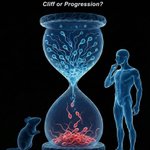
We see a paradox: the rsRNA length shift is progressive⏳yet the global RNA profile shows an "Aging Cliff"📉.
Cliff or Progression? Maybe the gradual shift is the forerunner—accumulating silently until it triggers the cliff.
xitter.cf/qichen_lab/status/2013…

1/5 It took us some time to connect the dots...now in @embojournal we use PANDORA-seq to start decoding the 'sperm RNA code of aging'
We find a conserved rsRNA length shift that reflects aging in both mouse & human sperm, and an 'aging cliff' at mid-life🧵
link.springer.com/article/10…

Qi Chen retweeted
1/5 It took us some time to connect the dots...now in @embojournal we use PANDORA-seq to start decoding the 'sperm RNA code of aging'
We find a conserved rsRNA length shift that reflects aging in both mouse & human sperm, and an 'aging cliff' at mid-life🧵
link.springer.com/article/10…
Qi Chen retweeted

RNA Day Special: With Ru-Juan Liu’s lab & @IliasSkeparnias @NasosSh, we review in @NatRevMCB how structurally degenerate mitochondrial #tRNAs drove evolutionary adaptations in their biogenesis machinery, modifications and mitoribosomes— and how this unique biology shapes disease.


Qi Chen retweeted
Our toolchain developed over the years to explore the expanding small RNA universe:
PANDORA-seq (see the once invisible)
nature.com/articles/s41556-0…
nature.com/articles/s41596-0…
SPORTS (comprehensive annotation)
sciencedirect.com/science/ar…
FUSION (robust comparison)
academic.oup.com/bioinformat…
qMAP (read the fragmentome)
link.springer.com/article/10…
Along with:
Our thoughts on exploring the expanding universe of small RNAs with new tools:
nature.com/articles/s41556-0…
&
Our reflections on small RNA origins & their functions beyond RNAi (aptamer-like)
cell.com/trends/biochemical-…
jbc.org/article/S0021-9258(2…
cell.com/molecular-cell/full…
cell.com/trends/biochemical-…

Qi Chen retweeted

Human embryos are often mosaics of normal and abnormal cells. Can “they” sense and decide which cells should stay and do all lineages play by the same rules?
Our new study @natcomms.nature.com uncovers lineage-specific quality control after implantation.
nature.com/articles/s41467-0…

Qi Chen retweeted

This Perspective positions cellular self-organization as a foundational principle for the origin of multicellular life and discusses how decoding this concept with stem cell-based models will advance biological engineering go.nature.com/4e1m3Br
rdcu.be/ftZeL

Qi Chen retweeted
Sharing this perspective reinforced for me the idea that constraints are not obstacles. In biology, they can drive self-organization and the emergence of complexity. I suspect similar principles may operate far beyond biology, in the organization of cultures, ideas, and societies
After years of crystallization, now in @NatureBiotech, @ZernickaGoetz and I discuss the evolutionary origins of multicellularity and how physical constraints inevitably drive cellular self-organization.
Harnessing these rules may help us better understand and engineer life – Build to understand. rdcu.be/flTKa
Qi Chen retweeted
Decoding the origins of cellular self-organization for engineered biology go.nature.com/4e1m3Br


Qi Chen retweeted

Scientists discover a hidden RNA ‘aging clock’ in human sperm.
New research from @UofUHealth sheds light on connection between paternal age and elevated health risks for the unborn.
attheu.utah.edu/facultystaff…

Qi Chen retweeted

Advanced paternal age is linked to adverse health outcomes of offspring. Discovery of how sperm age, enabling a sperm RNA code or aging clock link.springer.com/article/10… @EMBO

Qi Chen retweeted

New research led by @qichen_lab @UUHSResearch reveals an “aging cliff” in sperm RNA, a molecular marker tied to increased health risks in children of older fathers. This suggests a molecular clock tied to sperm aging in both mice and humans. Learn more: uofuhealth.utah.edu/newsroom…

Perhaps the most puzzling part:
We see a paradox: the rsRNA length shift is progressive⏳yet the global RNA profile shows an "Aging Cliff"📉.
Cliff or Progression? Maybe the gradual shift is the forerunner—accumulating silently until it triggers the cliff.
xitter.cf/qichen_lab/status/2013…
Qi Chen retweeted
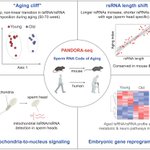
2/5 The first revelation: In mice, PANDORA-seq uncovers a sharp "Aging Cliff"📉in sperm RNA profiles at mid-life—a non-linear shift distinct from chronological age.
Crucially, this cliff signal (genomic & mitochondrial tsRNAs/rsRNAs) is invisible to traditional small RNA-seq.

Qi Chen retweeted
3/5 Perhaps the most surprising discovery: we see an age-dependent "Length Shift" in rsRNAs, exclusively found in sperm heads.
Specifically, longer fragments accumulate while shorter ones decrease with age—a sign of altered RNA cleavage/processing efficiency (e.g., enzymatic).

Qi Chen retweeted
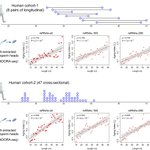
4/5 Crucially, beyond mouse data, we validated the sperm-head-specific rsRNA length shift signal in two independent human cohorts (longitudinal & cross-sectional).
This suggests an evolutionarily conserved feature, which may stem from shared (enzymatic) mechanisms during aging.

Qi Chen retweeted
Perhaps our boldest hypothesis… we propose a model for RNA Structural Memory propagation @NatureCellBio, where RNA conformation is reshaped by stress, locked by RBPs, copied prion-like in condensates & passed across generations—all without altering DNA.🧵
rdcu.be/eBwPJ

Qi Chen retweeted

1/3 🚨New paper from our lab!🔥
Most textbooks will tell you that invertebrates employ #RNAi as antiviral mechanism. Yet, do 🪸🪼 actually do it? Well, the answer is complicated. We show that in #Nematostella dsRNA induces RNAi 🧵
journals.plos.org/plosbiolog…

Qi Chen retweeted

1/ Excited to share our new study with @Brumbaugh_JB, now out in @NatureBiotech! P-bodies selectively sequester RNAs encoding cell fate regulators, often from the preceding developmental stage. Releasing these RNAs can drive changes in cell identity. 🧵nature.com/articles/s41587-0…
